
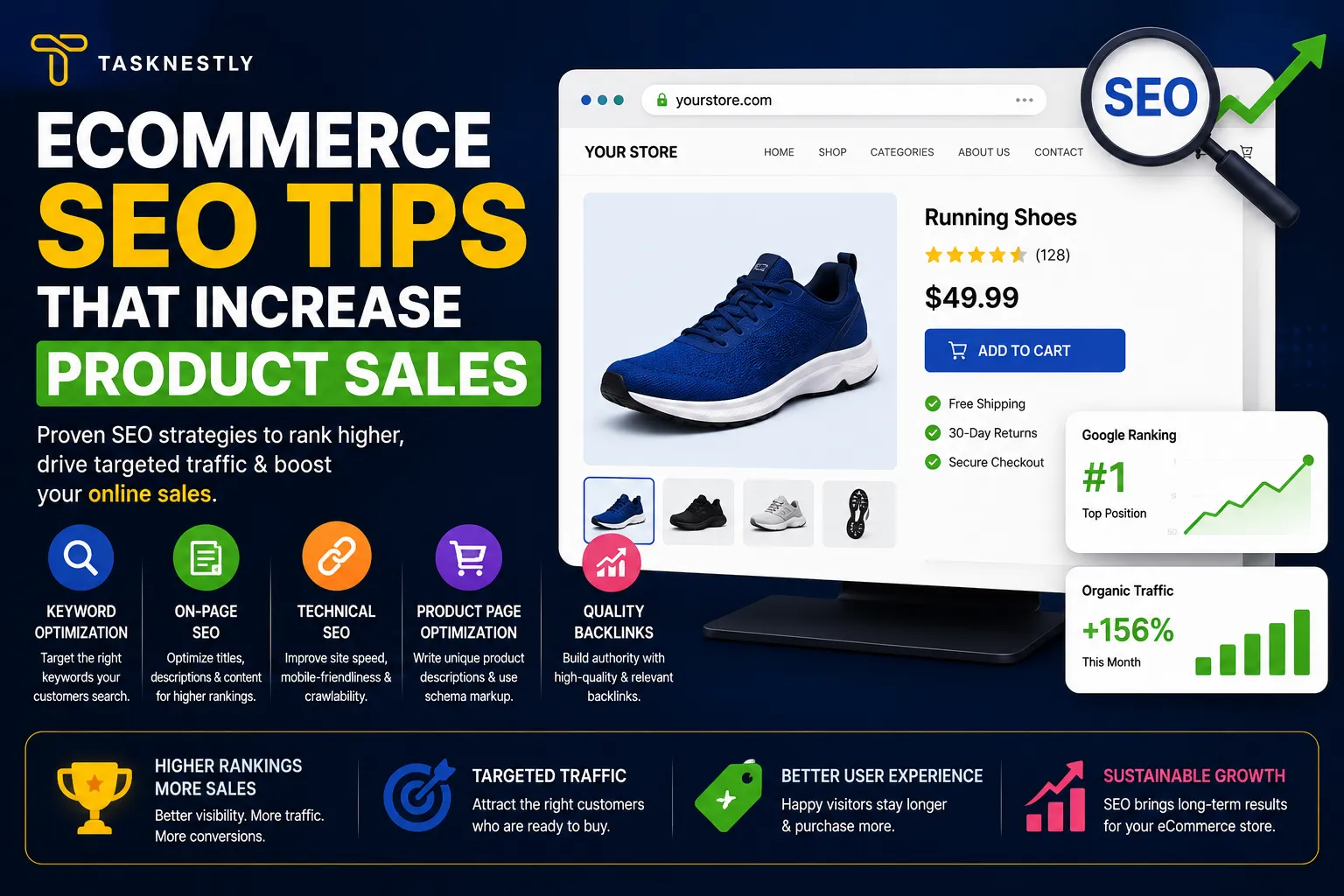
Ecommerce SEO tips are the most cost-efficient investment available to any online store. While paid advertising delivers immediate traffic that stops the moment your budget runs out, SEO builds compounding organic visibility that generates qualified, high-intent traffic for months and years after the initial optimisation work is complete. The ecommerce stores consistently winning market share in 2026 are not simply those spending the most on ads — they are the ones whose product and category pages appear organically at the top of search results when potential customers are actively looking to buy.
The challenge with ecommerce SEO tips is that these tips require consistent implementation across multiple areas across multiple dimensions simultaneously: keyword strategy, on-page content quality, technical site health, page loading speed, structured data, and backlink authority. Most online stores have significant untapped ecommerce SEO potential — tips that go unimplemented sitting in plain sight — thin product descriptions, missing alt text, slow page speeds, and ignored long-tail keywords — that can be addressed without any major technical investment and will produce measurable ranking improvements relatively quickly.
This guide provides 10 specific, actionable ecommerce SEO tips that address the most impactful ranking factors for online stores in 2026. Each tip is explained with the rationale behind it, the specific implementation steps required, and a realistic expectation of the impact it will have on your organic traffic and product sales.
| Want SEO That Drives Qualified Shoppers to Your Store?Tasknestly’s ecommerce SEO services cover keyword strategy, product page optimisation, technical SEO, and content marketing — everything your store needs to rank and convert organic traffic.Get your FREE SEO Audit → |
Want Your Store To Actually Convert?
Strategy is step one — execution is what moves revenue. Tasknestly builds and optimizes ecommerce stores that convert.
Get Ecommerce Services →Table of Contents
Ecommerce SEO Tips for Product and Category Pages
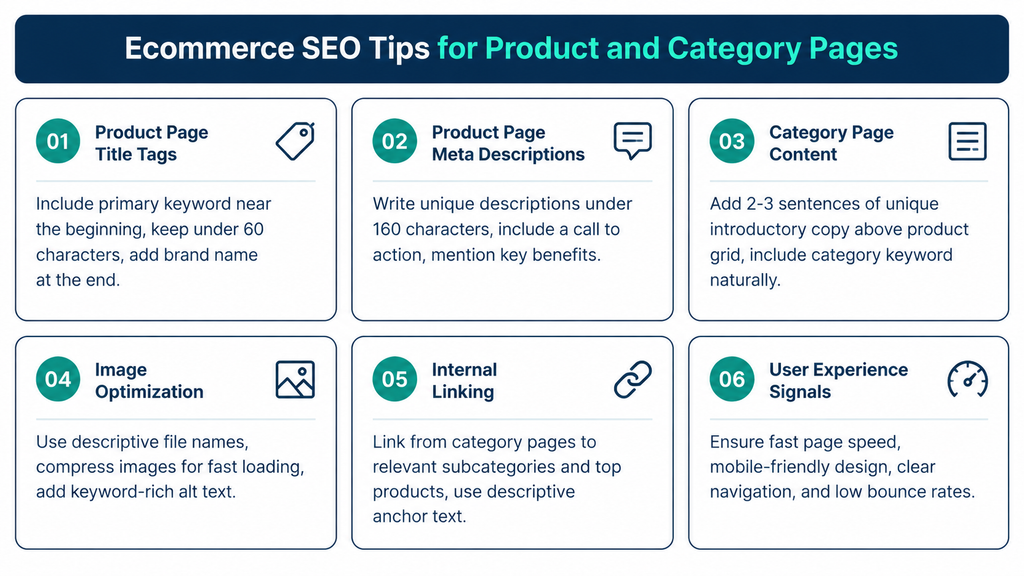
Your product and category pages are the commercial heart of your ecommerce store. These ecommerce SEO tips address the on-page factors that determine whether those pages rank for the keywords your potential customers are searching — and whether they convert the organic traffic those rankings generate.
Tip 1: Conduct Keyword Research Specifically for Product Pages
Most ecommerce SEO tips begin with keyword research — and for good reason. Targeting the wrong keywords is the most common and most expensive SEO mistake in ecommerce. Product page keywords should reflect buyer intent: phrases that include product-specific terminology, brand names, model numbers, and descriptors that people use when they are ready to purchase, not just researching.
Use SEMrush or Google Keyword Planner to identify keywords for each product page that balance three factors: search volume (enough people searching to make ranking worthwhile), purchase intent (the searcher wants to buy, not just learn), and competition level (you have a realistic chance of ranking given your domain authority). For new stores, targeting long-tail, lower-competition keywords produces faster results than competing immediately for broad, high-volume terms dominated by Amazon and major retailers.
Tip 2: Optimise Product Page Titles and Meta Descriptions
Your product page title tag and meta description are your advertisement in search results — they determine whether a user clicks your result or scrolls to a competitor. Strong ecommerce SEO tips for title tags include: placing your primary keyword near the beginning of the title, including the product name and key attribute (colour, size, model), and keeping the title under 60 characters to avoid truncation in search results. A well-optimised title like ‘Waterproof Walking Boots for Women — Sizes 3-9 | BrandName’ outperforms a generic ‘Walking Boots | BrandName’ in both rankings and click-through rate.
Meta descriptions do not directly affect rankings but significantly influence click-through rate — which does affect rankings indirectly. Write meta descriptions that include your target keyword, communicate the primary benefit or unique selling point, and include a subtle call to action. Keep them under 155 characters. Among all ecommerce SEO tips, title and meta description optimisation is the quickest to implement and often produces measurable click-through rate improvements within weeks of changes being indexed.
Tip 3: Write Unique, Detailed Product Descriptions
Thin or duplicate product descriptions are the most widespread SEO problem in ecommerce — and one of the most damaging. Stores that use manufacturer copy-paste descriptions or that have fewer than 100 words per product page are providing search engines with insufficient content to evaluate the page’s relevance for any specific query. Among ecommerce SEO tips, this one consistently produces the fastest ranking improvements when properly addressed.
Each product description should be a minimum of 200 to 300 words, contain the primary keyword and related terms naturally throughout, address the buyer’s specific questions (what problem does this product solve? Who is it for? What distinguishes it from similar products?), and include factual specifics like dimensions, materials, compatibility, and care instructions. Unique, detailed descriptions also reduce return rates by ensuring customers make informed purchasing decisions.
Tip 4: Optimise Every Product Image
Product images affect your ecommerce SEO tips performance in three distinct ways: alt text provides keyword context that search engines use to evaluate image and page relevance; file size directly affects page loading speed, which is a Google ranking factor; and optimised images appear in Google Image Search, generating additional organic discovery traffic that many ecommerce stores entirely neglect.
Add descriptive alt text to every product image using the format ‘[Product Name] — [Key Attribute] — [Brand Name]’. Compress all images to under 200KB using a tool like TinyPNG or Shopify’s built-in image optimisation, without sacrificing visible quality. Use descriptive file names (red-leather-crossbody-bag.jpg rather than IMG_4521.jpg) to provide additional keyword context to image search crawlers.
Want Your Store To Actually Convert?
Strategy is step one — execution is what moves revenue. Tasknestly builds and optimizes ecommerce stores that convert.
Get Ecommerce Services →Ecommerce SEO Tips for Site Architecture and Technical Health
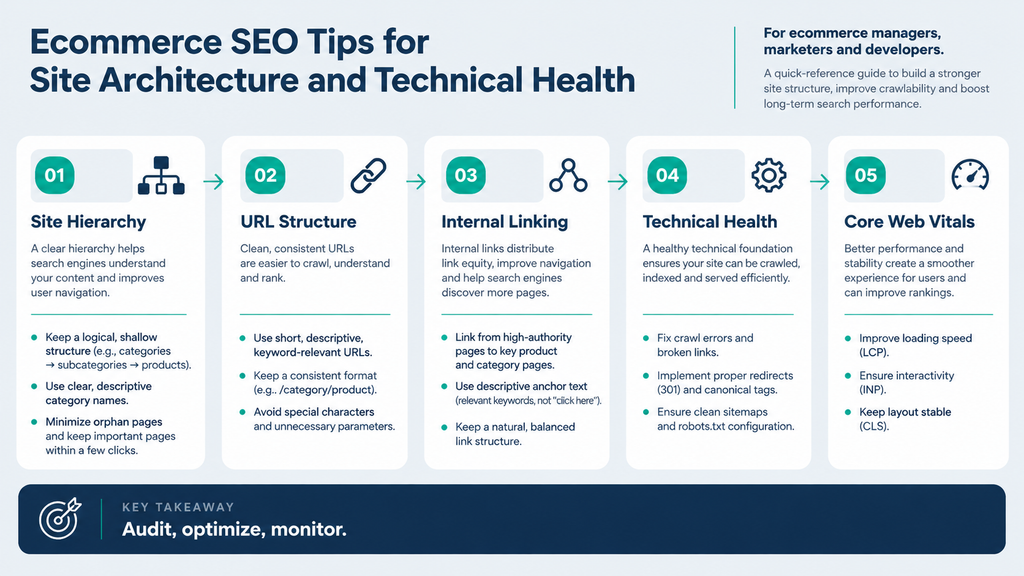
Technical ecommerce SEO tips address the foundational factors that determine how effectively search engines can crawl, index, and evaluate your store — and how quickly it loads for the visitors those rankings attract.
Tip 5: Build a Logical Site Architecture
A logical site architecture is one of the most important foundational ecommerce SEO tips for any store. Your architecture should follow a clear hierarchy: Home → Category → Subcategory → Product. This structure ensures that every page is accessible within a few clicks from the homepage, that link equity flows efficiently from your most authoritative pages to your commercial product pages, and that search engine crawlers can discover and evaluate every page on your site without hitting dead ends.
Clean, descriptive URL structures reinforce your site architecture and provide keyword context: tasknestly.com/ecommerce-services/ is better than tasknestly.com/page?id=123. Every product and category URL should include the primary keyword for that page, use hyphens to separate words, and avoid unnecessary parameters or session IDs. Review your URL structure before launching your store — changing URLs after launch creates redirect complexity that can temporarily suppress rankings.
Tip 6: Target Long-Tail Keywords in Blog Content
Long-tail ecommerce SEO tips are among the fastest ways to build organic traffic for new stores that cannot yet compete for broad category keywords. Long-tail keywords — specific, multi-word search queries with lower search volume but higher purchase intent — typically have far less competition than head terms and can be ranked for within weeks rather than months.
A furniture store targeting ‘sofa’ will take years to outrank established retailers. The same store targeting ‘L-shaped grey corner sofa for small living room’ can rank on page one within weeks, because the search is too specific for most large retailers to have optimised a page for. Build a blog that targets one long-tail keyword per post, links internally to relevant category and product pages, and answers the specific question in the search query comprehensively and accurately.
Tip 7: Fix Technical SEO Issues Before Scaling Traffic
Technical issues are invisible to shoppers but painfully visible to search engine crawlers — and they suppress rankings regardless of how good your content is. The most common technical ecommerce SEO tips to address include: crawl errors (pages returning 404 status codes that waste crawl budget), duplicate content (product pages accessible via multiple URLs creating thin content penalties), missing or incorrectly configured canonical tags, slow page loading speeds, and mobile usability issues that fail Google’s Core Web Vitals assessment.
Use Google Search Console to identify crawl errors and indexation issues. Use SEMrush’s Site Audit tool to identify technical problems across your full store — it categorises issues by severity and provides specific implementation guidance for each fix. Address critical issues first: broken links, duplicate content, and Core Web Vitals failures have the most direct impact on rankings and should be prioritised above cosmetic improvements.
| Need Professional SEO to Turn Your Store Into a Traffic Engine?Tasknestly’s ecommerce store and SEO services include technical SEO audits, product page optimisation, content strategy, and link building — everything your store needs to rank and generate consistent organic revenue.Book your free SEO consultation → |
Want Your Store To Actually Convert?
Strategy is step one — execution is what moves revenue. Tasknestly builds and optimizes ecommerce stores that convert.
Get Ecommerce Services →Ecommerce SEO Tips for Authority and Conversion
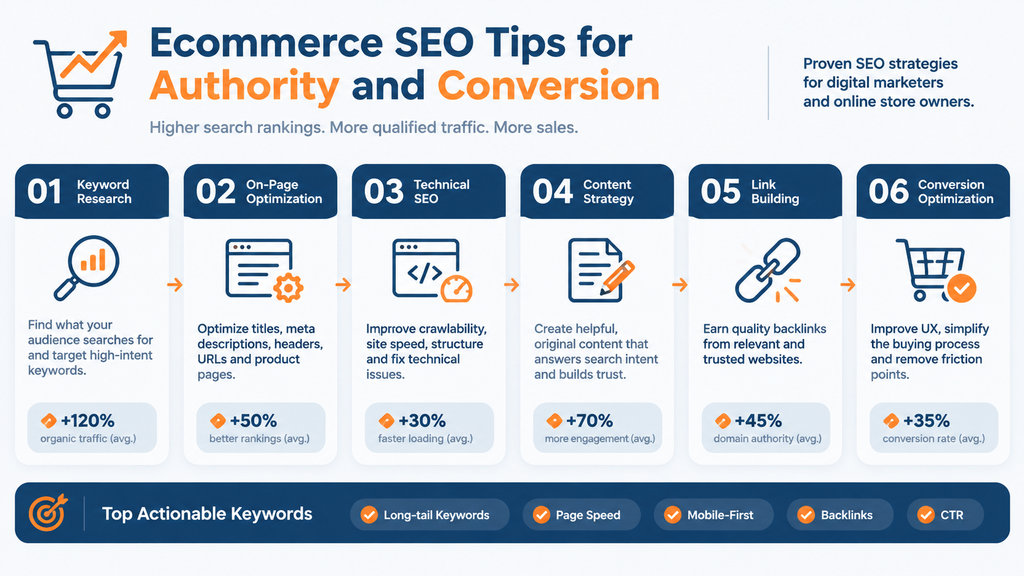
These final three ecommerce SEO tips address the factors that determine your store’s long-term ranking potential and how effectively your organic traffic converts into actual revenue.
Tip 8: Improve Page Loading Speed and Core Web Vitals
Page speed is one of Google’s confirmed ranking factors, and its impact on ecommerce conversion rates is extensively documented. A one-second delay in page loading reduces conversions by 7 percent. Core Web Vitals — Google’s specific set of user experience signals including Largest Contentful Paint, Cumulative Layout Shift, and Interaction to Next Paint — are incorporated directly into search ranking evaluations. Among all ecommerce SEO tips, improving speed produces the dual benefit of better rankings and higher conversion rates from the traffic those rankings generate.
Prioritise image optimisation, script minification, lazy loading for off-screen content, and server response time improvements. For Shopify stores, the most impactful speed improvement is typically reducing installed app count — each app adds JavaScript load to your pages. For WooCommerce stores, upgrading to managed WordPress hosting and implementing caching significantly improves Core Web Vitals scores.
Tip 9: Build Backlinks Through Content and Digital PR
Backlinks — links from other websites to your store — are one of the most significant ranking factors in Google’s algorithm, and earning them is one of the most challenging ecommerce SEO tips to execute. The most sustainable ecommerce backlink strategies are content-driven: publishing original research, data-driven reports, or genuinely useful tools that other websites reference and link to naturally.
Digital PR — proactively reaching out to journalists and bloggers with newsworthy product stories, expert commentary, or research findings — is one of the most effective ecommerce SEO tips for earning high-authority backlinks from news sites, industry publications, and blogs in your product category. Product review outreach to relevant bloggers and YouTubers also generates valuable backlinks alongside the referral traffic and social proof their reviews provide. Build backlinks steadily and naturally — a sudden influx of low-quality links triggers algorithmic scrutiny that can suppress rather than improve rankings.
Tip 10: Implement Structured Data for Products and Reviews
Structured data — schema markup that communicates specific information about your products to search engines in machine-readable format — enables Google to display rich snippets in search results: star ratings, price, availability, and review counts shown directly in the search listing. Rich snippets significantly increase click-through rates from search results by making your listing more visually distinctive and informative than plain-text competitors. Among all ecommerce SEO tips, structured data is one of the highest-impact, lowest-effort improvements available to stores that have not yet implemented it.
Use schema.org Product markup on every product page, including price, currency, availability, and review aggregate rating where available. Most major ecommerce platforms and SEO plugins — including RankMath Pro for WooCommerce — generate structured data automatically when configured correctly. Validate your structured data implementation using Google’s Rich Results Test tool to ensure it is correctly formatted and eligible for rich snippet display.
Want Your Store To Actually Convert?
Strategy is step one — execution is what moves revenue. Tasknestly builds and optimizes ecommerce stores that convert.
Get Ecommerce Services →How to Measure the Results of Your Ecommerce SEO Tips
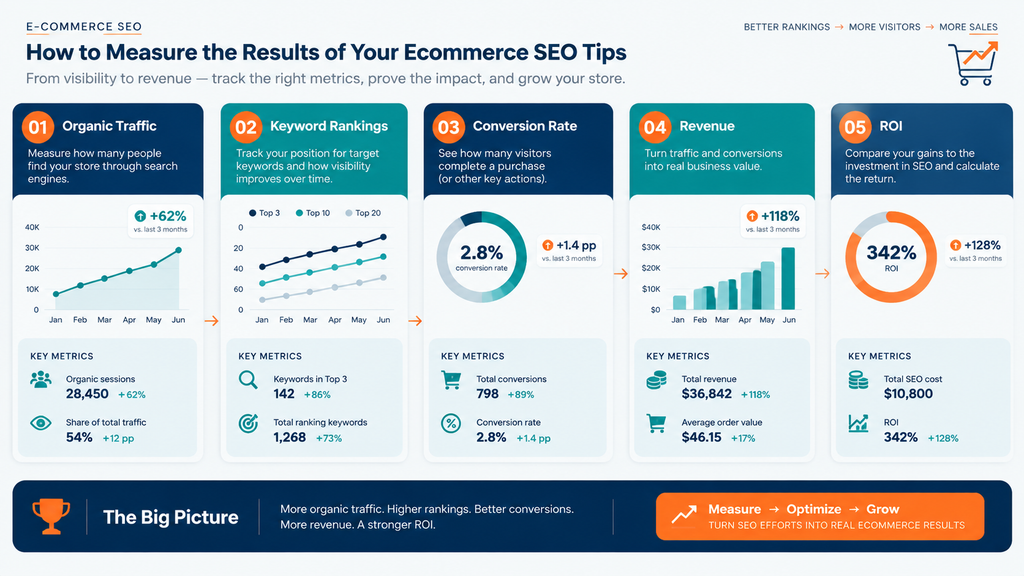
Implementing ecommerce SEO tips without tracking whether those tips produce results is effort without evidence. These measurement practices ensure you know which ecommerce SEO tips are generating the most impact and where to invest your next optimisation effort.
The most important free tool for validating your ecommerce SEO tips is Google Search Console. Install and connect it to your store from day one. Search Console shows you which keywords each page ranks for, how many impressions and clicks each page receives from organic search, and which pages have been indexed or are experiencing crawl errors. Review it weekly — it is the most direct feedback mechanism for how well your ecommerce SEO tips implementation is working.
Track the traffic impact of your ecommerce SEO tips month over month using Google Analytics 4’s traffic source report. Compare organic sessions, organic conversions, and organic revenue to the previous period to identify whether your ecommerce SEO tips are driving measurable business impact. Set up ecommerce conversion tracking in GA4 to attribute revenue directly to organic search, giving you a clear ROI figure for your SEO investment.
For tracking how well your ecommerce SEO tips are moving rankings — monitoring where your product and category pages rank for target keywords over time — use SEMrush’s Position Tracking feature. Set it up for your 20 to 30 most important target keywords and review it monthly. Ranking improvements for high-intent product keywords are the clearest indicator that your ecommerce SEO tips tips are working as intended and that organic revenue growth is forthcoming.
Want Your Store To Actually Convert?
Strategy is step one — execution is what moves revenue. Tasknestly builds and optimizes ecommerce stores that convert.
Get Ecommerce Services →10 Ecommerce SEO Tips: Quick Reference
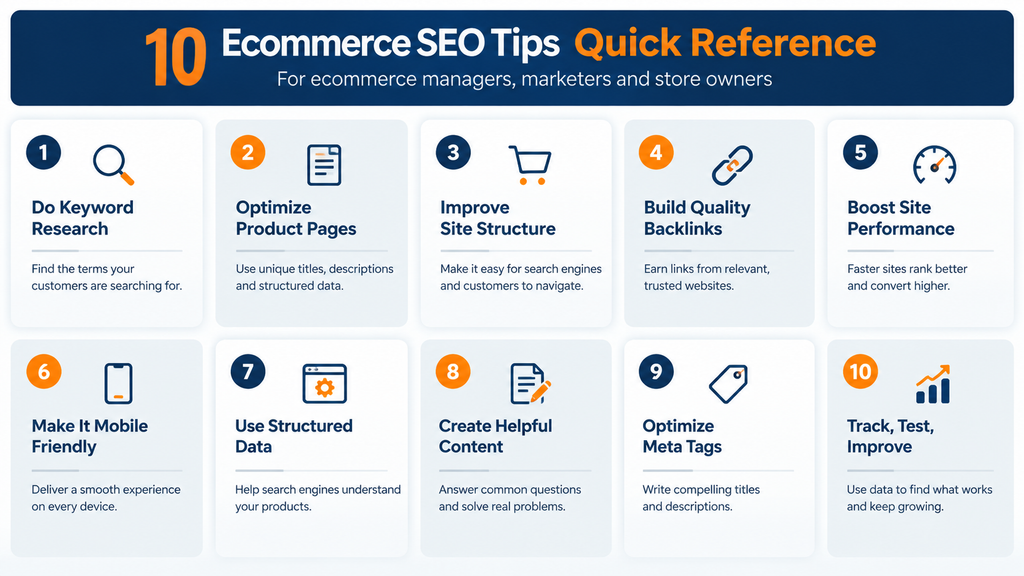
Use this table to prioritise your ecommerce SEO tips implementation based on the expected impact and your current store’s most pressing needs.
| # | Ecommerce SEO Tip | Priority | Expected Impact |
| 1 | Keyword research for product and category pages | Critical | Drives relevant organic traffic to buying-intent pages |
| 2 | Optimise product page titles and meta descriptions | Critical | Improves click-through rate from search results |
| 3 | Write unique, detailed product descriptions | High | Avoids duplicate content and improves rankings |
| 4 | Optimise product images with alt text and compression | High | Improves accessibility, speed, and image search traffic |
| 5 | Build a logical site architecture and URL structure | High | Improves crawlability and distributes link equity |
| 6 | Target long-tail keywords in product and blog content | High | Captures high-intent, low-competition search traffic |
| 7 | Earn backlinks to your store through content and PR | High | Builds domain authority and ranking power |
| 8 | Improve Core Web Vitals and page loading speed | Medium-High | Reduces bounce rate and satisfies Google ranking signals |
| 9 | Fix technical SEO issues: crawl errors and duplicates | Medium-High | Removes barriers to indexation and ranking |
| 10 | Use structured data for products and reviews | Medium | Earns rich snippets in search results |
| Essential Tools for Ecommerce SEOSEMrush — Find product and category keywords, audit your store for technical issues, and track your rankings over time.RankMath Pro — Optimise every product page, category page, and blog post for search directly inside WordPress and WooCommerce.Surfer SEO — Score your product descriptions and blog content against top-ranking competitors and optimise for better rankings. |
Want Your Store To Actually Convert?
Strategy is step one — execution is what moves revenue. Tasknestly builds and optimizes ecommerce stores that convert.
Get Ecommerce Services →Frequently Asked Questions: Ecommerce SEO Tips
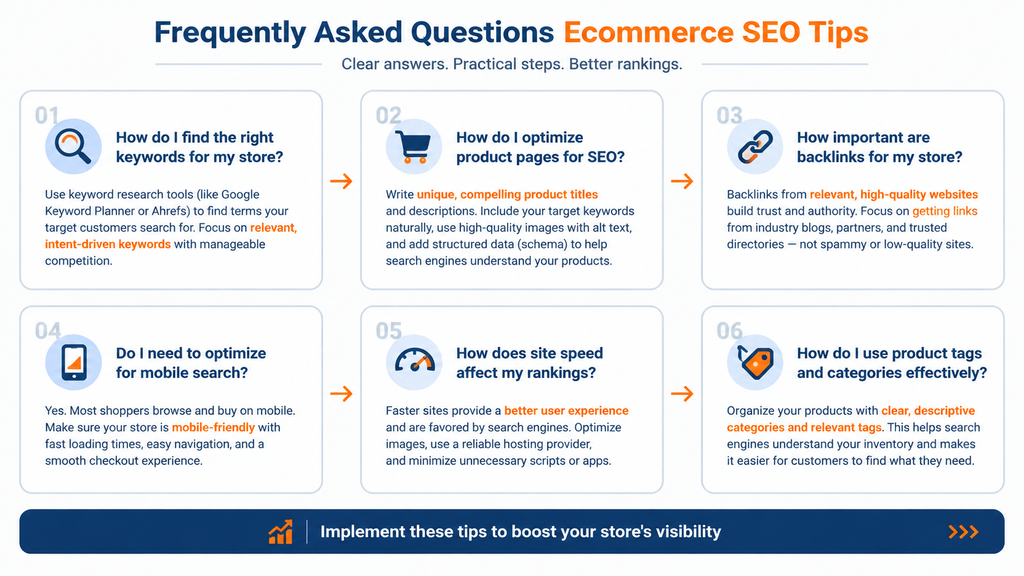
| Question | Answer |
| What are ecommerce SEO tips? | Ecommerce SEO tips are specific tactics and best practices for optimising online stores to rank higher in search engine results, attract targeted organic traffic, and increase product sales without relying on paid advertising. They cover keyword research, on-page optimisation, technical SEO, content creation, and link building. |
| How long does ecommerce SEO take to show results? | Ecommerce SEO typically produces measurable ranking improvements within three to six months of consistent implementation. Technical fixes often show faster results within weeks. New product pages targeting low-competition keywords can rank within four to eight weeks. Highly competitive category pages may take six to twelve months to achieve strong rankings. |
| What is the most important ecommerce SEO tip for product pages? | The single most important ecommerce SEO tip for product pages is writing unique, detailed product descriptions that target specific search keywords and comprehensively answer buyer questions. Thin or duplicate product content is the most common ecommerce SEO mistake, and fixing it typically produces measurable ranking improvements relatively quickly. |
| Do product images affect ecommerce SEO? | Yes. Product images affect ecommerce SEO in multiple ways: alt text provides keyword context for search engines, file size affects page loading speed (a direct ranking factor), and optimised images appear in Google Image Search, generating additional organic traffic. Compressing images to under 200KB without quality loss and adding descriptive alt text are essential ecommerce SEO tips for every product page. |
| What are long-tail keywords and why do they matter for ecommerce SEO? | Long-tail keywords are specific, multi-word search queries such as ‘waterproof hiking boots for wide feet’ rather than simply ‘hiking boots.’ They typically have lower competition and higher purchase intent than broad category keywords, making them among the most valuable ecommerce SEO tips for new stores building organic traffic without established domain authority. |
| How do I build backlinks for my ecommerce store? | The most effective ecommerce SEO backlink strategies include publishing data-driven blog content that earns natural links from industry publications, reaching out to relevant bloggers and journalists for product reviews, creating shareable infographics or resource pages, and listing your business in authoritative local and industry directories. Buying links is against Google’s guidelines and carries significant penalty risk. |
| Should I create a blog for my ecommerce store? | Yes. A blog is one of the highest-return ecommerce SEO tips for building organic traffic over the long term. Blog posts targeting informational keywords related to your product category attract potential customers at the awareness stage, build domain authority through backlink acquisition, and support internal linking to commercial product and category pages. |
Want Your Store To Actually Convert?
Strategy is step one — execution is what moves revenue. Tasknestly builds and optimizes ecommerce stores that convert.
Get Ecommerce Services →Conclusion: Apply These Ecommerce SEO Tips and Watch Your Rankings Grow
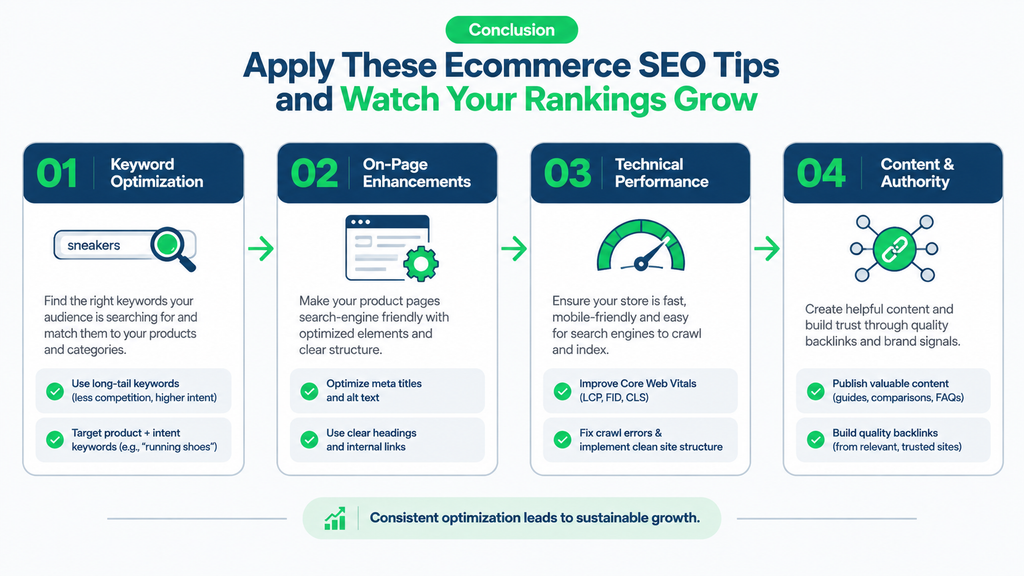
These 10 ecommerce SEO tips address every layer of the organic search equation — from keyword strategy and on-page content quality to technical site health, page loading speed, backlink authority, and structured data. Implementing all 10 consistently over a 6 to 12 month period will produce compounding organic traffic growth that reduces your dependence on paid advertising and builds a sustainable, high-value customer acquisition channel that continues working long after the initial investment.
The most important principle underlying all these ecommerce SEO tips is that organic search rewards genuine quality. The stores that rank highest are those that provide the most relevant, most comprehensive, most technically sound experience for both search engine crawlers and human shoppers. Every SEO improvement that makes your store easier to find, faster to load, and more useful to visit serves both purposes simultaneously — which is why ecommerce SEO, done well, is the single most compoundingly valuable marketing investment available to any online store owner.
Revisit these ecommerce SEO tips quarterly. The ecommerce SEO tips that matter most will evolve as search algorithms update, but the core ecommerce SEO tips in this guide — quality content, technical health, keyword targeting, and link building — remain consistently rewarded.
At Tasknestly, we help ecommerce stores rank higher, drive more qualified organic traffic, and convert that traffic into consistent product sales through expert SEO strategy, technical implementation, and content marketing. If you are ready to build organic visibility that reduces your advertising dependency and grows your revenue sustainably, explore our SEO services or request a free SEO audit today.
To see exactly what Google expects from product pages, read its official guide to product structured data before you add schema markup to your store.
Want Your Store To Actually Convert?
Strategy is step one — execution is what moves revenue. Tasknestly builds and optimizes ecommerce stores that convert.
Get Ecommerce Services →Grow With Tasknestly
Subscribe to the Tasknestly newsletter and get the latest tips on websites, SEO, social media, and digital growth.