
Ecommerce website features are the difference between a store that converts visitors at 1 percent and one that converts at 4 percent from the same traffic. That gap — three percentage points — means tripling your revenue without spending a single additional pound on advertising. Yet most ecommerce businesses invest heavily in driving traffic while neglecting the fundamental features of their store that determine what happens when that traffic arrives.
In 2026, online shoppers have experienced world-class ecommerce from Amazon, ASOS, and other category leaders. Their expectations have risen accordingly. A store that loads slowly, looks broken on mobile, forces account creation at checkout, or lacks customer reviews is not just an inconvenience — it is a trust violation that sends potential customers straight to a competitor. The ecommerce website features in this guide are the specific elements that meet those expectations and convert browsers into buyers.
Whether you are building your first online store or auditing an existing one, this guide covers the 10 ecommerce website features that have the most direct and measurable impact on sales — with specific implementation guidance for each and realistic expectations for the conversion improvement each one delivers.
| Want an Ecommerce Store Built to Convert From Day One?Tasknestly’s ecommerce services include conversion-optimised store design, mobile-first development, and full SEO setup — everything your store needs to turn visitors into paying customers.Get your FREE Ecommerce Quote → |
Want Your Store To Actually Convert?
Strategy is step one — execution is what moves revenue. Tasknestly builds and optimizes ecommerce stores that convert.
Get Ecommerce Services →Table of Contents
Ecommerce Website Features: Technical Foundations
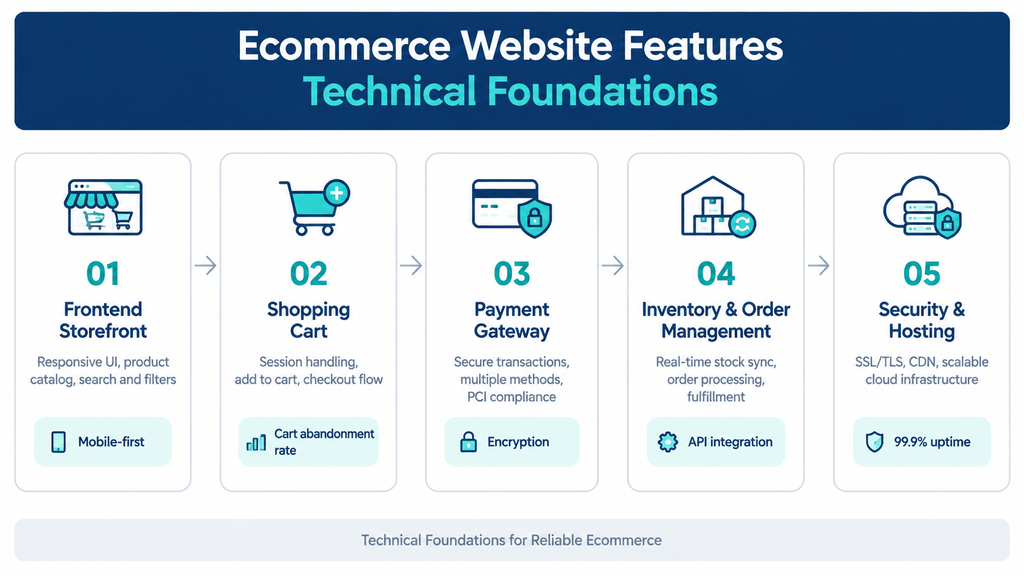
The technical ecommerce website features in this section are non-negotiable. They determine whether your store is discoverable, usable, and trustworthy — the three prerequisites for any conversion.
Feature 1: Mobile-Optimised Responsive Design
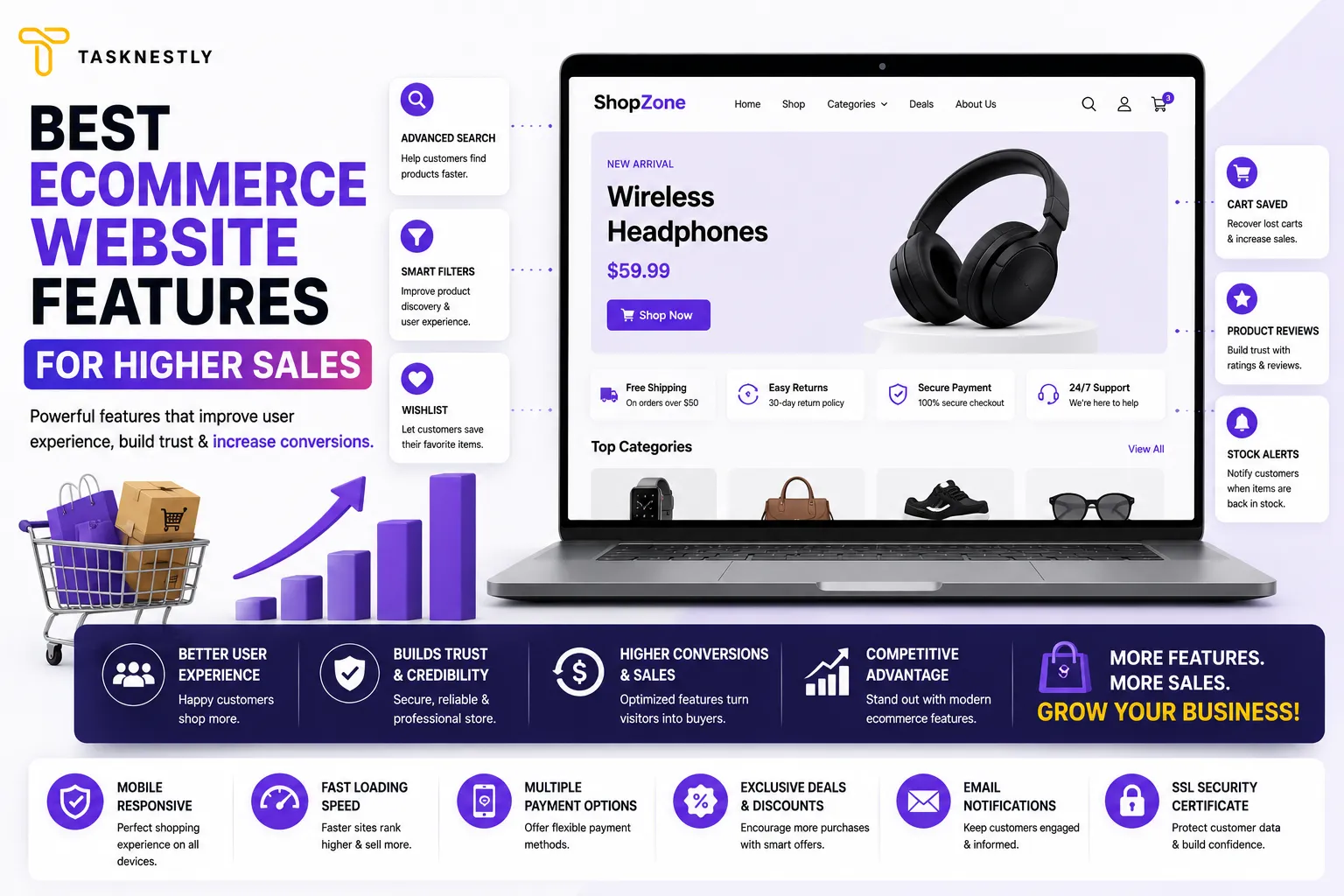
Over 70 percent of ecommerce traffic in 2026 arrives on mobile devices. A store that looks and functions perfectly on desktop but is difficult to navigate on a smartphone is invisible to the majority of its potential customers. Mobile optimisation is the single most foundational of all ecommerce website features — without it, every other improvement you make is undermined by the basic failure to serve your largest audience segment.
Mobile optimisation encompasses responsive design that adapts to any screen size, touch-friendly navigation with adequately sized tap targets, product images that display clearly on small screens, and a checkout process designed for one-handed mobile use. Test your store on multiple real devices across different screen sizes — not just in browser emulation — to identify the specific friction points costing you mobile conversions.
Feature 2: Fast Page Loading Speed
Page speed is simultaneously a user experience issue and an SEO ranking factor, making it one of the most commercially valuable ecommerce website features to invest in. Research consistently shows that a one-second delay in page loading reduces conversions by 7 percent. At a three-second load time, 40 percent of visitors abandon the page before it even finishes loading. Google’s Core Web Vitals assessment directly incorporates page speed into search ranking calculations, meaning slow stores rank lower and attract less organic traffic.
The most impactful speed improvements for ecommerce stores are image compression (product images are the most common speed bottleneck), browser caching, content delivery network (CDN) implementation, and script minification. For Shopify stores, reducing installed app count is frequently the fastest speed win available. Measure your current performance using Google PageSpeed Insights and prioritise the specific improvements recommended for your store.
Feature 3: SSL Security and Trust Badges
SSL security — indicated by the padlock icon and HTTPS in your store’s URL — is the minimum security expectation for any ecommerce website. Most modern ecommerce platforms include SSL automatically, but verifying that it is correctly configured and covering every page of your store is essential. Alongside SSL, displaying trust badge ecommerce website features — recognised payment provider logos, security certification badges, and money-back guarantee icons — at strategic points in the shopping journey (product pages, cart, checkout) reduces the purchase anxiety that causes abandonment at high-consideration moments.
Want Your Store To Actually Convert?
Strategy is step one — execution is what moves revenue. Tasknestly builds and optimizes ecommerce stores that convert.
Get Ecommerce Services →Ecommerce Website Features: Product Discovery
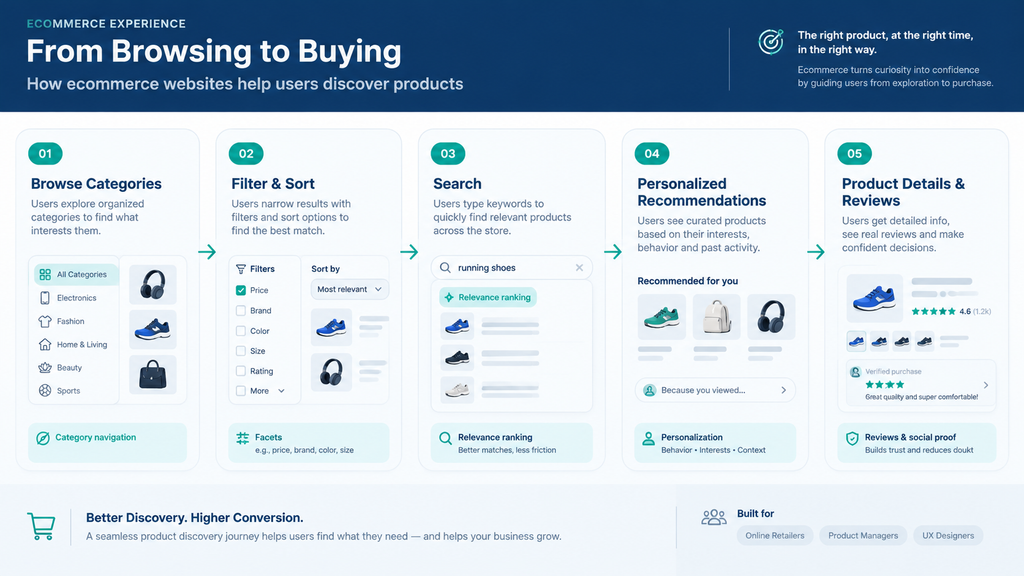
The ecommerce website features in this section determine how effectively shoppers find the products they are looking for — and discover products they did not know they wanted. Poor product discovery is one of the most common and most costly conversion barriers in ecommerce.
Feature 4: High-Quality Product Images and Video
Product imagery is the closest substitute an online shopper has for the physical retail experience of seeing, touching, and trying a product before buying. It is one of the most directly conversion-impacting ecommerce website features available — stores with multiple high-resolution images showing different angles, lifestyle context, and scale references consistently outperform stores with single, low-quality product shots on every key metric: add-to-cart rate, conversion rate, and return rate.
For high-consideration products, adding product video — a 30 to 60 second clip demonstrating the product in use — increases purchase confidence significantly. Video communicates texture, scale, and functionality in ways that static images cannot. Among all visual ecommerce website features, product video consistently delivers the highest conversion uplift per unit of production investment, particularly for fashion, electronics, homewares, and beauty products.
Feature 5: Intuitive Site Search and Filtering
Shoppers who use your site search convert at up to three times the rate of those who browse category pages. This makes intelligent site search one of the highest-ROI ecommerce website features for any store with more than 50 products. Your search must include autocomplete suggestions that help shoppers refine their query, typo tolerance that returns relevant results despite misspellings, and synonym handling that matches ‘sofa’ with ‘couch’ and ‘settee’.
Category filtering — the ability to narrow results by price, size, colour, material, rating, and other relevant attributes — is equally important for stores with large or varied catalogues. Shoppers who cannot quickly filter to their specific requirements leave frustrated. Investing in robust filtering capabilities as one of your core ecommerce website features keeps those shoppers engaged and dramatically increases the likelihood they find and purchase what they came for.
Feature 6: Smart Product Recommendations
Intelligent product recommendations — ‘customers who bought this also bought’, ‘complete the look’, ‘you might also like’ — are ecommerce website features that simultaneously increase average order value and improve product discovery. Amazon attributes approximately 35 percent of its revenue to its recommendation engine, demonstrating the extraordinary commercial impact of well-implemented personalisation.
Recommendation modules should appear on product pages (to suggest complementary or alternative products), on the cart page (to encourage additional add-ons before checkout), and on the homepage (to surface relevant products based on browsing history). Modern ecommerce platforms and plugins make basic recommendation functionality accessible without custom development — the investment in implementing this feature typically pays back within weeks.
| Need a Professional Website That Drives Real Sales?Tasknestly’s website services include conversion-focused design, fast loading pages, and full mobile optimisation — built to turn your store into a consistent revenue generator.Start with a free website consultation → |
Want Your Store To Actually Convert?
Strategy is step one — execution is what moves revenue. Tasknestly builds and optimizes ecommerce stores that convert.
Get Ecommerce Services →Ecommerce Website Features: Checkout and Conversion
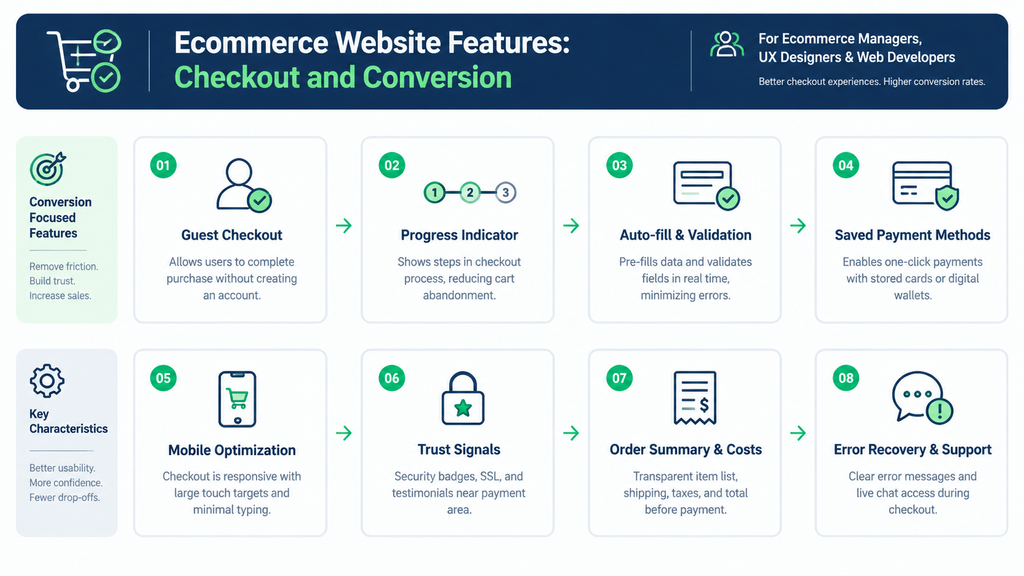
The checkout is where intent becomes revenue — or where it is lost forever. These ecommerce website features address the friction points that cause shoppers who are ready to buy to abandon at the final step.
Feature 7: Streamlined Checkout With Guest Option
The average ecommerce checkout abandonment rate is 70 percent. The single most impactful checkout feature for reducing that rate is offering guest checkout — allowing customers to complete a purchase without creating an account. Forced account creation before purchase is one of the most consistently cited reasons for checkout abandonment, particularly among first-time buyers who are not yet committed enough to your brand to invest in creating an account.
Beyond guest checkout, the most conversion-positive ecommerce website features for the checkout process include a single-page checkout layout, autofill for address fields, a persistent order summary visible throughout the checkout, and a progress indicator that shows shoppers exactly how many steps remain. Every additional field and every additional click in your checkout is a potential abandonment point — minimise both relentlessly.
Feature 8: Multiple Payment Options Including BNPL
Every payment method you do not offer is a segment of potential customers you cannot serve. Among all ecommerce website features at checkout, payment flexibility has the most immediate impact on the breadth of customers your store can convert. At minimum, offer credit and debit cards through a primary gateway like Stripe, PayPal for the substantial portion of shoppers who prefer not to enter card details on unfamiliar stores, and Apple Pay and Google Pay for mobile one-click checkout.
BNPL options — Klarna, Clearpay, Laybuy — deserve particular attention for stores selling products priced above £50. Offering instalment payments through a BNPL provider typically increases conversion rates by 15 to 30 percent on eligible products, because it reduces the perceived financial commitment of the purchase. The merchant receives the full payment upfront from the BNPL provider, making it a pure conversion tool with no credit risk to your business.
Feature 9: Trust Signals Throughout the Purchase Journey
Trust must be built at every stage of the purchase journey, not just on an ‘About Us’ page. The most effective trust-signal ecommerce website features are: customer reviews and star ratings displayed prominently on product pages and listing pages; clear, accessible returns and refund policies that appear near the add-to-cart button; a visible customer service contact option; and real-time social proof indicators like ‘X people viewing this product’ or ‘Only 3 left in stock’ where genuinely accurate.
Review generation should be a systematic business process, not an afterthought. After every purchase, send an automated follow-up email inviting customers to leave a review. Stores with 50+ reviews per product consistently outperform stores with fewer reviews in both conversion rate and organic search rankings — making review generation one of the highest-compound-return ecommerce website features you can invest time in building.
Want Your Store To Actually Convert?
Strategy is step one — execution is what moves revenue. Tasknestly builds and optimizes ecommerce stores that convert.
Get Ecommerce Services →Ecommerce Website Features: Retention and Engagement
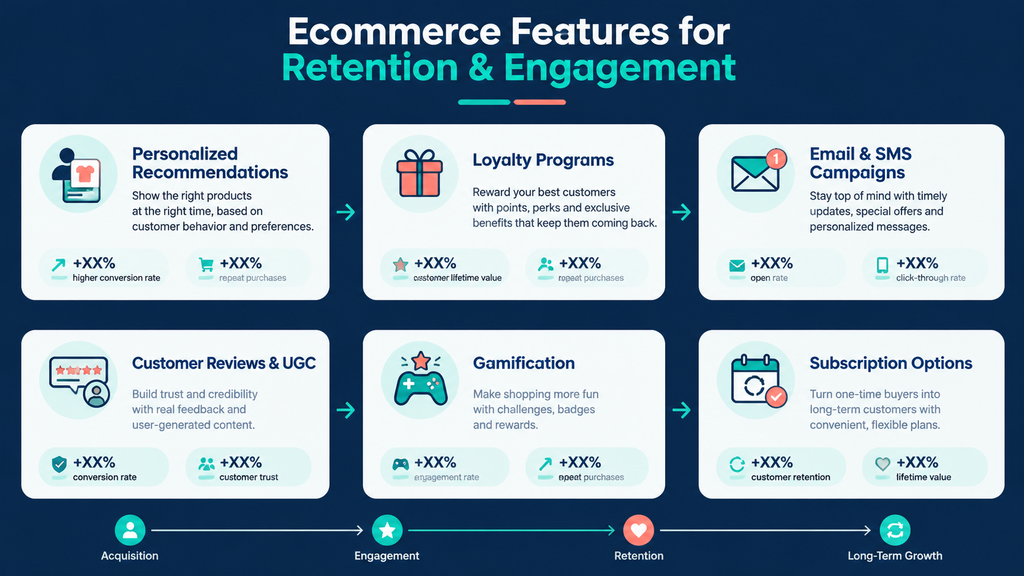
The final ecommerce website features in this guide focus on capturing shoppers who are not yet ready to buy and re-engaging customers who have already purchased — the two most cost-efficient sources of additional revenue available to any ecommerce store.
Feature 10: Live Chat and AI Customer Support
Purchase objections that go unanswered become abandoned carts. Live chat and AI chatbot ecommerce website features give hesitant shoppers an instant channel to resolve doubts about sizing, compatibility, delivery timelines, or return policies — in real time, at the exact moment they are considering a purchase. Stores that implement live chat consistently report conversion rate improvements of 10 to 30 percent on product pages where chat is actively available and responsive.
AI chatbots handle the majority of common pre-purchase questions automatically, escalating to human agents only for complex enquiries. This means small teams can provide 24/7 customer support without proportional staffing costs. For growing ecommerce businesses that want to deliver premium customer service without building a large support team, AI-powered chat is one of the highest-ROI ecommerce website features available in 2026.
Want Your Store To Actually Convert?
Strategy is step one — execution is what moves revenue. Tasknestly builds and optimizes ecommerce stores that convert.
Get Ecommerce Services →Ecommerce Website Features: Quick Reference
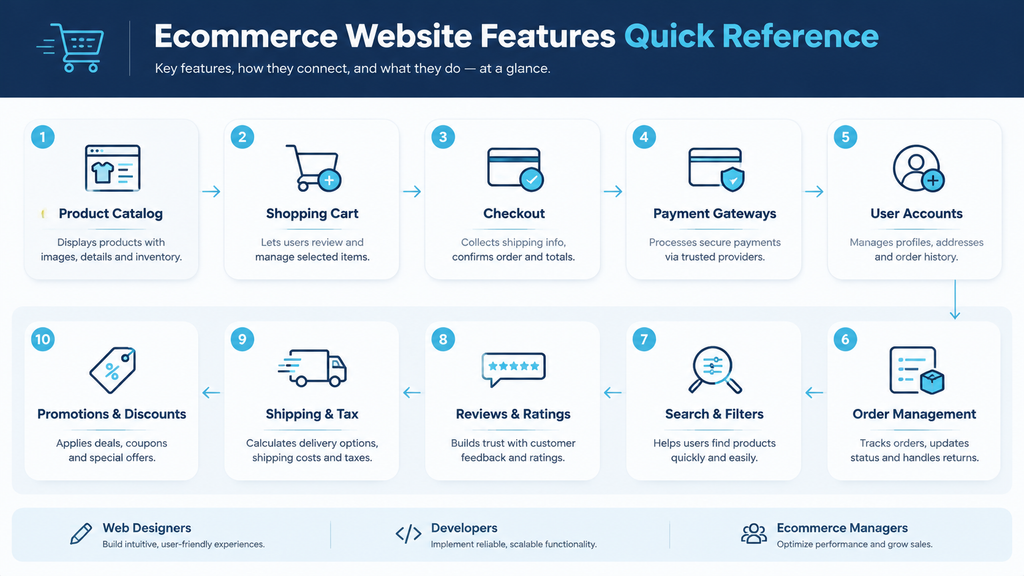
Use this table when planning your ecommerce website features roadmap or auditing your store against the conversion best practices covered in this guide.
| # | Ecommerce Website Feature | Priority | Impact on Sales |
| 1 | Mobile-optimised responsive design | Critical | 70%+ of traffic is mobile — poor UX loses every sale |
| 2 | Fast page loading speed | Critical | 1s delay = 7% conversion drop |
| 3 | High-quality product images and video | Critical | Better visuals = higher add-to-cart rates |
| 4 | Intuitive site search and filtering | High | Shoppers who search convert 3x more than browsers |
| 5 | Multiple payment options including BNPL | High | Every missing payment method loses a segment of buyers |
| 6 | Trust signals: reviews, badges, guarantees | High | Social proof reduces purchase hesitation significantly |
| 7 | Streamlined checkout with guest option | High | Forced account creation kills conversion at final step |
| 8 | Clear product descriptions and specs | High | Detailed info reduces returns and increases confidence |
| 9 | Live chat or AI customer support | Medium | Real-time answers prevent objection-driven abandonment |
| 10 | Wishlist and save-for-later functionality | Medium | Captures future purchase intent and return visits |
| Essential Tools to Build These Ecommerce Website FeaturesShopify — The most beginner-friendly platform with built-in ecommerce features including fast checkout, mobile optimisation, and app integrations.Elementor — Build and customise your ecommerce website pages with drag-and-drop precision — no coding required.Canva — Create professional product images, promotional banners, and trust-building visual content for your store. |
Want Your Store To Actually Convert?
Strategy is step one — execution is what moves revenue. Tasknestly builds and optimizes ecommerce stores that convert.
Get Ecommerce Services →Frequently Asked Questions: Ecommerce Website Features
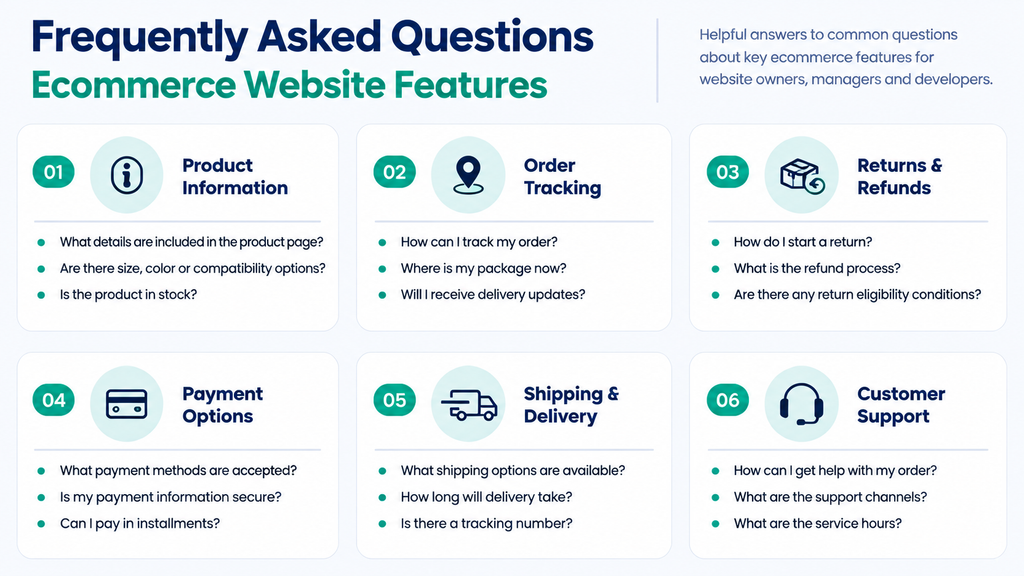
| Question | Answer |
| What are the most important ecommerce website features? | The most critical ecommerce website features are mobile optimisation, fast loading speed, high-quality product imagery, streamlined checkout, multiple payment options, and trust signals like reviews and security badges. These fundamentals determine whether visitors stay and buy or leave and bounce. |
| How do ecommerce website features affect conversion rates? | Ecommerce website features directly determine conversion rates by reducing friction, building trust, and making the path to purchase as smooth as possible. A slow-loading store with a complicated checkout and no reviews will convert at 0.5-1%, while a fast, trust-rich, mobile-optimised store with great images can convert at 3-5% from the same traffic. |
| What payment options should an ecommerce website offer? | An ecommerce website should offer credit and debit cards, PayPal, Apple Pay and Google Pay for mobile one-click checkout, and at least one BNPL option like Klarna or Clearpay for higher-ticket items. The more payment options you offer, the fewer customers you lose at the final conversion step. |
| How important is mobile optimisation for ecommerce? | Mobile optimisation is one of the most critical ecommerce website features in 2026. Over 70% of ecommerce traffic arrives on mobile devices, and Google uses mobile-first indexing to determine search rankings. A store that performs poorly on mobile loses both organic rankings and the majority of its potential customers. |
| What trust signals should an ecommerce website display? | Essential trust signals include customer reviews and star ratings, security badges (SSL, payment provider logos), a clear returns policy, money-back guarantee, business contact information, and social proof like the number of customers served or products sold. These ecommerce website features reduce purchase anxiety at the critical decision moment. |
| How does site search impact ecommerce sales? | Shoppers who use site search convert at up to 3x the rate of those who browse. An effective search feature with autocomplete, typo tolerance, and relevant filtering is one of the highest-ROI ecommerce website features for stores with large catalogues. Poor search that returns irrelevant results actively drives customers away. |
| Should I offer guest checkout on my ecommerce website? | Yes, always. Forcing account creation before purchase is one of the most common ecommerce conversion killers. Guest checkout removes a significant barrier for first-time buyers. You can invite account creation after the purchase is complete — when the customer is already satisfied and more likely to agree. |
Want Your Store To Actually Convert?
Strategy is step one — execution is what moves revenue. Tasknestly builds and optimizes ecommerce stores that convert.
Get Ecommerce Services →Conclusion: Build These Ecommerce Website Features Into Your Store
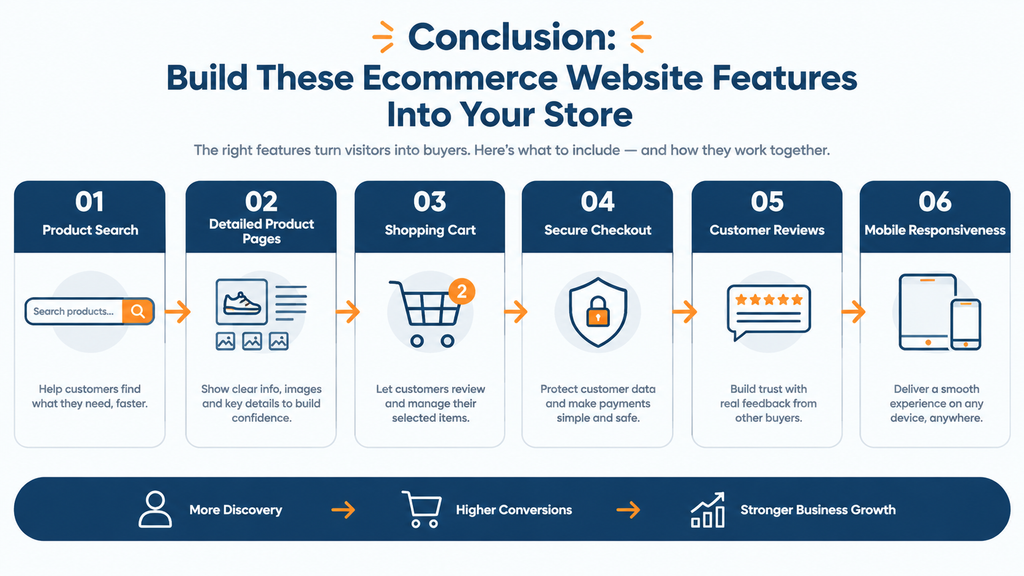
The 10 ecommerce website features in this guide are not design preferences or nice-to-have extras — they are the proven, commercially validated elements that determine whether online shoppers trust your store enough to buy from it. Missing even two or three of these features creates friction that drives potential customers to competitors who have implemented them. The cumulative impact of addressing all 10 is a store that converts significantly more traffic, generates more revenue per visitor, and builds the customer relationships that drive repeat purchases.
Audit your store against each of the ecommerce website features in this guide and prioritise the improvements with the most direct impact on your current conversion bottleneck. If mobile UX is poor, start there — it affects the majority of your traffic. If checkout abandonment is high, streamline checkout and add payment options. If product pages have few reviews, build a review collection system. The most important insight about ecommerce website features is that fixing one compounds the impact of all the others.
At Tasknestly, we design and build ecommerce stores with all of these ecommerce website features built in from day one — not retrofitted as afterthoughts. If you are ready to build or redesign your store with conversion at the centre of every decision, explore our ecommerce services or request a free quote today.
Want Your Store To Actually Convert?
Strategy is step one — execution is what moves revenue. Tasknestly builds and optimizes ecommerce stores that convert.
Get Ecommerce Services →Ecommerce Website Features: Building a Continuous Improvement Habit
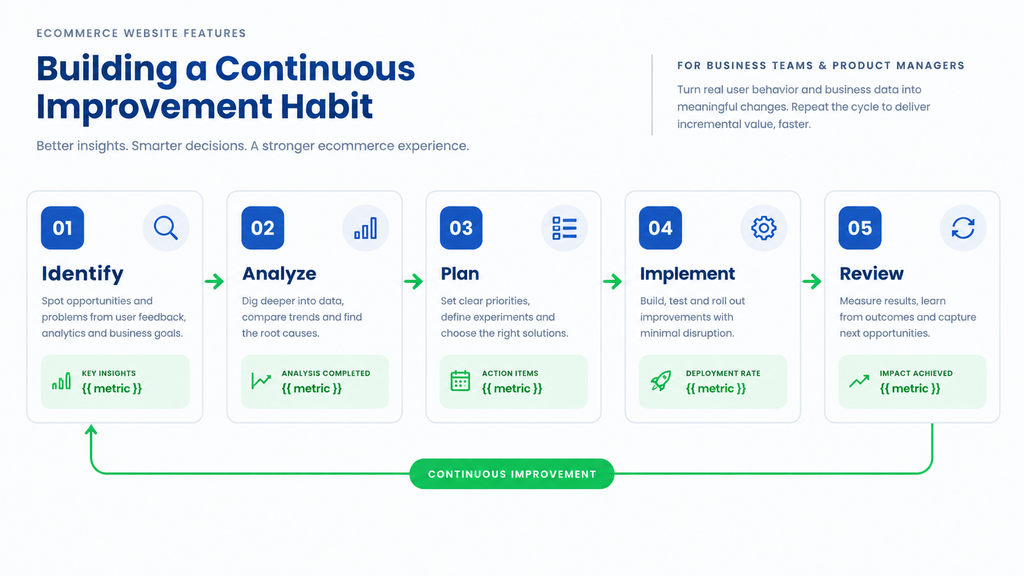
The most successful stores treat ecommerce website features as a continuous improvement cycle. Each ecommerce website feature you implement compounds with the others: faster speed amplifies better images; better images make descriptions more persuasive; strong social proof makes streamlined ecommerce website features more trusted. Schedule a quarterly ecommerce website features audit — comparing your implementation against your top three competitors and this guide — to maintain a conversion-optimised store that stays ahead of rising customer expectations.
Prioritise your ecommerce website features investments based on direct revenue impact. Fix mobile experience first if your mobile conversion rate is significantly below desktop. Fix checkout friction if cart abandonment is above 70 percent. Add reviews if your product pages have fewer than five. Every ecommerce website features improvement you make reduces the acquisition cost of every visitor your marketing brings to the store.
Review your ecommerce website features quarterly against best-in-class competitors in your category. The ecommerce website features that convert well today must be maintained and improved as customer expectations evolve and new ecommerce website features become standard.
To measure how your store performs on speed and usability, start with Google’s guide to Core Web Vitals and test your key pages with it.
Want Your Store To Actually Convert?
Strategy is step one — execution is what moves revenue. Tasknestly builds and optimizes ecommerce stores that convert.
Get Ecommerce Services →Grow With Tasknestly
Subscribe to the Tasknestly newsletter and get the latest tips on websites, SEO, social media, and digital growth.