
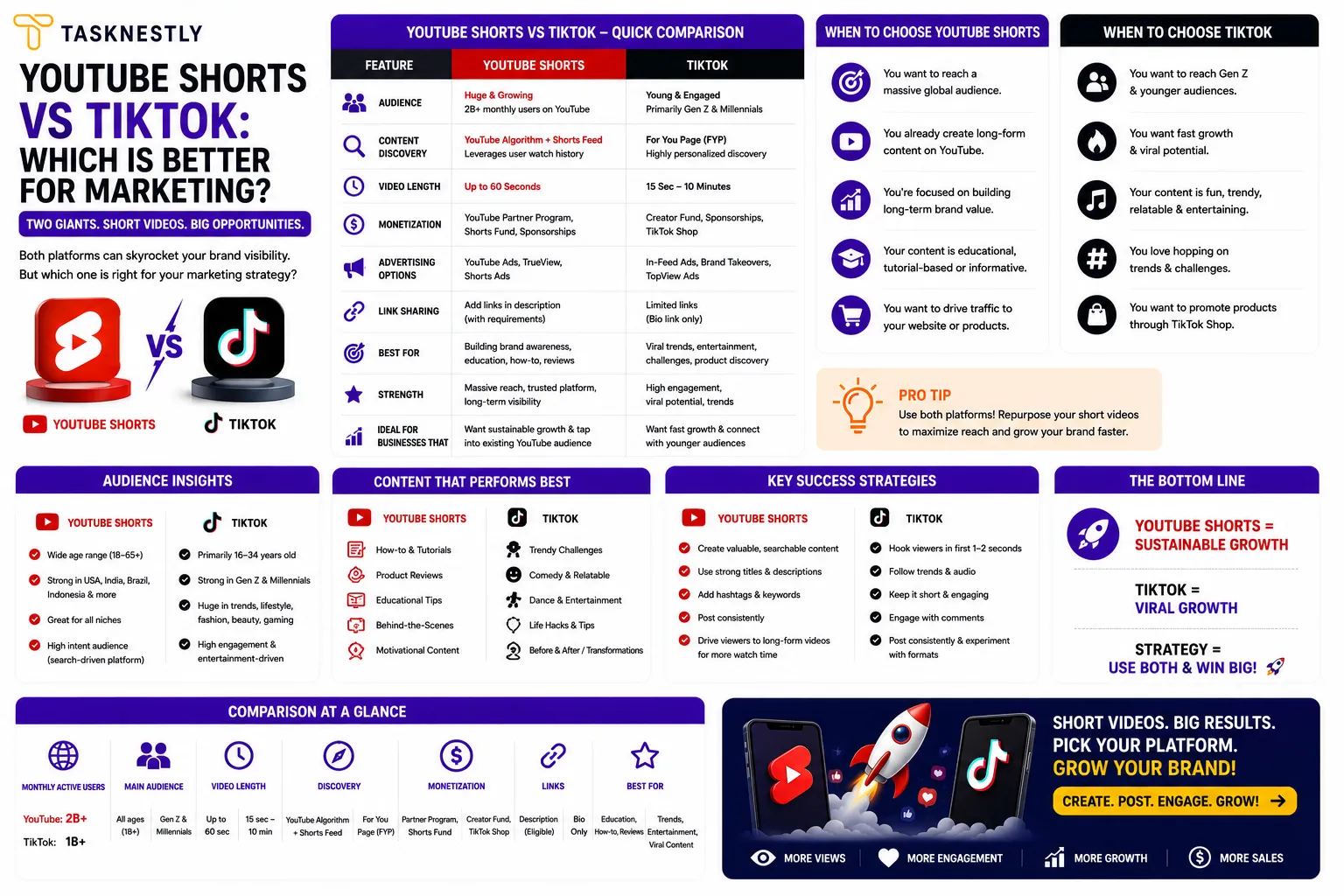
YouTube Shorts vs TikTok is one of the most important platform decisions any brand or creator must make in the short-form video era. Both platforms have built enormous audiences around short-form video content, both are actively investing in creator monetisation and brand tools, and both offer genuine organic reach potential that most other social media platforms cannot currently match. Yet YouTube Shorts vs TikTok is not an identical choice — the two platforms differ meaningfully in their algorithms, their audience demographics, their content culture, and their commercial infrastructure.
The YouTube Shorts vs TikTok debate has intensified in 2026 as both platforms have expanded significantly. Brands that have not yet made a deliberate YouTube Shorts vs TikTok decision are often inadvertently underinvesting in both, which is the worst possible outcome of an unresolved strategy question. TikTok has grown its social commerce tools, expanded its professional content library, and improved its advertising platform considerably. YouTube Shorts has integrated more deeply with the broader YouTube ecosystem — giving Shorts creators access to YouTube’s established monetisation programmes, its long-form content audience, and its unmatched search-driven discovery infrastructure. The YouTube Shorts vs TikTok question is therefore not simply “which has more users?” but “which platform best serves your specific audience, content style, and business objectives?”
This YouTube Shorts vs TikTok guide provides a comprehensive comparison across every dimension that matters for marketing — algorithm, audience, content format, reach, commercial tools, and long-term brand investment — so you can make an informed decision about where to focus your short-form video marketing effort in 2026.
Need expert support building your short-form video strategy? Tasknestly’s social media management team builds platform-specific strategies that maximise your growth on YouTube Shorts, TikTok, or both. Get your free quote today.
Ready To Actually Go Viral?
Strategy gets you started — execution gets you views. Tasknestly’s viral video service handles the full production and distribution.
Get Viral Video Services →Table of Contents
YouTube Shorts vs TikTok: Algorithm Comparison
The algorithm is the most commercially significant dimension of the YouTube Shorts vs TikTok comparison for brands trying to grow organically. Both platforms use recommendation-driven feeds that push content to non-followers — but they operate differently and reward different content behaviours.
How the TikTok Algorithm Works
TikTok’s algorithm is the most content-merit-based system of any major social platform. Every video is initially shown to a small test audience regardless of the creator’s follower count or account history. If that test audience engages strongly — high completion rates, shares, re-watches — the video is pushed to progressively larger audiences. A brand new account on TikTok can achieve viral reach if the content is compelling enough. This democratic distribution model is one of TikTok’s most significant advantages in the YouTube Shorts vs TikTok debate for new brands building from zero.
TikTok’s algorithm also gives content an unusually long active window. A TikTok video can resurface and go viral days, weeks, or even months after its original posting date — meaning your content library continues to work for you long after each video is published.
How the YouTube Shorts Algorithm Works
YouTube Shorts distributes content through two distinct mechanisms that give it a structural advantage in the YouTube Shorts vs TikTok debate for brands with existing YouTube audiences. First, Shorts are recommended to non-subscribers through the Shorts feed — similar to TikTok’s For You page. Second, Shorts appear in recommendations for creators’ existing long-form YouTube audiences, creating a cross-format amplification loop that TikTok cannot replicate. A brand with an established YouTube channel effectively gets double distribution for its Shorts — through the Shorts feed to new audiences AND through YouTube’s standard recommendation system to existing subscribers.
YouTube also benefits from its unmatched search infrastructure. Shorts that are optimised for YouTube search can generate discovery through search results in addition to algorithmic recommendations — a compounding discoverability advantage that TikTok, which is primarily a recommendation-driven platform, cannot currently match.
TikTok vs YouTube Shorts Algorithm: Verdict
In the YouTube Shorts vs TikTok algorithm comparison: TikTok wins for new accounts seeking rapid discovery with no existing audience. YouTube Shorts wins for brands with an established YouTube presence or for brands prioritising long-term, search-driven discoverability. Both platforms deserve serious consideration in any short-form video marketing strategy — and the YouTube Shorts vs TikTok decision should always be revisited as your audience data matures.
Ready To Actually Go Viral?
Strategy gets you started — execution gets you views. Tasknestly’s viral video service handles the full production and distribution.
Get Viral Video Services →YouTube Shorts vs TikTok: Audience Comparison
Understanding the audience differences is critical for making the YouTube Shorts vs TikTok decision for your specific brand.
TikTok’s Audience
TikTok’s core demographic remains the 18 to 34 age range, though its audience has diversified considerably since its early years. The platform’s content culture is entertainment-first and trend-driven, with authenticity and personality valued over production polish. TikTok’s audience is highly responsive to creator-brand relationships and native advertising that feels organic to the platform’s tone — which makes TikTok particularly effective for consumer-facing brands in fashion, beauty, food, entertainment, and lifestyle categories.
YouTube Shorts Audience
YouTube’s overall audience is one of the most demographically diverse of any digital platform — spanning age groups from young teenagers to adults over 65. YouTube Shorts inherits this diversity, meaning brands can reach audiences on YouTube Shorts that would be very difficult to engage on TikTok. YouTube’s audience is also more accustomed to intentional video consumption — they come to YouTube to watch specific content, not to scroll passively — which means YouTube Shorts audiences have slightly higher purchase intent when they do engage with brand content.
| Dimension | YouTube Shorts | TikTok |
|---|---|---|
| Core audience age | Broad (13–65+) | 18–34 primary |
| Content culture | Entertainment + education | Entertainment-first |
| Discovery method | Search + recommendation | Recommendation only |
| New account reach | Moderate | Very High |
| Search integration | Yes (Google + YouTube) | Limited |
| Social commerce | Growing | More established |
| Monetisation for creators | Mature (AdSense + memberships) | Growing |
| Brand advertising maturity | Very High | High and growing |
Ready To Actually Go Viral?
Strategy gets you started — execution gets you views. Tasknestly’s viral video service handles the full production and distribution.
Get Viral Video Services →YouTube Shorts vs TikTok: Content Format and Creative Expectations
The content that performs on TikTok and the content that performs on YouTube Shorts are similar in length and format but different in tone, presentation style, and audience expectation. Understanding these differences is essential for brands deciding between YouTube Shorts vs TikTok — or adapting content for both.
Content That Performs on TikTok
TikTok content rewards authenticity above polish. The most successful brand content on TikTok feels native to the platform — shot casually, with personality, using trending sounds and formats where relevant. Production values that work for TV advertising often work against brands on TikTok by making content feel corporate and out of place. The best TikTok content for brands is direct, fast-paced, and either immediately entertaining or immediately useful.
Content That Performs on YouTube Shorts
YouTube Shorts rewards content that connects to broader YouTube viewing intent. Educational content, “how to” guides, and clips that tease or summarise longer-form content perform particularly well as Shorts because they serve the YouTube audience’s characteristic desire for substantive, value-first content. Production quality can be slightly higher than TikTok without feeling out of place — YouTube audiences are more accustomed to polished video content than TikTok audiences.
For independent, in-depth reviews of the best video editing and analytics tools for both YouTube Shorts and TikTok, TechBothQ covers the leading platforms with detailed comparisons.
Want content that performs on both YouTube Shorts and TikTok? Tasknestly’s viral video production specialists create short-form content adapted for every platform’s unique algorithm and audience. Book your free quote.
Ready To Actually Go Viral?
Strategy gets you started — execution gets you views. Tasknestly’s viral video service handles the full production and distribution.
Get Viral Video Services →YouTube Shorts vs TikTok for Business: Commercial Outcomes
For brands, the YouTube Shorts vs TikTok decision ultimately comes down to which platform drives the business outcomes that matter most. This requires looking beyond reach and engagement to the commercial infrastructure each platform provides.
TikTok for Business
TikTok Shop is the platform’s most significant commercial development — enabling direct in-app purchasing from videos, live streams, and creator storefronts. For product-based businesses targeting the 18 to 34 demographic, TikTok’s social commerce capabilities make it one of the most commercially integrated short-form video platforms available. TikTok Ads also provides sophisticated targeting options that have improved significantly, making TikTok a viable paid advertising channel alongside its organic capabilities.
YouTube Shorts for Business
YouTube Shorts’ commercial advantage lies in its integration with the broader digital ecosystem. YouTube videos rank in Google search — meaning a business with a strong YouTube Shorts strategy also benefits from Google search visibility in a way that TikTok does not provide. YouTube’s link functionality (including clickable cards and end screens on longer videos, and direct links in channel descriptions) creates cleaner pathways from video to website than TikTok’s more restricted link options. For businesses where website traffic and lead generation are primary goals, YouTube Shorts’ Google integration gives it a meaningful commercial advantage in the YouTube Shorts vs TikTok comparison.
YouTube Shorts or TikTok for Brands: Making the Decision
The honest YouTube Shorts vs TikTok answer for most brands in 2026 is: assess your audience’s age and platform behaviour, your content style capabilities, and your primary commercial goal. If your audience skews 18 to 34 and entertainment-led content suits your brand, TikTok is likely the stronger primary platform. If your audience is broader, if you already have a YouTube presence, or if Google search visibility is a priority, YouTube Shorts deserves to be your primary short-form video investment.
For brands with the capacity to be active on both, the YouTube Shorts vs TikTok choice does not need to be binary — produce content natively for your primary platform and repurpose it thoughtfully for the other. The YouTube Shorts vs TikTok decision is most important as a prioritisation tool when you have limited time and resources, not as a permanent either-or commitment. Tasknestly’s digital marketing strategy services help brands make and execute this decision confidently based on their specific audience data and commercial objectives.
Ready To Actually Go Viral?
Strategy gets you started — execution gets you views. Tasknestly’s viral video service handles the full production and distribution.
Get Viral Video Services →YouTube Shorts vs TikTok: Creator Economy and Monetisation
For brands working with influencers and creators — or for creators building a monetisation strategy alongside organic growth — the YouTube Shorts vs TikTok comparison includes an important creator economy dimension that directly affects the quality and availability of creator partners on each platform.
YouTube’s monetisation infrastructure is the most mature of any video platform. Through AdSense, channel memberships, Super Thanks, merchandise integration, and the YouTube Partner Programme, creators on YouTube have access to multiple reliable revenue streams that have existed for years and are well understood. For brands seeking creator partnerships, this maturity means that many serious creators on YouTube have built sustainable businesses around the platform — which translates into more professional, more reliable, and more consistently high-quality creator partnerships than are typically available on newer platforms.
TikTok’s creator monetisation has evolved significantly, with TikTok Shop affiliate commissions, the Creator Rewards Programme, and brand partnership tools all improving substantially. For brands in categories where TikTok’s younger, entertainment-oriented creator community is a natural fit — consumer goods, beauty, fashion, food, and gaming — TikTok creator partnerships can deliver exceptional reach and authenticity that more polished YouTube creator partnerships sometimes lack.
The YouTube Shorts vs TikTok creator economy comparison ultimately reflects the platforms’ broader differences: YouTube offers more mature infrastructure and more diverse creator specialisations; TikTok offers more raw energy, higher trend-responsiveness, and stronger cultural resonance with 18 to 34 audiences. Choosing between YouTube Shorts vs TikTok for influencer marketing requires the same audience and brand-fit analysis as choosing between them for organic content.
Ready To Actually Go Viral?
Strategy gets you started — execution gets you views. Tasknestly’s viral video service handles the full production and distribution.
Get Viral Video Services →YouTube Shorts vs TikTok: Long-Term Content Value
One of the most underappreciated dimensions of the YouTube Shorts vs TikTok comparison is what happens to your content after its initial publication. This long-term content value dimension significantly favours YouTube Shorts for brands thinking about content as a compounding asset rather than a one-time reach play.
A TikTok video’s active life is typically measured in days to weeks. Viral exceptions exist — TikTok’s algorithm can resurface older content — but the vast majority of TikTok views are generated in the first 48 to 72 hours after publication. After that, TikTok content largely becomes invisible unless it resurfaces through a trend or challenge.
YouTube Shorts, by contrast, benefits from YouTube’s search-driven discoverability model. A well-optimised Short that targets a specific search query can continue generating views from search months or years after publication — because YouTube is a search engine as much as a social platform, and content that ranks for a search query keeps receiving traffic as long as that query is being searched. This long-term content value gives YouTube Shorts a compounding ROI advantage in the YouTube Shorts vs TikTok comparison for brands investing in evergreen educational or informational content.
The YouTube Shorts vs TikTok decision therefore also depends on your content strategy timeline. For brands optimising for immediate reach and viral potential, TikTok is the stronger choice. For brands building a content library that generates compounding organic discovery over years, YouTube Shorts’ search integration makes it the more valuable long-term investment. Combining Tasknestly’s SEO expertise with a YouTube Shorts strategy ensures your short-form content is optimised for search from day one — maximising its long-term discoverability value.
Top Tools to Manage Your YouTube Shorts vs TikTok Strategy
- Later — Schedule and publish content to both TikTok and YouTube from one platform, with analytics to compare performance across the YouTube Shorts vs TikTok divide side by side.
- CapCut — Create and edit short-form video content with platform-specific export formats for both YouTube Shorts and TikTok, including aspect ratio adaptation and caption tools.
- VidIQ — YouTube-focused analytics and keyword research tool that gives you the search optimisation data you need to make your YouTube Shorts perform in Google and YouTube search as well as the Shorts feed.
Ready To Actually Go Viral?
Strategy gets you started — execution gets you views. Tasknestly’s viral video service handles the full production and distribution.
Get Viral Video Services →Frequently Asked Questions: YouTube Shorts vs TikTok
| Question | Answer |
|---|---|
| Which is better for reach: YouTube Shorts vs TikTok? | TikTok delivers faster reach for new accounts with no existing audience due to its purely merit-based algorithm. YouTube Shorts delivers broader demographic reach and compounding search-driven visibility over time. |
| Is YouTube Shorts or TikTok better for small businesses? | For new brands with no existing audience, TikTok offers faster organic discovery. For businesses with an existing YouTube presence or those targeting older demographics, YouTube Shorts is the stronger choice. |
| Can I post the same content on YouTube Shorts and TikTok? | Yes, but adapting content to each platform’s culture improves performance. TikTok rewards native-feeling authenticity; YouTube Shorts rewards slightly more structured, value-led content. Remove TikTok watermarks before posting to YouTube Shorts. |
| Which has better advertising: YouTube Shorts vs TikTok? | YouTube (through Google Ads) has more mature and sophisticated advertising targeting. TikTok Ads has improved significantly and excels for reaching 18 to 34 consumers. For B2B or older demographics, YouTube advertising is generally more effective. |
| Does YouTube Shorts help with SEO? | Yes — YouTube Shorts appear in YouTube search results and can also surface in Google search. This search integration is a significant advantage of YouTube Shorts vs TikTok for brands where organic search visibility is a priority. Optimising Shorts titles, descriptions, and spoken content for search keywords maximises this SEO benefit significantly. |
| Is TikTok still growing in 2026? | Yes. TikTok continues to grow its global user base and is expanding its commerce and advertising capabilities. The YouTube Shorts vs TikTok competition remains strong and neither platform shows signs of clear dominance over the other. |
| Should I be on both YouTube Shorts and TikTok? | For brands with the capacity to maintain both platforms, yes — produce natively for your primary platform and repurpose for the secondary. The YouTube Shorts vs TikTok question is most useful as a prioritisation guide when resources are limited, not as a permanent restriction on which platforms you can eventually build a presence on. |
Ready To Actually Go Viral?
Strategy gets you started — execution gets you views. Tasknestly’s viral video service handles the full production and distribution.
Get Viral Video Services →Conclusion: YouTube Shorts vs TikTok — Choose Based on Your Specific Situation
The YouTube Shorts vs TikTok comparison does not have a universal winner — it has a winner for each specific brand situation. TikTok wins on pure discovery speed, viral reach potential, and social commerce for younger audiences. YouTube Shorts wins on demographic breadth, search integration, long-term content compounding, and integration with Google’s advertising ecosystem.
Whichever side of the YouTube Shorts vs TikTok debate you land on — and no matter how many times the YouTube Shorts vs TikTok question gets revisited as both platforms evolve — the most important thing is to commit to a strategy, maintain the posting consistency that algorithms reward, and measure your results against the commercial goals that actually matter to your business — not just vanity metrics like raw view counts. Your YouTube Shorts vs TikTok choice should be driven by data, refined by results, and always in service of your specific brand growth objectives.
If you want expert help navigating the YouTube Shorts vs TikTok decision and building the short-form video content strategy to back it up, Tasknestly’s social media management specialists are ready. Get your free quote today and let us build the platform strategy your brand needs to win on short-form video in 2026 and beyond. The YouTube Shorts vs TikTok choice is not permanent — it is a strategic starting point that should be revisited regularly as your audience data, content performance, and platform capabilities evolve together.
Ready To Actually Go Viral?
Strategy gets you started — execution gets you views. Tasknestly’s viral video service handles the full production and distribution.
Get Viral Video Services →Grow With Tasknestly
Subscribe to the Tasknestly newsletter and get the latest tips on websites, SEO, social media, and digital growth.