
Video marketing strategies are reshaping how brands grow, compete, and connect with their audiences in 2026. Video content is now the dominant format across every major digital channel — social media algorithms prioritise it, search engines index it, email campaigns that include it outperform those that do not, and audiences consistently prefer to consume information through video over text when given the choice. For businesses that have not yet developed clear video marketing strategies, the competitive gap between them and those that have is widening every month.
What makes video marketing strategies particularly powerful is their versatility. The same strategic framework applies whether you are creating short-form Reels for Instagram and TikTok, long-form educational content for YouTube, product demonstration videos for your website, thought leadership clips for LinkedIn, or promotional videos for paid ad campaigns. Understanding the core principles behind effective video marketing strategies allows you to build a coherent, cross-platform approach that serves your brand’s growth goals at every stage of the customer journey.
This guide covers the most effective video marketing strategies for brand growth in 2026 — from foundational planning and content format selection to distribution, optimisation, and measurement. Whether you are starting your video marketing strategy from scratch or looking to make your existing video content work harder, these video marketing strategies are grounded in current platform behaviour, audience psychology, and proven commercial outcomes.
Want professionally produced video content built into your marketing strategy? Tasknestly’s viral video production team creates short-form and long-form video content engineered for brand growth and engagement. Get your free quote today.
Ready To Actually Go Viral?
Strategy gets you started — execution gets you views. Tasknestly’s viral video service handles the full production and distribution.
Get Viral Video Services →Table of Contents
Why Video Marketing Strategies Are Essential for Brand Growth
Before diving into specific video marketing strategies, it is worth establishing why video has become so commercially important and why the brands investing in deliberate video marketing strategies are consistently outperforming those that treat video as an optional activity.
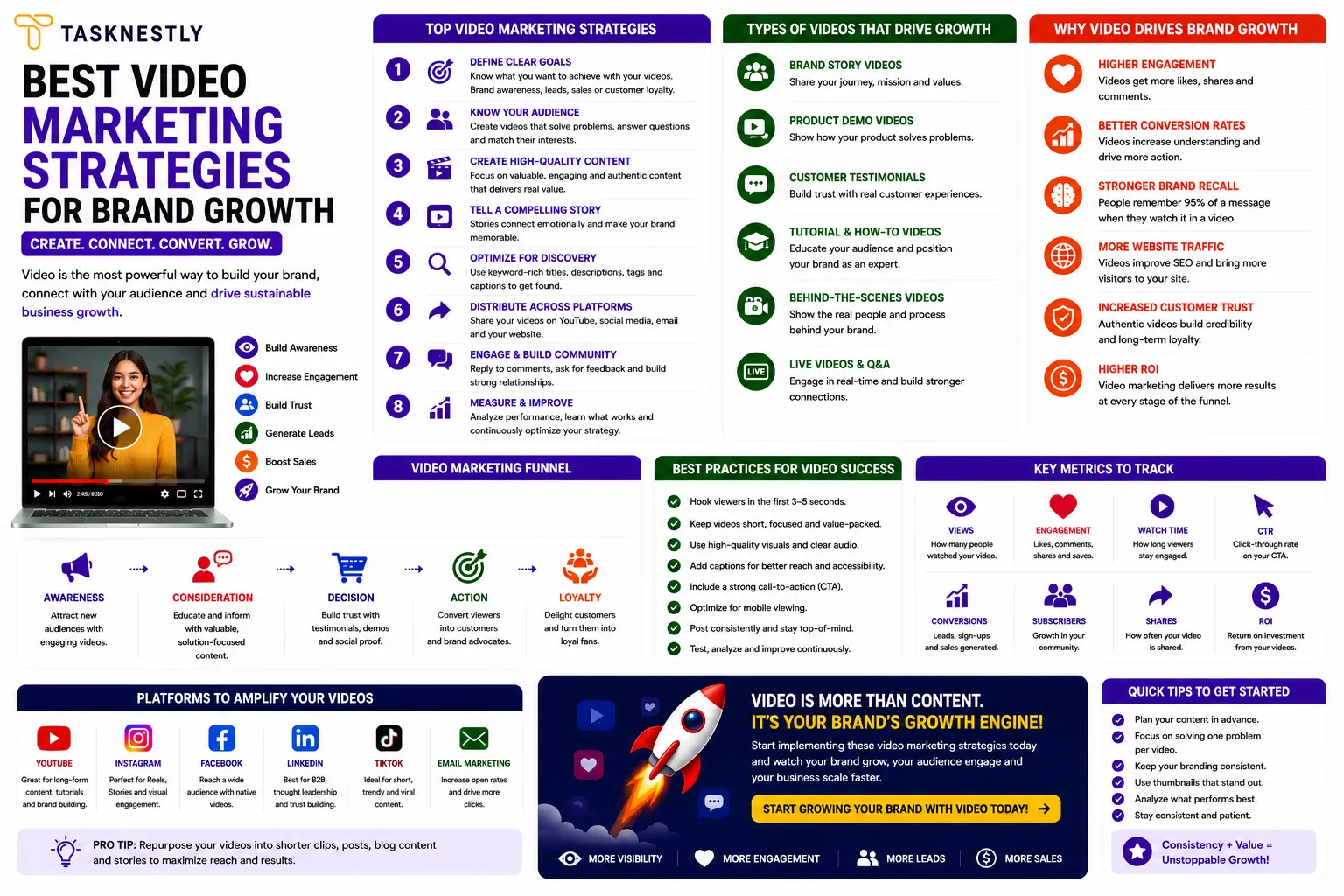
Video content outperforms virtually every other content format on every major engagement metric. Viewers retain 95% of a message delivered through video compared to just 10% when reading text. Pages with video content keep visitors on site significantly longer than those without — which improves both SEO performance and conversion rate. Social media platforms actively push video to non-followers at a much higher rate than static content, making video marketing strategies the primary driver of organic reach for most brands.
The rise of short-form video platforms — TikTok, Instagram Reels, YouTube Shorts — has also dramatically lowered the production barrier for effective video marketing strategies. Compelling, high-performing video content does not require professional camera equipment, editing suites, or large budgets. A smartphone, good lighting, and a clear message are sufficient to produce video marketing content that outperforms expensive corporate productions that lack authenticity or audience relevance. Video marketing for small business has never been more accessible or more commercially impactful.
Ready To Actually Go Viral?
Strategy gets you started — execution gets you views. Tasknestly’s viral video service handles the full production and distribution.
Get Viral Video Services →Video Content Marketing Strategy: Planning Before Production
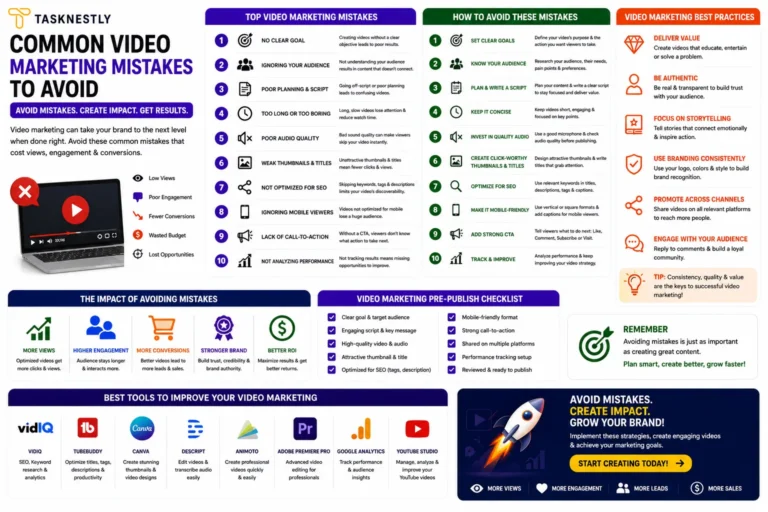
The most common mistake brands make with video marketing is producing content before they have a strategy. Effective video marketing strategies begin with planning — defining your audience, your goals, your content pillars, and your distribution channels before a single frame is captured. A clear video content marketing strategy produces better content and better results because every creative decision has a strategic rationale rather than relying on inspiration or trend-chasing.
Define Your Video Marketing Goals
Your video marketing strategies should be anchored to specific, measurable business goals. Video marketing for brand awareness requires different content types, distribution channels, and success metrics than video marketing strategies designed to generate leads, convert prospects, or retain existing customers. Common video marketing goals include increasing brand awareness (measured by reach and impressions), driving website traffic (measured by click-through from video to site), generating leads (measured by enquiries attributed to video content), and driving direct sales (measured by revenue attributed to video).
Identify Your Video Content Pillars
A video content marketing strategy built around clearly defined content pillars produces more coherent, more searchable, and more compelling content than one that creates individual videos without an overarching theme structure. Content pillars for video marketing strategies might include educational content (how-to guides, explainers, tips series), social proof (customer testimonials, case study walkthroughs, before-and-after reveals), brand storytelling (founder story, team culture, behind-the-scenes), and promotional content (product demos, service overviews, offer announcements).
Ready To Actually Go Viral?
Strategy gets you started — execution gets you views. Tasknestly’s viral video service handles the full production and distribution.
Get Viral Video Services →Best Video Marketing Strategies by Platform
Video marketing strategies need to be platform-native to perform. The video content that succeeds on TikTok is fundamentally different from what succeeds on LinkedIn, YouTube, or your website. Understanding the video marketing tactics that work on each specific platform is essential for building a cross-platform video strategy that produces results.
Video Marketing Strategies for Instagram and TikTok
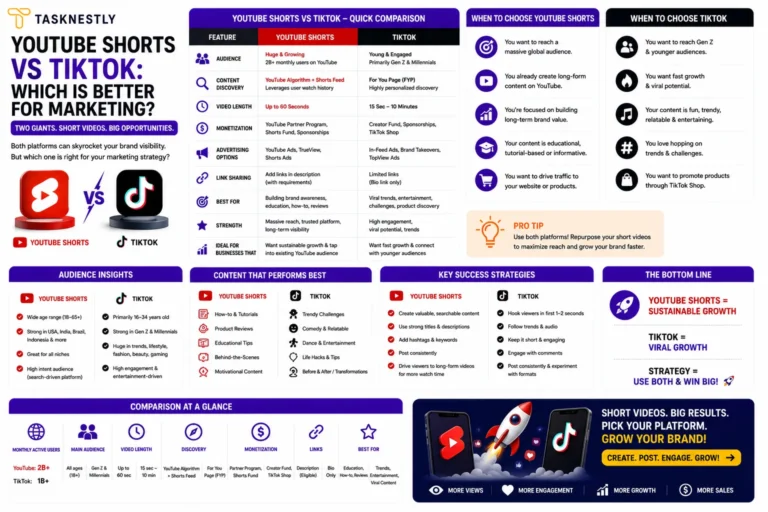
Short-form video is the highest-reach format on both Instagram and TikTok, and the video marketing strategies that work here are built around hooks, authenticity, and value delivery in the first three seconds. Video marketing tips for businesses on these platforms consistently point to one principle: the hook determines everything. A video that fails to capture attention in the first two seconds will not be watched long enough to deliver its message, regardless of how good the rest of the content is.
The strongest video marketing strategies for Instagram and TikTok include: educational tip videos that deliver one highly specific, immediately actionable insight per clip; trend participation that adapts popular formats to your brand’s message; behind-the-scenes content that humanises the brand; and transformation or before-and-after videos that make the value of your product or service immediately visible and emotionally compelling.
Video Marketing Strategies for LinkedIn
LinkedIn video marketing strategies require a different register — more professional, more insight-led, and more focused on thought leadership than entertainment. The video marketing tactics that drive the strongest results on LinkedIn include: expert opinion pieces that take a clear position on an industry debate; case study walkthroughs that demonstrate measurable client results; founder and leadership stories that build personal brand alongside company brand; and educational series that position the brand as a subject matter authority.
LinkedIn video is not subject to the same viral reach dynamics as TikTok or Instagram — it distributes primarily through professional networks and comment engagement. Video marketing strategies for LinkedIn therefore prioritise sparking professional debate and generating substantive comments, which are the engagement signals that drive LinkedIn’s algorithm to distribute content more widely.
Video Marketing Strategies for YouTube
YouTube requires a longer-term, more search-driven video content marketing strategy than any other platform. YouTube is the world’s second-largest search engine — which means video marketing strategies for YouTube are built around the same keyword research and search intent principles as SEO content strategy, not social media content strategy. Every YouTube video should be built around a specific search query your target audience is asking, with the video title, description, and thumbnail optimised to earn the click from search results and suggested videos. For independent reviews of the best YouTube analytics and video marketing tools available in 2026, TechBothQ covers the leading platforms with detailed comparisons.
Ready to build video marketing strategies that drive real brand growth? Tasknestly’s social media management specialists develop and execute video marketing strategies across every platform, from short-form social content to long-form YouTube series. Request your free quote.
Ready To Actually Go Viral?
Strategy gets you started — execution gets you views. Tasknestly’s viral video service handles the full production and distribution.
Get Viral Video Services →How to Use Video Marketing for Brand Growth: Key Tactics
Beyond platform-specific video marketing strategies, several tactics apply across every video channel and consistently produce stronger brand growth outcomes when incorporated into your video marketing approach.
Consistency Is the Foundation of Every Video Marketing Strategy
The most important of all video marketing tips for businesses is posting consistency. A video marketing strategy that produces one exceptional video per month will underperform one that produces good videos every week — because consistency builds algorithmic momentum, audience habit, and brand familiarity that occasional exceptional content cannot replicate. Set a realistic video posting frequency for each platform you are active on and commit to it for at least 90 days before evaluating results. The compounding effect of consistent video marketing strategies is the most reliable path to sustainable brand growth.
Repurpose Every Video Across Formats
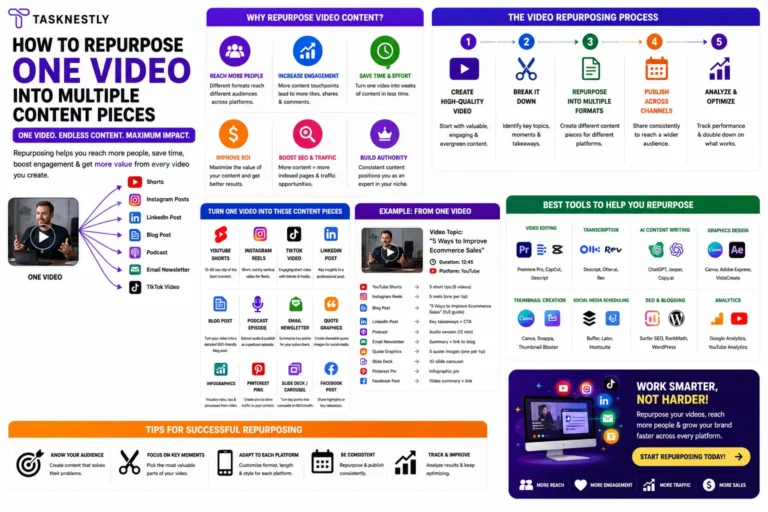
Efficient video marketing strategies extract maximum value from every piece of video content by repurposing it across multiple formats and platforms. A 20-minute YouTube video can generate three to five short-form clips for TikTok and Reels. A LinkedIn video can be transcribed into a long-form blog post. A testimonial video can be cut into multiple quote clips for social media. Repurposing as part of your video marketing strategy gives you significantly more content output for the same production investment.
Use Video Marketing for Every Stage of the Customer Journey
Effective video marketing strategies map content to the full customer journey — not just the awareness stage. Top-of-funnel video content should attract new audiences through entertainment, education, or inspiration. Middle-of-funnel video should build trust through case studies, demonstrations, and in-depth educational series. Bottom-of-funnel video should convert through testimonials, product walkthroughs, and FAQ responses that address the final objections standing between a prospect and a purchase. Building video marketing strategies that cover all three stages creates a comprehensive conversion system that works through the full buying cycle.
Ready To Actually Go Viral?
Strategy gets you started — execution gets you views. Tasknestly’s viral video service handles the full production and distribution.
Get Viral Video Services →Video Marketing for Small Business: Getting Started Without a Big Budget
Video marketing for small business does not require the resources that large brand productions demand. These are the most practical video marketing strategies for businesses with limited budgets and time.
Start with what you have. A modern smartphone produces video quality that exceeded professional camera standards just five years ago. Invest in a ring light (under £30), a simple phone tripod (under £20), and a lapel microphone (under £40) and your production setup is complete. These minimal investments remove the biggest quality barriers in small business video marketing without the cost of professional equipment.
Batch your video production. Filming five to ten videos in a single two-hour session and scheduling them over the following weeks is one of the most time-efficient video marketing strategies for small business owners who cannot dedicate daily time to content creation. Prepare your topics, set up your filming environment once, and capture multiple videos in sequence — this approach makes consistent video marketing strategies sustainable for solo operators and small teams.
Combine Tasknestly’s digital marketing services with our viral video production capabilities and your video marketing strategies are supported by both creative production expertise and the distribution strategy needed to make that content reach the right audiences. For ecommerce businesses, integrating video marketing strategies with professional ecommerce solutions turns product videos, unboxing content, and customer testimonials into direct revenue drivers.
Ready To Actually Go Viral?
Strategy gets you started — execution gets you views. Tasknestly’s viral video service handles the full production and distribution.
Get Viral Video Services →Video Marketing Strategies for Paid Advertising
Organic video marketing strategies build brand authority and audience over time — but paid video advertising accelerates results when you need faster reach or want to amplify content that is already performing well organically. Paid video marketing strategies operate on the same creative principles as organic video but with targeting precision and budget control that organic channels cannot replicate.
Meta (Facebook and Instagram) video ads are among the most effective paid video marketing strategies for reaching defined audience segments with precision. The targeting capabilities — interest, behaviour, lookalike, and retargeting audiences — combined with the visual impact of video make Meta video ads one of the highest-return paid channels for most consumer-facing brands. The most effective paid video marketing strategies on Meta use short, hook-driven videos (under 15 seconds for awareness, under 60 seconds for consideration) with captions for sound-off viewing and a single, clear call to action.
YouTube pre-roll ads are a powerful video marketing tactic for reaching high-intent audiences at the moment they are searching for topics related to your product or service. A viewer searching for “how to choose an accounting firm” who is then shown a 15-second video from your accounting practice is seeing your brand at a highly relevant moment — which makes YouTube pre-roll one of the most intent-aligned paid video marketing strategies available. The skippable ad format (where viewers can skip after 5 seconds) means you only pay when someone chooses to watch — an inherently qualified engagement signal.
Connected TV (CTV) and streaming platform video ads are an emerging paid video marketing tactic gaining traction with brands targeting premium audiences who have moved away from traditional broadcast television. Platforms like YouTube TV, Hulu, and various streaming services offer programmatic video advertising that combines the visual impact of television advertising with the targeting precision of digital. For brands with aspirations to build broad consumer awareness alongside their performance video marketing strategies, CTV video advertising represents an increasingly accessible and measurable option.
Top Tools to Help You Execute Your Video Marketing Strategies
- CapCut — Free video editing app with AI-powered captions, templates, and effects built for short-form social media video — ideal for implementing video marketing strategies on Instagram and TikTok.
- VidIQ — YouTube analytics and keyword research tool that helps you build search-driven video marketing strategies for your YouTube channel, identifying the queries your audience is searching for.
- Canva Video — Create branded video intros, outros, and animated graphics to make your video marketing content look polished and on-brand without a professional design background.
Ready To Actually Go Viral?
Strategy gets you started — execution gets you views. Tasknestly’s viral video service handles the full production and distribution.
Get Viral Video Services →Frequently Asked Questions: Video Marketing Strategies
| Question | Answer |
|---|---|
| What are the best video marketing strategies for brand growth? | The most effective video marketing strategies combine platform-native short-form content for reach, educational series for authority building, customer testimonials for trust, and search-optimised YouTube content for long-term organic traffic. Consistency across all of these is what drives compounding brand growth. |
| How do I create a video content marketing strategy from scratch? | Start by defining your goals and target audience. Select the one or two platforms where your audience is most active. Choose three to five content pillars that reflect your expertise. Set a realistic posting frequency. Plan your first month of content and begin production. Review analytics after 60 days and refine. |
| How much does video marketing cost for a small business? | Video marketing for small business can start at near-zero cost using smartphone filming and free editing apps. Professional video production — for higher-end brand content, product videos, or video ad campaigns — starts from a few hundred pounds per video and scales with complexity. |
| Which video platform should I focus on first? | It depends on your audience. TikTok and Instagram Reels are best for consumer-facing brands with younger demographics. LinkedIn video is best for B2B and professional services. YouTube is best for long-form, search-driven educational content. Choose based on where your target customer spends time, not where you personally prefer to consume content. |
| How do I measure whether my video marketing strategies are working? | Track views, watch time completion rate, engagement rate (comments, shares, saves), follower growth per video, website traffic from video, and enquiries or sales attributed to video content. Completion rate and shares are the most meaningful performance indicators for content quality. |
| How often should I post video content? | For Instagram Reels and TikTok, three to five times per week is optimal for growth. For LinkedIn, two to three times per week is effective. For YouTube, one to two videos per week is the standard for consistent channel growth. Always prioritise the frequency you can sustain with genuine quality. |
| Can video marketing strategies work for B2B businesses? | Absolutely. Video marketing strategies for B2B include LinkedIn thought leadership videos, educational webinars, case study walkthroughs, product demos, and explainer animations. B2B video marketing often requires more patience than B2C — trust builds more slowly — but delivers high-quality leads when the content demonstrates genuine expertise. |
Ready To Actually Go Viral?
Strategy gets you started — execution gets you views. Tasknestly’s viral video service handles the full production and distribution.
Get Viral Video Services →Conclusion: Build Video Marketing Strategies That Compound Over Time
The video marketing strategies that produce the greatest brand growth are not those that chase viral moments — they are those that show up consistently, deliver genuine value, and build the kind of audience trust and algorithmic momentum that compounds over months and years. Starting your video marketing strategy is always more important than starting it perfectly.
Choose your primary platform based on where your audience is. Invest in a basic production setup — lighting, tripod, and microphone — that removes the most common quality barriers without requiring professional equipment. Define your content pillars based on your expertise and their needs. Set a posting frequency you can genuinely sustain. Film your first five to ten videos in a single session, publish them consistently over the following weeks, and use the analytics to learn what your audience responds to. Do not wait until your videos are perfect — the learning you gain from publishing imperfect early content is more valuable than the polish you might achieve by waiting indefinitely. These video marketing strategies do not require perfection or large budgets — they require commitment, curiosity, and the patience to let the compounding effects of consistent video content production build over time.
If you want expert support building and executing video marketing strategies for your brand — from content planning and production to distribution and performance reporting — Tasknestly’s social media and video specialists are ready. Get your free quote today and let us build the video marketing strategy your brand needs to grow in 2026.
Ready To Actually Go Viral?
Strategy gets you started — execution gets you views. Tasknestly’s viral video service handles the full production and distribution.
Get Viral Video Services →Grow With Tasknestly
Subscribe to the Tasknestly newsletter and get the latest tips on websites, SEO, social media, and digital growth.