
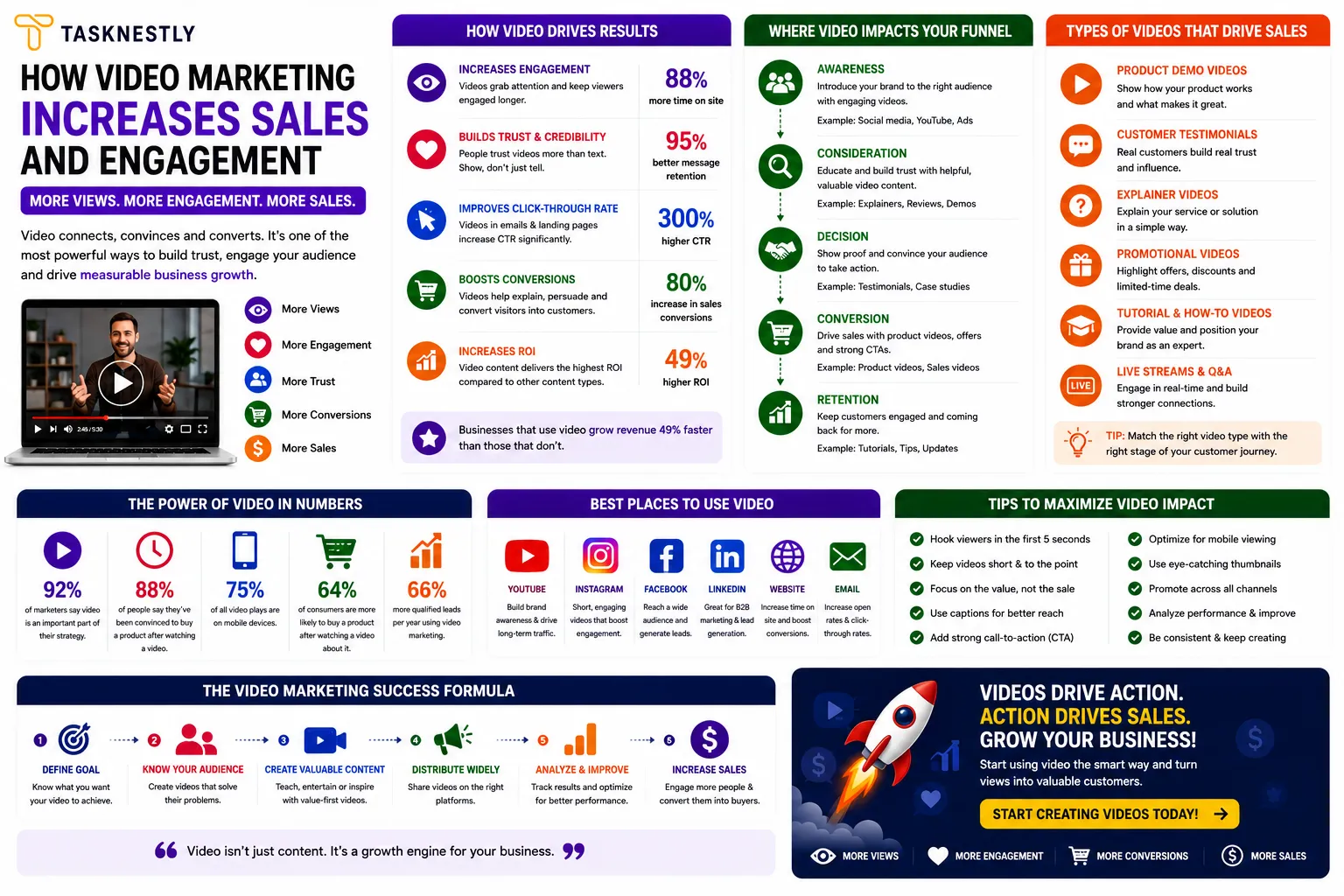
Short-form and long-form video is the most commercially powerful content format available to businesses in 2026 — and the data behind this claim is consistent, cross-industry, and growing stronger every year. Wyzowl’s State of Video report found that 87% of marketers say video marketing has delivered a positive ROI. HubSpot’s research identifies this as the highest-ROI content format in social media for the third consecutive year. And businesses that invest consistently in this format report stronger brand awareness, better lead quality, higher conversion rates, and shorter sales cycles than those that do not invest in video content.
Understanding how it increases sales and engagement requires looking beyond the surface-level argument that “video is more engaging than text.” The commercial mechanisms through which video marketing drives business outcomes are specific, measurable, and learnable — and building a strategy around these mechanisms produces consistently better results than simply producing video content and hoping audiences respond.
This guide covers exactly how it increases sales and engagement, the specific formats that drive the most commercial impact, and how to build a strategy that connects directly to revenue rather than simply generating views and followers.
Want a video marketing strategy built specifically for your business? Tasknestly’s viral video specialists and social media team build video marketing strategies that drive real sales and engagement. Get your free quote today.
Ready To Actually Go Viral?
Strategy gets you started — execution gets you views. Tasknestly’s viral video service handles the full production and distribution.
Get Viral Video Services →Table of Contents
How Video Marketing Works: The Core Commercial Mechanisms
This format increases sales through several distinct mechanisms that operate at different stages of the customer journey. Understanding these mechanisms helps you build a strategy that targets the specific commercial outcomes you need rather than producing video content without a clear theory of impact.
Video Marketing Builds Trust Faster Than Any Other Format
Trust is the prerequisite for any commercial transaction — and video builds trust at a speed and depth that no other content format can match. When a potential customer watches a video of your team, your founder, your process, or your satisfied clients, they form judgements about your credibility, competence, and values in seconds. These judgements would take multiple text-based interactions to establish. It accelerates the trust-building process dramatically — which directly shortens sales cycles and increases conversion rates from prospects who would otherwise need more time and touchpoints before committing.
Research by Forrester found that a single minute of video marketing content communicates the equivalent of 1.8 million words of text in terms of information density and emotional impact. For businesses selling complex services or high-consideration products, this emotional and informational compression makes video uniquely effective at moving prospects through the awareness and consideration stages of the customer journey at a faster rate than any comparable format. The trust that video builds in a two-minute watch would take weeks of email sequences, multiple blog posts, and several social media interactions to establish through text alone — and the prospects who arrive at a sales conversation having watched your videos are measurably more qualified and easier to convert than those who found you through text-only channels.
Video Marketing Demonstrates Value Visually
One of the most direct commercial mechanisms is product demonstration through video. Showing your product in real-world use, demonstrating the before-and-after transformation it enables, or walking a prospect through the service delivery process communicates value in a way that written descriptions and static images simply cannot. Video marketing removes the imagination gap that exists in text-based marketing — the prospect does not need to picture how your product works because they can see it working. This visual demonstration reduces purchase hesitation and objection significantly, particularly for products or services where the proof of value is visible.
For ecommerce businesses, video marketing on product pages has been shown to increase conversion rates by 80% in numerous studies. For service businesses, video marketing case studies and testimonials consistently produce stronger purchase intent than text-based equivalents. The visual proof this format provides is one of its most commercially powerful attributes.
Ready To Actually Go Viral?
Strategy gets you started — execution gets you views. Tasknestly’s viral video service handles the full production and distribution.
Get Viral Video Services →Video Marketing Strategy: Formats That Drive the Most Sales
Not all video marketing formats drive equal commercial outcomes. Understanding which formats produce the strongest results at each stage of the customer journey allows you to build a targeted strategy that maximises return on your production investment.
Product Demo Videos
Product demonstration videos are one of the highest-converting formats available. A well-produced product demo shows the product working as advertised, demonstrates the specific feature that solves the viewer’s problem, and frames every capability in terms of the customer outcome it enables rather than the technical specification. Product demo content should be concise — under two minutes — and focused on the single most important value proposition rather than trying to cover every feature.
Customer Testimonial Videos
Customer testimonial videos are the most trust-generating format available. A real customer talking about the specific problem they had, how your business solved it, and what the measurable outcome was will convert a hesitant prospect more effectively than almost any other video marketing content. The most effective testimonial video marketing content focuses on specific, measurable results rather than generic praise — and the more specific the outcome (a percentage improvement, a time saved, a revenue increase), the stronger the conversion impact.
Explainer and Educational Videos
Educational content in video format builds the authority and trust that makes prospects choose you over competitors when they are ready to buy. How-to guides, industry explainers, and tutorial videos that genuinely help your target audience solve problems position your brand as the expert in your field — and the brand that taught you something is the brand you trust when you need a professional or a product. A strategy that incorporates consistent educational video content creates a library of trust-building assets that grow in value over time.
Social Proof and UGC Videos
User-generated content (UGC) videos — customer-created content showing your product or service in real use — are one of the most powerful and most cost-effective video marketing formats available for ecommerce and consumer brands. UGC video content converts at high rates because it is perceived as unbiased and authentic. Encouraging customers to create and share video marketing content featuring your brand amplifies your reach while simultaneously producing the social proof that persuades new customers to buy. This type of content is often the most cost-effective addition to any video content plan — and it creates a virtuous cycle where happy customers produce content that attracts new customers who become equally happy advocates.
| Video Marketing Format | Funnel Stage | Primary Commercial Outcome | Avg. Conversion Impact |
|---|---|---|---|
| Brand story video | Awareness | Trust building | High (long-term) |
| Educational tutorial | Awareness / Consideration | Authority & SEO | Medium |
| Product demonstration | Consideration / Decision | Purchase intent | Very High |
| Customer testimonial | Decision | Conversion | Very High |
| UGC / social proof | Decision | Purchase confidence | High |
| FAQ / objection handling | Decision | Conversion rate | High |
| Post-purchase / onboarding | Retention | LTV & referrals | Medium-High |
Want video marketing content that converts browsers into buyers? Tasknestly’s digital marketing team builds complete video marketing strategies that serve every stage of the customer journey. Request your free quote.
Ready To Actually Go Viral?
Strategy gets you started — execution gets you views. Tasknestly’s viral video service handles the full production and distribution.
Get Viral Video Services →Video Marketing for Small Business: Getting Disproportionate Returns
Video marketing for small business is one of the most accessible and highest-return marketing investments available — and the barriers to producing effective video marketing content have dropped dramatically with the rise of smartphone cameras and AI editing tools.
The video marketing benefits for small businesses are particularly pronounced in competitive local or niche markets where established competitors may have larger advertising budgets but smaller or less engaged social followings. A small business that produces consistent, genuine, high-quality video marketing content on social media — behind-the-scenes content, customer stories, expert tips, founder insights — can build the kind of authentic audience connection and local brand recognition that outperforms traditional advertising spend for a fraction of the cost.
Video marketing for small business also delivers strong SEO benefits. Video marketing content on YouTube generates persistent organic traffic from search for months or years after publication. Video marketing content embedded in blog posts increases dwell time and reduces bounce rate — both of which are positive signals for search ranking. For small businesses trying to compete with larger brands in organic search, video marketing is one of the most effective strategies available.
For independent reviews of the best video marketing tools and platforms available to small businesses in 2026, TechBothQ covers the leading options with detailed comparisons.
Ready To Actually Go Viral?
Strategy gets you started — execution gets you views. Tasknestly’s viral video service handles the full production and distribution.
Get Viral Video Services →How Video Marketing Increases Engagement on Social Media
Video marketing does not just drive direct commercial outcomes — it drives the engagement signals that give your brand better organic reach, wider audience growth, and stronger social proof across every social media platform. Understanding how video marketing drives engagement helps you design video marketing content that maximises both commercial and algorithmic outcomes simultaneously.
Video content generates dramatically higher engagement rates than static content on every major platform. Instagram video content receives three times higher engagement than image posts on average. LinkedIn video posts generate five times more engagement than text-based posts. TikTok’s entire discovery mechanism is built around video marketing content. YouTube is a search engine powered entirely by video. This engagement advantage over other formats is structural — baked into platform algorithms — which means every piece of content enjoys a distribution advantage before a single viewer has engaged with it.
The engagement signals that video generates — comments, shares, saves, re-watches — are also the most commercially meaningful engagement signals available. A share tells the platform your content was valuable enough to pass on. A save tells it your content was worth returning to. A comment indicates your video sparked genuine emotional or intellectual response. These signals build the algorithmic momentum that gives each subsequent piece of content broader initial distribution — creating a compounding engagement benefit that grows the more consistently you publish video content. This is why brands that have maintained a consistent video publishing cadence for 12 or more months consistently outperform newer video adopters in both organic reach and commercial outcomes — the algorithm has learned to trust their content, and the audience has developed the habit of engaging with it.
Ready To Actually Go Viral?
Strategy gets you started — execution gets you views. Tasknestly’s viral video service handles the full production and distribution.
Get Viral Video Services →Video Content Marketing Tips: Making Every Video Work Harder
The most effective strategies treat each piece of video content as a multi-purpose asset rather than a one-off post. These video content marketing tips ensure your video marketing investment generates value across multiple channels and over an extended period.
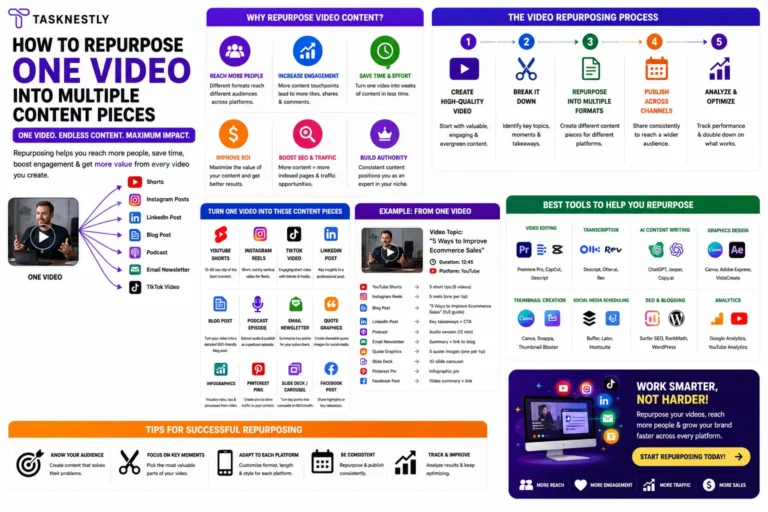
Repurpose every video piece across formats and platforms. A three-minute YouTube tutorial can generate five short-form clips for TikTok and Reels, a transcribed blog post for SEO, a quote graphic for LinkedIn, and a section for an email newsletter. The content you produce should generate significantly more output than the single platform where it was originally published.
Embed video marketing content on your key website pages. Pages with embedded video marketing content have significantly higher dwell times, lower bounce rates, and stronger conversion rates than equivalent pages without video. Your homepage, service pages, and high-traffic blog posts should all include relevant video content to improve both user experience and SEO performance.
Combine your video marketing strategy with Tasknestly’s website development services to ensure your video marketing content is embedded and displayed optimally across your digital presence. For ecommerce businesses, integrating video content into product pages and checkout flows through Tasknestly’s ecommerce solutions is one of the most direct paths to measurable revenue improvement from your video investment.
Ready To Actually Go Viral?
Strategy gets you started — execution gets you views. Tasknestly’s viral video service handles the full production and distribution.
Get Viral Video Services →The SEO Benefits of Video Marketing in 2026
One of the most underappreciated dimensions of video content in business marketing is its compound SEO impact. Embedding video on your website pages — particularly service pages, homepage, and high-traffic blog posts — creates measurable improvements across multiple SEO signals simultaneously.
Pages with embedded video have significantly higher average session duration than equivalent pages without video. Longer sessions signal to Google that your content is satisfying the visitor’s search intent — which is one of the most important quality indicators Google uses to determine ranking position. For businesses competing for high-value keywords, the dwell time improvement from embedded video can meaningfully improve rankings without any additional link building or content creation.
YouTube is also the world’s second-largest search engine — which means a business with a consistent YouTube presence is essentially running two separate organic search strategies simultaneously: one on Google and one on YouTube. Content that addresses specific search queries in video format, with well-optimised titles and descriptions, can generate discovery from YouTube search in addition to Google — giving each piece of content multiple organic traffic channels from a single production investment.
Video content also earns backlinks at a higher rate than most other content formats. When your video tutorial, explainer, or case study is genuinely useful, other websites reference and link to it naturally — generating the high-quality inbound links that are the most powerful SEO ranking signal available. A single high-performing video can generate backlinks that would take months of active link-building outreach to replicate through conventional SEO tactics.
For businesses building their organic presence through SEO, combining a consistent video content strategy with Tasknestly’s SEO services creates a compounding advantage that grows in value with every piece of content produced and every link earned through video-driven authority.
Top Video Marketing Formats for Increasing Sales and Engagement
- Customer testimonial videos — The highest-trust, highest-converting video marketing format. Film one per month featuring a real client with a specific, measurable outcome.
- Product demonstration videos — Show your product or service in real use. Keep under two minutes and focus on the single most important value proposition.
- Educational tip series — Weekly video marketing content that builds authority and drives organic search traffic while keeping your audience engaged between promotional posts.
Ready To Actually Go Viral?
Strategy gets you started — execution gets you views. Tasknestly’s viral video service handles the full production and distribution.
Get Viral Video Services →Frequently Asked Questions: Video Marketing
| Question | Answer |
|---|---|
| How does video content increase sales? | Video increases sales by building trust faster than text, demonstrating product value visually, reducing purchase objections through testimonials, and increasing conversion rates on landing pages and product pages where it is embedded. |
| What are the biggest benefits of video for businesses? | The key benefits include higher engagement rates than any other content format, faster trust building with prospects, stronger SEO performance, better social media algorithmic reach, and higher conversion rates on pages with embedded video. |
| How much does video content cost for a small business? | Video content for small business can start at near-zero cost using smartphone filming and free editing tools. Professional video marketing production starts from a few hundred pounds per video. The ROI consistently exceeds production cost for most business types. |
| Which video format converts best? | Customer testimonial videos and product demonstration videos consistently produce the highest direct conversion rates of any video format. Educational video marketing content produces the strongest long-term authority and organic traffic outcomes. |
| How do I measure video content ROI? | Track video views, completion rates, and engagement as reach metrics. Track website traffic from video, lead enquiries attributed to video content, and sales closed from video-influenced prospects as commercial metrics. The ratio of commercial outcomes to production cost is your video marketing ROI. |
| How often should I post video content? | For social media, three to five video posts per week on your primary platform is optimal for consistent audience growth. For YouTube, one to two videos per week is the standard for channel growth. Consistency matters more than volume. |
| Is video content worth it for B2B businesses? | Yes. Video content for B2B produces strong results through LinkedIn thought leadership videos, YouTube educational content, website explainer videos, and client testimonial videos. B2B video marketing builds the expertise trust that drives high-value service sales. |
Ready To Actually Go Viral?
Strategy gets you started — execution gets you views. Tasknestly’s viral video service handles the full production and distribution.
Get Viral Video Services →Conclusion: Video Marketing Is the Highest-ROI Content Investment in 2026
This content format has earned its position as the most commercially effective available to businesses through consistent, measurable proof across industries, business sizes, and customer types. The key benefits — trust building, visual demonstration, engagement amplification, SEO performance, conversion rate improvement — compound over time as your content library grows and your algorithmic presence strengthens.
A strategy that starts with your most commercial use cases — product demos, customer testimonials, and educational content — and builds from there will consistently outperform a scattered approach to video content creation. Define your three primary video formats, establish a realistic production schedule you can sustain for at least 90 days, and measure results against commercial metrics — enquiries generated, conversion rate improvements, organic traffic growth — rather than vanity metrics like raw view counts. Treat every video content investment as an asset that generates returns over its lifetime, not a one-time expense that produces a single metric.
If you want expert help building and executing a content strategy built around video that drives real sales and engagement growth for your business, Tasknestly’s video specialists are ready to design, produce, and distribute the right content for your audience. Get your free quote today and let us build the engine your business needs to grow through video in 2026.
Ready To Actually Go Viral?
Strategy gets you started — execution gets you views. Tasknestly’s viral video service handles the full production and distribution.
Get Viral Video Services →Grow With Tasknestly
Subscribe to the Tasknestly newsletter and get the latest tips on websites, SEO, social media, and digital growth.