
Choosing the right payment gateways for ecommerce is one of the most impactful decisions you will make when building an online store. The gateway you select determines how smoothly customers can check out, how secure their card data stays, how quickly funds reach your bank, and how much you pay in transaction fees every single month. Get it wrong and you will watch conversion rates drop, chargebacks climb, and revenue leak. Get it right and your checkout becomes a competitive advantage.
The 2026 ecommerce landscape is more competitive than ever. Shoppers expect a frictionless payment experience across mobile, desktop, and even social commerce channels. They want to pay with credit cards, digital wallets, buy-now-pay-later options, and sometimes cryptocurrency. That means modern payment gateways for ecommerce must do far more than simply process a Visa or Mastercard transaction. They need to support multiple currencies, integrate with your shopping cart, offer robust fraud detection, and provide developer-friendly APIs for customisation.
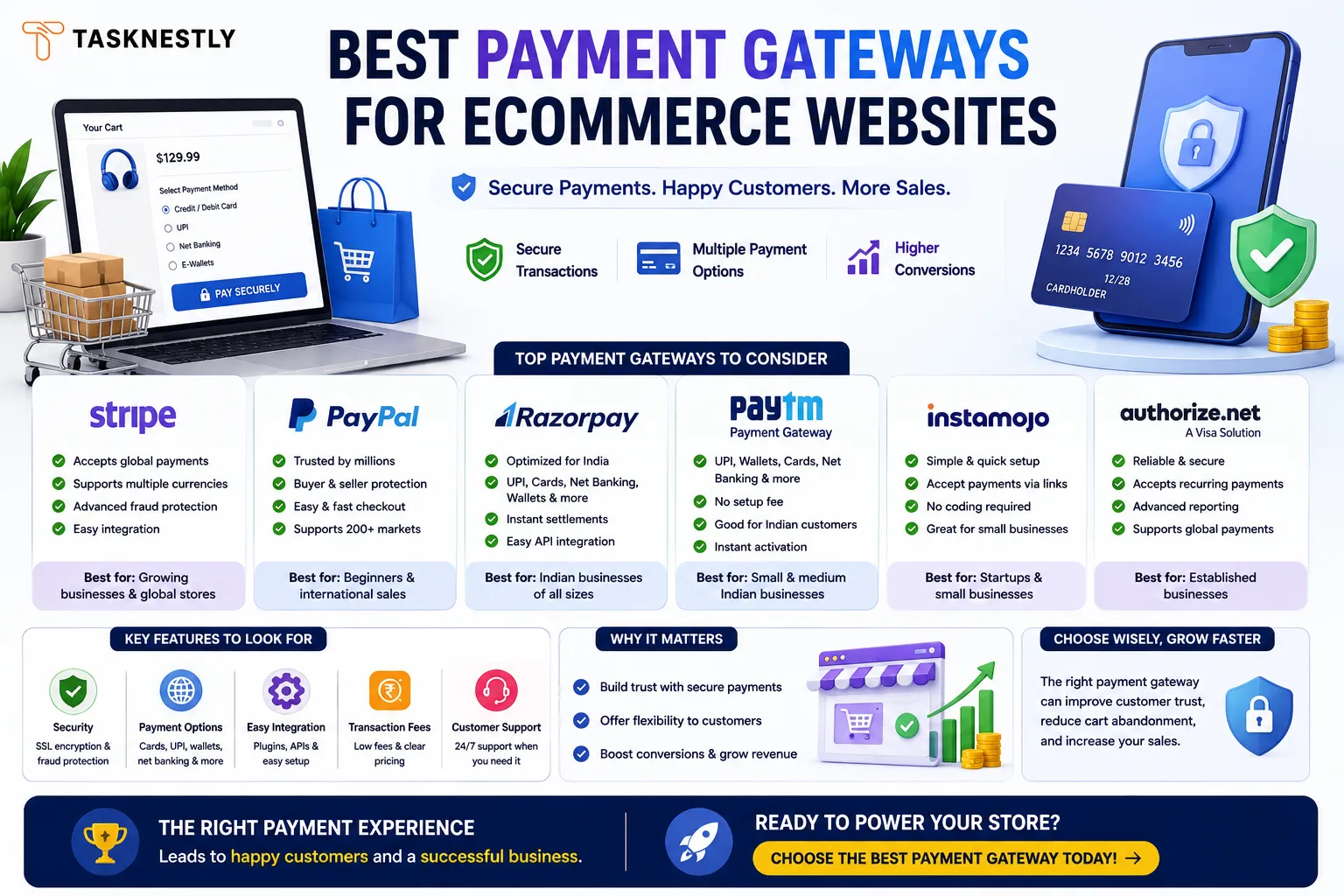
In this guide, we have researched and ranked the ten best payment gateways for ecommerce websites in 2026. For every option you will find a breakdown of pricing, standout features, integration options, and the type of business each solution suits best. Whether you are launching your first Shopify store or scaling a high-volume enterprise operation, this list of payment gateways for ecommerce will help you match the right payment partner to your goals.
| Ready to Launch a High-Converting Ecommerce Store?Tasknestly builds fully optimised ecommerce websites designed to maximise conversions and revenue from day one. From payment gateway integration to UX design and SEO, we handle everything. Explore our ecommerce services or get a free quote today and let us build the store your business deserves. |
Want Your Store To Actually Convert?
Strategy is step one — execution is what moves revenue. Tasknestly builds and optimizes ecommerce stores that convert.
Get Ecommerce Services →Table of Contents
What Are Payment Gateways for Ecommerce and Why Do They Matter?
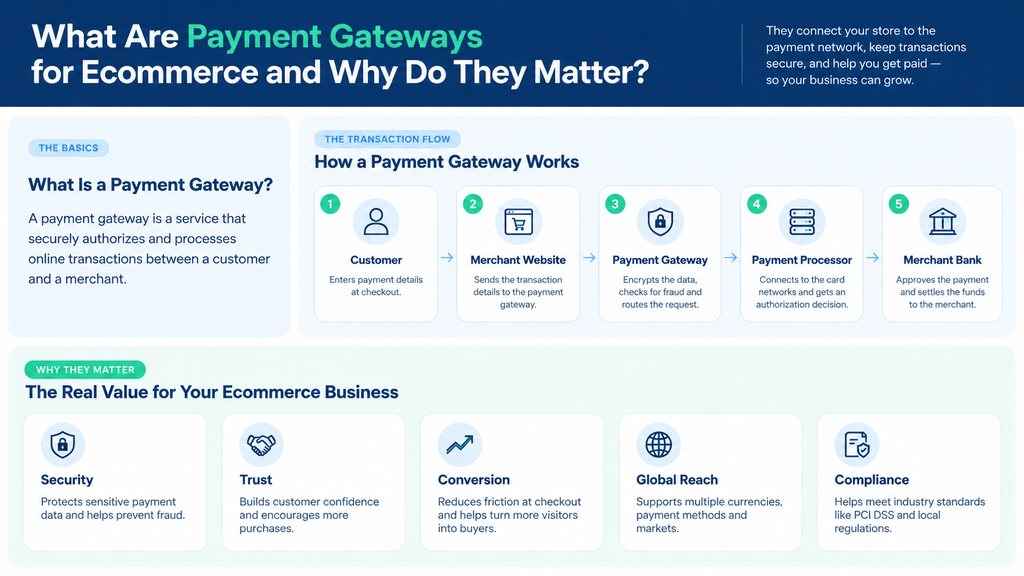
A payment gateway for ecommerce is the technology that authorises and processes card and digital wallet transactions between a customer and your store. When a shopper hits “Buy Now,” the gateway encrypts their payment data, communicates with the acquiring bank and card network, and returns an approval or decline in seconds. Without a reliable gateway, you have no ecommerce business.
The Hidden Cost of a Bad Payment Gateway
Many store owners focus only on the headline transaction fee — typically 1.4% to 3% per sale — without accounting for the broader picture. A slow or unreliable payment gateway for ecommerce can cause checkout abandonment, which costs the average store far more than a slightly higher fee. Studies consistently show that payment friction is among the top three reasons shoppers abandon carts. A gateway that loads slowly, fails on mobile, or lacks local payment methods could be costing you thousands in lost revenue every month.
Key Factors to Evaluate
When comparing payment gateways for ecommerce, look at: transaction fees and monthly costs, supported currencies and countries, integration with your platform (Shopify, WooCommerce, Magento, custom-built), fraud prevention tools, payout speed, PCI compliance level, customer support quality, and whether the gateway supports the specific payment methods your audience expects — such as Apple Pay, Google Pay, or BNPL.
Want Your Store To Actually Convert?
Strategy is step one — execution is what moves revenue. Tasknestly builds and optimizes ecommerce stores that convert.
Get Ecommerce Services →10 Best Payment Gateways for Ecommerce Websites in 2026
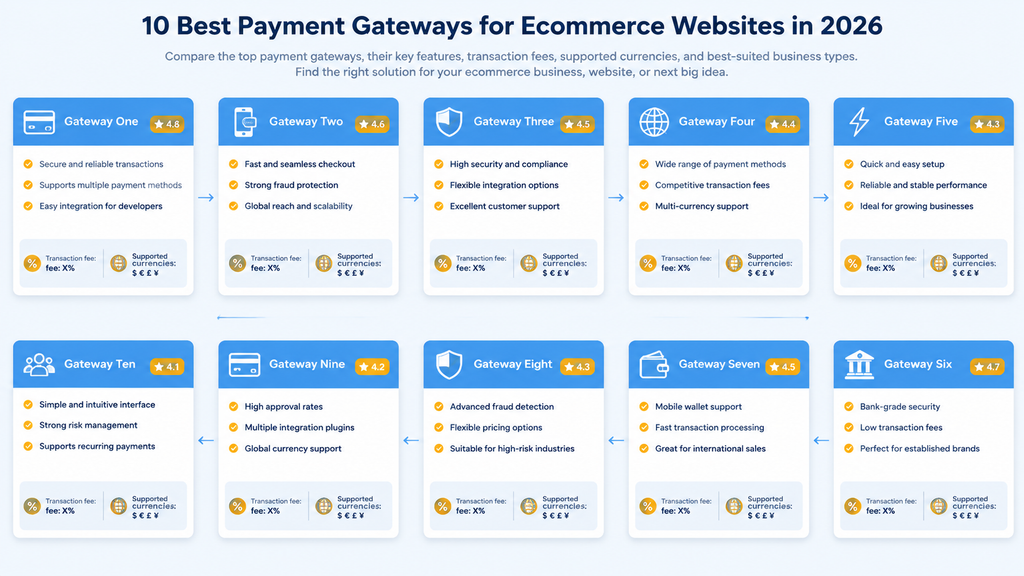
Below are the ten payment gateways for ecommerce that consistently deliver the best combination of reliability, features, and value in 2026.
1. Stripe — Best Overall Payment Gateway for Ecommerce
Stripe remains the gold standard for payment gateways for ecommerce, particularly for businesses that want full control over the checkout experience. Its API is among the cleanest in the industry, and its feature set covers everything from one-time transactions to subscription billing, marketplace payouts, fraud detection with Stripe Radar, and support for over 135 currencies.
Stripe charges 2.9% + 30 cents per successful card charge in the United States, with no monthly fees on the standard plan. For high-volume merchants, negotiated rates are available. The Dashboard is intuitive, real-time reporting is excellent, and Stripe’s no-code options — such as Payment Links and hosted Checkout — mean even non-developers can get started quickly.
Stripe integrates natively with Shopify, WooCommerce, BigCommerce, Magento, and virtually every major ecommerce platform, one of the widest ranges among payment gateways for ecommerce. It also powers custom-built stores through its comprehensive REST API and pre-built UI components. Stripe is the top choice for tech-forward teams and SaaS businesses as well as product stores.
2. PayPal — Best for Brand Recognition and Buyer Trust
No list of payment gateways for ecommerce is complete without PayPal. With over 430 million active accounts worldwide, PayPal’s logo at checkout can directly increase conversion rates because shoppers already trust it with their financial information. PayPal offers a range of products including PayPal Checkout, Braintree (developer-focused), and Pay Later, which is the company’s own BNPL product.
PayPal’s standard fee is 3.49% + a fixed fee for PayPal button transactions, which is higher than Stripe. However, the conversion lift from displaying the PayPal button often offsets the cost. PayPal also offers seller protection, which is valuable for merchants dealing with high chargeback rates.
3. Square — Best Payment Gateway for Omnichannel Retailers
Square started in physical retail and has built one of the most integrated ecommerce payment gateway experiences for merchants who sell both in-store and online. Square Online is a capable ecommerce platform in its own right, and it integrates seamlessly with Square’s POS hardware. The same inventory, customer records, and reporting flow across all channels.
Square charges 2.9% + 30 cents per online transaction. There are no monthly fees for the basic plan. For businesses that need a single solution covering both physical and digital commerce, Square stands out among payment gateways for ecommerce as the clear omnichannel choice.
4. Shopify Payments — Best for Shopify Store Owners
If your store is on Shopify, Shopify Payments is almost always the best payment gateway choice. It is built directly into the Shopify admin, eliminates the third-party transaction fee Shopify charges when you use an external gateway (0.5% to 2% per sale), and supports Shopify’s accelerated checkout features including Shop Pay.
Transaction rates for Shopify Payments range from 2.9% + 30 cents on Basic to 2.4% + 30 cents on Advanced. The real saving is avoiding Shopify’s additional fee on every sale. For any serious Shopify store, activating Shopify Payments as the primary gateway is a straightforward financial decision.
5. Braintree — Best Payment Gateway for Marketplaces and Platforms
Braintree, a PayPal subsidiary, is one of the most powerful payment gateways for ecommerce platforms and marketplaces that need to split payments between multiple sellers. Its marketplace solution, Braintree Marketplace, handles split payments, escrow, and payout logic natively — features that would otherwise require significant custom development.
Braintree charges 2.59% + 49 cents per transaction with no monthly fee. It supports PayPal, Venmo, Apple Pay, Google Pay, and cards, all through a single API integration. Among payment gateways for ecommerce, developers consistently rate Braintree highly for its documentation and SDK quality.
6. Authorize.Net — Best for Established US Merchants
Authorize.Net has been one of the most trusted payment gateways for ecommerce since 1996. It is now owned by Visa and serves over 400,000 merchants. It charges $25 per month plus 2.9% + 30 cents per transaction, or a transaction-only plan at 10 cents per transaction plus a 10-cent daily batch fee.
Authorize.Net is well-suited for mid-to-large US merchants who want a stable, well-documented gateway with strong fraud prevention, recurring billing, and phone support. It integrates with most major shopping carts and works especially well for merchants using older or custom-built platforms.
7. Adyen — Best Payment Gateway for Enterprise Ecommerce
Adyen is the payment gateway of choice for global enterprise ecommerce brands including ASOS, eBay, Spotify, and McDonald’s. Unlike most payment gateways for ecommerce, Adyen acts as both the payment gateway and the acquirer, which means better data, lower interchange fees on high volumes, and a single contract for global processing.
Adyen’s pricing is interchange-plus, meaning you pay the actual interchange cost plus a small processing markup and a fixed 12 to 15 cents per transaction. Adyen requires a minimum monthly processing volume and is not suitable for small stores. For enterprises, it offers unmatched global reach across 200+ payment methods in 40+ currencies.
8. Klarna — Best for Buy Now Pay Later Ecommerce Integration
Klarna is not a traditional gateway but has become one of the most important payment gateways for ecommerce stores targeting younger shoppers. Klarna’s BNPL options — Pay in 3, Pay in 30, and financing — have been shown to lift average order values significantly, sometimes by 30 to 50%, because shoppers can spread the cost of larger purchases.
Klarna charges merchants a transaction fee similar to standard gateways. The merchant pays slightly more per transaction, but the AOV increase typically delivers a positive ROI. Klarna integrates with Shopify, WooCommerce, BigCommerce, Magento, and most major platforms. It also provides Klarna Checkout, a full hosted checkout experience.
9. 2Checkout (Verifone) — Best for Global Digital Product Sales
2Checkout, now rebranded under Verifone, specialises in global digital commerce. It supports 87 currencies, 15 payment methods, and handles VAT and tax compliance in over 180 countries — a feature set that makes it one of the best payment gateways for ecommerce businesses selling software, subscriptions, or digital downloads internationally.
2Checkout charges 3.5% + 35 cents per transaction on its entry plan. Higher plans reduce the transaction fee and add features such as cart abandonment recovery and advanced subscription management. It also offers a Merchant of Record service, meaning 2Checkout becomes the seller of record for tax purposes, removing compliance complexity from the merchant.
10. Mollie — Best European Payment Gateway for Ecommerce
Mollie has grown rapidly to become one of the leading payment gateways for ecommerce businesses across Europe. It supports all major European payment methods including iDEAL, Bancontact, SOFORT, Giropay, and SEPA Direct Debit alongside cards and PayPal. This makes it the natural first choice for stores targeting Dutch, Belgian, German, and wider European audiences.
Mollie charges pay-as-you-go pricing with no monthly fees — for example, 0.25 euros plus 1.8% for EU consumer cards. The integration options are clean, the Dashboard is one of the friendliest in the industry, and Mollie’s support team is highly responsive. Among payment gateways for ecommerce, Mollie often beats both Stripe and PayPal on total cost of ownership for European merchants.
Want Your Store To Actually Convert?
Strategy is step one — execution is what moves revenue. Tasknestly builds and optimizes ecommerce stores that convert.
Get Ecommerce Services →Payment Gateway Comparison Table for Ecommerce Stores
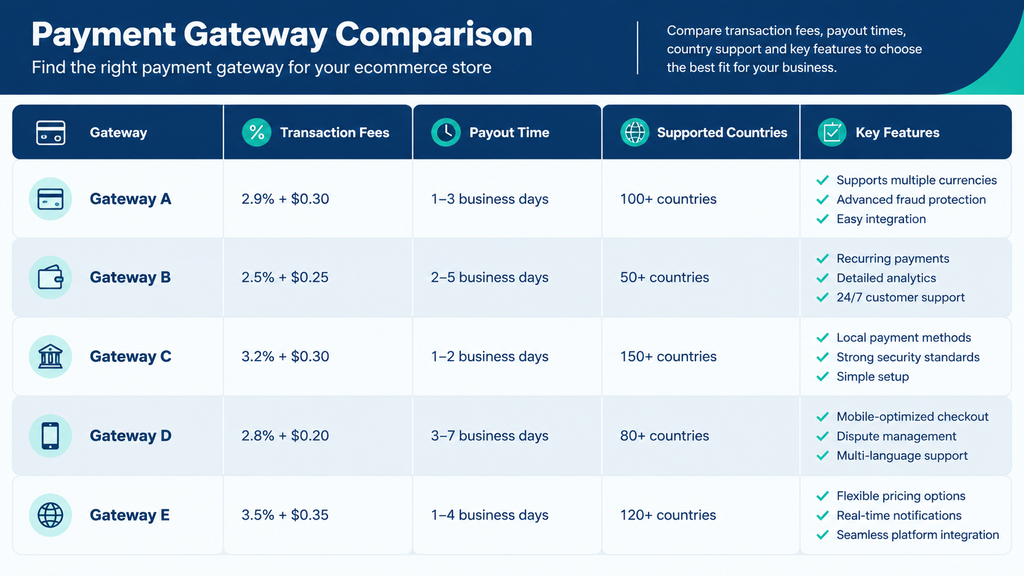
Use this table to compare the ten best payment gateways for ecommerce at a glance.
| Gateway | Tx Fee (US) | Monthly Fee | Best For | Platforms |
| Stripe | 2.9% + 30¢ | None | All-round ecommerce | All major platforms |
| PayPal | 3.49% + fixed | None | Trust & brand recognition | All major platforms |
| Square | 2.9% + 30¢ | None | Omnichannel retail | Square, others |
| Shopify Payments | 2.4–2.9% + 30¢ | None | Shopify stores | Shopify only |
| Braintree | 2.59% + 49¢ | None | Marketplaces | API + most carts |
| Authorize.Net | 2.9% + 30¢ | $25/mo | Established US merchants | Most US carts |
| Adyen | Interchange+ | Minimums apply | Enterprise global | API + major carts |
| Klarna | Similar to std | None | BNPL / AOV boost | All major platforms |
| 2Checkout | 3.5% + 35¢ | None | Digital/global sales | API + plugins |
| Mollie | €0.25 + 1.8% | None | European ecommerce | All major platforms |
Want Your Store To Actually Convert?
Strategy is step one — execution is what moves revenue. Tasknestly builds and optimizes ecommerce stores that convert.
Get Ecommerce Services →How to Choose the Right Payment Gateway for Your Ecommerce Website
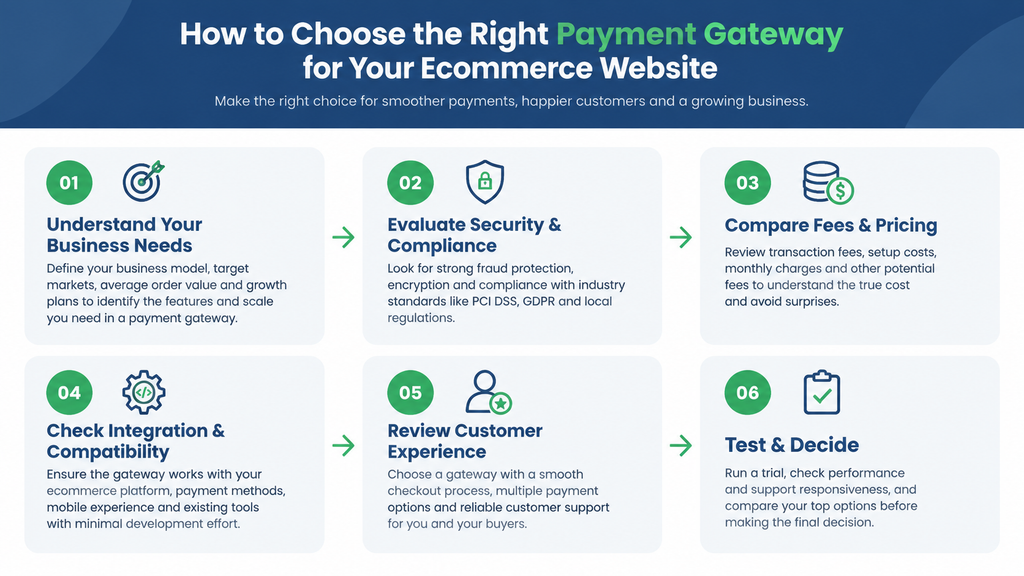
No single gateway wins for every store. The best payment gateway for ecommerce is the one that aligns with your specific platform, target market, product type, and growth plans. Use these criteria to narrow down your shortlist.
Platform Compatibility
Your first filter should be compatibility with your ecommerce platform. Shopify merchants gain the most by using Shopify Payments. WooCommerce store owners get strong value from Stripe and PayPal, both of which have well-maintained official plugins. Magento and BigCommerce users have wide gateway support, so they can prioritise other factors.
Target Geography
Payment preferences vary dramatically by country. US and UK shoppers are comfortable with cards and PayPal. Dutch shoppers expect iDEAL. German shoppers often prefer SOFORT or invoice payment. If you are selling internationally, choose a payment gateway for ecommerce that supports local methods — or you will lose sales at checkout to competitors who do.
Volume and Fee Structure
At low volumes, a pay-as-you-go gateway with no monthly fee (Stripe, PayPal, Mollie) is almost always most cost-efficient. As you grow past $50,000 per month in GMV, the difference between a 2.4% and a 2.9% transaction rate starts to become significant. At enterprise volumes, an interchange-plus gateway like Adyen can save meaningful amounts annually.
If you are unsure which gateway is right for your store, our professional ecommerce website services include full payment setup and integration so you can launch with confidence from day one.
Want Your Store To Actually Convert?
Strategy is step one — execution is what moves revenue. Tasknestly builds and optimizes ecommerce stores that convert.
Get Ecommerce Services →Security and PCI Compliance for Ecommerce Payment Gateways
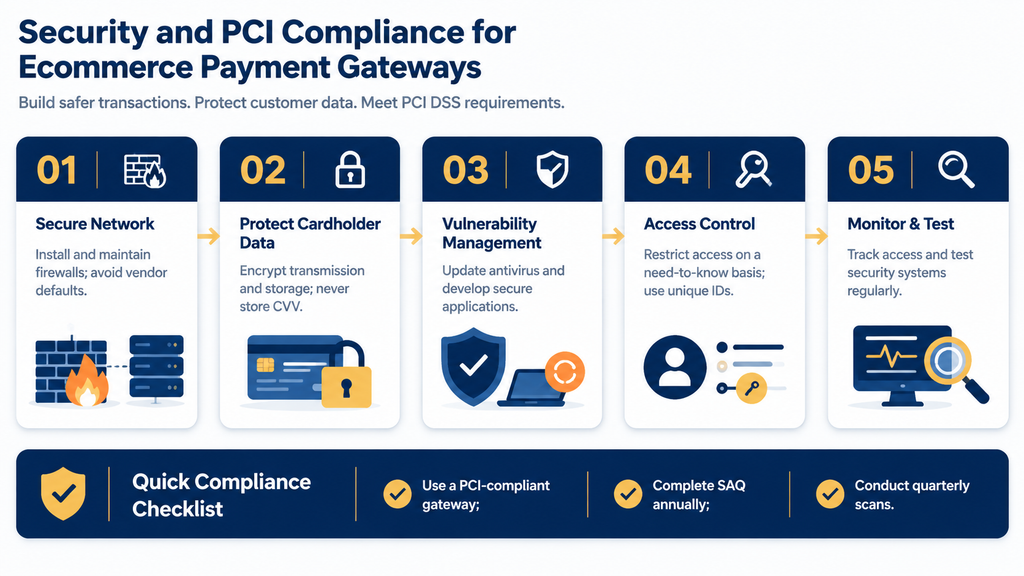
Every payment gateway for ecommerce must meet PCI DSS (Payment Card Industry Data Security Standard) requirements. PCI compliance is not optional — failing to meet the standard exposes you to significant fines and reputational damage if a breach occurs. The good news is that the major payment gateways for ecommerce listed here handle the heavy lifting of PCI compliance for you.
Hosted vs Self-Hosted Gateways
Hosted payment gateways for ecommerce redirect the customer to the provider’s secure page to enter card details (for example, PayPal Standard). This means card data never touches your server, making PCI compliance simpler. Self-hosted or embedded gateways use JavaScript to tokenise card data in the browser before it ever reaches your server — this is how Stripe and Braintree work. Both approaches are secure when implemented correctly.
Fraud Prevention Tools
Look for built-in fraud detection when evaluating payment gateways for ecommerce. Stripe Radar uses machine learning trained on billions of data points across the Stripe network. Braintree’s fraud tools are solid. Authorize.Net offers an Advanced Fraud Detection Suite. For high-risk products, layering a dedicated fraud prevention tool on top of your gateway can reduce chargebacks further.
Want Your Store To Actually Convert?
Strategy is step one — execution is what moves revenue. Tasknestly builds and optimizes ecommerce stores that convert.
Get Ecommerce Services →Integrating Payment Gateways with Popular Ecommerce Platforms
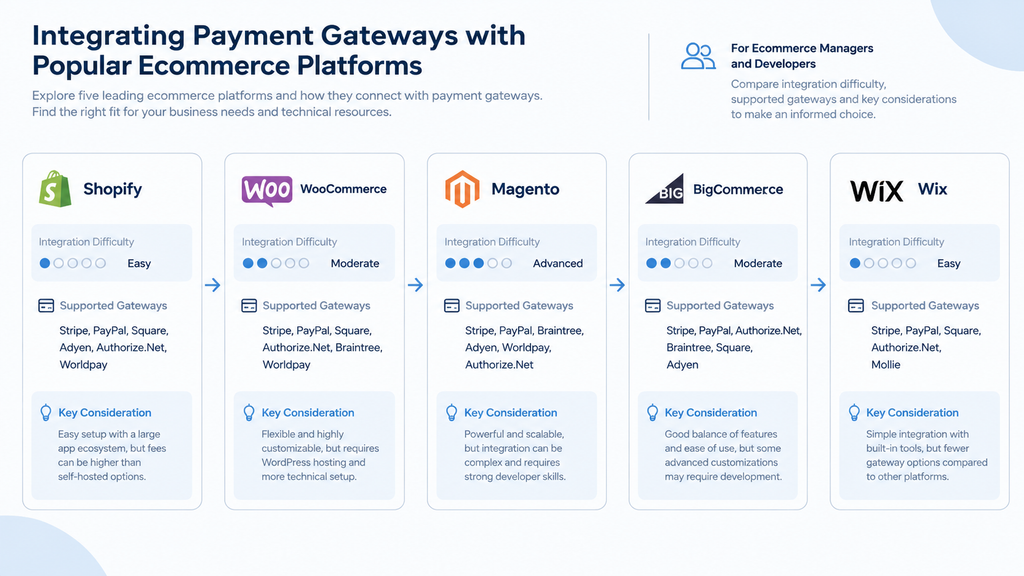
Integration complexity varies significantly between payment gateways for ecommerce. Here is a quick overview for the platforms most of our clients use.
Shopify Payment Gateway Integration
Shopify supports hundreds of payment gateways through its partner programme, but Shopify Payments is the simplest to activate — it takes less than five minutes from the Payments settings page. Third-party gateways like Stripe, PayPal, and Klarna are available as Shopify payment apps and connect with minimal configuration.
WooCommerce Payment Gateway Integration
WooCommerce has official plugins for Stripe (WooCommerce Stripe Payment Gateway), PayPal (PayPal Payments), Square, and many others. Most install via the WordPress plugin directory. For custom integrations or developer-built plugins, Stripe’s WooCommerce plugin is the most actively maintained and feature-rich.
Custom-Built Stores
For bespoke ecommerce builds, the API quality of your chosen payment gateway becomes critical. Stripe leads the industry here with comprehensive documentation, client libraries in every major language, and an exceptional developer experience. Braintree and Adyen are strong alternatives for enterprise custom builds.
If your store needs a custom payment gateway integration, our team at Tasknestly specialises in custom ecommerce development and payment setup. We handle the technical complexity while you focus on your products.
| Need Help Setting Up Your Ecommerce Store’s Payment System?From gateway selection to technical integration, Tasknestly’s ecommerce team has you covered. We build stores on Shopify, WooCommerce, and custom platforms — all optimised to convert. See our digital marketing services or request a free quote to get a tailored plan for your store. |
Want Your Store To Actually Convert?
Strategy is step one — execution is what moves revenue. Tasknestly builds and optimizes ecommerce stores that convert.
Get Ecommerce Services →Payment Gateways for Ecommerce: Fees Explained
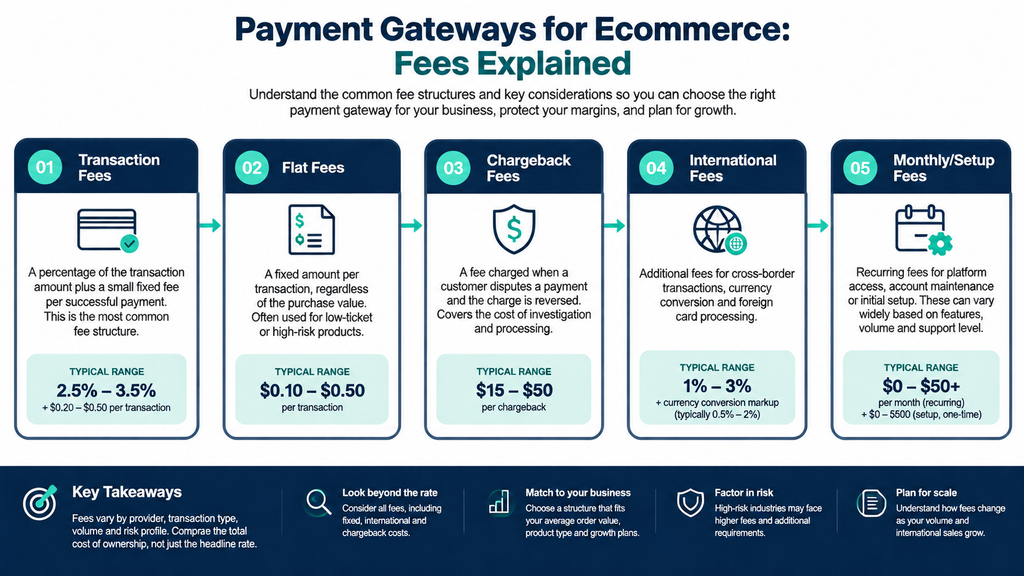
Understanding the true cost of a payment gateway for ecommerce requires looking beyond the headline transaction rate. Here are the fee types you need to account for.
Transaction Fees
This is the percentage plus fixed amount charged per successful sale. It is the most visible cost and the one most commonly compared. What matters is the effective rate after accounting for your average order value — a higher fixed fee hits small orders harder than large ones.
Monthly and Setup Fees
Some payment gateways for ecommerce charge a monthly subscription fee (Authorize.Net charges $25 per month). Others like Stripe and PayPal have no monthly fee but charge a higher per-transaction rate. A monthly fee can make sense if you process enough volume that the lower per-transaction rate more than offsets the fixed cost.
Chargeback Fees
Chargebacks — when a customer disputes a transaction with their bank — typically cost $15 to $25 per incident, regardless of whether the merchant wins the dispute. Choosing a gateway with strong fraud prevention tools is one of the most effective ways to reduce chargeback exposure.
Currency Conversion Fees
If you accept payments in multiple currencies, most gateways charge an additional 1 to 2% for currency conversion on top of the standard transaction fee. For cross-border ecommerce, this can add up significantly. Adyen and Stripe both offer options to settle in the customer’s local currency, which can reduce conversion costs.
Want Your Store To Actually Convert?
Strategy is step one — execution is what moves revenue. Tasknestly builds and optimizes ecommerce stores that convert.
Get Ecommerce Services →Best Payment Gateway for Ecommerce by Business Type
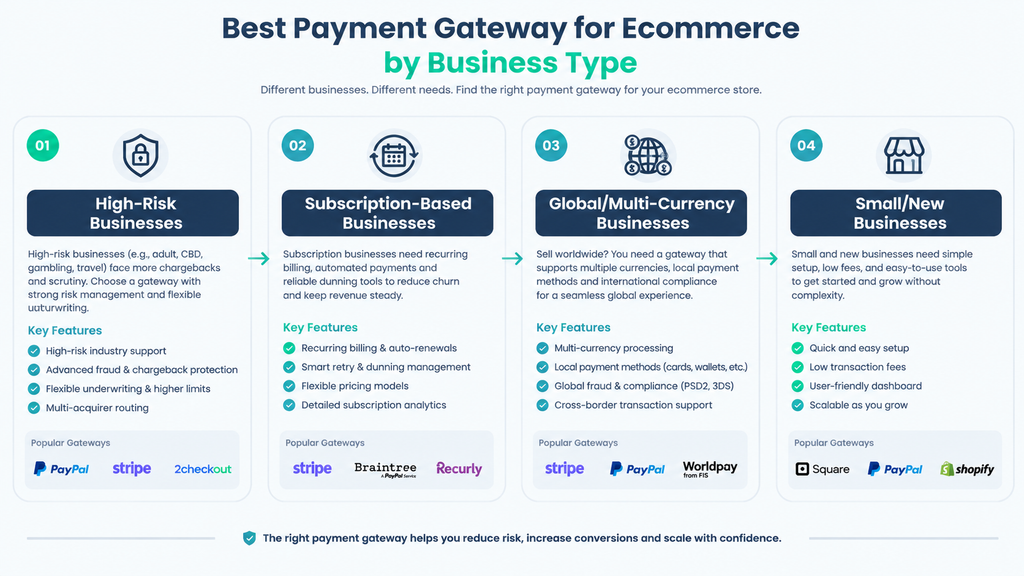
Different business models have different payment gateway needs. Here are our recommendations by business type.
Startups and New Stores
Among payment gateways for ecommerce, Stripe is the default recommendation for startups. No monthly fee, best-in-class API, and easy integration with Shopify, WooCommerce, and custom stacks. Add PayPal as a secondary option to capture shoppers who prefer to pay with their PayPal balance.
Physical + Online Retailers
Square is the standout choice for omnichannel merchants. Its POS hardware, ecommerce integration, and unified inventory make running both channels from one dashboard straightforward. Shopify merchants who also sell in person may prefer Shopify POS + Shopify Payments for the same reason.
Subscription and SaaS Businesses
Stripe Billing is purpose-built for recurring revenue models with support for trials, metered billing, and dunning management. Braintree is a strong alternative and is particularly popular with larger subscription businesses. Both handle the complexity of failed payment retries and subscription lifecycle management natively.
Global Enterprise
Adyen is the clear leader for large global merchants who process significant volumes. Its interchange-plus pricing, single-contract global acquiring, and advanced analytics provide a level of control and insight that no other payment gateway for ecommerce matches at scale.
Choosing the right payment setup is just one part of building a profitable online store. Our ecommerce website and strategy services cover everything from platform selection to post-launch growth.
| Recommended Tools for Ecommerce Store OwnersThese beginner-friendly tools pair well with any payment gateway setup and help you manage and grow your ecommerce business:Tidio — Live chat and AI chatbot platform to reduce cart abandonment and answer payment queries in real time on your store.TaxJar — Automated sales tax calculation and filing for ecommerce stores, supporting compliance across US states and international markets.Gorgias — Customer support helpdesk built for ecommerce, letting your team handle payment disputes, refund requests, and order queries from one inbox. |
Want Your Store To Actually Convert?
Strategy is step one — execution is what moves revenue. Tasknestly builds and optimizes ecommerce stores that convert.
Get Ecommerce Services →Frequently Asked Questions About Payment Gateways for Ecommerce
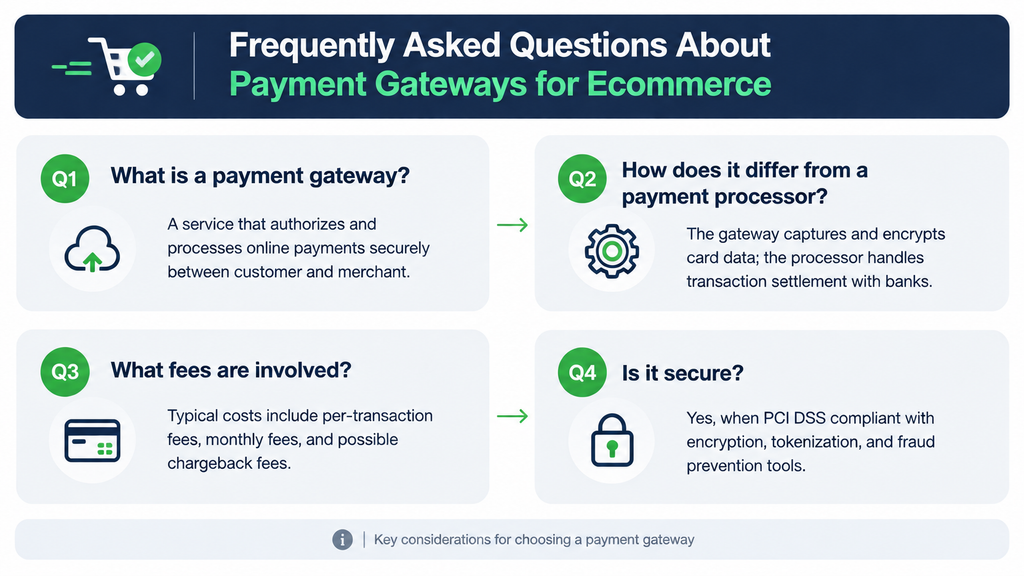
| Question | Answer |
| What is the cheapest payment gateway for ecommerce? | For low-volume stores, Stripe and Square have no monthly fees and competitive rates. For high-volume merchants, Adyen’s interchange-plus pricing typically works out cheaper. Mollie is excellent value for European merchants. |
| Can I use multiple payment gateways for ecommerce on one site? | Yes. Most ecommerce platforms support multiple gateways simultaneously. A common approach is to use Stripe as the primary gateway and PayPal as an alternative, giving shoppers flexibility at checkout. |
| What payment gateway is best for Shopify? | Shopify Payments is the best payment gateway for Shopify stores because it eliminates the additional Shopify transaction fee (0.5 to 2%) that applies when using a third-party gateway. It also enables accelerated checkout via Shop Pay. |
| How long does it take to get paid by a payment gateway? | Standard payout times range from two to seven business days for most gateways. Stripe offers two-day standard payouts and instant payouts (for a 1% fee) to eligible bank accounts. Square settles next business day by default. |
| Do payment gateways support recurring billing for subscriptions? | Stripe Billing, Braintree, Authorize.Net, and 2Checkout all offer robust subscription and recurring billing support. Look for features like trial periods, dunning management, and metered billing if you are building a subscription business. |
| Is PayPal a payment gateway or a payment processor? | PayPal functions as both. For merchants, PayPal acts as the payment gateway (handling the transaction authorisation and customer interface) and the payment processor (moving funds and managing settlement). Braintree, which PayPal owns, is a more developer-focused gateway product. |
| What is PCI compliance and do I need it? | PCI DSS (Payment Card Industry Data Security Standard) is a set of security requirements for businesses that handle card payments. Every ecommerce store that accepts card payments must be PCI compliant. Using a hosted or tokenised payment gateway significantly reduces your PCI compliance burden. |
Want Your Store To Actually Convert?
Strategy is step one — execution is what moves revenue. Tasknestly builds and optimizes ecommerce stores that convert.
Get Ecommerce Services →Conclusion
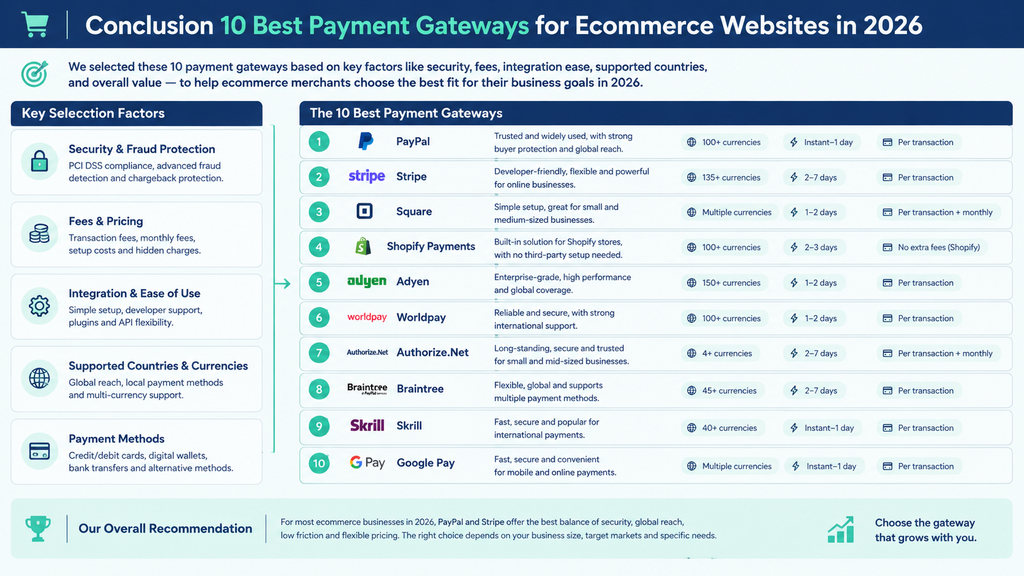
Finding the right payment gateways for ecommerce is one of the highest-leverage optimisations you can make to your online store. A smooth, trustworthy checkout experience reduces abandonment, increases conversions, and builds the kind of customer confidence that drives repeat purchases. Whether you choose Stripe for its developer power, Shopify Payments for its native integration, or Mollie for its European coverage, the right gateway can quietly become one of your store’s biggest assets.
The ten payment gateways for ecommerce reviewed in this guide cover every business type, geography, and budget. Start by matching your platform compatibility and target market, then evaluate fee structures against your expected volume. If you are a small or new store, Stripe or PayPal will serve you well. As you scale, revisit the comparison and consider whether Adyen’s enterprise pricing or Braintree’s marketplace capabilities become relevant to your model.
At Tasknestly, we help ecommerce businesses get every technical detail right — from selecting and integrating the best payment gateway for ecommerce to building the full store, optimising for SEO, and driving traffic that converts. If you are ready to build or improve your online store, get a free quote from our ecommerce team and let us handle the heavy lifting.
Many merchants ask whether they should use hosted or embedded payment gateways for ecommerce checkout pages. Hosted gateways redirect shoppers to the provider’s secure environment, which simplifies PCI compliance but can reduce conversion rates due to the redirect. Embedded gateways keep the shopper on your site while still tokenising card data securely — a setup that typically converts better and feels more professional.
Developers evaluating payment gateways for ecommerce should pay close attention to sandbox environments and testing tools. The best gateways provide realistic test cards, webhook simulation, and staging environments that closely mirror production behaviour. Stripe and Braintree both offer particularly strong developer tooling, which reduces integration time and the risk of production bugs at launch.
Finally, customer support quality is an underrated differentiator among payment gateways for ecommerce. When a payment fails at scale or a payout is delayed, fast access to knowledgeable support can make a significant difference to your business. Stripe, Mollie, and Adyen all have strong support reputations. Klarna’s merchant support has also improved considerably in recent years.
Testing multiple payment gateways side by side during the evaluation phase is always worthwhile. Many gateways offer free trials or sandbox access, letting you compare checkout flow, speed, and the back-end reporting experience before committing. The gateways that perform best in testing are almost always the ones that deliver the strongest results in production.
Payment gateways for ecommerce also differ in how they handle disputes and refunds. The best gateways provide a streamlined dispute management dashboard so merchants can respond to chargebacks quickly with evidence, improving win rates and protecting revenue.
Mobile commerce is another area where payment gateways for ecommerce vary considerably. Leading gateways such as Stripe and Braintree offer optimised mobile SDKs and support for Apple Pay and Google Pay out of the box. Gateways that deliver a frictionless one-tap checkout on mobile consistently outperform those that route shoppers through lengthy form fills.
When it comes to analytics, top-tier payment gateways for ecommerce surface data about authorisation rates, failed payments, and conversion by payment method directly in their dashboards. Tracking these metrics allows merchants to identify and fix checkout leaks — for example, switching to a gateway with stronger local acquiring relationships to improve authorisation rates in specific markets.
For the official security rules behind card payments, read the PCI Security Standards Council, the body that sets the PCI DSS standard every store accepting cards must meet.
Want Your Store To Actually Convert?
Strategy is step one — execution is what moves revenue. Tasknestly builds and optimizes ecommerce stores that convert.
Get Ecommerce Services →Grow With Tasknestly
Subscribe to the Tasknestly newsletter and get the latest tips on websites, SEO, social media, and digital growth.