
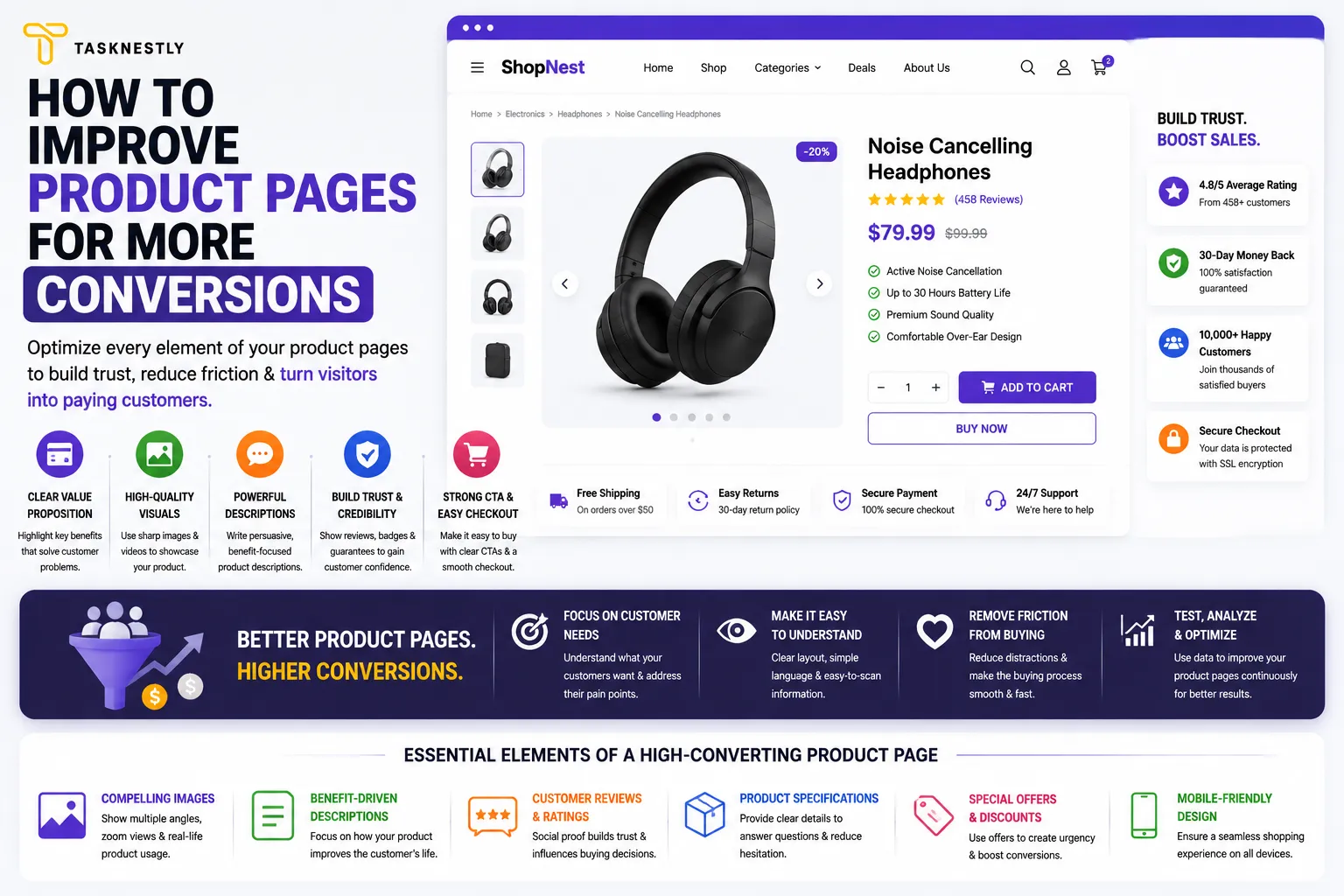
Understanding how to improve product pages is one of the highest-value skills available to any ecommerce store owner. Your product pages are the commercial heart of your store — the specific locations where visitor intent translates into purchasing decisions. A visitor who reaches your product page is already interested in what you sell. The question is whether your product page gives them everything they need to commit to the purchase, or whether it leaves enough uncertainty, friction, or doubt to drive them away.
Most ecommerce stores have significant untapped conversion potential sitting in their existing product pages — pages that attract traffic from search and advertising but convert at 1 to 2 percent when they should be converting at 3 to 5 percent. The gap is almost always explained by a small number of specific, fixable deficiencies: inadequate images, thin descriptions, missing social proof, unclear delivery information, or a poorly placed add-to-cart button.
This guide provides 10 specific, actionable tactics for how to improve product pages that directly increase conversion rates, reduce return rates, and improve search rankings — covering every element from product imagery and descriptions to page speed, structured data, and internal linking. Each improvement is practical, implementable without technical expertise, and delivers measurable results.
| Want Product Pages Built to Convert From Day One?Tasknestly’s ecommerce services include full product page optimisation, conversion-focused copywriting, and SEO setup — turning your product pages into consistent revenue generators.Get your FREE Ecommerce Quote → |
Want Your Store To Actually Convert?
Strategy is step one — execution is what moves revenue. Tasknestly builds and optimizes ecommerce stores that convert.
Get Ecommerce Services →Table of Contents
How to Improve Product Pages: Visual Elements
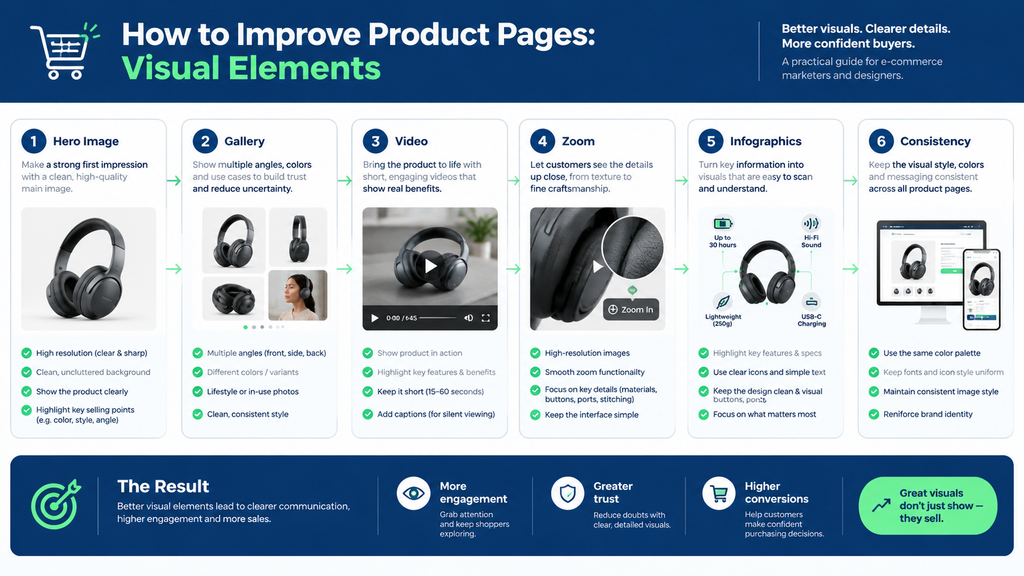
The visual elements of your product page — images, video, and layout — are the first things a visitor evaluates and the most powerful determinants of their initial purchase intent. Here is how to improve product pages through better visuals.
Tip 1: Use High-Quality Multi-Angle Product Images
Product imagery is the primary substitute for the physical retail experience online, and improving it is the single most impactful answer to how to improve product pages for most ecommerce stores. High-quality images showing multiple angles, lifestyle context, scale references, and close-up detail shots communicate everything a shopper needs to visually verify before purchasing — replacing the ability to pick up, examine, and try that physical retail provides.
The minimum standard for competitive product pages in 2026 is five to eight images per product: a clean studio shot on white background, two to three angle shots, at least one lifestyle image showing the product in use, a scale reference image showing the product next to a familiar object, and a close-up detail shot for products where material or texture is commercially relevant. For fashion and wearables, model images showing the product worn dramatically outperform flat-lay images for conversion.
Tip 2: Add Product Video
Video addresses the limitations of static imagery by showing how a product moves, functions, and looks in real-world context — information that drives purchase decisions for products where static images leave uncertainty. Knowing how to improve product pages with video is particularly valuable for fashion (showing drape and movement), furniture (showing scale in a real room), electronics (demonstrating functionality), and beauty products (showing application and texture in use).
Product videos do not need to be professionally produced to be effective. A 30 to 60 second clip filmed on a modern smartphone in good lighting, showing the product being used in context, consistently outperforms even high-budget studio product photography for conversion on high-consideration items. Embed the video on the product page without autoplay and without sound enabled by default — let the shopper choose to engage rather than forcing the experience on them.
Tip 3: Optimise Page Layout for Mobile Conversion
Over 70 percent of ecommerce product page visits happen on mobile devices, making mobile layout optimisation central to understanding how to improve product pages for maximum conversion. On mobile, product pages must display images clearly at small screen sizes, position the add-to-cart button within thumb reach without scrolling, present product options (size, colour, quantity) in large, easy-to-tap selectors, and load quickly enough that shoppers do not abandon before the content appears.
Test every product page change on actual mobile devices across multiple screen sizes — not just in browser emulation — before considering it complete. The mobile experience determines the majority of your product page conversion rate.
Want Your Store To Actually Convert?
Strategy is step one — execution is what moves revenue. Tasknestly builds and optimizes ecommerce stores that convert.
Get Ecommerce Services →How to Improve Product Pages: Content and Copy
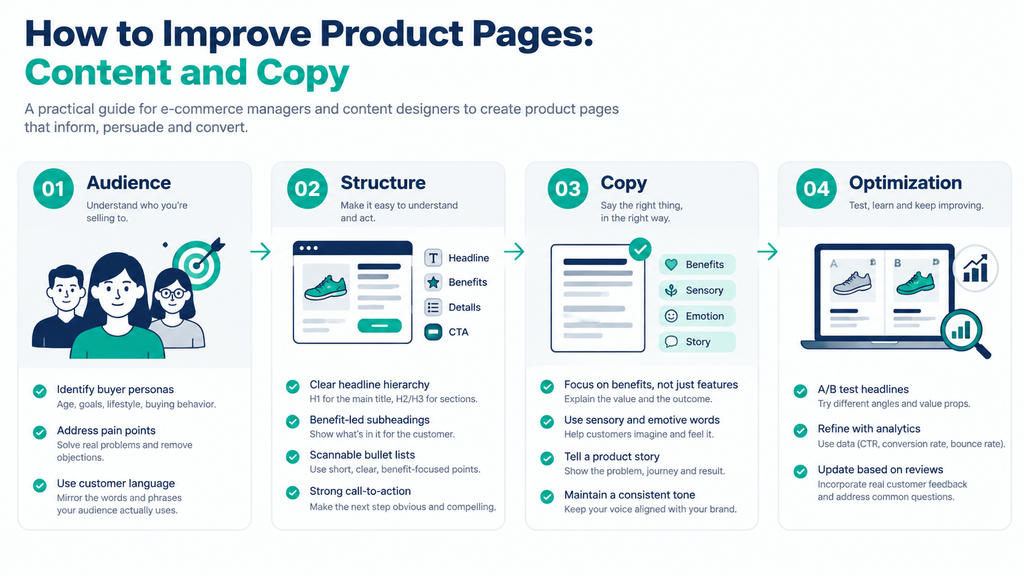
Content quality is the second major dimension of how to improve product pages for both conversion and SEO. The words on your product page answer buyer questions, communicate product value, signal search engine relevance, and ultimately provide the psychological permission to purchase.
Tip 4: Write Detailed Benefit-Focused Descriptions
Learning how to improve product pages through better descriptions means understanding the difference between features and benefits. Features describe what a product is; benefits explain what it does for the buyer. ‘Made from 100% merino wool’ is a feature. ‘Stays warm in temperatures down to -5°C without adding bulk under a coat’ is the benefit that feature delivers — and it is the benefit that converts.
Write product descriptions that address the specific questions a serious buyer would have before committing to a purchase: what problem does this product solve, who is it designed for, what specific outcome does it deliver, and what makes it preferable to alternatives? Aim for at least 250 to 300 words per product, incorporating your target keyword naturally without forcing it. This length both serves the buyer and provides sufficient content for search engines to evaluate the page’s relevance.
Tip 5: Include Complete Product Specifications
Missing or incomplete specifications are one of the most common product page deficiencies — and one of the most fixable when considering how to improve product pages to reduce abandonment. Shoppers who cannot find the specific detail they need — dimensions, weight, material composition, compatibility specifications, care instructions — leave to find that information elsewhere, frequently not returning. Providing comprehensive specifications removes the need to search for additional information and eliminates specification-related returns after purchase.
Present specifications in a scannable format — a bulleted list or a dedicated specifications tab rather than buried in running prose. Key specification categories vary by product type but typically include physical dimensions, materials, weight, technical specifications (voltage, connectivity, compatibility), care and maintenance requirements, and what is included in the package.
Tip 6: Add and Display Customer Reviews Prominently
Customer reviews are the most powerful trust signal available on a product page, and their placement is as important as their presence. When learning how to improve product pages, review placement should be considered carefully: star ratings and aggregate review counts should appear near the product title and price — above the fold — not just at the bottom of the page where many shoppers never scroll. The average star rating and number of reviews influence the purchasing decision at the first point of evaluation, not after reading the full description.
Build a systematic review collection process: an automated email sent two to three weeks post-delivery inviting customers to share their experience. Make leaving a review as frictionless as possible with a direct link to your review form. Display all reviews, including critical ones — a mix of ratings is more credible than a suspiciously perfect five-star average, and critical reviews that are responded to professionally demonstrate customer service quality.
| Need a Website That Converts Browsers Into Buyers?Tasknestly’s professional website services include product page design, mobile optimisation, and SEO setup — building a conversion-focused store that generates consistent revenue.Start with a free website consultation → |
Want Your Store To Actually Convert?
Strategy is step one — execution is what moves revenue. Tasknestly builds and optimizes ecommerce stores that convert.
Get Ecommerce Services →How to Improve Product Pages: Technical and SEO Elements
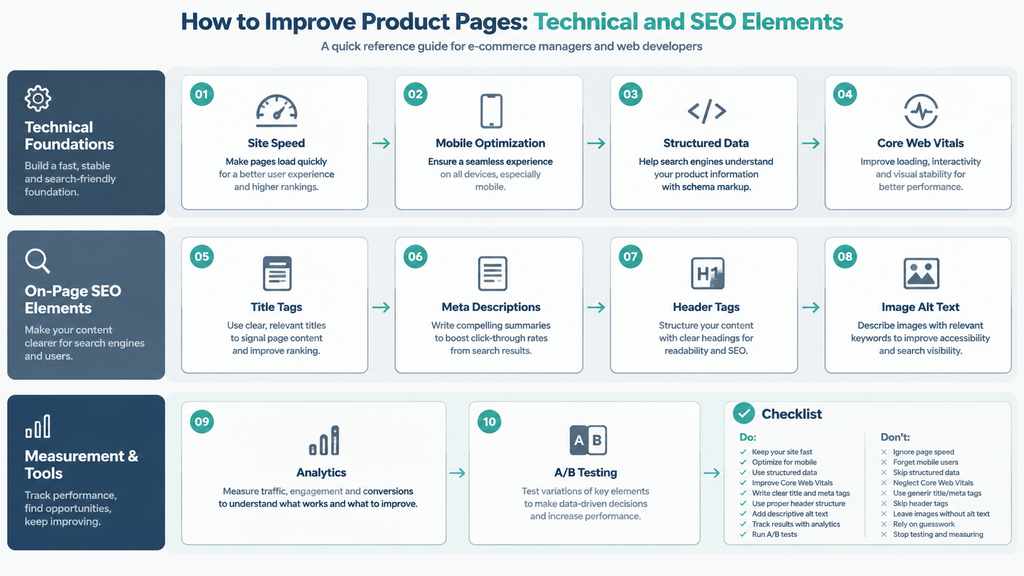
The technical and SEO elements of product page optimisation are the dimension most often overlooked by ecommerce businesses that focus their attention on visual and content improvements. Here is how to improve product pages at the technical level for better rankings and faster conversion.
Tip 7: Display Delivery and Returns Information
Delivery timeline and returns policy information are among the most persuasive elements of any product page, yet many stores bury them in the footer or on a separate policy page that most shoppers never visit. Knowing how to improve product pages for maximum conversion means surfacing this information at the point of decision — near the add-to-cart button where purchase hesitation is highest.
Display your delivery promise prominently: ‘Free next-day delivery on orders over £50’ or ‘Order before 2pm — dispatched today’ are conversion-driving statements that remove delivery uncertainty. Display your returns policy with equal prominence: ’30-day free returns’ or ‘Easy hassle-free returns’ immediately adjacent to your add-to-cart button reduces the perceived risk of purchasing from an unfamiliar store.
Tip 8: Optimise Your Add-to-Cart Button
The add-to-cart button is the conversion trigger on your product page, and its visual prominence, positioning, and text are all elements of how to improve product pages that are frequently underinvested. The button should be: a contrasting colour that stands out clearly from the surrounding page design, large enough to tap comfortably on mobile without zooming, positioned above the fold so it is visible without scrolling on both desktop and mobile, and labelled clearly with action-oriented text like ‘Add to Cart’, ‘Buy Now’, or ‘Get Yours’.
Sticky add-to-cart buttons — which remain visible as the shopper scrolls down to read the description and reviews — consistently improve conversion rates on product pages with longer content, because the purchase action is always accessible without requiring the shopper to scroll back up.
Tip 9: Improve Page Loading Speed
Page speed affects product pages more acutely than any other page on your store because product pages carry the heaviest visual load — multiple large product images, review content, recommendation widgets, and third-party scripts all compete to load simultaneously. Improving product page speed is one of the highest-impact answers to how to improve product pages because speed affects both conversion rates (slow pages increase abandonment) and SEO rankings (Google rewards faster pages).
The most impactful speed improvements for product pages are image compression and lazy loading (images load only when they scroll into view), deferring non-critical scripts until after the main content loads, and reducing the number of third-party apps or plugins loading on product pages. Measure your product page speed using Google PageSpeed Insights and address the specific improvements recommended for your highest-traffic product pages first.
Tip 10: Add Structured Data and Internal Links
Structured data (Product schema markup) and internal linking are the most overlooked elements of how to improve product pages for long-term SEO performance. Product schema markup communicates your product’s name, price, availability, and review rating to search engines in machine-readable format, enabling Google to display rich snippets in search results — star ratings, price, and availability shown directly in the listing — that dramatically increase click-through rates.
Internal links from related blog content and category pages to your product pages distribute link equity and increase crawl frequency, improving rankings for the specific product keywords those pages target. Build an internal linking habit: every new blog post should link to two to three relevant product pages, and every category page should be optimised to pass authority to the products within it.
Want Your Store To Actually Convert?
Strategy is step one — execution is what moves revenue. Tasknestly builds and optimizes ecommerce stores that convert.
Get Ecommerce Services →How to Improve Product Pages: Quick Reference
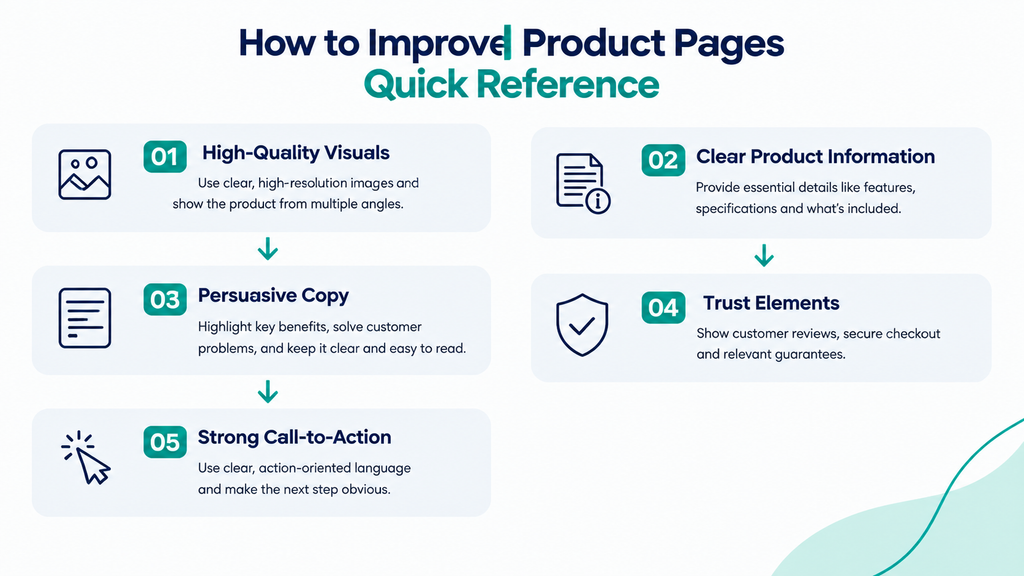
Use this checklist table when auditing any product page to identify the specific improvements most likely to increase its conversion rate.
| # | How to Improve Product Pages | Priority | Conversion Impact |
| 1 | Optimise product title for search and clicks | Critical | Improves rankings and search click-through rate |
| 2 | Use high-quality multi-angle images | Critical | Direct add-to-cart rate improvement |
| 3 | Write detailed benefit-focused descriptions | Critical | Reduces hesitation and return rates |
| 4 | Add customer reviews prominently | High | Social proof drives purchase decisions |
| 5 | Include clear product specifications | High | Reduces returns from misaligned expectations |
| 6 | Optimise the add-to-cart button | High | Small CTA improvements have measurable impact |
| 7 | Display delivery and returns info | High | Removes pre-purchase uncertainty |
| 8 | Add product videos | Medium-High | Video increases purchase confidence significantly |
| 9 | Include related product recommendations | Medium | Increases average order value per session |
| 10 | Improve page loading speed | Critical | Speed directly affects conversion and rankings |
| Essential Tools to Improve Your Product PagesShopify — The most beginner-friendly platform with built-in tools for product page optimisation, image management, and conversion tracking.Canva — Create professional product images, lifestyle graphics, and promotional banners that directly improve product page conversion rates.SEMrush — Find the keywords your product pages should be targeting and audit your pages for the SEO improvements that drive more organic traffic. |
Want Your Store To Actually Convert?
Strategy is step one — execution is what moves revenue. Tasknestly builds and optimizes ecommerce stores that convert.
Get Ecommerce Services →Frequently Asked Questions: How to Improve Product Pages
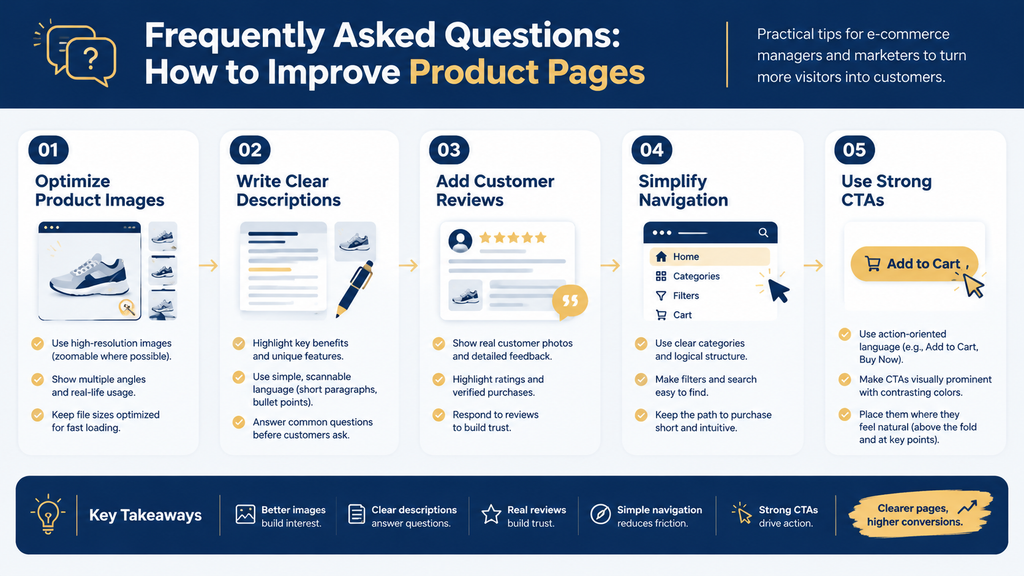
| Question | Answer |
| What is the most important element when improving product pages? | The most important elements when you improve product pages are high-quality images and detailed, unique descriptions. These two components most directly influence a shopper’s decision to add to cart — images replace the physical inspection that retail allows, and descriptions answer the specific questions that prevent purchase hesitation. |
| How long should a product description be? | Product descriptions should be a minimum of 250 to 300 words for standard products and 400 to 600 words for high-consideration or high-ticket items. Longer descriptions support better SEO performance by providing more content for search engines to evaluate, and they reduce return rates by ensuring customers have complete information before purchasing. |
| How do customer reviews improve product pages? | Customer reviews improve product pages by providing third-party social proof that reduces purchase anxiety, adding unique content that improves SEO, answering specific questions that your description may not cover, and providing keyword-rich content that matches the natural language searchers use. Pages with 10+ reviews consistently convert at higher rates than pages with no reviews. |
| Should I add video to my product pages? | Yes, particularly for products where material, texture, scale, or functionality is important. Product video increases purchase confidence by showing the product in real-world use — communicating information that static images cannot. Studies show that adding video to product pages can increase conversions by 80 percent or more on applicable product categories. |
| How does page speed affect product page performance? | Page speed directly affects product page performance in two ways: slow loading increases bounce rates before the page content is even seen, and Google’s Core Web Vitals assessment incorporates page speed into search rankings. A product page that loads in under two seconds will rank higher and convert more visitors than an identical page that loads in four seconds. |
| What should the add-to-cart button look like? | The add-to-cart button should be visually prominent — a contrasting colour that stands out from the rest of the page, large enough to tap easily on mobile, and positioned above the fold so shoppers do not need to scroll to find it. The button text should be specific (‘Add to Cart’ or ‘Buy Now’) rather than generic. These small improvements consistently generate measurable conversion uplifts. |
| How do I improve product pages for SEO? | To improve product pages for SEO: write a unique, keyword-rich product title under 60 characters; include your primary keyword naturally in the first 100 words of the description; add descriptive alt text to every product image; ensure the page URL includes the product keyword; add structured data (Product schema) for rich search result eligibility; and build internal links from related category and blog pages to the product page. |
Want Your Store To Actually Convert?
Strategy is step one — execution is what moves revenue. Tasknestly builds and optimizes ecommerce stores that convert.
Get Ecommerce Services →Conclusion: Apply These Tips and Watch Your Product Pages Convert
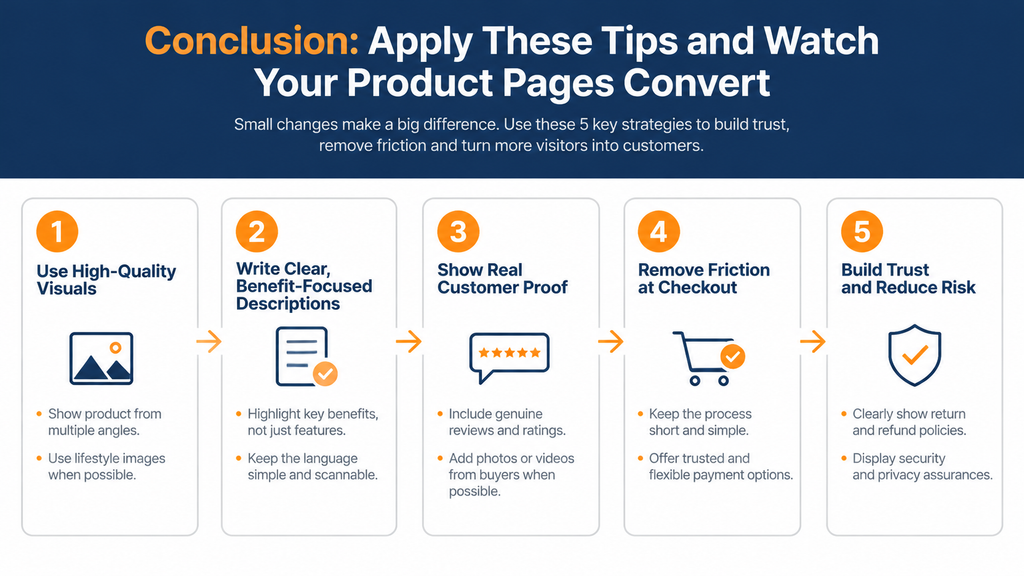
Knowing how to improve product pages is one of the highest-return skills in ecommerce because product pages are where visitor intent becomes revenue — or where it is lost. Every improvement you make to your product images, descriptions, social proof, delivery information, and technical performance compounds with every other improvement, creating a product page experience that builds purchase confidence at every stage of the shopper’s evaluation process.
Start with the improvements that address your most apparent current deficiencies. If your images are low quality, fixing them is the fastest path to a meaningful conversion improvement. If your descriptions are thin, rewriting the five highest-traffic product pages this week will have a measurable impact within 30 days. If your page speed score is poor, addressing it improves both conversions and rankings simultaneously. The key principle in how to improve product pages is that each improvement makes the next one more valuable — because a fast page with great images and detailed descriptions converts even hesitant shoppers, while a slow page with poor images fails even the most motivated ones.
At Tasknestly, we optimise product pages for conversion and search as part of our comprehensive ecommerce store services. If you want product pages that attract organic traffic and convert that traffic into consistent revenue, explore our ecommerce services or request a free quote today.
Want Your Store To Actually Convert?
Strategy is step one — execution is what moves revenue. Tasknestly builds and optimizes ecommerce stores that convert.
Get Ecommerce Services →How to Improve Product Pages: Making It a Consistent Practice
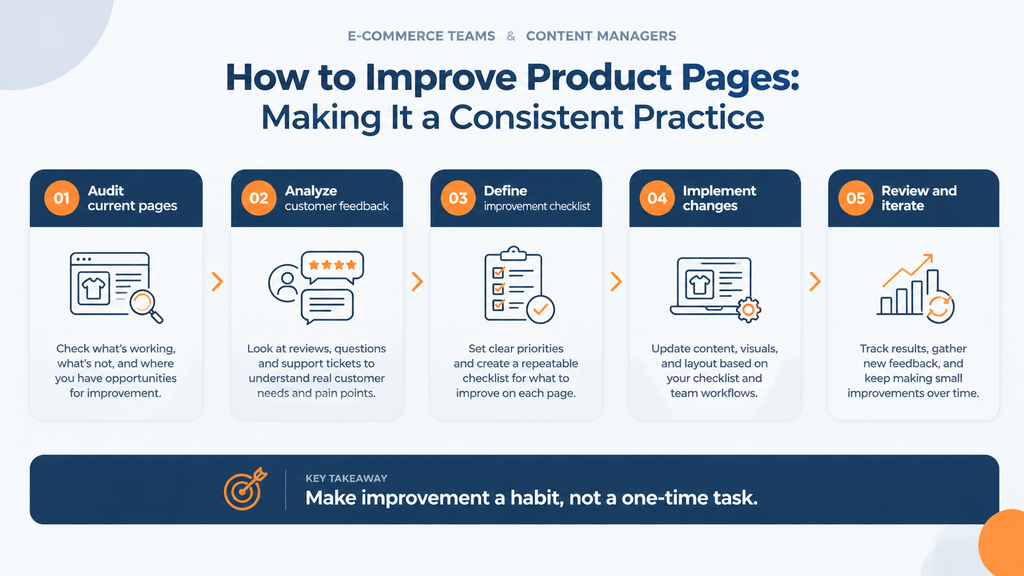
Knowing how to improve product pages is the beginning, not the end. Product page optimisation is an ongoing practice — pages that performed well at launch gradually fall behind as competitor pages improve and expectations rise. Build a quarterly product page review into your ecommerce calendar: check how to improve product pages that are getting traffic but underperforming on conversion, and prioritise fixes based on traffic volume and conversion gap.
The most efficient approach to how to improve product pages at scale is to fix your ten highest-traffic pages first. How to improve product pages with the greatest revenue impact is always to start where the most visitors are already arriving — improving a high-traffic page with a 1% conversion rate to 2% doubles revenue from that page, whereas improving a low-traffic page produces minimal absolute gain. How to improve product pages systematically and how to measure the improvement accurately are the two skills that separate stores that grow from those that plateau.
Knowing how to improve product pages continuously is how ecommerce businesses maintain their conversion advantage. Review how to improve product pages on your top ten most visited URLs each quarter. How to improve product pages effectively is always a data-driven question — check analytics to understand how to improve product pages that have high traffic but low conversion, and how to improve product pages that are ranked but not clicked. Applying these tactics consistently is how to improve product pages from good to exceptional, and how to improve product pages in a way that compounds in value over time.
For a practical reference on getting your product photos found and displayed properly in search, see Google’s image best practices for search.
Want Your Store To Actually Convert?
Strategy is step one — execution is what moves revenue. Tasknestly builds and optimizes ecommerce stores that convert.
Get Ecommerce Services →Grow With Tasknestly
Subscribe to the Tasknestly newsletter and get the latest tips on websites, SEO, social media, and digital growth.