
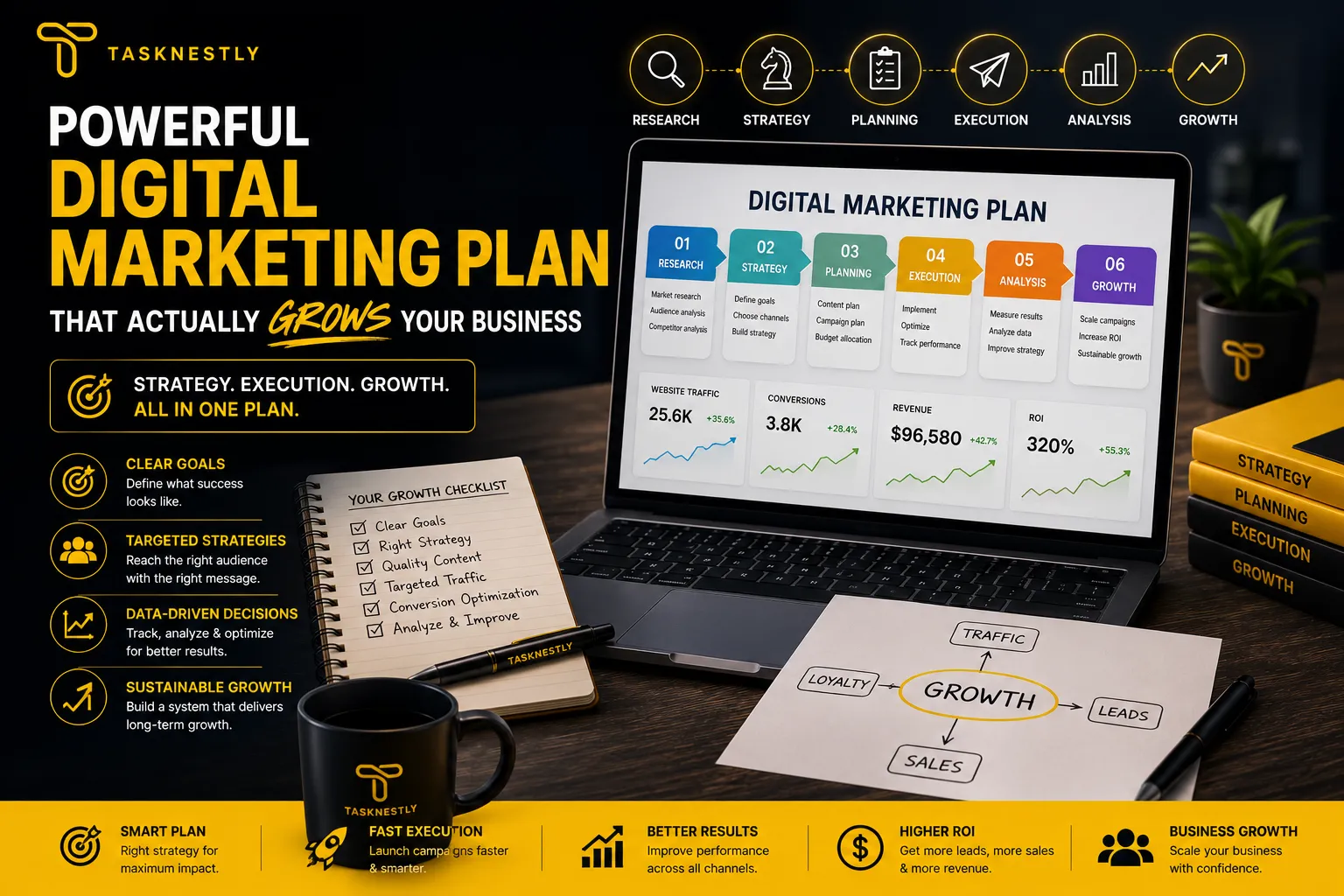
A solid digital marketing plan is the difference between a business that generates consistent, measurable growth online and one that bounces between tactics without building momentum. Without a clear marketing strategy, budgets get wasted on channels that do not align with business goals, teams work without direction, and results are impossible to attribute to specific decisions. With one clear direction, every campaign, every piece of content, and every dollar spent has a defined purpose and a measurable outcome.
Creating a digital marketing plan does not require an MBA or a massive budget. It requires clarity about your goals, an honest assessment of your current situation, a realistic allocation of resources across the channels that matter most, and a system for measuring and improving your results over time. The process of building a marketing roadmap forces you to make strategic choices — which audience, which channels, which message — that improve everything downstream.
This guide walks you through every step of creating a winning digital marketing strategy that works in 2026, from setting objectives and auditing your current performance to building your channel mix and implementing a reporting system that keeps your marketing programme on track as your business grows.
| Need a Custom Digital Marketing Plan for Your Business?Tasknestly builds tailored digital marketing plans for businesses at every growth stage. From strategy to execution, we cover SEO, social, email, and paid advertising. Explore our digital marketing services or get a free marketing plan consultation today. |
Ready To Put This Into Action?
Reading about digital marketing strategy is one thing — having it run for you is another. Let Tasknestly handle your campaigns end to end.
Get Digital Marketing Services →Ready To Put This Into Action?
Reading about digital marketing strategy is one thing — having it run for you is another. Let Tasknestly handle your campaigns end to end.
Get Digital Marketing Services →Table of Contents
What Is a Digital Marketing Plan and Why Do You Need One?
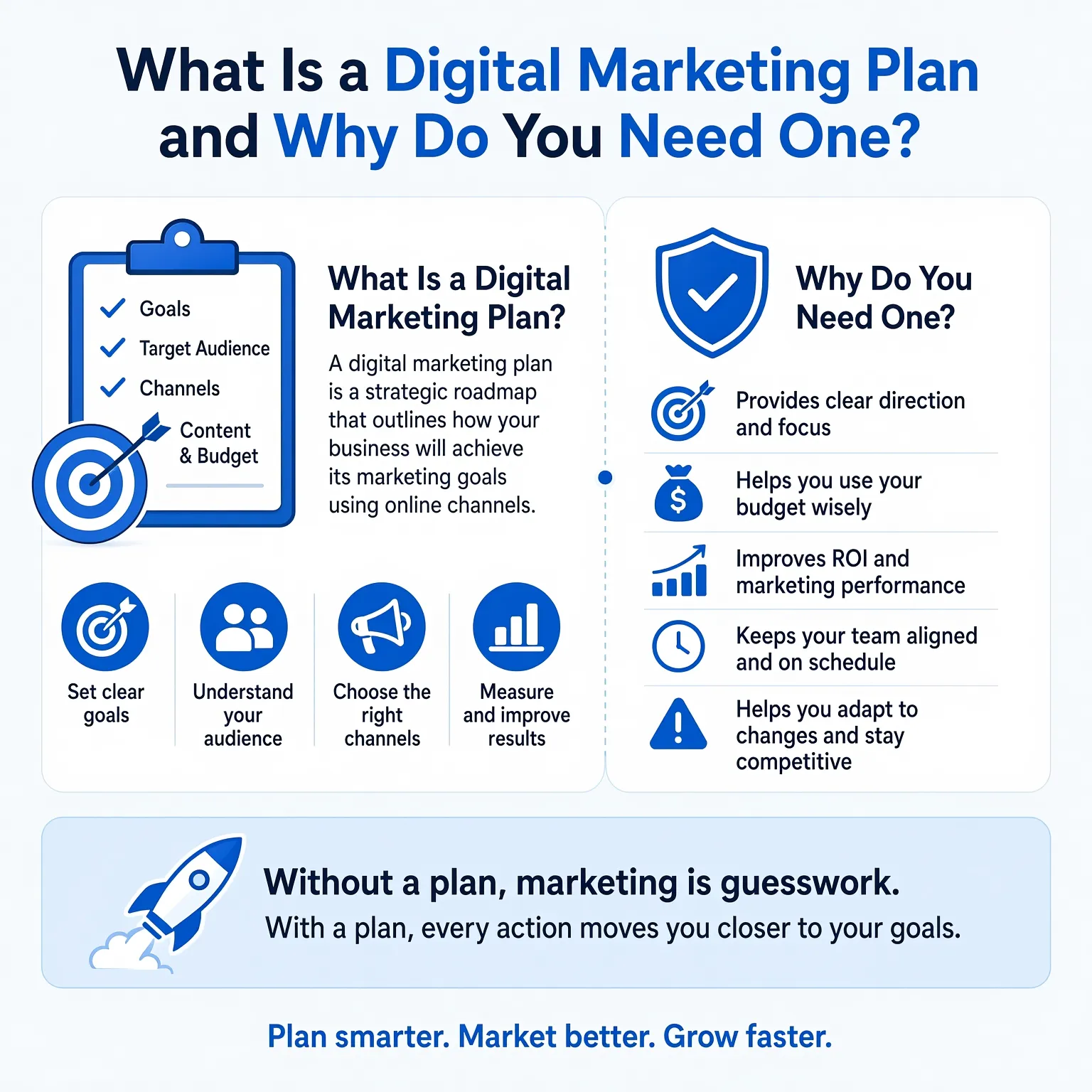
A digital marketing plan is a strategic document that defines your marketing objectives, target audience, channel mix, budget allocation, content strategy, and performance metrics for a defined period — typically a quarter or a year. It is the operational blueprint that aligns your marketing activities with your business goals and ensures that everyone on your team or agency is working toward the same outcomes.
The Cost of Having No Digital Marketing Plan
Businesses without a digital marketing plan tend to market reactively — posting on social media when they remember to, running ads when sales are slow, and sending emails without a consistent strategy. This reactive approach wastes budget, produces inconsistent results, and makes it impossible to understand what is working and why. A structured marketing approach introduces intentionality, consistency, and accountability into your marketing operation.
How a Digital Marketing Plan Differs from a Marketing Strategy
A marketing strategy defines your overall positioning, target market, and competitive differentiation — the ‘why’. A digital marketing plan translates that strategy into specific actions, timelines, channels, and budgets — the ‘how’. Your digital marketing plan should be grounded in a clear strategy but focused on execution. Without the strategic layer, a digital marketing plan is just a list of tasks. Without the plan, a strategy never gets implemented.
Ready To Put This Into Action?
Reading about digital marketing strategy is one thing — having it run for you is another. Let Tasknestly handle your campaigns end to end.
Get Digital Marketing Services →Step 1: Define Your Digital Marketing Plan Objectives
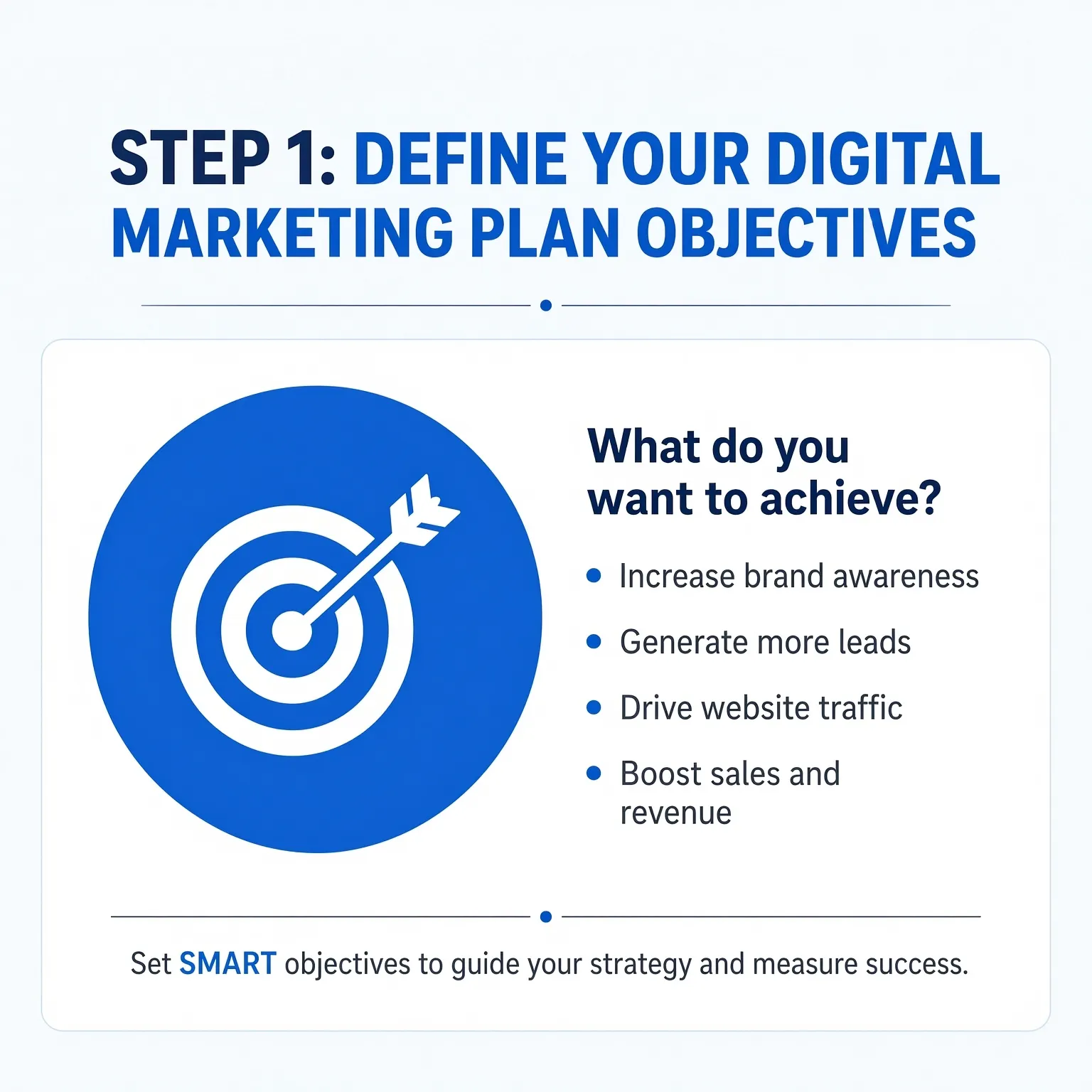
Every effective digital marketing plan starts with clear, measurable objectives. Use the SMART framework: Specific, Measurable, Achievable, Relevant, and Time-bound. Vague goals such as ‘grow our social media presence’ or ‘get more website traffic’ are not objectives — they are directions. Objectives like ‘increase organic traffic by 40% within 12 months’ or ‘generate 200 qualified leads per month via email marketing by Q3’ are objectives you can build a plan around.
Aligning Objectives with Business Goals
Your digital marketing plan objectives must connect directly to business goals. If the business goal is to increase revenue by 30%, your digital marketing plan needs objectives that demonstrably contribute to that revenue — not just vanity metrics like follower counts or page views. Map each marketing objective to a business outcome and you will have a digital marketing plan that your leadership team can support and your team can execute with confidence.
Common Digital Marketing Plan Objectives
The most common objectives in a well-structured marketing programme include: growing organic search traffic, increasing email subscriber count, reducing cost per acquisition, improving conversion rate, growing social media engagement, launching in a new market, increasing average order value, and improving customer retention rate. Choose two to four objectives for your digital marketing plan rather than trying to optimise everything simultaneously.
Ready To Put This Into Action?
Reading about digital marketing strategy is one thing — having it run for you is another. Let Tasknestly handle your campaigns end to end.
Get Digital Marketing Services →Step 2: Audit Your Current Digital Marketing Performance
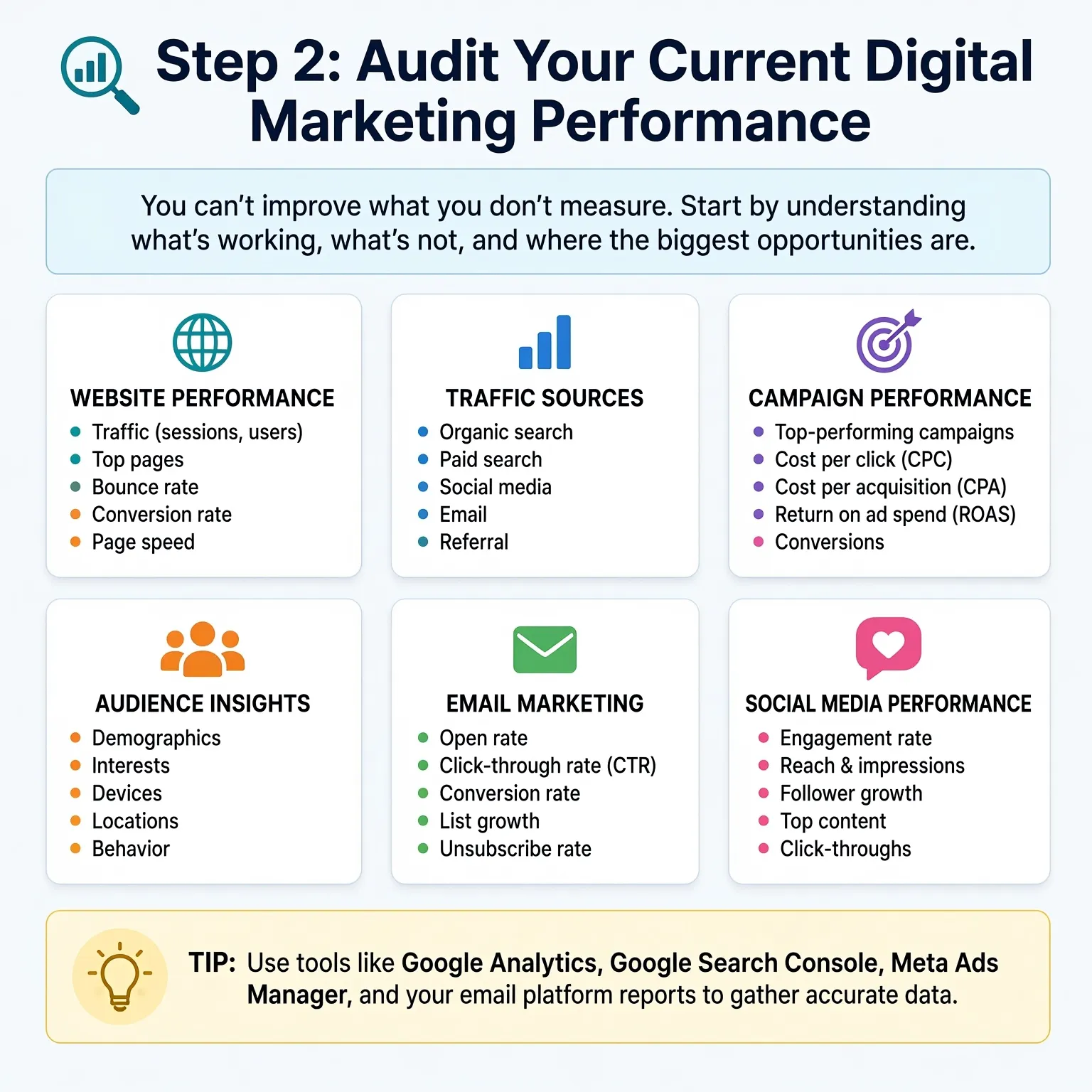
Before building a digital marketing plan, you need an honest baseline of where you stand. A digital marketing audit covers: website analytics (traffic sources, top pages, conversion rates), SEO performance (rankings, backlink profile, technical health), social media performance (growth, engagement, reach), email marketing performance (list size, open rates, click rates, revenue attribution), and paid advertising performance (ROAS, CPA, spend efficiency).
Tools to Support Your Marketing Audit
Google Analytics 4 and Google Search Console are the essential starting points for any digital marketing plan audit. For SEO competitive analysis, tools like Semrush or Ahrefs provide keyword ranking data and backlink intelligence. For social media, platform-native analytics plus tools like Sprout Social give you engagement and reach data. Your email platform’s built-in reporting covers subscriber growth and campaign performance. Document your baseline across all these areas before writing a single objective in your digital marketing plan.
Competitive Analysis in Your Digital Marketing Plan
Understanding what competitors are doing in digital is a critical input to your digital marketing plan. Analyse their organic keyword rankings, their social media content strategy, their paid ad creative, and their content output. Identify gaps where you can outperform them — keywords they are not ranking for, audiences they are not serving well, content formats they are neglecting. Competitive intelligence makes your digital marketing plan more targeted and more likely to succeed in a crowded market.
Ready To Put This Into Action?
Reading about digital marketing strategy is one thing — having it run for you is another. Let Tasknestly handle your campaigns end to end.
Get Digital Marketing Services →Step 3: Define Your Target Audience for Your Digital Marketing Plan
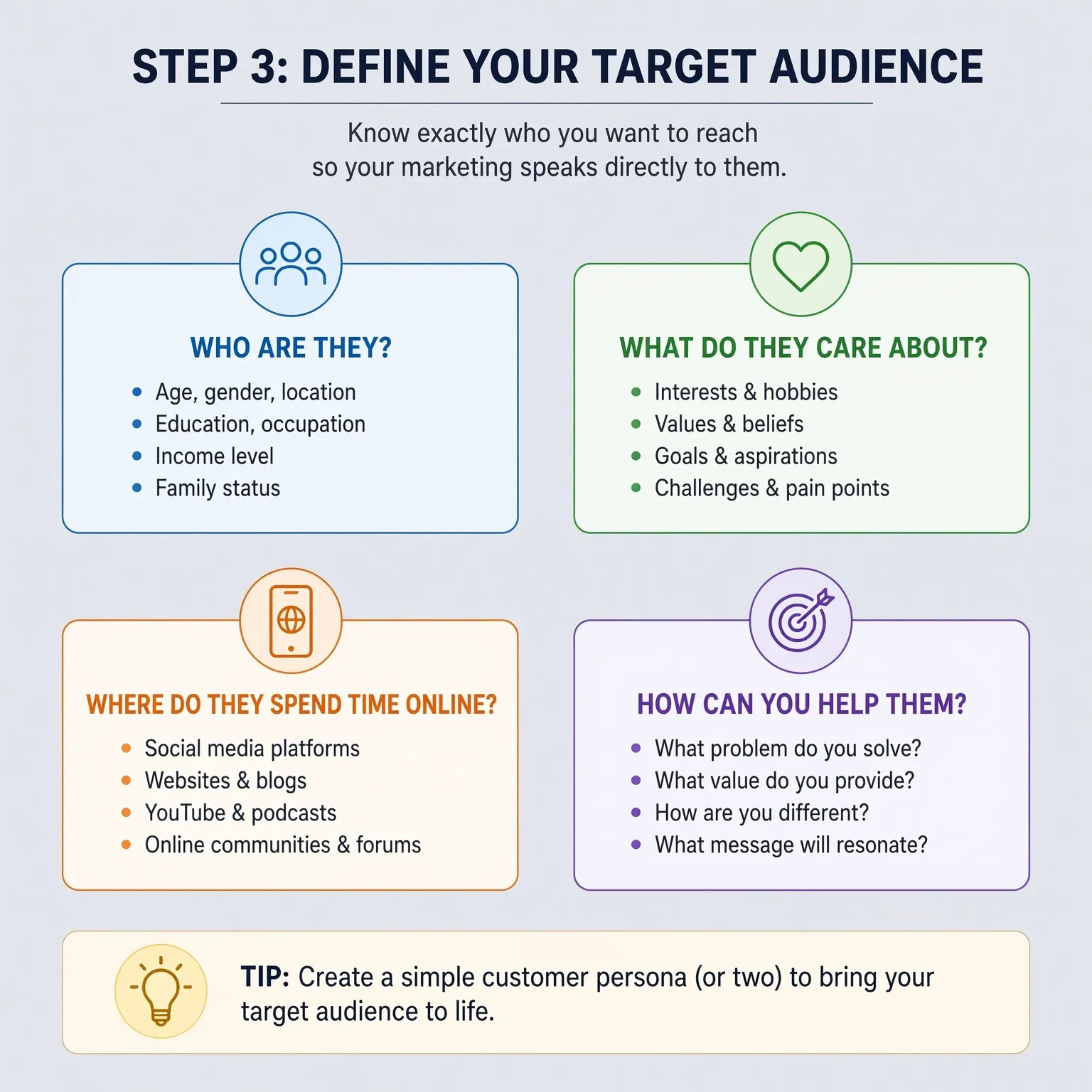
No digital marketing plan can be effective without a precise definition of the audience it is designed to reach. Go beyond basic demographics. Build audience profiles that include psychographics — values, motivations, pain points, and aspirations. Understand where your audience spends time online, how they research purchase decisions, what content they consume, and what objections they have to buying your product or service.
Building Audience Personas
Most marketing roadmaps benefit from two to four audience personas that represent the distinct segments of your target market. Each persona should have a name, demographic profile, job or lifestyle context, primary pain points relevant to your product, preferred content channels, and typical objections. These personas inform every creative decision in your digital marketing plan — which platforms to prioritise, what messages to lead with, and what content to create.
Using First-Party Data to Refine Your Audience
If your business has been operating for any length of time, your existing customer data is the most valuable input to your digital marketing plan audience definition. Review purchase history, customer surveys, support tickets, and sales call notes to understand who your best customers actually are. Many businesses discover that their real best customer profile differs significantly from their assumed target audience — a discovery that can fundamentally reshape a digital marketing plan for the better.
Ready To Put This Into Action?
Reading about digital marketing strategy is one thing — having it run for you is another. Let Tasknestly handle your campaigns end to end.
Get Digital Marketing Services →Step 4: Choose the Right Channels for Your Digital Marketing Plan
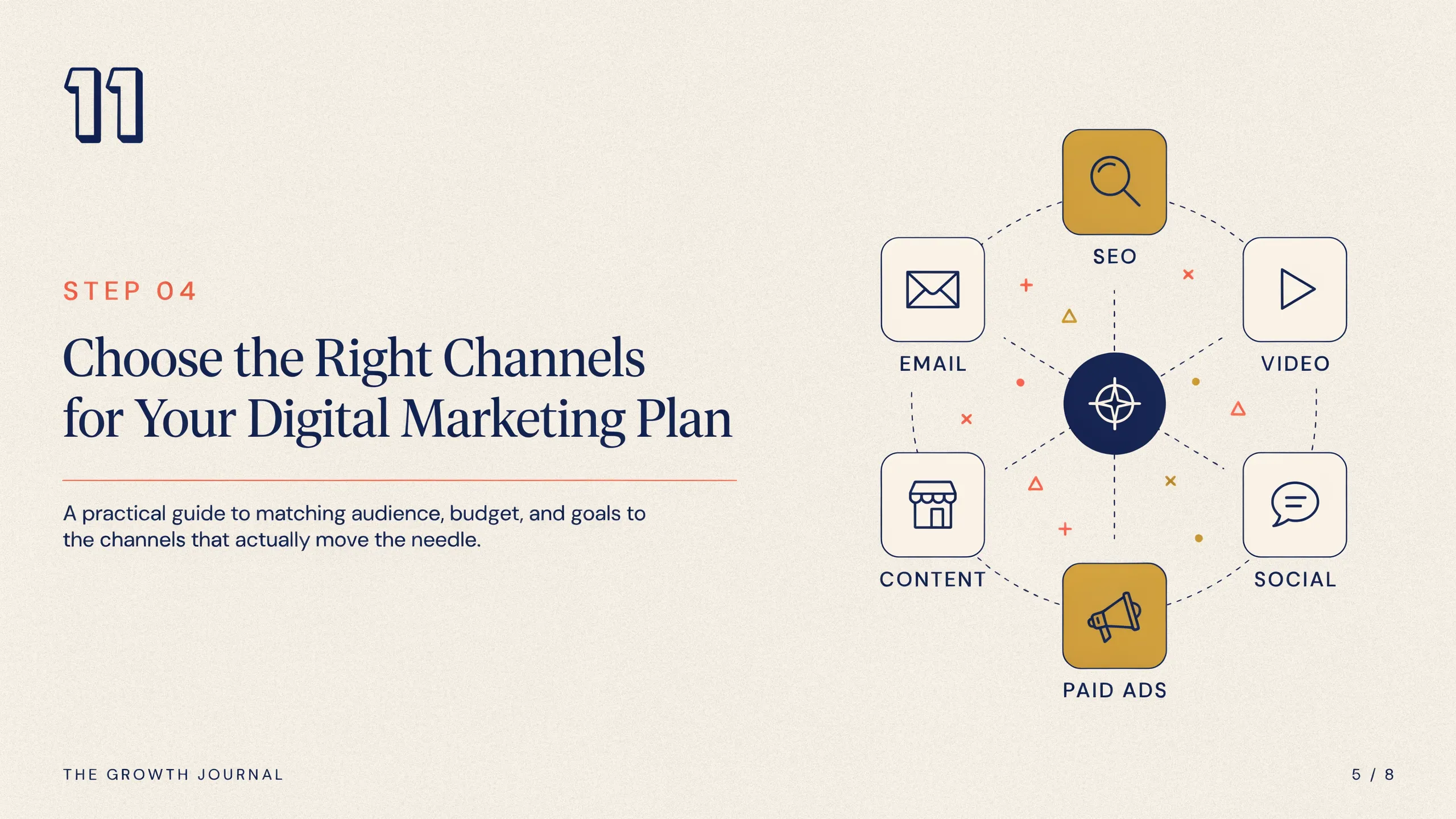
Channel selection is one of the most consequential decisions in any marketing programme. The right channels depend on your audience, your product, your budget, and your team’s capabilities. Trying to be active across every channel simultaneously is a common marketing strategy mistake — it spreads resources thin and produces mediocre results everywhere instead of excellent results in the channels that matter most.
Matching Channels to Objectives
Different channels serve different objectives. If your digital marketing plan objective is brand awareness among a new audience, social media and content distribution are the primary channels. If your objective is converting existing traffic more efficiently, your digital marketing plan should focus on CRO and email automation. If your objective is capturing high-intent buyers, Google Search and Shopping campaigns belong in your digital marketing plan. Match every channel you include to at least one defined objective — if a channel cannot be connected to an objective, it should not be in your plan.
Ready To Put This Into Action?
Reading about digital marketing strategy is one thing — having it run for you is another. Let Tasknestly handle your campaigns end to end.
Get Digital Marketing Services →Step 5: Set Your Digital Marketing Plan Budget
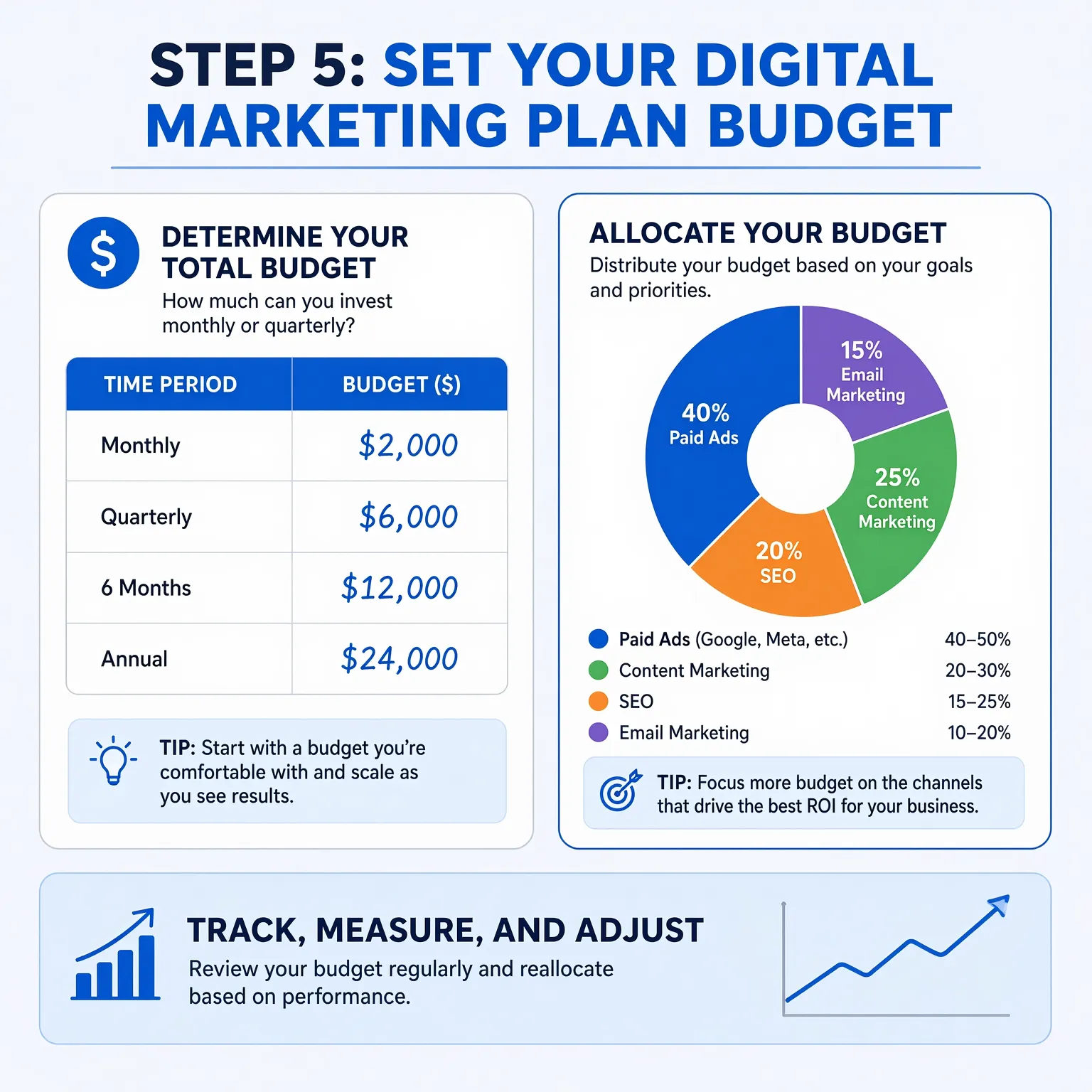
Budget allocation is where many marketing programmes become unrealistic. The most common mistake is underestimating both the cost and the time to results for content-driven channels like SEO and social media, while overestimating the speed at which paid advertising can be profitably scaled without a strong creative and testing foundation.
Budget Allocation Frameworks
A common approach in a marketing roadmap is the 70/20/10 framework: 70% of budget to proven channels and tactics, 20% to channels with demonstrated potential but room to scale, and 10% to experimental channels that could become significant. This keeps your marketing programme grounded in what works while leaving room to discover new opportunities. Adjust the ratios based on how mature your overall programme is — newer businesses may need to allocate more to experimentation and testing.
| Let Tasknestly Build and Execute Your Digital Marketing Plan From audience research and channel strategy to content creation and campaign management, Tasknestly turns your digital marketing plan into measurable results. See how our SEO and digital marketing team works or request a free proposal for a plan built around your business goals. |
Ready To Put This Into Action?
Reading about digital marketing strategy is one thing — having it run for you is another. Let Tasknestly handle your campaigns end to end.
Get Digital Marketing Services →Step 6: Create Your Content Strategy Within the Digital Marketing Plan
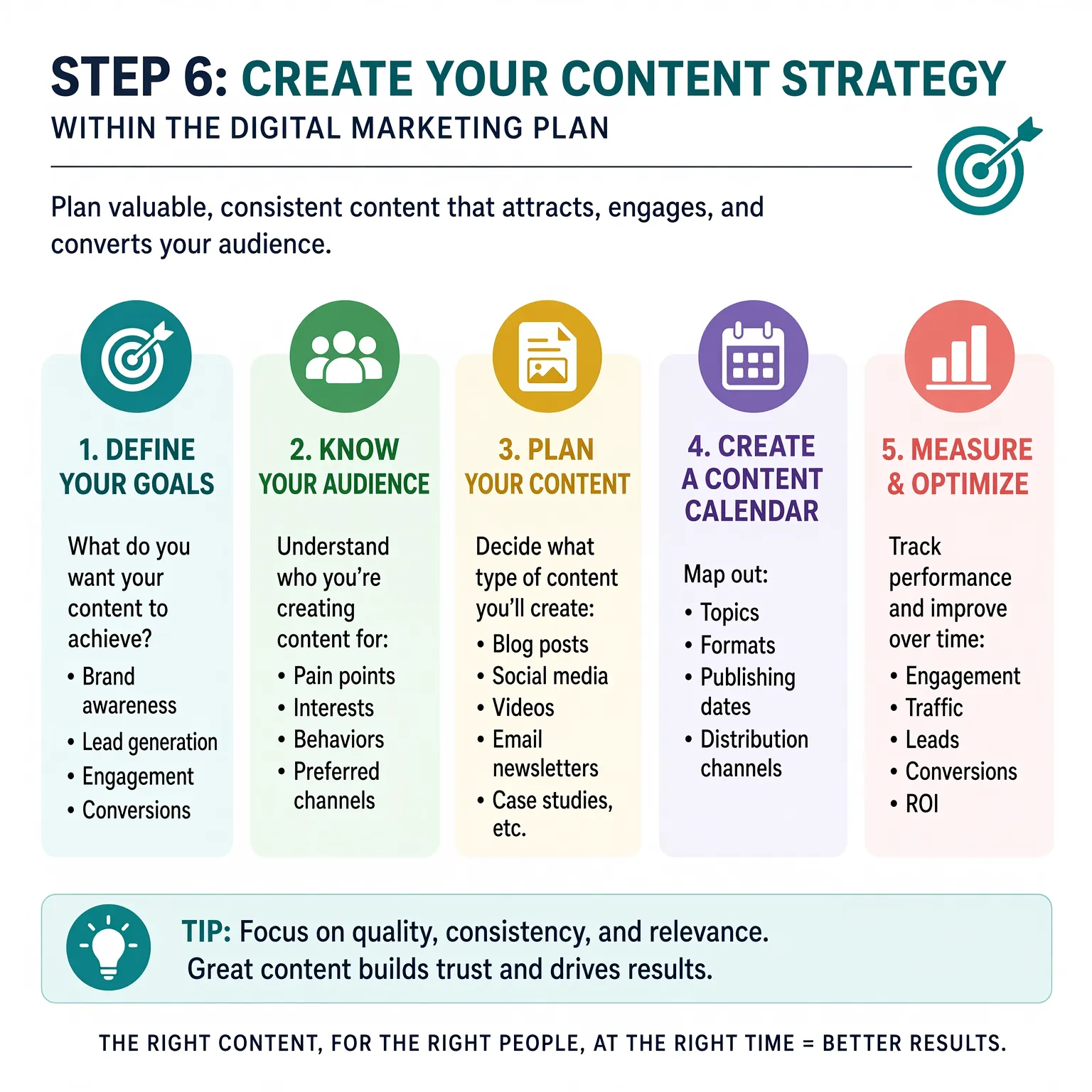
Content is the fuel that powers every channel in your digital marketing plan. Your content strategy defines what you will create, for whom, in what format, on which platforms, and how often. A well-structured content strategy within your digital marketing plan ensures that your team always knows what to produce next and that every piece of content serves a defined marketing objective.
Content Mapping to the Funnel
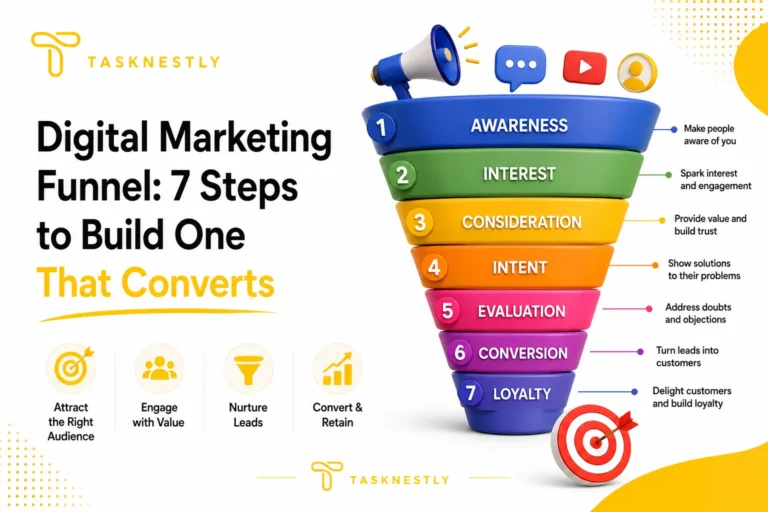
Structure your content strategy within the digital marketing plan around the customer journey. Top-of-funnel content — blog posts, social media, video, podcasts — builds awareness and attracts new audiences. Middle-of-funnel content — comparison guides, case studies, webinars, email newsletters — educates and nurtures prospects. Bottom-of-funnel content — product pages, testimonials, demos, limited-time offers — converts high-intent visitors into buyers.
Content Calendar and Production Planning
Your digital marketing plan should include a content calendar that schedules production and publication at least four to eight weeks in advance. This prevents last-minute content creation that is almost always lower quality, and allows you to coordinate across channels — so a blog post launches alongside a social media campaign and an email newsletter in the same week. A content calendar is not a rigid constraint but an operating rhythm that makes your marketing programme executable at scale.
Ready To Put This Into Action?
Reading about digital marketing strategy is one thing — having it run for you is another. Let Tasknestly handle your campaigns end to end.
Get Digital Marketing Services →Step 7: Define KPIs and Reporting for Your Digital Marketing Plan
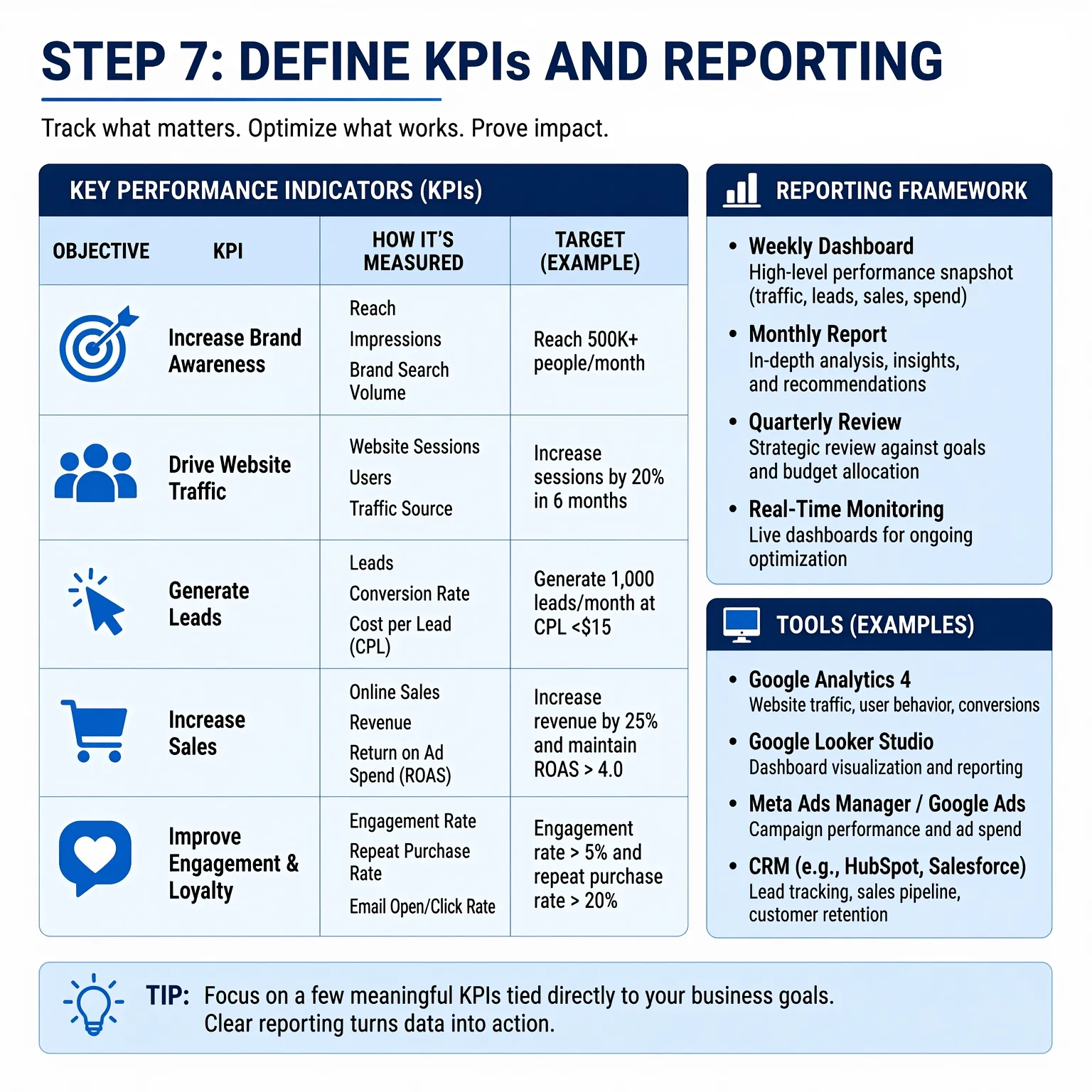
A marketing strategy without a measurement framework is not a plan — it is a wish list. Define the key performance indicators (KPIs) for each channel and each objective before you launch any campaign. Set reporting cadences — weekly channel reviews, monthly digital marketing plan reviews, quarterly strategy assessments — and assign ownership of each metric.
Common KPIs for your digital marketing plan include: organic sessions and keyword rankings for SEO, ROAS and CPA for paid advertising, open rate and revenue per send for email, reach and engagement rate for social media, and conversion rate and bounce rate for website performance. Combine channel-level KPIs with business-level KPIs — revenue, customer acquisition cost, customer lifetime value — to maintain a clear line between marketing activities and business outcomes in your digital marketing plan.
| Plan Element | Key Question | Common Mistake | Best Practice |
| Objectives | Are they SMART? | Too vague or too many | 2-4 specific, measurable goals |
| Audience | Who exactly is this for? | Assuming broad target | 2-4 detailed personas |
| Channel Mix | Which channels match goals? | Too many channels at once | 2-3 core channels, test others |
| Budget | Is it realistic? | Underestimating content cost | Allocate by channel ROI tier |
| Content Strategy | What and how often? | No production calendar | 4-8 week rolling calendar |
| KPIs | How do you measure success? | Only tracking vanity metrics | Channel + business KPIs linked |
Ready To Put This Into Action?
Reading about digital marketing strategy is one thing — having it run for you is another. Let Tasknestly handle your campaigns end to end.
Get Digital Marketing Services →Executing Your Digital Marketing Strategy: From Document to Action
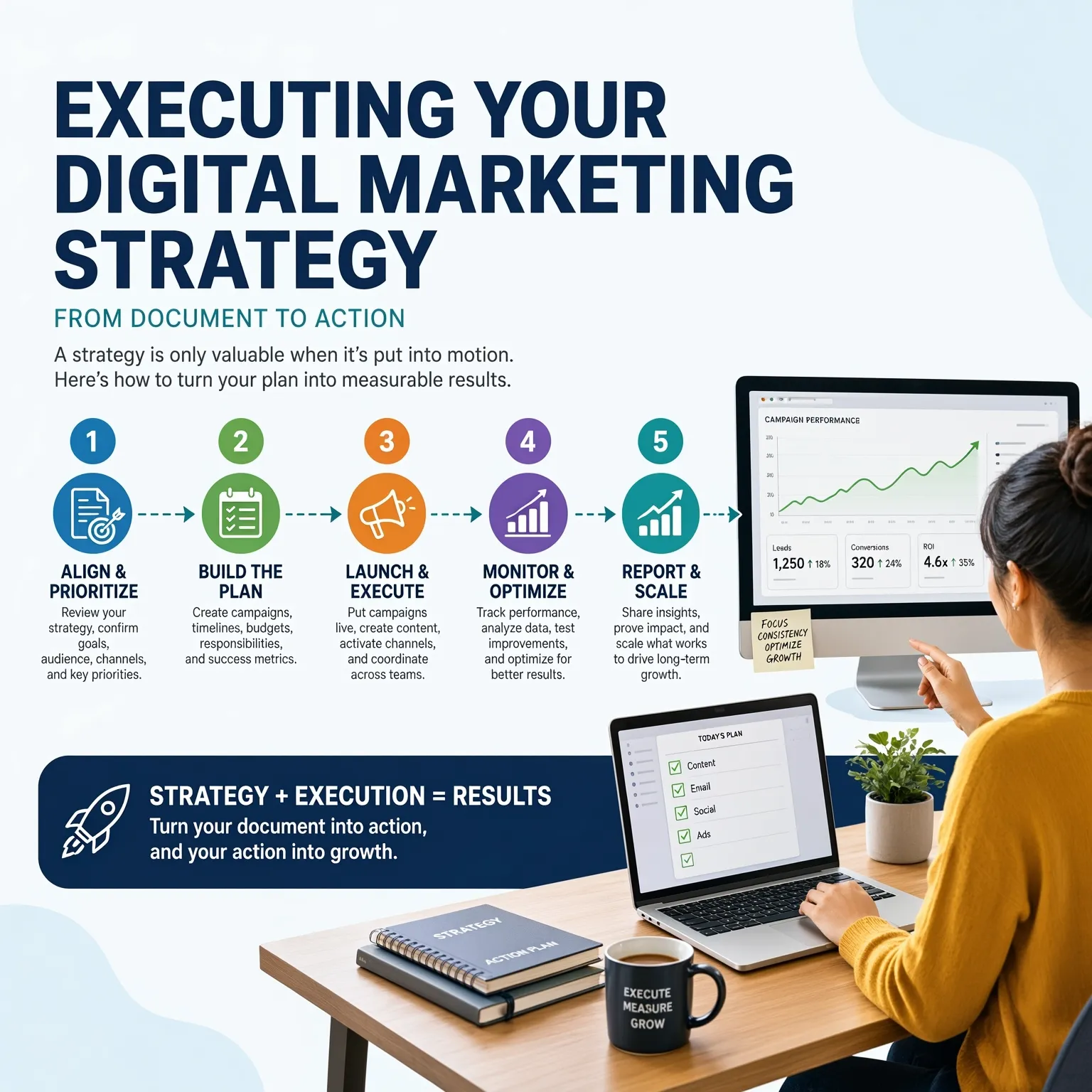
The best marketing strategy in the world only delivers results when it is executed consistently. One of the most common pitfalls for businesses with a solid marketing strategy document is the gap between planning and doing. The strategy sits in a shared folder, referenced occasionally, while day-to-day marketing decisions are made reactively without consulting it. Closing this gap requires building execution habits into your team’s workflow.
Weekly marketing standups that reference your core objectives, monthly KPI reviews that compare performance against targets, and quarterly full-team sessions that assess whether the strategy needs to pivot — these rhythms transform a static document into a living operational framework. Assign clear ownership of every channel and every KPI to a specific person. When accountability is clear, execution improves dramatically.
Execution also requires being willing to adjust. The most successful marketing teams treat their strategy as a hypothesis that data either confirms or challenges. When a channel underperforms against its targets for two consecutive months, the response should not be to wait and see — it should be a structured review of what is not working and a decision about whether to adjust tactics or reallocate budget. Agility within a framework produces better outcomes than rigid adherence to a flawed strategy or chaotic pivoting without structure.
Ready To Put This Into Action?
Reading about digital marketing strategy is one thing — having it run for you is another. Let Tasknestly handle your campaigns end to end.
Get Digital Marketing Services →Aligning Your Digital Marketing Strategy With Your Sales Team

A digital marketing strategy that operates in isolation from your sales team is working at half capacity. Marketing generates leads and awareness; sales converts that awareness into revenue. When the two functions are aligned on target audience definition, messaging, and lead quality expectations, the whole customer acquisition engine performs better.
This alignment starts with shared definitions — what counts as a marketing-qualified lead, how quickly sales should follow up on leads from specific channels, and what feedback sales provides about the quality of inbound enquiries. It continues with regular communication — monthly meetings where marketing shares campaign performance and sales shares conversion data from marketing-sourced leads. When marketing and sales operate from the same data and the same customer understanding, the entire customer acquisition process becomes more efficient.
For ecommerce businesses with no traditional sales team, the equivalent alignment is between marketing and the customer experience function. Understanding which marketing messages attract the best customers — those with high lifetime value, low return rates, and strong referral behaviour — allows you to refine your targeting and messaging to attract more of your ideal buyers and fewer of the customers who drain support resources.
If you are looking for a partner to help you build and execute a robust marketing strategy, our digital marketing and website services at Tasknestly are designed to translate marketing strategy into measurable results across every digital channel.
Ready To Put This Into Action?
Reading about digital marketing strategy is one thing — having it run for you is another. Let Tasknestly handle your campaigns end to end.
Get Digital Marketing Services →Common Reasons Digital Marketing Strategies Fail
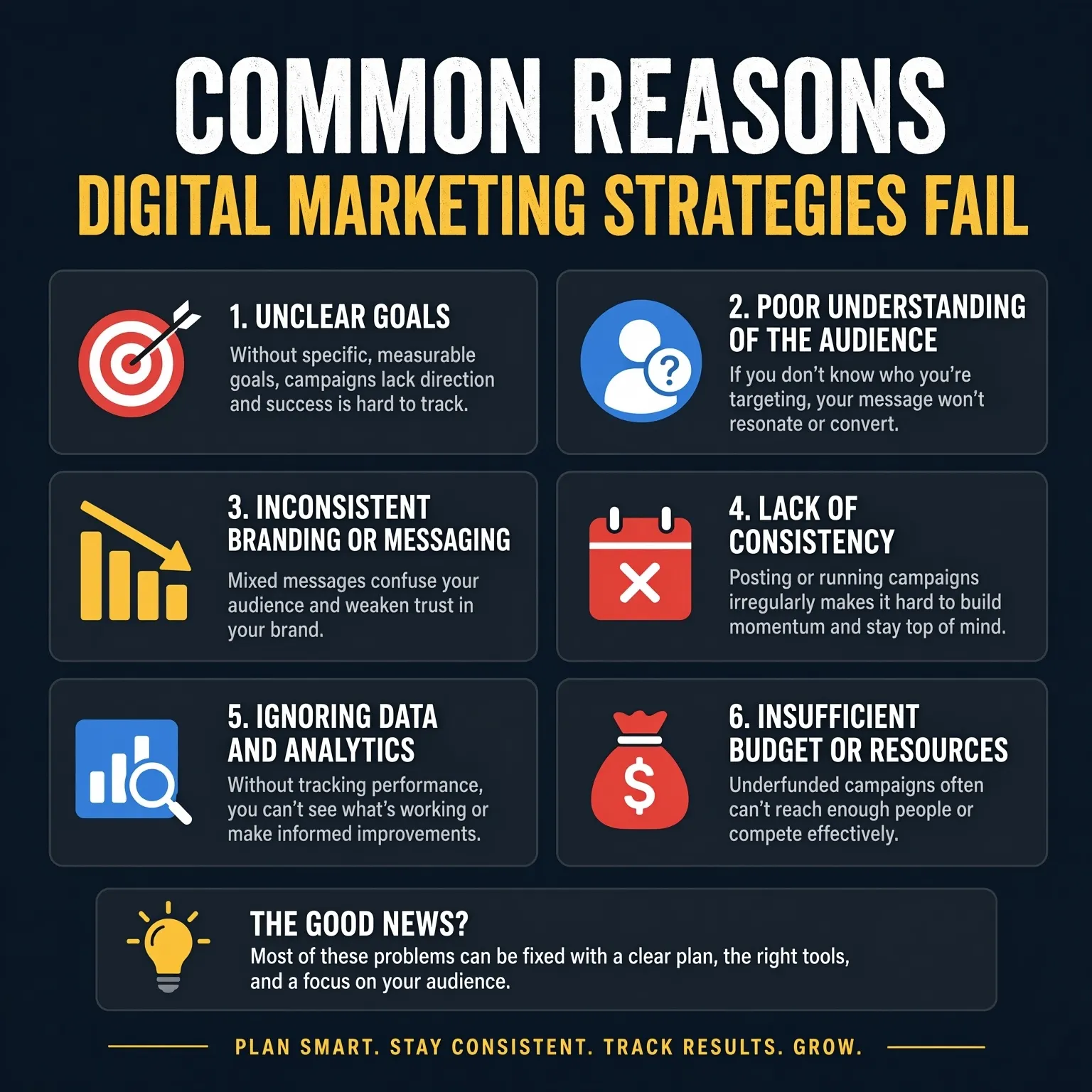
Even well-constructed marketing strategies fail for predictable reasons. Understanding these failure modes in advance helps you avoid them.
The first is lack of executive buy-in. A marketing strategy that leadership does not actively support will always be under-resourced and under-prioritised. Present your strategy with clear links to business outcomes and financial projections, and secure leadership commitment before investing significant resources in execution.
The second is unrealistic timelines. Marketers consistently underestimate how long it takes for new channels to deliver results. SEO typically requires six to twelve months for significant organic traffic growth. Content marketing compounds over twelve to twenty-four months. Setting realistic expectations in your strategy — and communicating them clearly to leadership — prevents premature strategy abandonment when results are slow to materialise in the early phases.
The third is poor data infrastructure. A marketing strategy built on incomplete or inaccurate data will make consistently wrong decisions. Invest in proper analytics setup, UTM tagging, conversion tracking, and attribution modelling before you launch major campaigns. Clean data is the foundation on which every other element of a successful marketing strategy depends.
Ready To Put This Into Action?
Reading about digital marketing strategy is one thing — having it run for you is another. Let Tasknestly handle your campaigns end to end.
Get Digital Marketing Services →Integrating Your Digital Marketing Channels for Maximum Impact
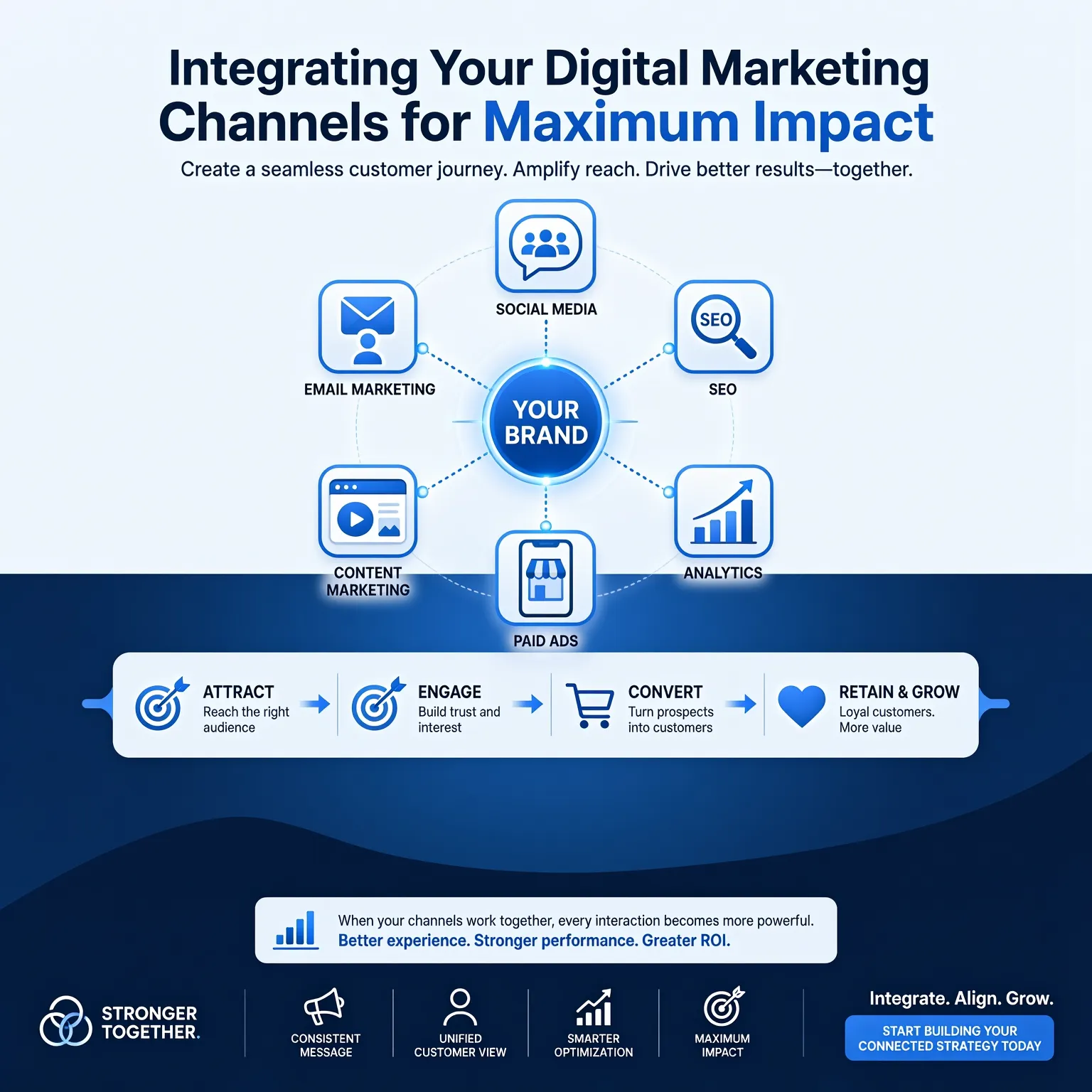
The most effective marketing strategies in 2026 are built on channel integration rather than channel isolation. When your SEO content feeds your social media calendar, your social media campaigns drive email list growth, and your email list powers your paid advertising audiences, every channel becomes more effective because of the others. This integration does not happen by accident — it must be designed into your marketing strategy from the start.
Start by identifying the natural content flow between your channels. A well-researched blog post can become: a series of LinkedIn posts, a short-form video script, an email newsletter feature, a lead magnet that grows your list, and a foundation for long-tail keyword rankings that bring in organic traffic for years. When you build this kind of content multiplication into your marketing strategy, your output grows far beyond what your team size would suggest is possible.
Channel integration also applies to your data and targeting. Customer email addresses collected through your website can be uploaded as custom audiences in Facebook and Google Ads, allowing you to target existing subscribers with social advertising or exclude them from acquisition campaigns to avoid wasted spend. Paid ad performance data reveals which product categories and audience segments convert best, informing your SEO keyword priorities and email segmentation strategy.
The integration flywheel — where each channel feeds and improves the others — is what separates marketing programmes that compound in efficiency from those that require proportionally increasing investment to maintain results. Building this flywheel into your marketing strategy from the start is one of the highest-value things you can do for your business’s long-term growth trajectory.
Ready To Put This Into Action?
Reading about digital marketing strategy is one thing — having it run for you is another. Let Tasknestly handle your campaigns end to end.
Get Digital Marketing Services →Localising Your Digital Marketing Strategy for Different Markets
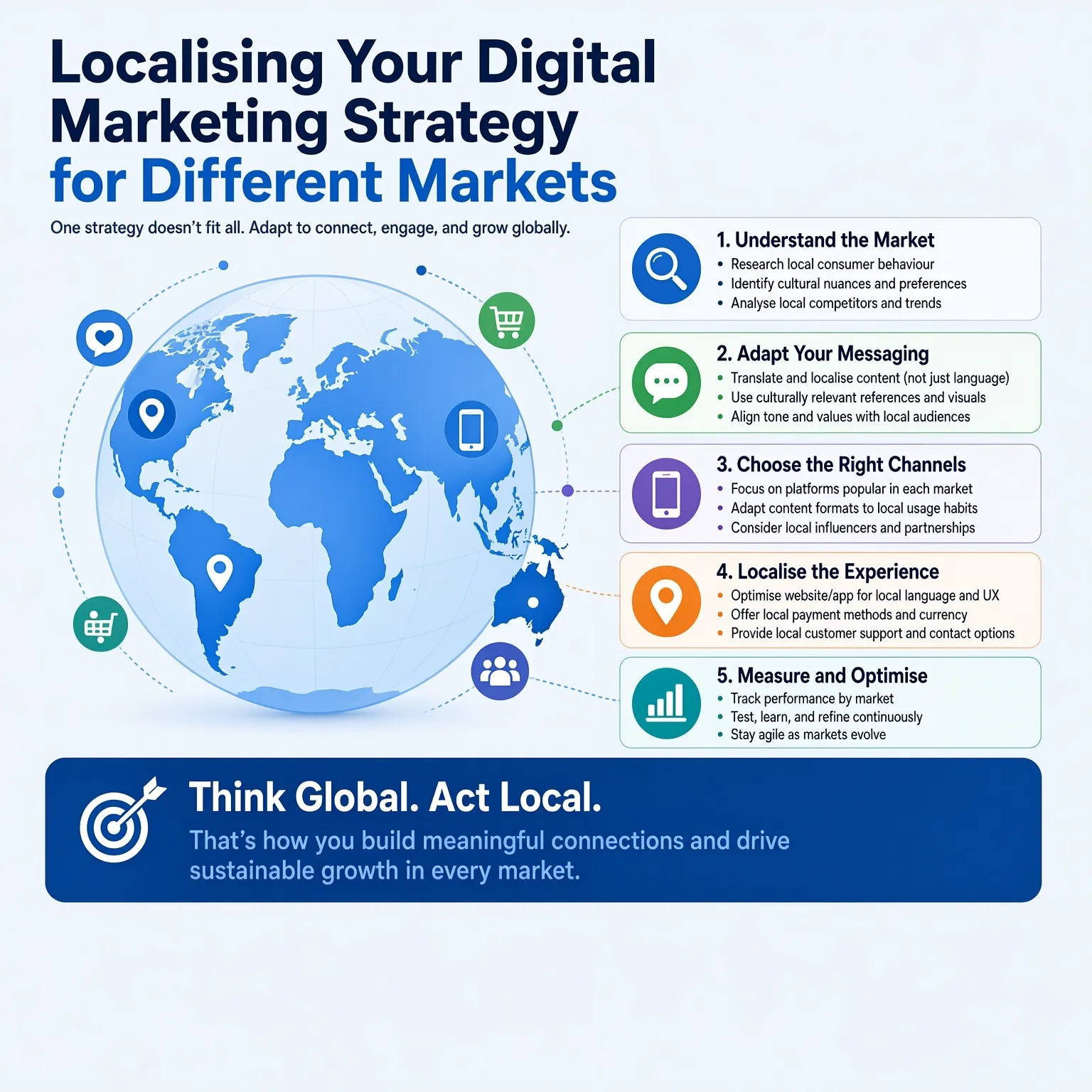
If your business serves customers in more than one geographic market, your marketing strategy needs to account for local differences in audience behaviour, platform preferences, regulatory requirements, and competitive dynamics. A marketing approach built entirely around US consumer behaviour may perform very differently in European, Asian, or Middle Eastern markets.
Localisation in digital marketing goes beyond translating website copy. It includes adapting your content tone and cultural references, selecting the right social media platforms for each market (WeChat in China, VK in Russia, TikTok everywhere for Gen Z), ensuring compliance with local data privacy regulations such as GDPR in Europe, and understanding the local competitive landscape for SEO and paid advertising. Brands that localise their marketing strategy for new markets consistently outperform those that apply a one-size-fits-all global approach.
Building localisation into your marketing strategy early also makes expansion more efficient. Developing localised content assets, landing pages, and audience segments takes time and investment, but the compounding effect of ranking organically in a new market, building a local social following, and developing local partnerships creates durable competitive advantages that are difficult for late-entering competitors to overcome.
| Recommended Tools for Building Your Digital Marketing PlanThese beginner-friendly tools help you research and execute a strong digital marketing plan effectively:Google Analytics 4 — analytics.google.com — Free website analytics platform for tracking traffic, conversions, and audience behaviour across your digital marketing channels.Semrush — semrush.com — Comprehensive SEO and competitive intelligence toolkit for keyword research, site audits, and tracking your digital marketing plan performance.Notion — notion.so — Flexible workspace for building your digital marketing plan document, content calendar, and campaign tracking in one organised hub. |
Ready To Put This Into Action?
Reading about digital marketing strategy is one thing — having it run for you is another. Let Tasknestly handle your campaigns end to end.
Get Digital Marketing Services →Frequently Asked Questions: Digital Marketing Plan
| Question | Answer |
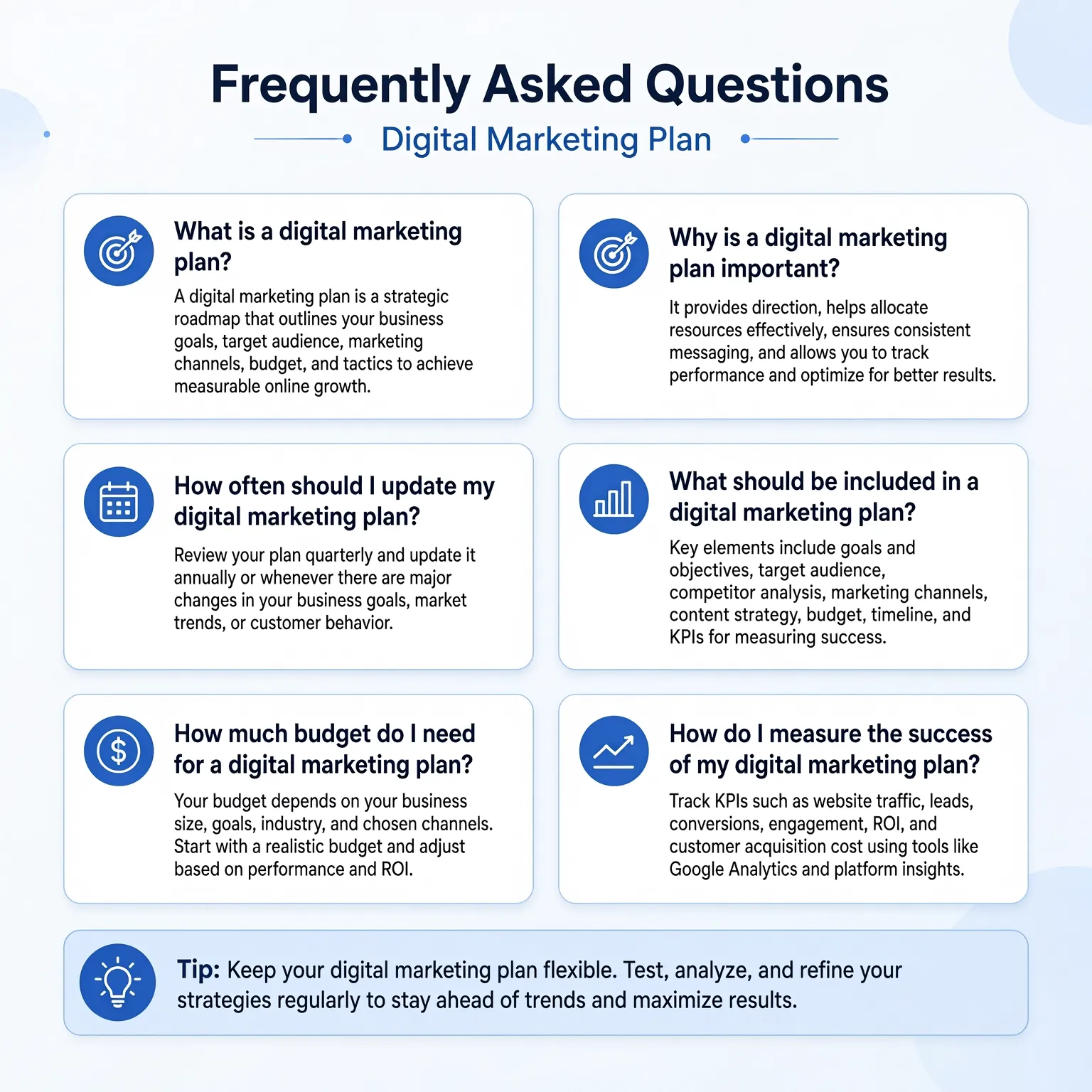
| What should a digital marketing plan include? | A complete digital marketing plan should include: defined objectives (SMART), target audience personas, competitive analysis, channel strategy with budget allocation, content strategy and calendar, KPIs for each channel, and a reporting cadence. All elements should connect back to your core business goals. |
| How long should a digital marketing plan be? | Your marketing strategy document can be as short as 5 pages or as long as 50 depending on business complexity. What matters is clarity and completeness, not length. Most growing businesses benefit from a quarterly plan of 10-15 pages covering all core elements. |
| How often should I update my digital marketing plan? | Review your digital marketing plan monthly to check KPI performance and make tactical adjustments. Conduct a full strategic review quarterly. Annual planning should reset objectives and budget allocation based on the previous year’s performance data. |
| What budget do I need for a digital marketing plan? | Digital marketing budgets vary enormously. Early-stage businesses can execute a meaningful plan with $1,000-$3,000 per month across SEO, content, and social media. Established ecommerce brands typically invest 10-20% of revenue. What matters more than the total budget is that it is allocated rationally across channels based on your objectives. |
| Can I create a digital marketing plan without an agency? | Yes. Many small businesses create and execute their digital marketing plan in-house. The key is honest self-assessment of your team’s skills and time availability. Areas requiring specialist expertise — technical SEO, paid media management — benefit most from external support, but the strategy and roadmap can absolutely be built in-house. |
| What is the most important part of a digital marketing plan? | Clear objectives are the most important element of any digital marketing plan. Everything else — channel selection, budget allocation, content strategy, KPIs — flows from knowing specifically what you are trying to achieve and why it matters for the business. A plan with vague objectives will produce vague results regardless of how sophisticated the execution. |
Technology will continue to evolve rapidly, and the channels and tactics that drive growth in 2026 will look different from those that dominated in 2021. Artificial intelligence, voice search, new social platforms, and shifting privacy regulations are all reshaping the competitive landscape. Building a robust framework for your marketing activities — one that is channel-agnostic and outcome-focused — ensures that your programme can adapt to these changes without losing momentum. The businesses that thrive long-term are those that build strong strategic foundations, measure everything, and stay curious about what is changing in the channels their customers use.
Competitor benchmarking is another habit that separates high-performing marketing teams from stagnant ones. Reviewing what your top three to five competitors are doing across SEO, content, social media, and paid advertising — quarterly at minimum — reveals opportunities you might otherwise miss and threats you need to respond to. Keeping an eye on the competitive landscape is not about copying what others do; it is about understanding the environment in which your marketing is competing so you can position your business to stand out.
Ready To Put This Into Action?
Reading about digital marketing strategy is one thing — having it run for you is another. Let Tasknestly handle your campaigns end to end.
Get Digital Marketing Services →Conclusion
Building a winning digital marketing plan is not a one-time event — it is an ongoing process of setting clear objectives, executing consistently, measuring results, and refining your approach based on data. The plan you write today will evolve as you learn more about what works for your specific audience and business model. That is not a weakness of the approach; it is the approach working correctly.
The businesses that grow most consistently in the digital landscape are those that commit to having a digital marketing plan and updating it regularly, rather than those that execute the most elaborate or expensive campaigns without direction. Consistency, measurement, and willingness to adjust are the defining characteristics of a marketing strategy that compounds over time.
If you need expert support building and executing a digital marketing plan that delivers real business results, get a free proposal from Tasknestly. Our team creates custom digital marketing plans for businesses across every industry and executes them with the rigour and creativity that drives measurable, sustainable growth.
If your plan includes email, text messages or targeted social advertising, read the ICO’s direct marketing guidance to make sure your campaigns follow UK rules.
Ready To Put This Into Action?
Reading about digital marketing strategy is one thing — having it run for you is another. Let Tasknestly handle your campaigns end to end.
Get Digital Marketing Services →Grow With Tasknestly
Subscribe to the Tasknestly newsletter and get the latest tips on websites, SEO, social media, and digital growth.