
Shopify vs WooCommerce is the most searched ecommerce platform comparison in the world — and for good reason. Both platforms power millions of online stores and are credible choices for businesses at every stage. But they are built on fundamentally different philosophies: Shopify is a fully hosted, all-in-one ecommerce solution designed for simplicity and speed; WooCommerce is an open-source WordPress plugin that offers maximum flexibility and control at the cost of greater technical complexity.
The Shopify vs WooCommerce decision is one where choosing the wrong platform is an expensive mistake that many ecommerce businesses make in their first year — and then spend significant time and money correcting. Your platform choice affects everything from how quickly you can launch to how much you pay in monthly fees, how well your store ranks in search engines, and how much developer support you will need as your business grows.
This Shopify vs WooCommerce guide breaks down the comparison across every dimension that matters — cost, ease of use, design, SEO, scalability, payment options, and customer support — so you can make the right choice for your specific business, budget, and technical comfort level without wading through platform marketing spin.
| Want Your Ecommerce Store Set Up and Optimised for You?Tasknestly’s ecommerce services cover platform setup, store design, product page optimisation, and SEO — whether you choose Shopify, WooCommerce, or another platform entirely.Get your FREE Ecommerce Quote → |
Want Your Store To Actually Convert?
Strategy is step one — execution is what moves revenue. Tasknestly builds and optimizes ecommerce stores that convert.
Get Ecommerce Services →Table of Contents
Shopify vs WooCommerce: Ease of Use
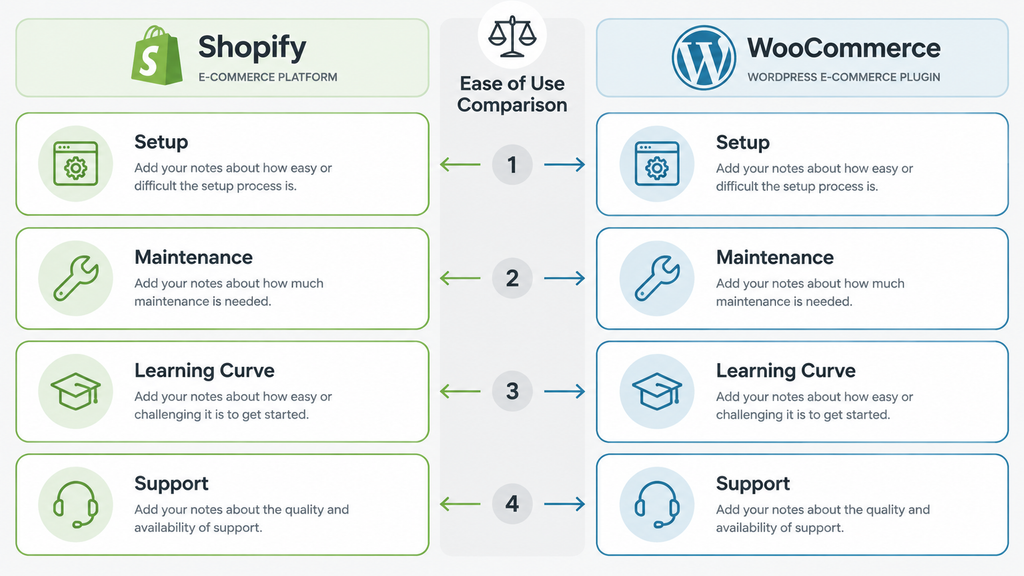
For most beginners, ease of use is the decisive factor in the Shopify vs WooCommerce comparison. The platform you can actually set up, manage, and grow without constantly hitting technical walls is the right platform for you, regardless of what any comparison chart says about features.
Shopify: Designed for Non-Technical Users
In the Shopify vs WooCommerce ease comparison, Shopify wins for non-technical users. Shopify is built from the ground up for people who want to sell online without becoming web developers. The onboarding process walks you through every step — from choosing a theme and uploading products to setting up payment processing and configuring shipping rates. Everything is managed through a clean, intuitive dashboard that requires no coding knowledge and no hosting management.
Within a few hours of signing up, most beginners have a functional online store live and ready to accept orders. This speed-to-launch advantage is one of Shopify’s most significant strengths in the Shopify vs WooCommerce debate — particularly for entrepreneurs who want to validate a product idea quickly before investing heavily in a platform they are not yet sure about.
WooCommerce: Powerful but More Complex
On the WooCommerce side of the Shopify vs WooCommerce comparison, WooCommerce is a plugin for WordPress, which means you first need to set up a WordPress site, purchase hosting, install WordPress, install WooCommerce, configure your payment gateways through separate plugins, manage security through additional plugins, and handle software updates manually. For someone comfortable with WordPress, this is straightforward. For a complete beginner, the Shopify vs WooCommerce ease of use comparison lands heavily in Shopify’s favour.
The complexity of WooCommerce is not a flaw — it is a feature for the right user. Every aspect of your store is customisable to a degree that Shopify’s templated system cannot match. But that customisation comes with the ongoing responsibility of maintaining the technical infrastructure that supports it, which has a real cost in time or money for developer assistance.
Want Your Store To Actually Convert?
Strategy is step one — execution is what moves revenue. Tasknestly builds and optimizes ecommerce stores that convert.
Get Ecommerce Services →Shopify vs WooCommerce: Cost Comparison
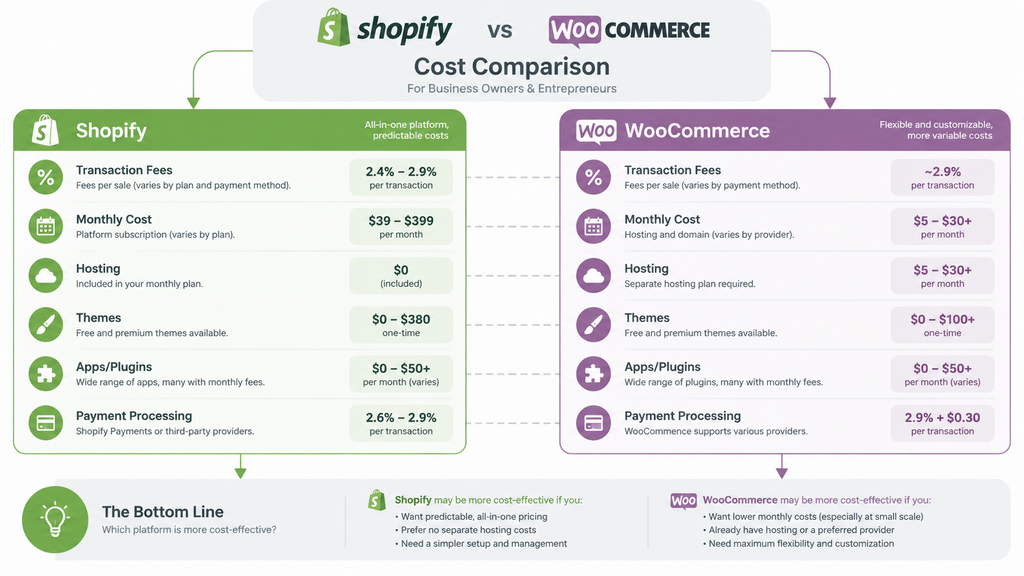
The Shopify vs WooCommerce cost comparison is more nuanced than the headline numbers suggest. WooCommerce appears cheaper at first glance because the core plugin is free. Shopify appears expensive because you pay a monthly subscription. But the total cost of ownership over 12 to 24 months tells a more balanced story.
Shopify Pricing
On the Shopify vs WooCommerce pricing comparison, Shopify plans start at £25 per month for the Basic plan, £65 per month for the standard Shopify plan, and £344 per month for Advanced. These prices include hosting, SSL security, unlimited bandwidth, and 24/7 customer support. The primary variable cost is the transaction fee — 2% on Basic, 1% on Shopify, 0.5% on Advanced — which is waived entirely if you use Shopify Payments as your payment processor.
For most new ecommerce businesses, the Basic or standard Shopify plan provides everything needed for the first one to two years. The all-inclusive pricing model makes monthly costs predictable and eliminates the hidden costs that frequently inflate WooCommerce’s true expense.
WooCommerce Pricing
WooCommerce itself is free in the Shopify vs WooCommerce cost comparison, but the total cost of a WooCommerce store includes hosting (£5 to £30 per month depending on quality and traffic), a premium theme (£40 to £100 one-off), essential plugins for subscription management, SEO, security, and backups (£100 to £300 per year), and — for most non-technical users — occasional developer costs for customisation and maintenance. When these costs are totalled, mid-range WooCommerce stores are frequently comparable in cost to Shopify. However, WooCommerce can be genuinely cheaper for technical users who manage their own setup. In the Shopify vs WooCommerce cost comparison, the winner depends entirely on your technical capabilities and whether you value time or money more highly.
Want Your Store To Actually Convert?
Strategy is step one — execution is what moves revenue. Tasknestly builds and optimizes ecommerce stores that convert.
Get Ecommerce Services →Shopify vs WooCommerce: SEO and Marketing
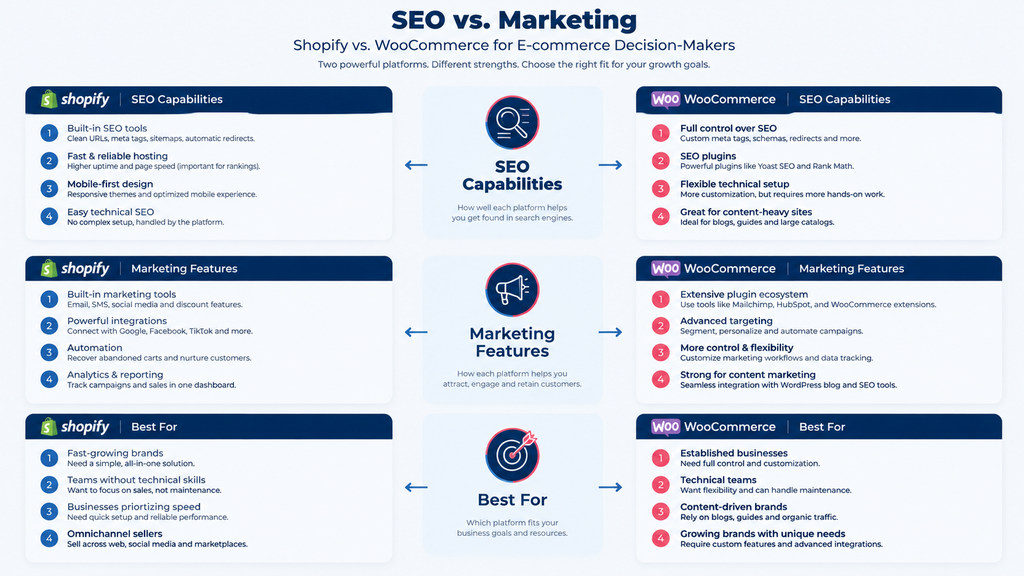
Search engine optimisation is one of the most important long-term growth drivers for any ecommerce business, making the Shopify vs WooCommerce SEO comparison a critical evaluation point for businesses investing in organic traffic.
WooCommerce SEO Advantages
WooCommerce’s greatest strength in the SEO comparison is that it runs on WordPress — the most SEO-friendly content management system available. WordPress gives you granular control over URL structures, meta tags, heading hierarchies, schema markup, site speed optimisation, and canonical tags. Combined with plugins like RankMath Pro or Yoast SEO, WooCommerce stores can achieve a level of technical SEO precision that is difficult to replicate on Shopify.
The ability to blog natively within WooCommerce — using WordPress’s powerful content editor — is also a significant organic growth advantage. Content marketing is one of the most effective long-term traffic strategies for ecommerce, and WooCommerce’s seamless integration between store and blog gives it a meaningful edge in the Shopify vs WooCommerce SEO debate for businesses committed to content-driven growth.
Shopify SEO Capabilities
Shopify’s built-in SEO is solid for most businesses — it generates XML sitemaps automatically, allows editing of meta titles and descriptions, supports structured data for product listings, and integrates with Google Search Console. Its main SEO limitations are structural: URL formats for collections and products include fixed subdirectories that cannot be removed, and canonical tag management has historically been less flexible than WordPress.
For the majority of ecommerce businesses selling physical products through standard category and product page structures, Shopify’s SEO is more than adequate. The SEO gap between the two platforms matters most for content-heavy stores and businesses investing heavily in technical SEO differentiation.
| Want a Store That Ranks and Converts From Launch Day?Tasknestly’s website services include full SEO setup, conversion-optimised store design, and mobile-first development — built for growth on Shopify, WooCommerce, or your platform of choice.Book your free store consultation → |
Want Your Store To Actually Convert?
Strategy is step one — execution is what moves revenue. Tasknestly builds and optimizes ecommerce stores that convert.
Get Ecommerce Services →Shopify vs WooCommerce: Scalability and Ownership
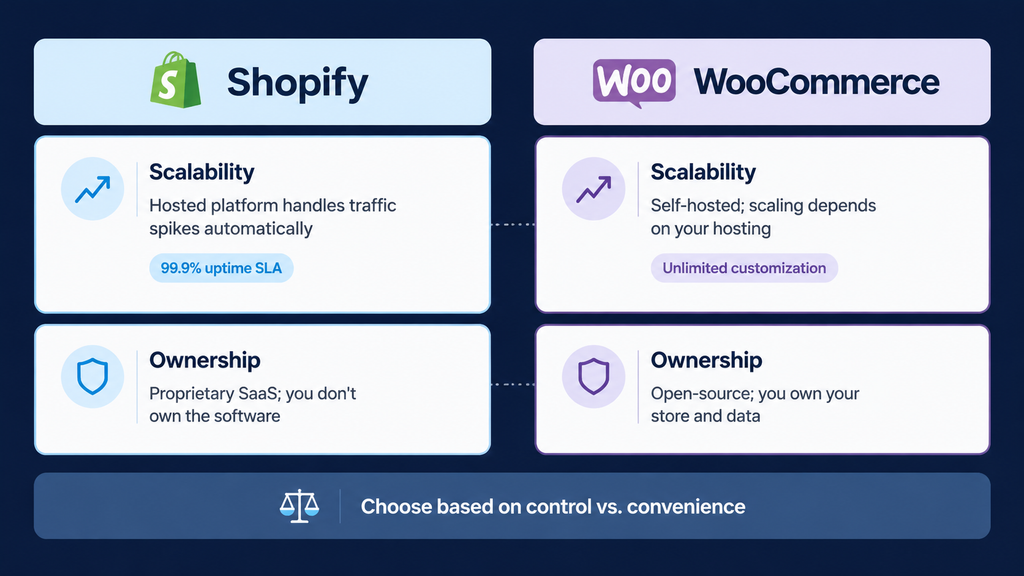
As your ecommerce business grows, scalability and data ownership become increasingly important considerations in the Shopify vs WooCommerce decision.
Shopify Scalability
Shopify handles scale exceptionally well. The platform is built to manage high-volume traffic spikes — such as Black Friday sales — without requiring any technical intervention from the store owner. Shopify’s infrastructure scales automatically, meaning you never need to upgrade your hosting plan or worry about your store going down during peak trading periods.
Shopify Plus, the enterprise tier, powers some of the world’s largest ecommerce brands including Gymshark and Allbirds. If growth is your primary objective, Shopify vs WooCommerce scalability clearly favours Shopify for businesses that anticipate significant traffic volume and want to avoid the technical infrastructure management that scaling WooCommerce requires.
WooCommerce: Ownership and Control
The most significant WooCommerce advantage in the Shopify vs WooCommerce comparison is data ownership. With WooCommerce, you own your store completely — your customer data, your product data, your order history, and your store code all live on your server and can be exported, migrated, or backed up entirely at any time. With Shopify, your data is hosted on Shopify’s infrastructure, and if Shopify were to change its terms, pricing, or cease to exist, your access to your store data depends on their cooperation.
For businesses that place high value on data sovereignty — particularly those in regulated industries or those with large, valuable customer databases — WooCommerce’s complete data ownership is a compelling advantage that no Shopify feature can fully replicate.
Want Your Store To Actually Convert?
Strategy is step one — execution is what moves revenue. Tasknestly builds and optimizes ecommerce stores that convert.
Get Ecommerce Services →Shopify vs WooCommerce: Payment and App Ecosystems
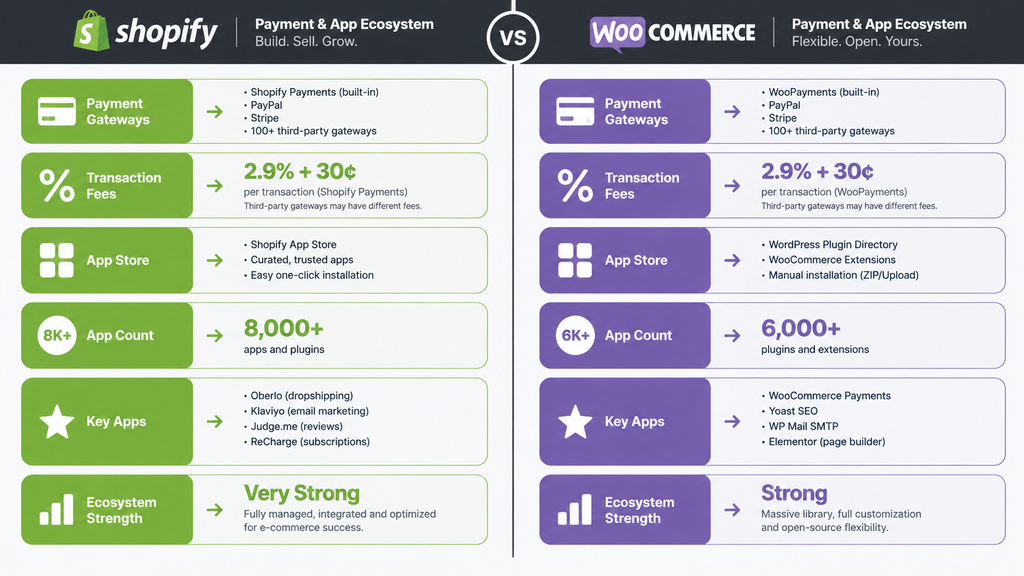
Payment processing and apps are two important Shopify vs WooCommerce considerations — and understanding them is central to the Shopify vs WooCommerce decision and integrations are two of the most practically significant factors in the Shopify vs WooCommerce decision — they determine what your store can do and how much each additional capability will cost.
Payment Processing
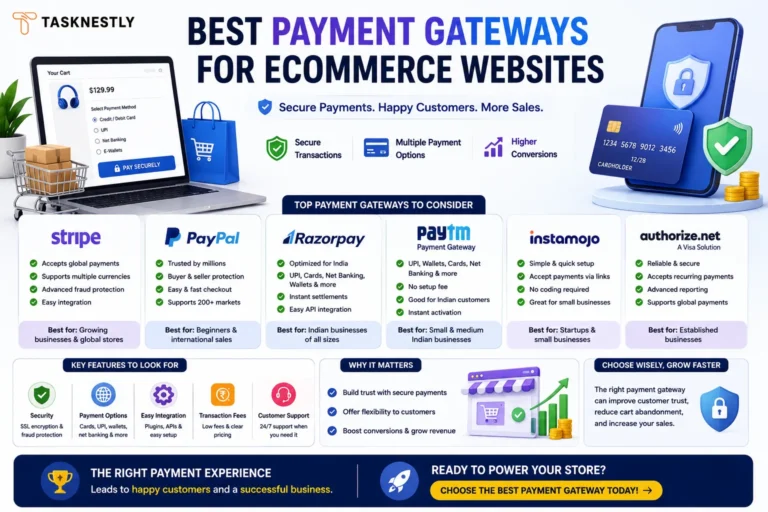
Shopify offers 100+ payment gateways and its own Shopify Payments processor, which eliminates transaction fees when used. This is one of Shopify’s clearest advantages in the Shopify vs WooCommerce payment comparison — WooCommerce charges no platform transaction fees but also offers no native payment processing, requiring you to set up and manage a separate payment gateway account.
Both platforms support Stripe, PayPal, Apple Pay, and Google Pay. WooCommerce’s payment plugin ecosystem is extensive — virtually every payment gateway available worldwide has a WooCommerce plugin — giving it a slight edge for businesses selling into international markets with specific local payment method requirements.
App and Plugin Ecosystems
In the Shopify vs WooCommerce app ecosystem comparison, Shopify’s app store contains over 8,000 apps covering marketing, inventory, customer service, loyalty, subscriptions, and more. WooCommerce has access to the entire WordPress plugin ecosystem of 59,000+ plugins — the largest in the world. In the Shopify vs WooCommerce ecosystem comparison, WooCommerce wins on sheer volume, but Shopify’s curated app store maintains higher quality standards for performance and compatibility.
Shopify apps are reviewed for performance impact and must maintain compatibility with platform updates — reducing the risk of an app breaking your store after a platform update. WordPress plugins have no such mandatory quality gate, meaning incompatibility issues between plugins and WordPress or WooCommerce updates require more active management for WooCommerce store owners.
Want Your Store To Actually Convert?
Strategy is step one — execution is what moves revenue. Tasknestly builds and optimizes ecommerce stores that convert.
Get Ecommerce Services →Shopify vs WooCommerce: Which Should You Choose?
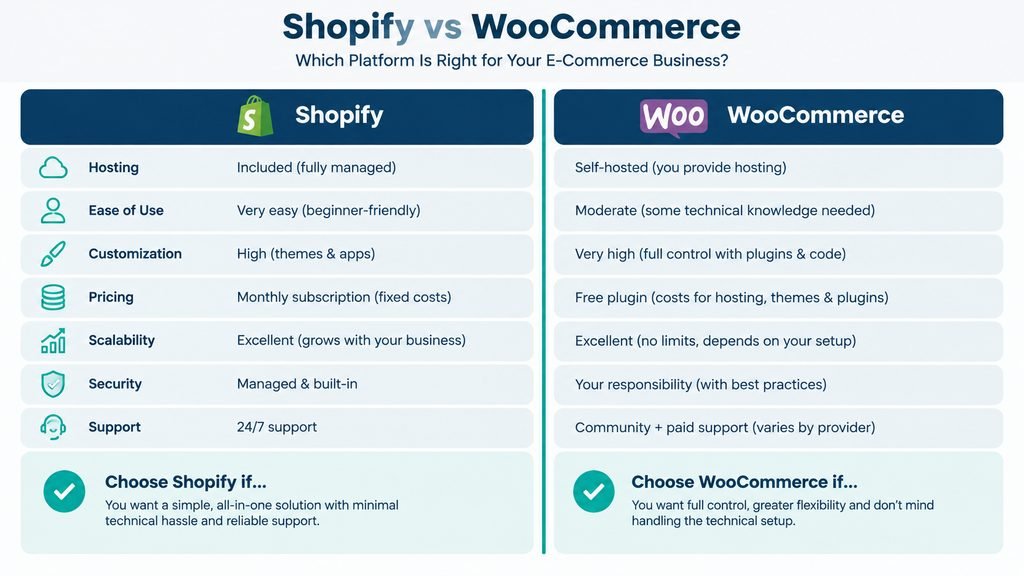
After this thorough Shopify vs WooCommerce comparison across every dimension, the answer comes down to three fundamental questions: How technical are you? How important is complete data ownership? And how quickly do you need to launch?
In the Shopify vs WooCommerce decision, choose Shopify if you want to launch quickly with minimal technical management, value 24/7 customer support, anticipate scaling to high transaction volumes, and are comfortable paying a monthly subscription for a fully managed ecommerce environment. Shopify is the right choice for the majority of new ecommerce businesses and for established businesses that want to focus on products and marketing rather than technical infrastructure.
Choose WooCommerce in the Shopify vs WooCommerce comparison if you are comfortable with WordPress and web hosting management, need maximum design and technical customisation, want complete ownership of your data and code, and are willing to invest in managing the technical complexity of a self-hosted platform. WooCommerce is the right choice for content-heavy stores, WordPress-based businesses expanding into ecommerce, and technically proficient users who want full control over every aspect of their store.
The Shopify vs WooCommerce debate does not have a universal winner — it has two valid answers for two different types of ecommerce business. Choosing the wrong platform for your specific situation is a recoverable mistake, but it is an expensive and time-consuming one. Take the time to evaluate both platforms honestly against your specific technical capabilities, budget, growth ambitions, and the type of shopping experience you want to create for your customers.
Want Your Store To Actually Convert?
Strategy is step one — execution is what moves revenue. Tasknestly builds and optimizes ecommerce stores that convert.
Get Ecommerce Services →Shopify vs WooCommerce: Security and Maintenance
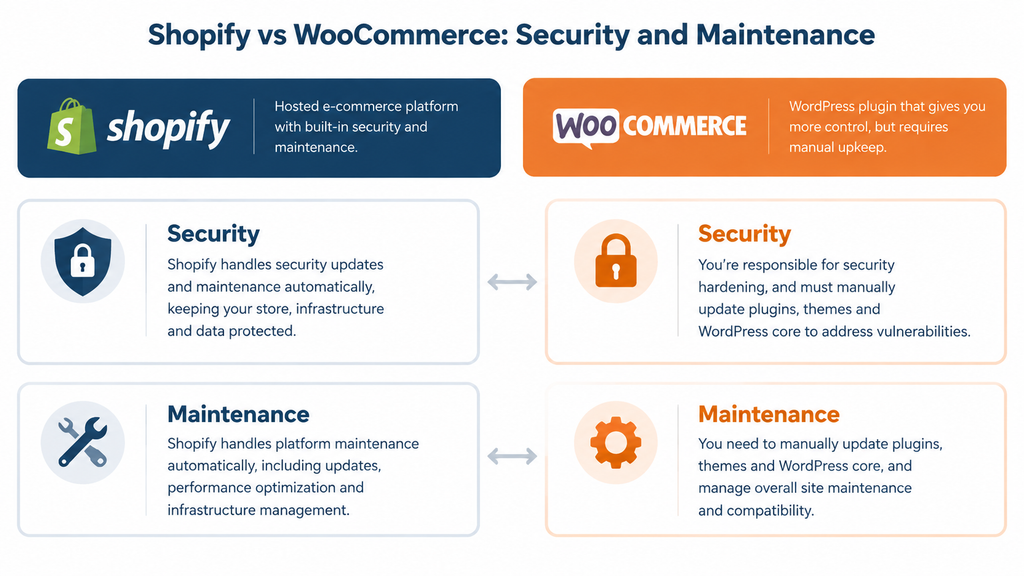
Security and ongoing maintenance is another meaningful Shopify vs WooCommerce difference between the platforms. With Shopify, the platform handles all security updates, SSL certificates, and compliance requirements automatically. You never need to patch a plugin, update a theme framework, or worry about whether your store is protected against the latest vulnerability — Shopify manages it as part of your subscription. This is one of the most underappreciated advantages of the Shopify side of the Shopify vs WooCommerce comparison for non-technical business owners.
On the WooCommerce side of the Shopify vs WooCommerce equation, you are responsible for keeping WordPress core, your theme, and all plugins updated. Outdated WordPress installations are the most common source of ecommerce security breaches, and a hacked store creates customer trust damage that far exceeds the cost of any technical fix. WooCommerce site owners should use a managed WordPress hosting provider, install a security plugin, and schedule weekly update reviews to maintain the security standards that Shopify vs WooCommerce managed hosting provides automatically. For most small business owners, this ongoing responsibility is the strongest argument for choosing Shopify over WooCommerce.
Want Your Store To Actually Convert?
Strategy is step one — execution is what moves revenue. Tasknestly builds and optimizes ecommerce stores that convert.
Get Ecommerce Services →Shopify vs WooCommerce: Full Feature Comparison
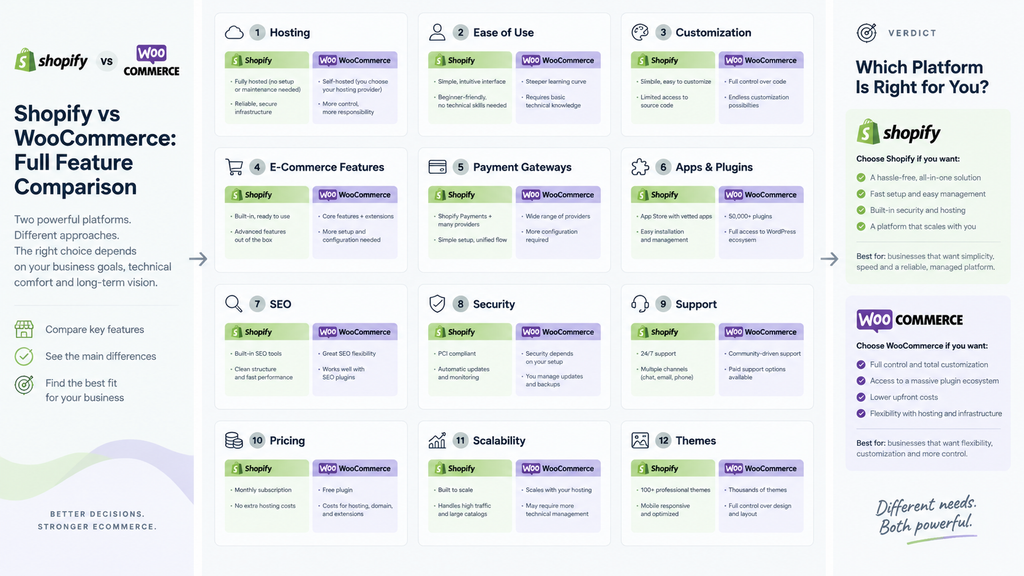
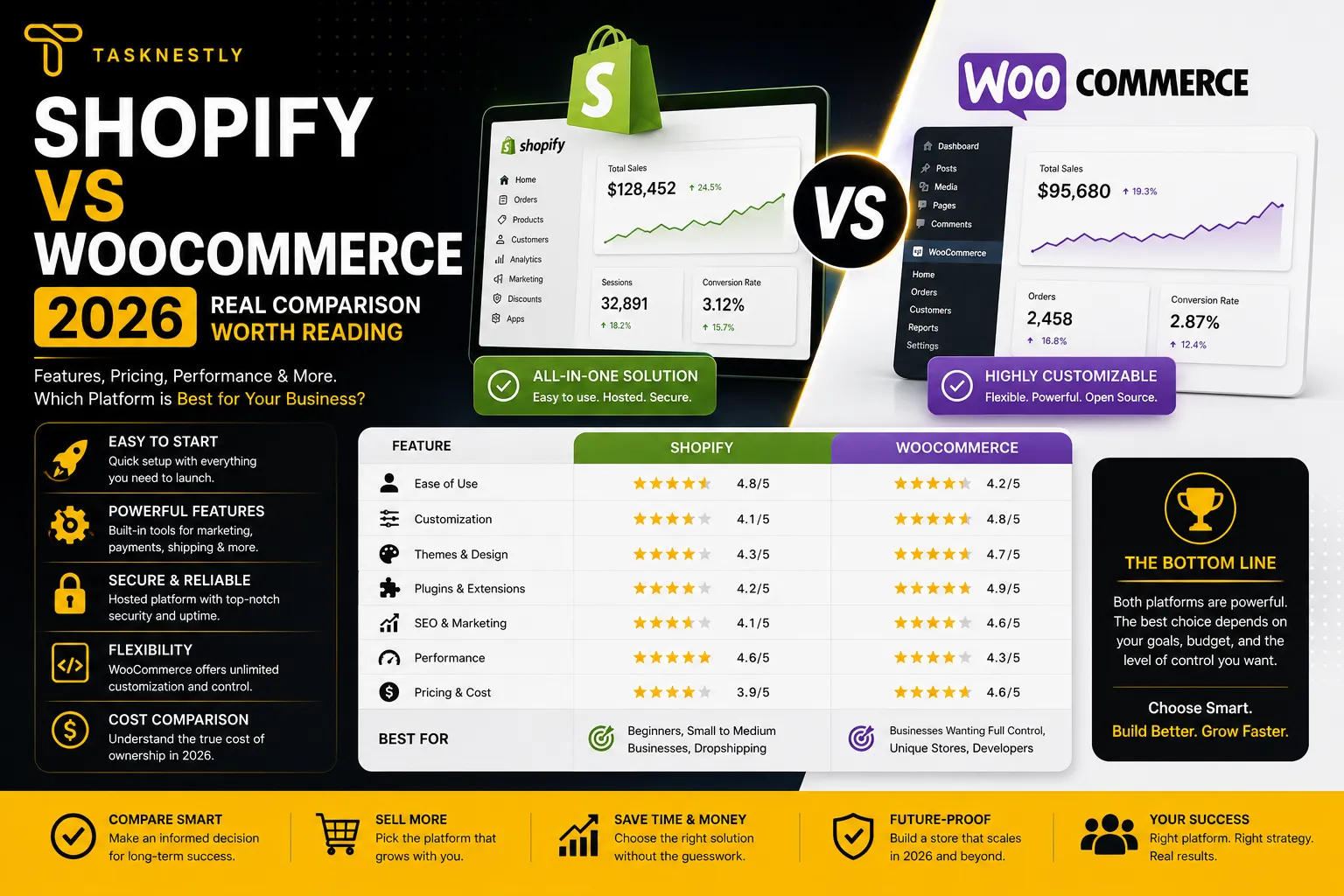
Use this table to compare Shopify vs WooCommerce across every key feature category relevant to your business decision.
| Feature | Shopify | WooCommerce | Winner |
| Ease of setup | Very easy — no technical skills | Moderate — WordPress knowledge helps | Shopify |
| Monthly cost | £25-£79+ (hosting included) | £5-£20 hosting + plugins | WooCommerce (lower base cost) |
| Design flexibility | High — 100+ themes | Very High — full code access | WooCommerce |
| App/plugin ecosystem | 8,000+ apps | 59,000+ WordPress plugins | WooCommerce |
| Payment options | 100+ gateways built-in | All major gateways via plugins | Tie |
| SEO capabilities | Good — built-in basics | Excellent — full WordPress SEO control | WooCommerce |
| Scalability | Excellent — handles high volume | Good — requires technical management | Shopify |
| Customer support | 24/7 live chat and phone | Community forums and paid support | Shopify |
| Transaction fees | 0.5-2% on non-Shopify Payments | None (pay gateway fees only) | WooCommerce |
| Ownership and control | Platform-dependent | Full ownership of data and code | WooCommerce |
| Best for | Beginners and fast launchers | Tech-savvy users and WordPress sites | Depends on user |
| Tools to Launch and Grow Your Ecommerce StoreShopify — The most beginner-friendly ecommerce platform with everything needed to launch, manage, and scale your online store.Hostinger — Fast, reliable WordPress hosting for WooCommerce stores with affordable plans and easy WordPress installation.Canva — Design your store branding, product images, and social content without needing a professional designer on day one. |
Want Your Store To Actually Convert?
Strategy is step one — execution is what moves revenue. Tasknestly builds and optimizes ecommerce stores that convert.
Get Ecommerce Services →Frequently Asked Questions: Shopify vs WooCommerce
| Question | Answer |
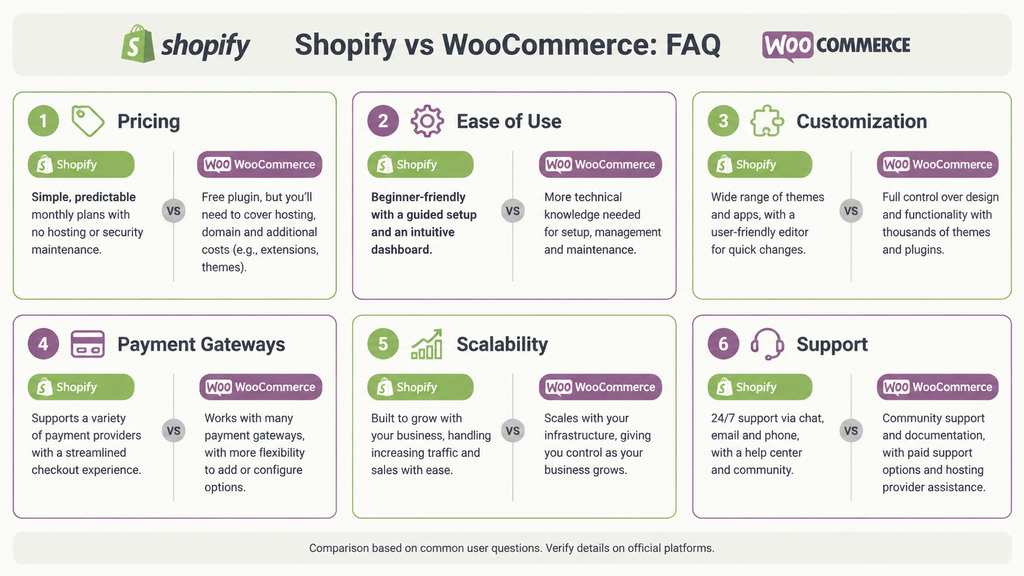
| Is Shopify better than WooCommerce for beginners? | Yes. Shopify is generally better than WooCommerce for beginners because it requires no technical knowledge, includes hosting and security management, and offers 24/7 support. WooCommerce offers more flexibility but requires managing WordPress, hosting, security, and plugin compatibility independently. |
| Which is cheaper: Shopify or WooCommerce? | WooCommerce has a lower base cost because the plugin itself is free, and basic hosting starts at £5-10 per month. However, premium themes, essential plugins, and developer costs often make WooCommerce comparable to or more expensive than Shopify for businesses that need significant functionality. |
| Can I migrate from WooCommerce to Shopify? | Yes, migrating from WooCommerce to Shopify is possible and is done regularly by growing businesses. The migration involves exporting your products, customers, and orders from WooCommerce and importing them into Shopify. Several migration tools and apps simplify the process, though some manual work is typically required. |
| Does Shopify or WooCommerce have better SEO? | WooCommerce (via WordPress) has stronger native SEO capabilities because it runs on WordPress, which offers granular control over technical SEO, URL structures, and content. Shopify’s SEO is solid for most businesses but has some structural limitations, particularly around URL formats and canonical tags. |
| What are Shopify’s transaction fees? | Shopify charges transaction fees of 2% on the Basic plan, 1% on the Shopify plan, and 0.5% on the Advanced plan when not using Shopify Payments. If you use Shopify Payments as your payment processor, transaction fees are waived entirely — making it essential to use Shopify Payments where available. |
| Can WooCommerce handle a large ecommerce store? | Yes, WooCommerce can handle large ecommerce stores with thousands of products, but it requires quality hosting — typically a managed WordPress host like WP Engine or Kinsta — and ongoing technical maintenance to ensure performance at scale. Large WooCommerce stores need developer input to optimise speed and security. |
| Which platform should I choose: Shopify or WooCommerce? | Choose Shopify if you are new to ecommerce, want a fast launch with minimal technical management, and value 24/7 support. Choose WooCommerce if you are comfortable with WordPress, need maximum customisation and data ownership, and want to avoid monthly platform fees beyond hosting. |
Want Your Store To Actually Convert?
Strategy is step one — execution is what moves revenue. Tasknestly builds and optimizes ecommerce stores that convert.
Get Ecommerce Services →Conclusion: Shopify vs WooCommerce — Final Shopify vs WooCommerce Verdict — Which Is Right for You?
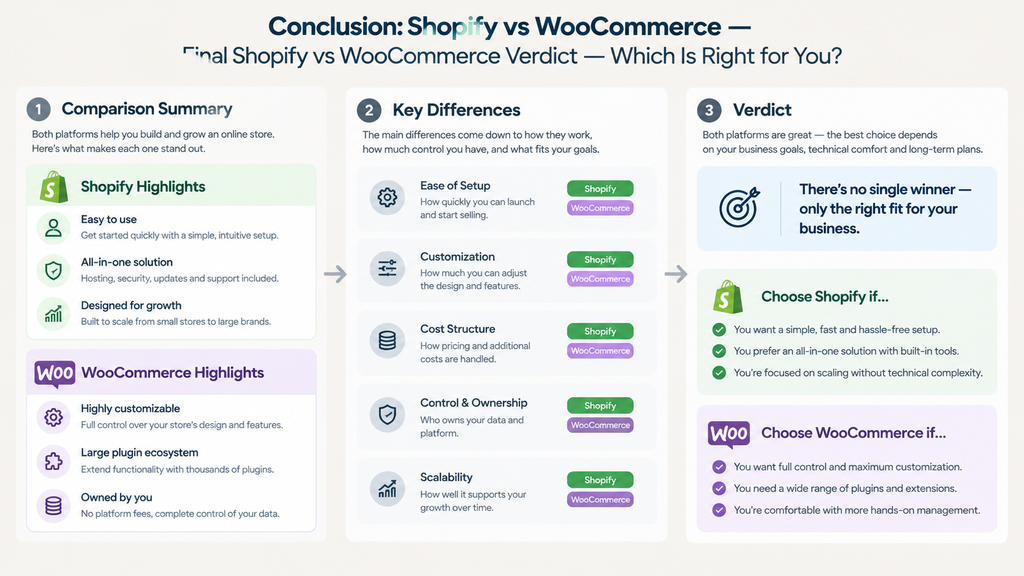
The Shopify vs WooCommerce decision ultimately comes down to two questions: how technically comfortable are you, and how much do you value speed and simplicity versus control and flexibility? Shopify wins on ease of use, launch speed, scalability, and customer support. WooCommerce wins on SEO control, data ownership, customisation depth, and long-term cost for technical users.
In the Shopify vs WooCommerce comparison, the majority of beginners will find Shopify is the right choice. The Shopify vs WooCommerce decision favours Shopify for non-technical entrepreneurs. It removes the technical barriers that prevent many new ecommerce businesses from launching and growing, and its ecosystem of apps and integrations covers almost every functionality need. For WordPress-experienced users, content-heavy stores, or businesses that require complete data ownership and maximum technical control, WooCommerce is the more powerful and ultimately more cost-efficient choice. The Shopify vs WooCommerce best answer is always the platform that you will actually use effectively — not the one with the longer feature list.
The Shopify vs WooCommerce debate will continue to evolve as both platforms grow — but the Shopify vs WooCommerce fundamentals covered in this guide will remain relevant for years to come.
At Tasknestly, we help businesses navigate the Shopify vs WooCommerce decision and build ecommerce stores on both platforms — designing for conversion, configuring for search, and setting up marketing systems that drive sustainable revenue growth. If you need expert Shopify vs WooCommerce guidance — including a definitive Shopify vs WooCommerce recommendation for your specific situation — or want a store built correctly from the start, explore our ecommerce services or request a free quote today.
Features and fees change often, so before you commit, check the current details on the official WooCommerce plugin page and compare them with your chosen Shopify plan.
Want Your Store To Actually Convert?
Strategy is step one — execution is what moves revenue. Tasknestly builds and optimizes ecommerce stores that convert.
Get Ecommerce Services →Grow With Tasknestly
Subscribe to the Tasknestly newsletter and get the latest tips on websites, SEO, social media, and digital growth.