
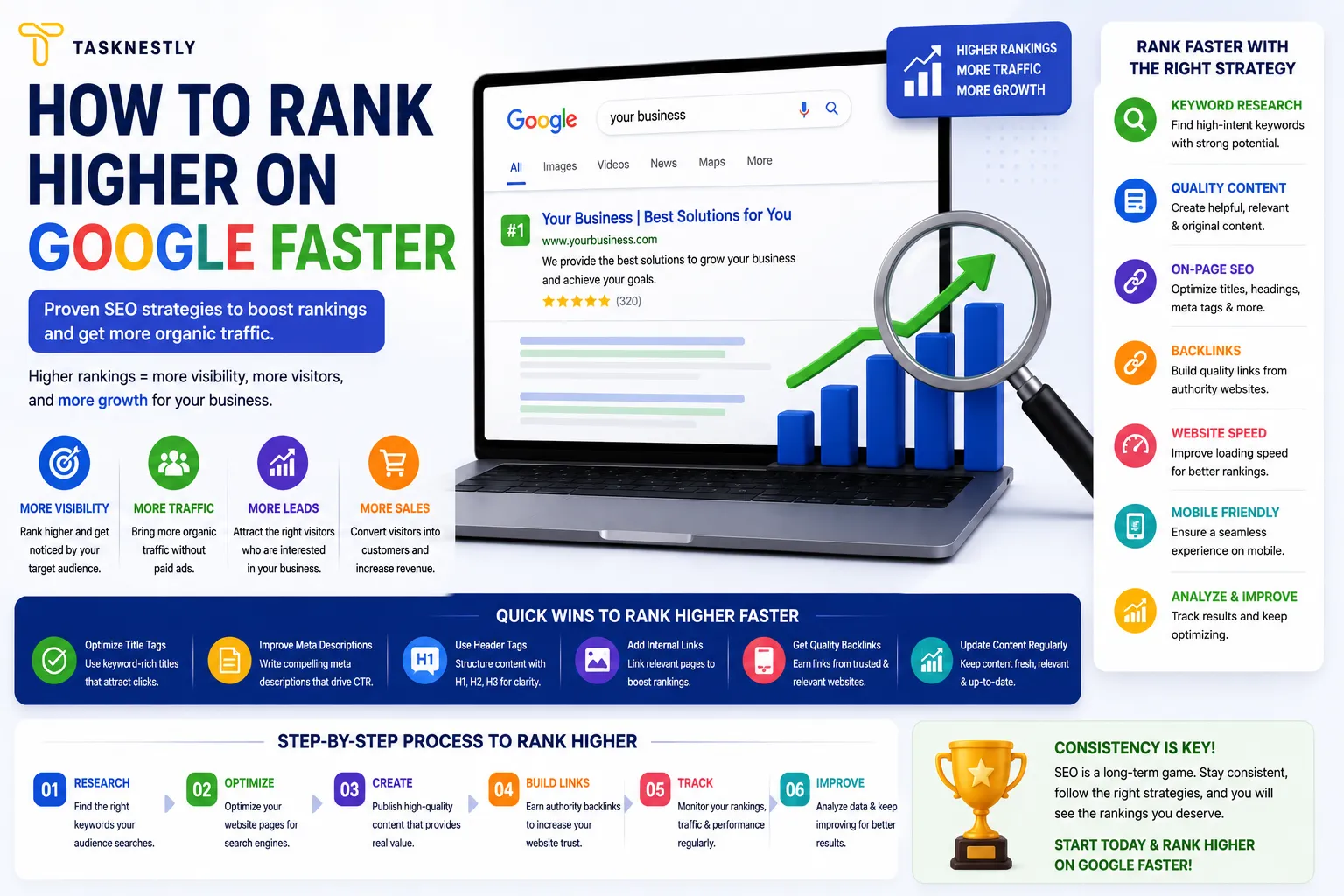
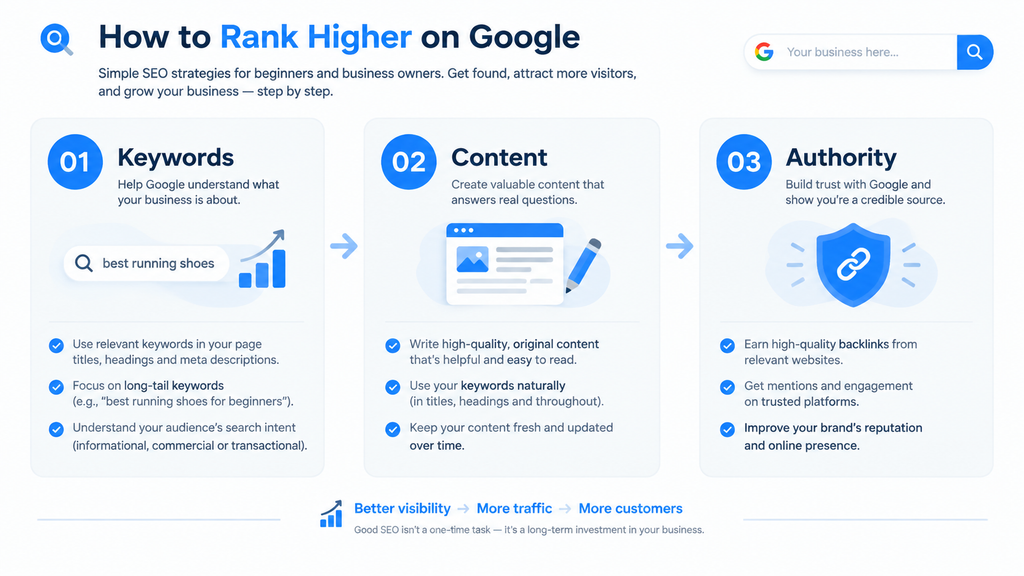
Knowing how to rank higher on Google is the most commercially valuable SEO skill available to any business or content creator in 2026. Google processes over 8.5 billion searches per day, and the websites appearing on page one of those searches capture over 90 percent of the clicks. The difference between ranking on page one and ranking on page two is not a small performance gap — it is a near-total visibility gap. Ranking in position one generates over 25 percent of all clicks for a given search; ranking in position eleven generates under 2 percent.
The tactics that determine how to rank higher on Google have become simultaneously more complex at the margins and simpler at the core. At the margins, voice search, AI-generated search summaries, and increasingly sophisticated intent-matching algorithms require nuanced understanding. At the core, the fundamentals that have always driven ranking success — comprehensive, relevant content, authoritative backlinks, and technically sound websites — remain the dominant ranking factors in 2026 and are likely to remain so for the foreseeable future.
This guide covers the 10 most impactful, proven tactics for how to rank higher on Google in 2026 — from content strategy and keyword targeting to technical SEO, backlink acquisition, and the increasingly important signals of user experience quality. Each tactic is explained with specific implementation steps, realistic timeline expectations, and the specific ranking mechanism it addresses.
| Want Expert SEO That Ranks Your Business Higher on Google?Tasknestly’s professional SEO services implement proven ranking tactics across content, technical SEO, and link building — building organic visibility that compounds month after month.Get your FREE SEO Audit → |
Ranking Takes More Than Tips
You know the strategy now — let Tasknestly handle the technical SEO, content, and link building that actually moves rankings.
Get SEO Services →Table of Contents
How to Rank Higher on Google: Content Tactics
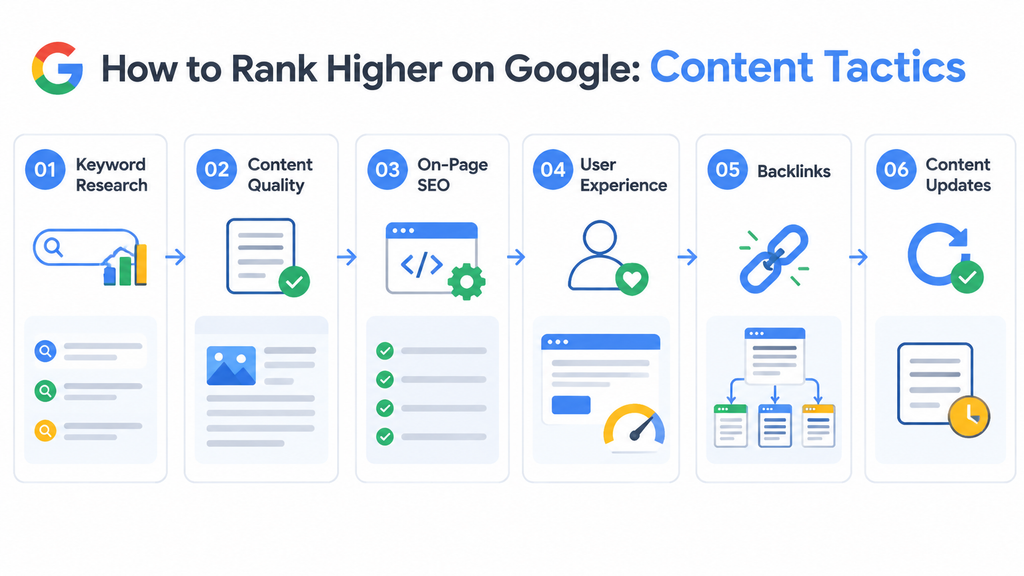
Content quality and strategic keyword targeting are the two most fundamental answers to how to rank higher on Google — they determine whether your pages are even eligible to rank before any other factor is considered.
Tactic 1: Produce Comprehensive, High-Quality Content
The most reliable answer to how to rank higher on Google is to produce the most genuinely helpful, most comprehensive content available for your target keyword. Google’s stated mission is to organise the world’s information and make it universally accessible and useful — and its algorithm is increasingly effective at identifying content that fulfils this mission versus content that merely appears to through keyword optimisation techniques.
Comprehensive content addresses every aspect of the search intent behind its target keyword: it answers the primary question, anticipates and answers follow-up questions, provides specific examples and actionable guidance, and presents information in a format that makes it easy to consume. Before writing any piece of content aimed at improving your Google rankings, read the top three ranking pages for your target keyword and identify what additional depth, clarity, or angle your content can provide that the existing results do not.
Tactic 2: Target Keywords Your Domain Can Actually Win
Understanding how to rank higher on Google requires understanding keyword difficulty — the competitive strength of the pages already ranking for your target keyword. A new website with low domain authority cannot outrank established sites with thousands of backlinks on highly competitive terms, regardless of content quality. Targeting keywords appropriate to your current domain strength is one of the fastest practical answers to how to rank higher on Google, because achievable keyword targets produce actual rankings rather than page-ten positions that generate no traffic.
Filter your keyword research to difficulty scores that match your domain’s current authority level — below 20 to 25 for new sites, up to 40 for mid-authority sites. Rank for these accessible keywords first, building the domain authority and ranking history that progressively enables competing for harder terms. Each page that achieves page one rankings adds to your site’s overall authority, making the next competitive keyword slightly easier to rank for.
Tactic 3: Match Content Precisely to Search Intent
Search intent matching is one of the most technically impactful answers to how to rank higher on Google because Google’s algorithm has become highly effective at identifying when a page satisfies the intent behind a search versus when it merely contains the keywords. If your target keyword is ‘best running shoes’, Google serves product listing pages and review articles — not a brand’s product page. If you publish a product page targeting that keyword, it will not rank regardless of on-page optimisation, because the format does not match what searchers want.
Determine the search intent for every target keyword before creating content by analysing the top 10 results: are they blog posts, product pages, listicles, videos, or local business listings? The dominant format of existing results tells you exactly what format your content must take to be eligible for competitive ranking on that keyword.
Ranking Takes More Than Tips
You know the strategy now — let Tasknestly handle the technical SEO, content, and link building that actually moves rankings.
Get SEO Services →How to Rank Higher on Google: Technical Tactics
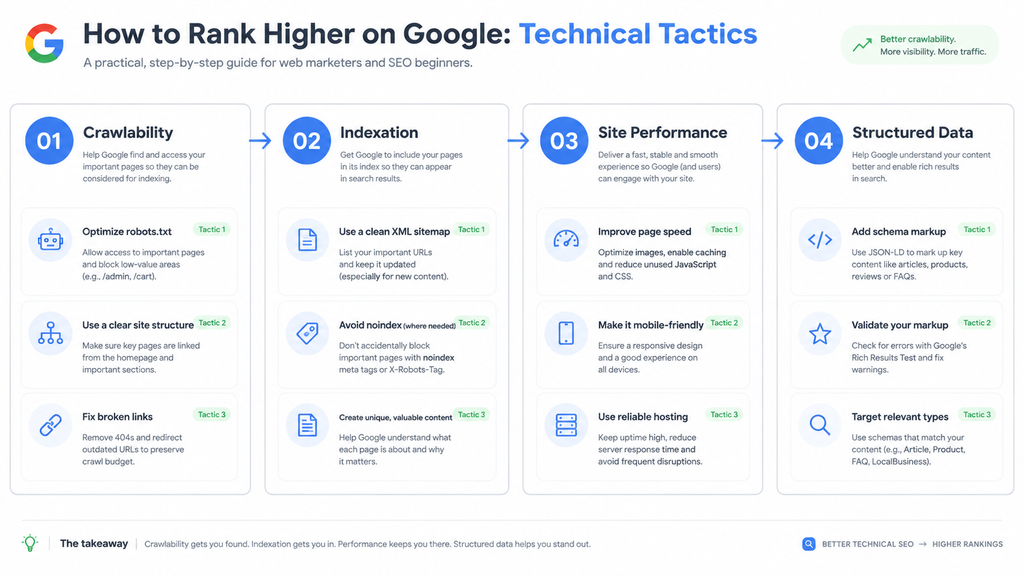
Technical SEO addresses the factors that determine whether Google can effectively crawl, index, and evaluate your pages. These how to rank higher on Google tactics often produce the fastest ranking improvements because they remove specific, identifiable barriers rather than building new competitive advantages.
Tactic 4: Improve Core Web Vitals and Page Speed
Google incorporates Core Web Vitals — a set of user experience metrics measuring loading speed, visual stability, and interactivity — directly into its ranking algorithm. Pages that score ‘Good’ on all three Core Web Vitals metrics (Largest Contentful Paint under 2.5s, Cumulative Layout Shift under 0.1, Interaction to Next Paint under 200ms) receive a ranking boost over pages with equivalent content quality but poor technical performance. Improving Core Web Vitals is one of the most direct answers to how to rank higher on Google for pages that are already ranking but not achieving page one positions.
The most impactful Core Web Vitals improvements are image optimisation and compression (the most common LCP bottleneck), elimination of render-blocking scripts, reduction of Cumulative Layout Shift caused by ads and embeds loading without reserved space, and upgrading to faster hosting infrastructure. Use Google PageSpeed Insights to identify your specific failing metrics and the precise changes recommended for your site.
Tactic 5: Fix Technical SEO Errors
Technical errors — broken links, crawl errors, redirect chains, duplicate content, and missing canonical tags — prevent Google from efficiently crawling and indexing your site, directly suppressing your ability to rank higher on Google. A page that returns a 404 error cannot rank. A page blocked by robots.txt cannot be indexed. A page with no canonical tag on a duplicate URL may lose ranking potential to a competing version of itself.
Run a full technical site audit using Screaming Frog quarterly to identify and fix technical issues systematically. Monitor Google Search Console’s Coverage report monthly for any new indexation errors. Technical fixes often produce rapid ranking improvements — pages with crawl errors corrected can gain meaningful positions within days of the fix being crawled and indexed.
Tactic 6: Optimise Page Titles, Meta Tags, and Structure
On-page elements — title tags, meta descriptions, heading structure, and URL format — are the primary signals Google uses to understand what your page is about and determine its relevance for specific search queries. Optimising these elements is one of the most direct how to rank higher on Google tactics for pages that already have content and traffic but are not ranking as highly as they should.
Your title tag should include your primary keyword within the first 60 characters and be written to maximise click-through rate. Your H1 should contain your primary keyword and match the searcher’s framing of the topic. H2 headings should include related keywords and questions that the content addresses. URL slugs should be short, descriptive, and keyword-inclusive without unnecessary words.
| Need a Complete Digital Marketing Strategy for Better Rankings?Tasknestly’s digital marketing services combine SEO, content strategy, and link building into a cohesive programme that builds rankings, organic traffic, and leads month after month.Book your free digital marketing consultation → |
Ranking Takes More Than Tips
You know the strategy now — let Tasknestly handle the technical SEO, content, and link building that actually moves rankings.
Get SEO Services →How to Rank Higher on Google: Authority and Long-Term Tactics
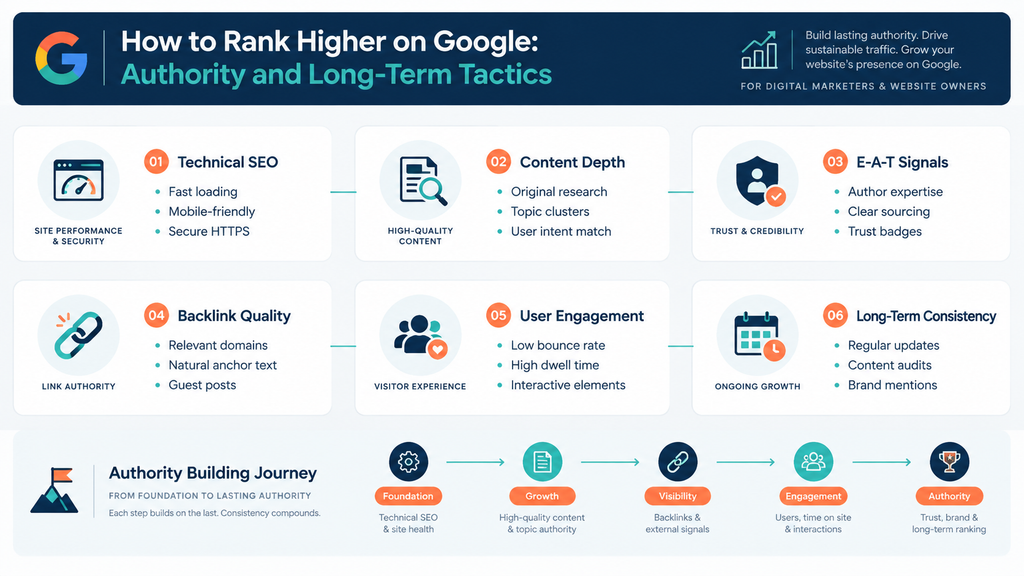
These tactics address the authority-building and long-term compounding factors that determine your site’s ability to rank higher on Google for competitive terms over a 6 to 12 month horizon.
Tactic 7: Build High-Quality Backlinks
Backlinks from relevant, authoritative websites remain one of the strongest signals Google uses to evaluate a page’s authority and determine how to rank higher on Google for competitive keywords. A page with strong on-page content but no backlinks will typically rank below a page with comparable content and ten high-quality backlinks for competitive terms — because backlinks signal that other credible sources consider the content valuable enough to reference.
Focus backlink acquisition on quality over quantity: ten backlinks from relevant, mid-to-high authority websites produce more ranking impact than a hundred links from low-quality or irrelevant sources. Effective beginner link building tactics include digital PR — pitching expert commentary to journalists — guest posting on relevant industry blogs, and creating linkable assets such as original research or comprehensive guides that naturally attract references from other content creators.
Tactic 8: Strengthen Internal Linking
Internal linking — how your pages link to each other — is one of the most underutilised how to rank higher on Google tactics for websites with existing content. Internal links distribute ranking authority from your most authoritative pages (typically your homepage, high-traffic blog posts, and pages with the most external backlinks) to your lower-authority pages, helping those pages rank higher on Google for their target keywords than they would without the internal link support.
Audit your most important commercial and content pages and identify opportunities to add internal links from relevant existing content. Prioritise adding links from pages with strong organic traffic or backlink profiles — these pass the most authority through internal links. Use descriptive anchor text for every internal link, accurately describing the destination page’s topic.
Tactic 9: Update and Refresh Existing Content Regularly
Content freshness is a ranking signal for Google, and regularly updating existing high-performing pages is one of the most efficient how to rank higher on Google tactics for sites with established content libraries. Pages that have been ranking well but are beginning to lose positions can often be rescued and improved with a content refresh: updating statistics and examples, adding new sections addressing search trends, improving the structure and readability, and ensuring the content still fully matches the current search intent for its target keyword.
Identify your top 20 organic traffic pages in Google Analytics and Search Console, then audit those with declining traffic or rankings. A focused content refresh — updating rather than replacing — signals to Google that the content is current and still actively maintained, often recovering lost positions within weeks.
Tactic 10: Build Topical Authority Across Your Subject
Topical authority — the recognition by Google that your website is a comprehensive, reliable resource on a specific topic — is the most powerful long-term answer to how to rank higher on Google for competitive terms. A website that has published 50 comprehensive, interconnected pieces of content on a topic and earned backlinks from relevant sources within that topic will consistently outrank sites that have published one or two high-quality pieces, even if those individual pieces are superior in isolation.
Build topical authority by creating content clusters: a comprehensive pillar page on your main topic, supported by in-depth articles on every subtopic, question, and related concept within that area. Interlink all cluster content to the pillar page and to each other. As your topical coverage grows, new content in the cluster ranks faster because Google recognises your domain as an authority source on the subject. This compounding authority effect is the ultimate answer to how to rank higher on Google sustainably over time.
Ranking Takes More Than Tips
You know the strategy now — let Tasknestly handle the technical SEO, content, and link building that actually moves rankings.
Get SEO Services →10 Tactics: How to Rank Higher on Google at a Glance
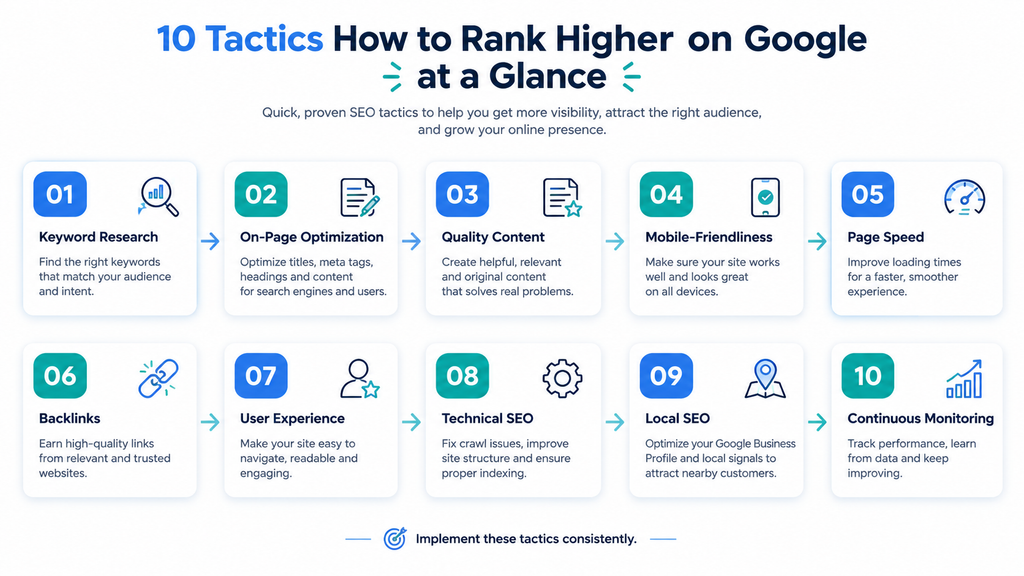
Use this table when planning your SEO roadmap for how to rank higher on Google and prioritising the tactics with the most direct impact on your current situation.
| # | Tactic to Rank Higher on Google | Timeline | Primary Ranking Factor |
| 1 | Produce comprehensive, high-quality content | 1–3 months | Content relevance and depth |
| 2 | Target low-competition keywords first | 4–8 weeks | Domain authority alignment |
| 3 | Optimise title tags and meta descriptions | 2–4 weeks | On-page relevance signals |
| 4 | Improve Core Web Vitals and page speed | 2–6 weeks | Technical ranking factors |
| 5 | Build high-quality backlinks | 3–6 months | Domain and page authority |
| 6 | Optimise for search intent precisely | 2–4 weeks | Content-to-intent alignment |
| 7 | Strengthen internal linking | 2–4 weeks | Authority distribution and crawlability |
| 8 | Fix technical SEO errors | 1–3 weeks | Crawlability and indexation |
| 9 | Update and refresh existing content | 2–6 weeks | Content freshness signals |
| 10 | Build topical authority across a subject | 6–12 months | Topical relevance and coverage depth |
| Essential Tools to Rank Higher on GoogleSEMrush — Research target keywords, analyse competitor rankings, audit technical issues, and track your position changes over time.RankMath Pro — Implement on-page SEO best practices for every WordPress page with real-time keyword guidance and scoring.Surfer SEO — Optimise your content against the top-ranking pages for your target keyword with data-driven content scoring. |
Ranking Takes More Than Tips
You know the strategy now — let Tasknestly handle the technical SEO, content, and link building that actually moves rankings.
Get SEO Services →Frequently Asked Questions: How to Rank Higher on Google
| Question | Answer |
| How long does it take to rank higher on Google? | How to rank higher on Google depends on keyword competition and your domain’s current authority. Low-competition keywords can rank on page one within 4 to 8 weeks of publishing optimised content. Competitive keywords typically take 3 to 6 months. Building authority for very competitive terms can take 12 months or more of consistent content and link building investment. |
| What is the fastest way to rank higher on Google? | The fastest way to rank higher on Google is to target low-competition, long-tail keywords with a new piece of highly relevant, comprehensive content. Pages on established domains targeting keywords with difficulty scores below 20 can achieve page one rankings within weeks. Technical fixes — correcting crawl errors, improving page speed — can also produce rapid ranking improvements for pages that were previously suppressed by technical issues. |
| Do backlinks still matter for ranking higher on Google? | Yes — backlinks remain one of the most powerful ranking signals Google uses. High-quality backlinks from relevant, authoritative websites directly increase a page’s ability to rank for competitive keywords. However, for low to medium competition keywords, strong on-page content and technical health can achieve page one rankings without significant backlink acquisition. |
| How does content length affect ranking higher on Google? | Longer, more comprehensive content tends to rank higher on Google for informational queries because it is more likely to fully satisfy the searcher’s intent. However, length alone does not produce rankings — a 3,000-word article that covers a topic shallowly will underperform a focused 1,500-word article that comprehensively addresses the specific search intent. Match your content length to the depth required to fully answer the searcher’s question. |
| Does page speed help rank higher on Google? | Yes — page speed is a confirmed Google ranking factor through Core Web Vitals. Slow loading speed increases bounce rates (a negative user experience signal), reduces crawl efficiency, and scores poorly on Core Web Vitals assessments that Google incorporates into ranking evaluations. Improving page speed to under 2.5 seconds LCP (Largest Contentful Paint) consistently improves both rankings and conversion rates. |
| What is search intent and how does it affect rankings? | Search intent is the reason behind a search query — what the searcher actually wants to find. Google serves results that match the dominant intent for each query: if most people searching a phrase want a how-to guide, Google ranks guides, not product pages. Matching your content format, depth, and angle to the search intent of your target keyword is one of the most impactful ways to rank higher on Google for that term. |
| How many keywords should a page target to rank higher on Google? | Each page should target one primary keyword and two to four closely related secondary keywords. Attempting to rank a page for many different, unrelated keywords produces unfocused content that ranks for nothing well. The best way to rank higher on Google across many keywords is to build a library of focused, intent-matched pages — each targeting one topic comprehensively — rather than trying to cover too many topics on a single page. |
Ranking Takes More Than Tips
You know the strategy now — let Tasknestly handle the technical SEO, content, and link building that actually moves rankings.
Get SEO Services →Conclusion: Apply These Tactics and Start Ranking Higher on Google
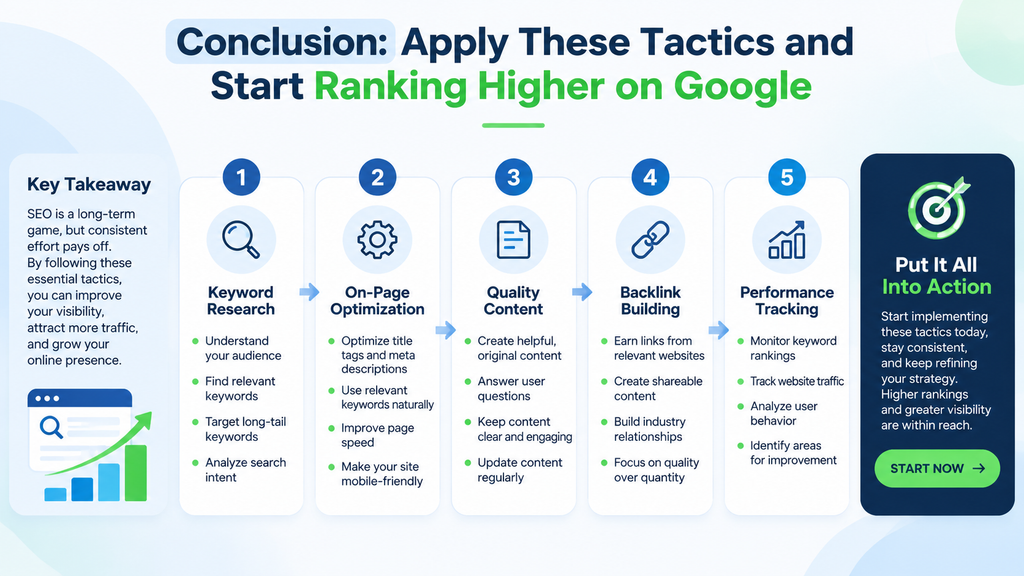
The 10 tactics in this guide for how to rank higher on Google are not theoretical — they are the specific, evidence-based methods used by every website generating significant organic search traffic. Content quality and keyword alignment are the foundation. Technical health ensures Google can access and evaluate that content efficiently. Backlinks provide the authority signal that competitive keywords require. Topical coverage creates the compounding authority that makes new content rank faster and existing content hold its position longer.
Apply these tactics in priority order based on your current situation. If your content is thin or poorly optimised, start there. If technical errors are suppressing indexation, fix them immediately. If your pages rank on page two or three for target keywords, backlinks and internal linking improvements will often push them to page one. If you are starting from scratch, target low-competition long-tail keywords with comprehensive content and build your domain authority systematically. Every tactic for how to rank higher on Google works best as part of a coherent, consistently applied strategy rather than in isolation.
At Tasknestly, we build and execute SEO strategies that implement these proven tactics for businesses that want to rank higher on Google and build sustainable organic growth. If you are ready to invest in how to rank higher on Google with expert guidance and proven execution, explore our SEO services or request a free SEO audit today.
To see how Google itself describes the systems behind its results, including link analysis, freshness and helpful content, read its guide to Google’s ranking systems.
Ranking Takes More Than Tips
You know the strategy now — let Tasknestly handle the technical SEO, content, and link building that actually moves rankings.
Get SEO Services →Grow With Tasknestly
Subscribe to the Tasknestly newsletter and get the latest tips on websites, SEO, social media, and digital growth.