
Local search has become the dominant discovery mechanism for service-area businesses and local retailers. Over 46 percent of all Google searches include local intent, and ‘near me’ searches have grown by more than 500 percent over the past five years. This shift means that for businesses serving specific geographic areas, local SEO is not an optional enhancement to their digital marketing — it is the primary channel through which new customers find and choose them.
This guide covers the 10 most effective local SEO strategies for 2026 — from Google Business Profile optimisation and citation building to review generation, locally-targeted content, and local link building. Each strategy is explained with specific implementation steps, realistic timelines, and the ranking factors it directly influences.
| Want Local SEO That Puts You on the Map?Tasknestly’s professional SEO services include full local SEO strategy and implementation — optimising your Google Business Profile, building citations, and creating locally-targeted content to drive more local customers to your business.Get your FREE Local SEO Audit → |
Ranking Takes More Than Tips
You know the strategy now — let Tasknestly handle the technical SEO, content, and link building that actually moves rankings.
Get SEO Services →Table of Contents
Local SEO Strategies: Google Business Profile Optimisation
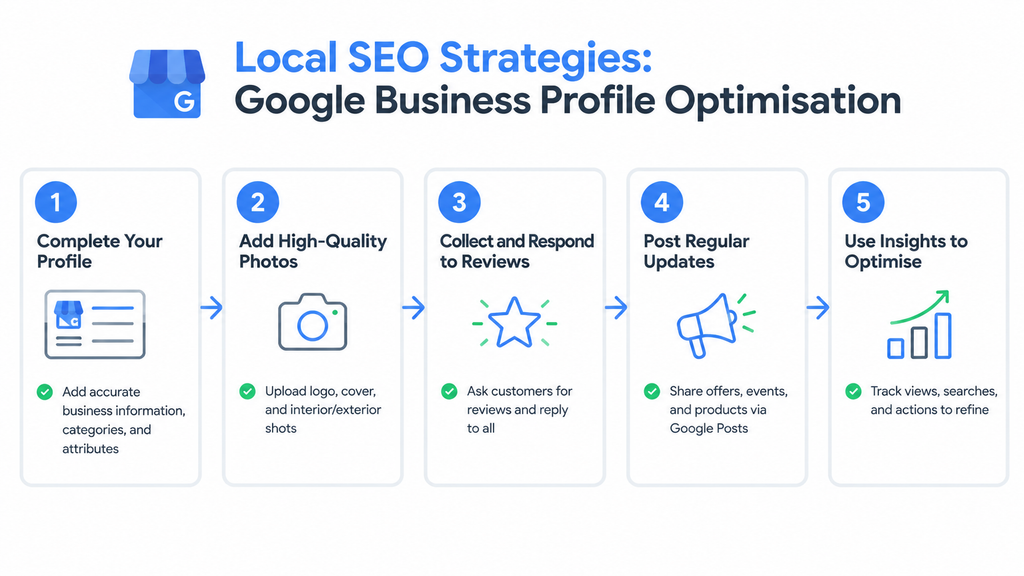
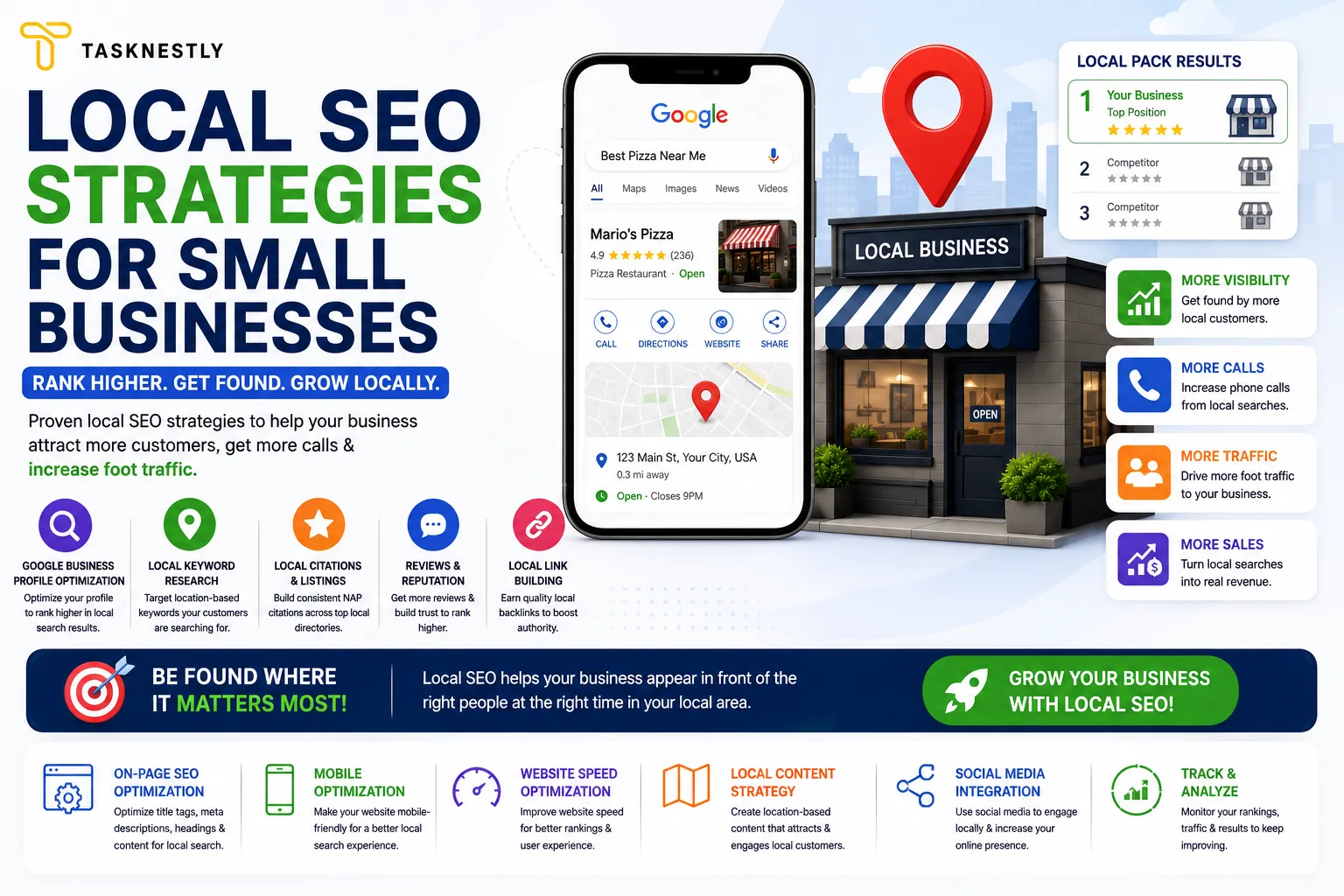
Your Google Business Profile (GBP) is the single most important asset in all local SEO strategies — it is the primary source of the information Google displays in the map pack and in the knowledge panel on the right side of search results. A fully optimised GBP generates dramatically more visibility and customer actions than a basic or incomplete one.
Strategy 1: Fully Optimise Your Google Business Profile
Complete every field in your Google Business Profile — this is the most foundational of all local SEO strategies and one of the fastest to implement. Ensure your business name exactly matches the name used on your website and in all directories. Select the most specific primary category and add all relevant secondary categories. Write a keyword-rich business description of at least 250 words that includes your primary services, your target area, and your key differentiators. Add your business hours, phone number, and website URL.
Upload a minimum of 10 high-quality photos covering your storefront, interior, team, products, and service work — GBPs with more than 10 photos receive significantly more direction requests, website clicks, and phone calls than those with no photos. Set up Google Business Profile Posts — weekly short-form updates, offers, or event announcements — to signal active business engagement, which is a positive local ranking factor.
Strategy 2: Build Local Citations and NAP Consistency
A local citation is any online mention of your business’s name, address, and phone number (NAP). Building citations across authoritative business directories — Google Business Profile, Bing Places, Apple Maps, Yelp, Yell, Thomson Local, and industry-specific directories — is one of the most proven local SEO strategies for signalling business legitimacy and location to search engines.
Critically, every citation must contain identical NAP information — the same business name format, the same address format, and the same phone number. Inconsistent NAP data across directories confuses search engines about which information is accurate, weakening your local authority signals. Audit your existing citations using a tool like BrightLocal or Moz Local, correct any inconsistencies, and build citations in directories where you do not yet appear.
Strategy 3: Generate and Actively Respond to Google Reviews
Customer reviews are one of the most powerful local SEO strategies available — they are a direct local ranking factor in Google’s map pack algorithm and the most persuasive trust signal for potential customers evaluating local businesses. Businesses with more reviews, more recent reviews, and higher average ratings consistently outrank competitors with fewer or lower-quality reviews in map pack results.
Implement a systematic review generation process: follow up with every customer via SMS or email after a completed service with a direct link to your Google review page. Make leaving a review as frictionless as possible — include a direct URL, not just a business name for the customer to find themselves. Respond to every review, positive and negative — responses signal active business engagement and provide opportunities to include local keywords naturally in your reply content.
Ranking Takes More Than Tips
You know the strategy now — let Tasknestly handle the technical SEO, content, and link building that actually moves rankings.
Get SEO Services →Local SEO Strategies: Website and Content Optimisation
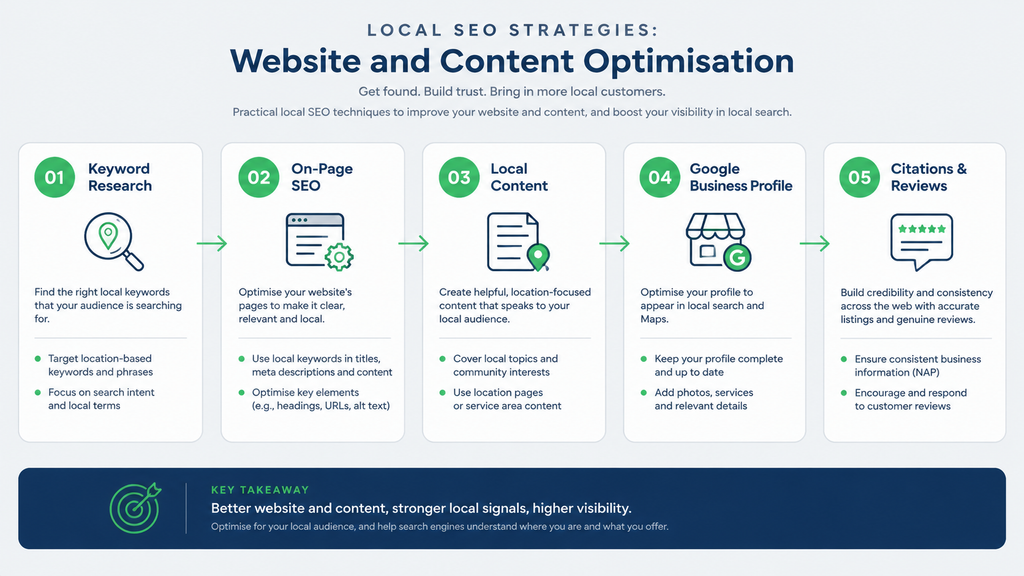
Your website is the second pillar of effective local SEO strategies — providing the content, technical structure, and signals that reinforce your GBP and allow your business to rank in organic search results for locally-modified keywords.
Strategy 4: Create Locally-Targeted Service Pages
If your business serves multiple areas, creating a dedicated service page for each location is one of the highest-impact local SEO strategies for capturing ‘[service] in [city]’ searches. Each page should include the area name in the title, URL, meta description, and H1; mention local landmarks or area-specific context that demonstrates genuine local relevance; feature a location-specific customer testimonial; and embed a Google Map of your business or service area.
Even single-location businesses benefit from creating a dedicated location page — a URL like yourbusiness.com/[city]-[service] gives Google a specific page to rank for local queries and provides context about your service area that a generic service page does not communicate.
Strategy 5: Target Local Keyword Variations
Local keyword research is a distinct subset of general keyword research and one of the most commercially productive local SEO strategies for service-area businesses. Research keywords using SEMrush or Google Keyword Planner filtered to your target location, identifying the specific ‘[service] in [city]’, ‘[service] [neighbourhood]’, and ‘[service] near [landmark]’ queries your potential customers are searching.
‘Near me’ searches deserve particular attention — they represent extremely high purchase intent and are served to mobile users based on their physical location. Optimising your GBP and website for ‘near me’ searches is primarily a Google Business Profile optimisation task, but adding ‘near me’ and location context to your website content reinforces these signals for mobile searchers in your area.
Strategy 6: Add Local Schema Markup
Local business schema markup is structured data code that communicates your business details — name, address, phone number, business hours, service area, and review data — to search engines in a machine-readable format. Among local SEO strategies focused on technical implementation, schema markup is one of the most impactful because it enables Google to display rich snippets showing your business hours, star ratings, and location directly in search results — without the user needing to visit your website.
Implement LocalBusiness schema on your website’s homepage and location pages using the appropriate schema.org type for your business category — Restaurant, MedicalBusiness, ProfessionalService, or one of hundreds of other specific business types. Validate your implementation using Google’s Rich Results Test tool to confirm the schema is correctly formatted and eligible for rich snippet display.
| Need a Website Built for Local Search Domination?Tasknestly’s website services include local schema setup, location page creation, and technical SEO optimisation — building a site structure that the best local SEO strategies can grow on top of.Book your free local SEO consultation → |
Ranking Takes More Than Tips
You know the strategy now — let Tasknestly handle the technical SEO, content, and link building that actually moves rankings.
Get SEO Services →Local SEO Strategies: Authority and Link Building
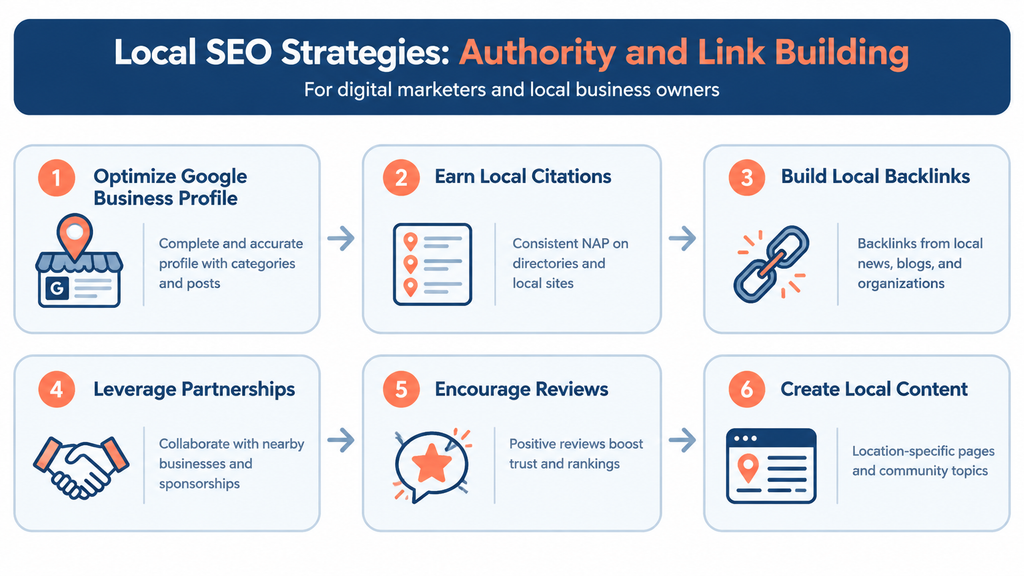
Building local authority through links and citations is the third pillar of effective local SEO strategies — the signal to Google that your business is genuinely established and trusted within your geographic community.
Strategy 7: Earn Local Backlinks
Local backlinks — links from other businesses, organisations, and publications in your geographic area — are among the strongest authority signals in local SEO strategies. A link from the local Chamber of Commerce website, a local newspaper article, a partner business’s website, or a community organisation directory sends a strong geographic relevance signal that generic backlinks cannot replicate.
Target local link opportunities by: sponsoring local events in exchange for a website link, joining and listing with your local Chamber of Commerce, partnering with complementary local businesses for mutual linking, contributing expert commentary to local news publications, and listing with area-specific business directories. Even five to ten high-quality local backlinks can produce a meaningful improvement in map pack rankings for competitive local terms.
Strategy 8: Optimise for Mobile and Voice Search
Over 70 percent of local searches happen on mobile devices, making mobile optimisation one of the most essential local SEO strategies for any business competing in local search. A local search done on mobile is frequently immediately actionable — the searcher is physically near the business category they are searching and may visit or call within minutes. If your mobile experience is poor, you lose these high-intent customers before they even reach your door.
Voice search optimisation is increasingly important for local queries — voice searches for local businesses are typically phrased in natural language (‘find a Thai restaurant near me’, ‘what time does [business] close’) and reward businesses whose GBP information is complete, accurate, and up to date. Ensure your business hours, phone number, and address are always current in your GBP to capture voice search traffic effectively.
Strategy 9: Create Locally-Relevant Blog Content
Locally-relevant blog content is one of the local SEO strategies most often overlooked by small businesses, but it can produce meaningful ranking improvements for area-specific queries with relatively modest effort. Blog posts targeting topics specific to your location — ‘best [service type] in [city]’, ‘[seasonal topic] for [area] residents’, ‘what to look for in a [service] provider in [neighbourhood]’ — build topical authority for local queries and provide additional pages for Google to rank in organic local results
Aim to publish one to two locally-relevant posts per month. Include area-specific keywords naturally, reference local landmarks and community events where contextually appropriate, and link from each post to your main service and location pages to distribute authority effectively.
Strategy 10: Monitor Local Rankings and Audit Performance
Ongoing monitoring is the final of the local SEO strategies in this guide — and the one that ensures all other strategies continue to perform as your competitive landscape evolves. Track your map pack rankings for your primary ‘[service] in [city]’ keywords monthly using a local rank tracking tool. Monitor your Google Business Profile insights weekly — views, website clicks, direction requests, and phone calls — to identify any performance drops that indicate a competitor is outperforming you or that a GBP update is needed.
Review your citation consistency quarterly using a citation audit tool to catch any new inconsistencies introduced by directory updates. Monitor competitors’ GBPs monthly to identify new review acquisition patterns or service additions that may be affecting their rankings relative to yours. The local SEO strategies that produce the best long-term results are those applied with consistent monitoring and rapid response to the inevitable changes in local competitive dynamics.
Ranking Takes More Than Tips
You know the strategy now — let Tasknestly handle the technical SEO, content, and link building that actually moves rankings.
Get SEO Services →10 Local SEO Strategies at a Glance
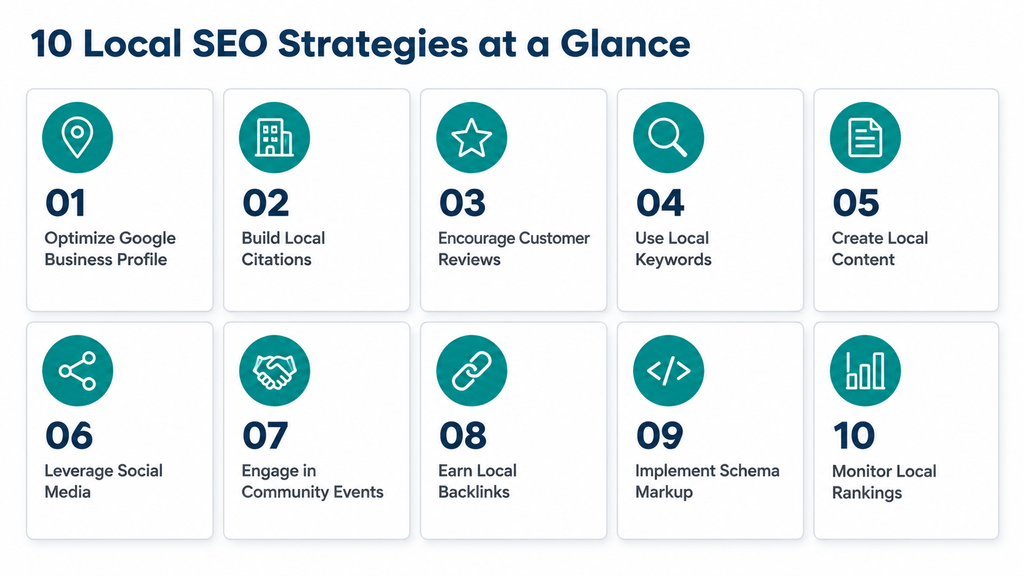
Use this table as a quarterly checklist for your local SEO strategies implementation and prioritisation.
| # | Local SEO Strategy | Priority | Business Impact |
| 1 | Optimise Google Business Profile | Critical | Appears in map pack for local searches |
| 2 | Build local citations and NAP consistency | Critical | Validates business location across directories |
| 3 | Generate and respond to Google reviews | High | Reviews are top local ranking factor |
| 4 | Create locally-targeted service pages | High | Ranks for ‘[service] in [city]’ queries |
| 5 | Optimise for mobile and voice search | High | 70%+ of local searches are mobile |
| 6 | Build local backlinks from area businesses | High | Local authority signals boost map pack rankings |
| 7 | Add local schema markup | Medium-High | Rich snippets with address and hours in search |
| 8 | Target local keyword variations | High | Captures ‘near me’ and geo-modified searches |
| 9 | Create locally-relevant blog content | Medium | Builds topical authority for local queries |
| 10 | Monitor and manage local rankings | Ongoing | Tracks performance and identifies new opportunities |
| Essential Tools for Your Local SEO StrategiesSEMrush — Research local keywords, monitor local rankings, and analyse competitor GBP performance with comprehensive local SEO data.RankMath Pro — Implement local schema markup, optimise location pages, and track keyword performance directly inside WordPress.Hostinger — Host your local business website on fast, reliable infrastructure with the uptime and speed that local search rewards. |
Ranking Takes More Than Tips
You know the strategy now — let Tasknestly handle the technical SEO, content, and link building that actually moves rankings.
Get SEO Services →Frequently Asked Questions: Local SEO Strategies
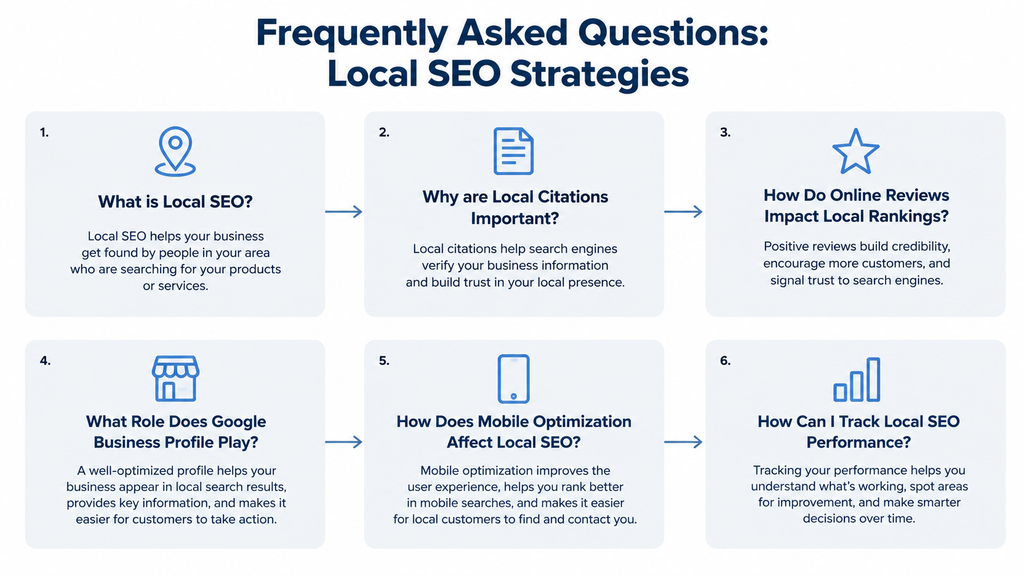
| Question | Answer |
| What are local SEO strategies? | Local SEO strategies are specific tactics for improving a business’s visibility in local search results — the map pack and organic listings that appear when someone searches for a service or product in a specific geographic area. They include Google Business Profile optimisation, citation building, review generation, and locally-targeted content creation. |
| How long do local SEO strategies take to show results? | Local SEO strategies typically produce measurable improvements in 1 to 3 months for Google Business Profile optimisation and citation building, which are the fastest-acting tactics. Locally-targeted page rankings typically improve within 2 to 4 months. Building a strong local map pack presence for competitive terms can take 4 to 6 months of consistent effort. |
| What is the most important local SEO strategy? | Google Business Profile optimisation is the single most important local SEO strategy for most businesses. A fully optimised, regularly updated GBP with accurate information, photos, and consistent review responses directly influences map pack rankings — the three-result local box that appears above organic results and generates the majority of local search clicks. |
| What is NAP consistency and why does it matter? | NAP stands for Name, Address, Phone number — the three business details that must be identical across every online directory, social profile, and citation source. Inconsistent NAP data confuses search engines about which location information is correct, weakening local ranking signals. NAP consistency is one of the foundational local SEO strategies for any business with a physical location. |
| Do online reviews affect local SEO rankings? | Yes, significantly. Google’s local search algorithm uses review quantity, recency, and rating as ranking factors in the map pack. Businesses with more reviews, more recent reviews, and higher average ratings consistently outrank competitors with fewer or lower-quality reviews, all other factors being equal. Responding to reviews also signals active business engagement, which is a positive ranking signal. |
| What is local schema markup and how does it help? | Local schema markup is structured data code added to your website that communicates your business details — name, address, phone, hours, reviews — to search engines in machine-readable format. This helps Google correctly display your business information in search results and can earn rich snippet features like star ratings and business hours displayed directly in search listings. |
| Should a local business blog for SEO? | Yes, when the content is locally relevant. Blog posts targeting area-specific topics — ‘best [service] in [city]’, ‘[problem] in [neighbourhood]’, ‘[seasonal topic] for [area] residents’ — build topical authority for local queries and provide additional pages for Google to rank for geographically-modified search terms. Even one or two locally-relevant posts per month produces meaningful local SEO benefit over time. |
Ranking Takes More Than Tips
You know the strategy now — let Tasknestly handle the technical SEO, content, and link building that actually moves rankings.
Get SEO Services →Conclusion: Apply These Local SEO Strategies and Dominate Your Area
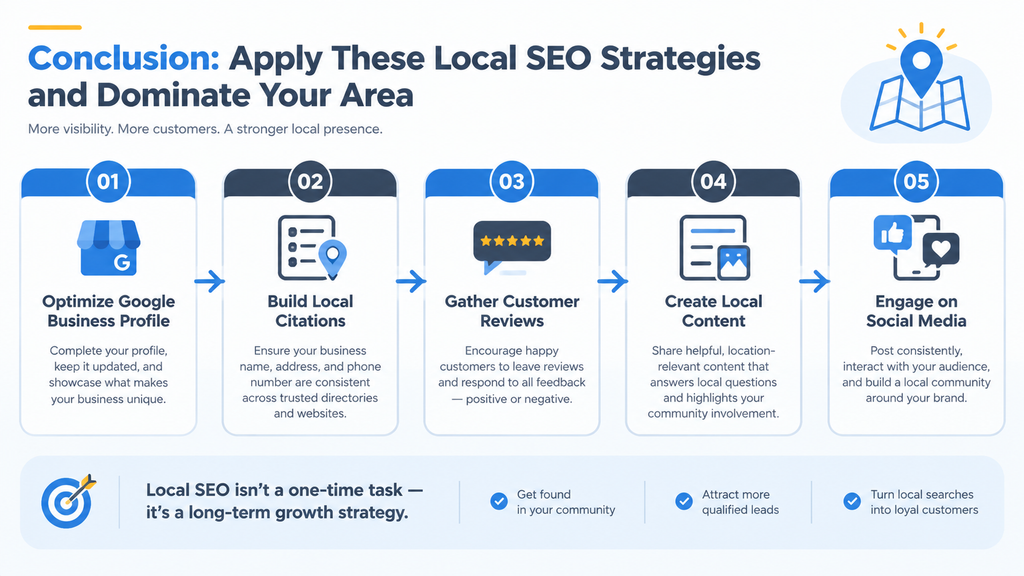
The 10 local SEO strategies in this guide — from Google Business Profile optimisation and citation building to review generation, locally-targeted content, and local link acquisition — are the proven methods that the top-ranking local businesses in every market use to dominate their geographic search landscape. They are not advanced technical tactics requiring specialist knowledge. They are systematic, implementable processes that any business owner can apply with the right guidance and consistent effort.
Implement your local SEO strategies in priority order: Google Business Profile first, citation consistency second, review generation third. Once those foundational elements are in place, build locally-targeted service pages, add schema markup, and begin building local backlinks. This sequence maximises early gains from the fastest-acting local ranking factors before investing in the longer-term tactics that compound in value over time.
At Tasknestly, we implement comprehensive local SEO strategies for businesses that want to dominate their local search market — from GBP optimisation and citation building to content creation and ongoing performance monitoring. If you are ready to become the top result in your area, explore our SEO services or request a free local SEO consultation today.
Ranking Takes More Than Tips
You know the strategy now — let Tasknestly handle the technical SEO, content, and link building that actually moves rankings.
Get SEO Services →Local SEO Strategies: Measuring and Sustaining Your Rankings
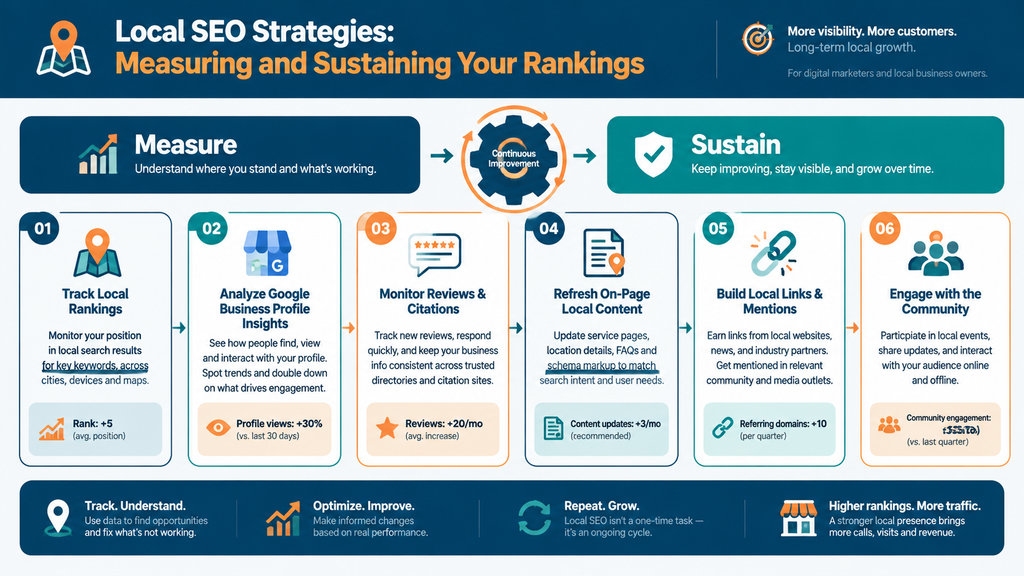
The most effective local SEO strategies are not one-time implementations — they are continuous programmes of monitoring, optimisation, and competitive response. Google’s local algorithm updates regularly, competitors invest in their own local SEO strategies, and customer search behaviour shifts over time. The local businesses maintaining top map pack positions year after year are those with systematic monitoring processes that catch competitive threats and algorithm changes early.
Set up a monthly local SEO strategies review: check your map pack position for your top ten ‘[service] in [city]’ keywords, review your GBP insights for direction requests and call click trends, audit your review count and recency against your top three competitors, and identify any new competitor content or citation changes that may be affecting relative rankings. This systematic approach to local SEO strategies monitoring ensures that the rankings you build through the ten strategies in this guide are maintained and improved over time, not gradually eroded by competitors who are more actively managing their local presence.
The businesses that win at local SEO strategies long-term are not those who implement perfectly once — they are those who treat local SEO strategies as an ongoing operational discipline, as routine and essential as managing their Google Business Profile posts and responding to new reviews. Local SEO strategies compound: each review earned, each citation built, each locally-relevant page created adds to a growing local authority that becomes progressively harder for competitors to overtake.
For the rules Google applies to business names, categories and descriptions, read Google’s guidelines for representing your business on Google.
Ranking Takes More Than Tips
You know the strategy now — let Tasknestly handle the technical SEO, content, and link building that actually moves rankings.
Get SEO Services →Grow With Tasknestly
Subscribe to the Tasknestly newsletter and get the latest tips on websites, SEO, social media, and digital growth.