
Internal linking SEO is one of the most powerful and underutilised strategies available to any website owner. Whether you run a small business blog or an e-commerce store, a deliberate approach to linking between your own pages gives search engines a clear map of your site, distributes ranking authority to the pages that matter most, and keeps visitors engaged longer. Yet most businesses pour resources into backlink campaigns while ignoring the gold that already exists within their own domain.
Every link you place from one page to another is a deliberate vote of confidence. When Google’s crawlers follow those connections, they discover new content, understand the hierarchy of your site, and calibrate how much authority each page deserves. The result is a website link structure that works like a well-designed road network — fast, logical, and built to move traffic exactly where you want it.
In this complete guide, you will learn how internal linking SEO works, why it is central to any serious SEO ranking strategy, and how to implement best practices that produce measurable results. By the end, you will have a clear, actionable system to apply today — or hand off to a team like Tasknestly to implement on your behalf.
| Want an SEO Strategy That Actually Ranks?Tasknestly builds proven SEO ranking strategies combining technical fixes, on-page optimisation, and smart site architecture to grow your organic traffic.Get your FREE SEO Quote → |
Ranking Takes More Than Tips
You know the strategy now — let Tasknestly handle the technical SEO, content, and link building that actually moves rankings.
Get SEO Services →Table of Contents
What Is Internal Linking SEO and Why Does It Matter?
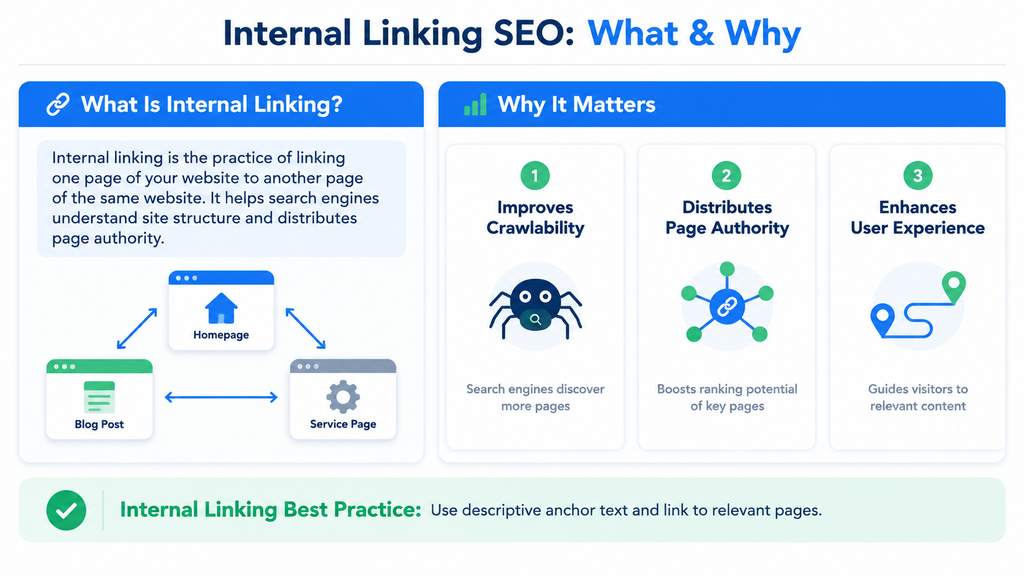
At its core, this discipline means strategically linking from one page on your website to another on the same domain. Unlike backlinks — which come from external sites — these connections are completely within your control. That makes them one of the most cost-effective levers in any SEO ranking strategy.
Search engines like Google rely on links to discover and evaluate content. When Googlebot crawls your site, it follows every link to move from page to page. A strong website link structure ensures every valuable page is within a few clicks of the homepage, and that no page is left isolated — what SEOs call an orphaned page.
Link Equity and PageRank Flow
PageRank — the original scoring system behind Google’s algorithm — travels through links. Every time a high-authority page connects to another, it passes a portion of its ranking power. Internal linking SEO allows you to funnel this authority toward your most commercially important pages: service pages, product categories, or landing pages you want to rank. Without a deliberate strategy, earned authority disperses randomly across your domain.
A blog post that earns organic backlinks naturally accumulates authority. By connecting that post to your core service pages, you transfer some of that earned power to pages that are harder to build links to directly. This is one of the most impactful techniques within the discipline.
Crawl Budget Optimisation
For larger websites, Google allocates a crawl budget — a limit on how many pages it will visit within a given period. A poor website link structure means important pages may go un-crawled for weeks. A well-built internal linking system ensures your high-priority pages are crawled more frequently, which means faster indexing and faster ranking improvements. Improving your internal links is one of the fastest wins available in technical SEO.
Ranking Takes More Than Tips
You know the strategy now — let Tasknestly handle the technical SEO, content, and link building that actually moves rankings.
Get SEO Services →How Strategic Linking Signals Topical Authority to Google
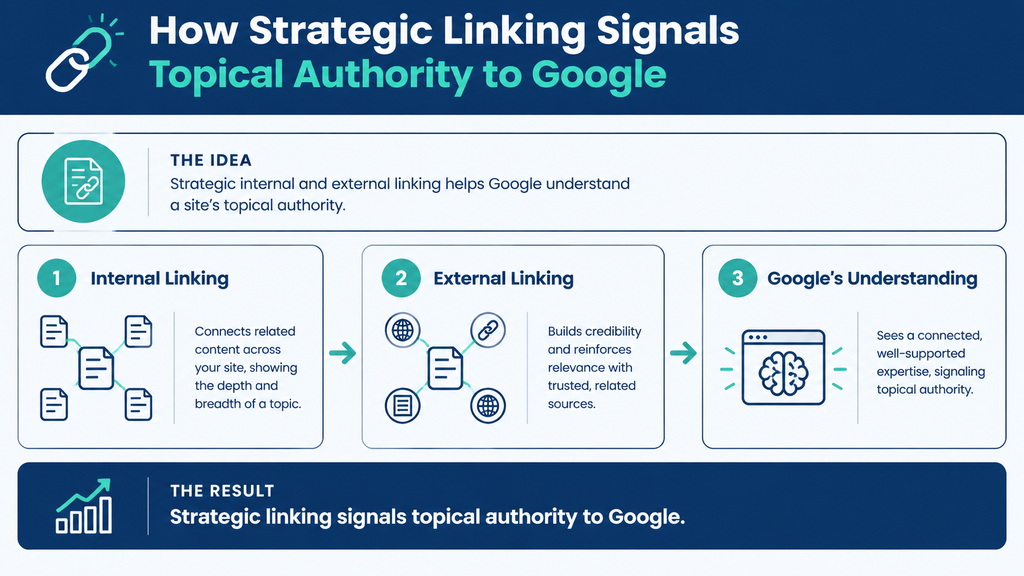
Google’s algorithms have become increasingly sophisticated at understanding topics, not just keywords. The internal linking SEO structure of your website plays a significant role in communicating your topical expertise. When multiple pages link to and from a central pillar page, Google recognises your website as an authoritative source on that subject.
Pillar Pages and Topic Clusters
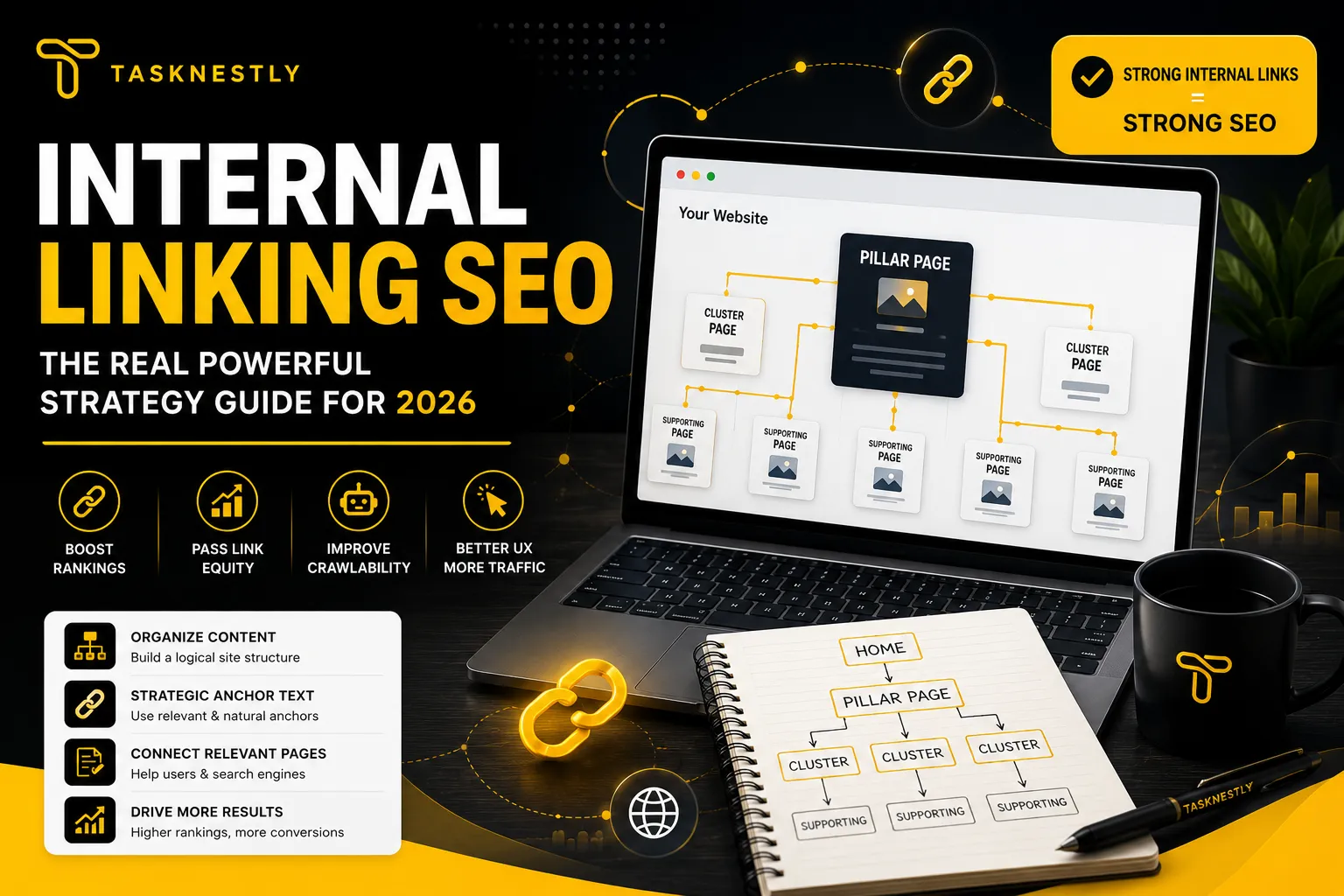
The topic cluster model is one of the most widely adopted best practices in internal linking. You create a comprehensive pillar page around a broad topic, then develop multiple supporting blog posts that explore specific subtopics. Every supporting post connects back to the pillar page, and the pillar page links out to each supporting post. This internal link architecture is the engine behind long-term ranking growth.
This website link structure tells Google that your site covers a topic in depth. It is the difference between appearing to be a general information site and being recognised as a specialist authority — and authority is exactly what drives SEO ranking strategy outcomes. Businesses that invest in structured site architecture consistently outperform competitors who publish content without a coherent linking plan.
Distributing Contextual Relevance
Context matters enormously. When you place an internal link inside a paragraph discussing a specific concept, Google reads the surrounding text — called anchor context — to understand what the target page is about. This is why contextual internal links placed within the body of an article carry far more weight than links placed in sidebars or footers. The more relevant each internal link is to its surrounding content, the stronger the relevance signal sent to search engines.
Investing in contextual placement pays far greater dividends than any sidebar widget. Every internal link you add should belong naturally in the text, serving the reader as much as the crawler.
Ranking Takes More Than Tips
You know the strategy now — let Tasknestly handle the technical SEO, content, and link building that actually moves rankings.
Get SEO Services →Internal Linking Best Practices: The Complete Framework
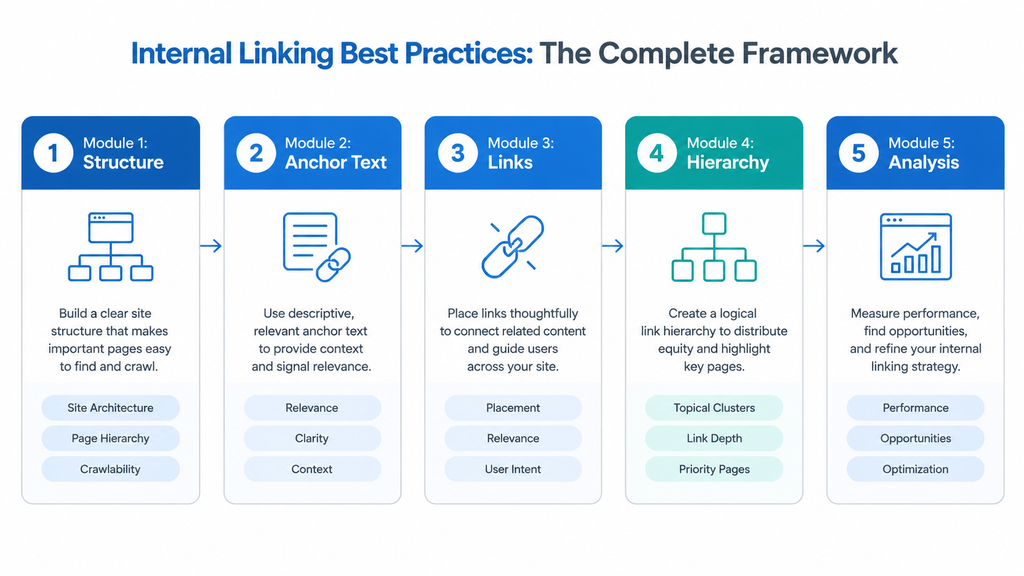
Knowing that internal linking SEO matters is one thing; knowing exactly how to do it correctly is another. The following best practices are used by professional SEO teams worldwide and form the foundation of any solid SEO ranking strategy.
1. Audit Your Existing Website Link Structure
Before adding new connections, understand what you already have. Use a tool like Screaming Frog or Ahrefs to crawl your site and produce a full map of every link. Look for:
- Orphaned pages — pages with no links pointing to them
- Pages with many inbound links but no outbound links
- Broken links returning 404 errors
- Pages only reachable through pagination or category archives
This audit forms the baseline for your improvement plan.
2. Prioritise Your Most Important Pages
Not all pages deserve the same number of internal links. Identify the pages that generate the most revenue or enquiries — typically service pages, product pages, or high-converting landing pages. Your internal linking plan should funnel the most equity toward these pages. Think of it like allocating a marketing budget: direct the most resources toward the highest-returning assets. A structured internal linking strategy ensures no high-value page is left without support.
3. Use Descriptive, Keyword-Rich Anchor Text
Internal linking SEO effectiveness depends heavily on anchor text. The words you use as clickable link text tell Google what the target page is about. Using descriptive anchor text like ‘proven SEO ranking strategies’ is far more valuable than ‘click here’ or ‘read more.’ Vary your anchor text naturally to avoid over-optimisation, but always ensure every link clearly communicates the destination.
| Anchor Text Type | Example | Best Practice? |
| Exact Match | “internal linking SEO guide” | Use sparingly (10-20%) |
| Partial Match | “boost SEO with strategic linking” | Use frequently (40%) |
| Branded | “Tasknestly SEO Services” | Use for branded pages |
| Generic | “click here” / “read more” | Never use |
| Naked URL | “tasknestly.com/seo-services/” | Avoid – use descriptive text |
| LSI/Related | “website link structure tips” | Use for supporting posts |
4. Link Deep, Not Just to the Homepage
A common mistake is linking too frequently to the homepage and top-level category pages while ignoring deeper, more specific pages. Deep linking — pointing to individual service sub-pages, blog articles, and specific product pages — spreads authority more evenly and helps those deeper pages rank for their target keywords.
5. Maintain a Logical Link Depth
Link depth refers to how many clicks it takes to reach a page from the homepage. Pages deeper than four clicks from the homepage tend to receive less crawl attention and lower authority. A clean internal link structure keeps all important pages within three clicks of the homepage. Review your site architecture periodically to ensure nothing critical gets buried, and use internal links strategically to elevate deep pages that deserve more visibility.
6. Update Old Content with New Links
Every time you publish a new page, go back to older, established articles and add links pointing to the new content. Older pages often carry more authority because they have been indexed longer and may have accumulated backlinks. Linking from a well-established page to a new page gives that new page an immediate authority boost and helps it rank faster. This technique is a core part of effective internal linking SEO execution.
Ranking Takes More Than Tips
You know the strategy now — let Tasknestly handle the technical SEO, content, and link building that actually moves rankings.
Get SEO Services →How Link Structure Affects User Experience and Bounce Rate
Internal linking SEO is not only a technical tactic — it is a powerful user experience tool. When visitors land on one of your pages and find well-placed internal links to related content, they are more likely to continue reading, explore your site, and ultimately take action. This reduces bounce rate, increases session duration, and sends positive engagement signals to Google. The UX benefits of a strong internal linking strategy compound over time as your content library grows.
Guiding Users Through the Buyer Journey
A deliberate website link structure guides users from awareness content through consideration content and toward decision pages. Each link is an opportunity to nudge a reader one step closer to becoming a paying client. This is why Tasknestly builds strategic linking into every SEO service we deliver — the goal is always conversion, not just traffic.
Related Content and Content Silos
Grouping related content into silos — clusters of pages linked tightly together — keeps users engaged within a topic area. A visitor reading about site link structure is highly likely to also want to read about anchor text strategy, crawl optimisation, or on-page SEO. Building internal links between these related articles signals to Google that your content on this subject is comprehensive and authoritative. The stronger your internal link network within a topic cluster, the more authority each page in that cluster accumulates.
| Turn Your Website Into a Lead-Generating MachineTasknestly’s digital marketing services include full link audits, content strategy, and SEO implementation tailored to your industry.Claim your free digital marketing consultation → |
Ranking Takes More Than Tips
You know the strategy now — let Tasknestly handle the technical SEO, content, and link building that actually moves rankings.
Get SEO Services →SEO Ranking Strategy: Combining Link Structure with Other Signals
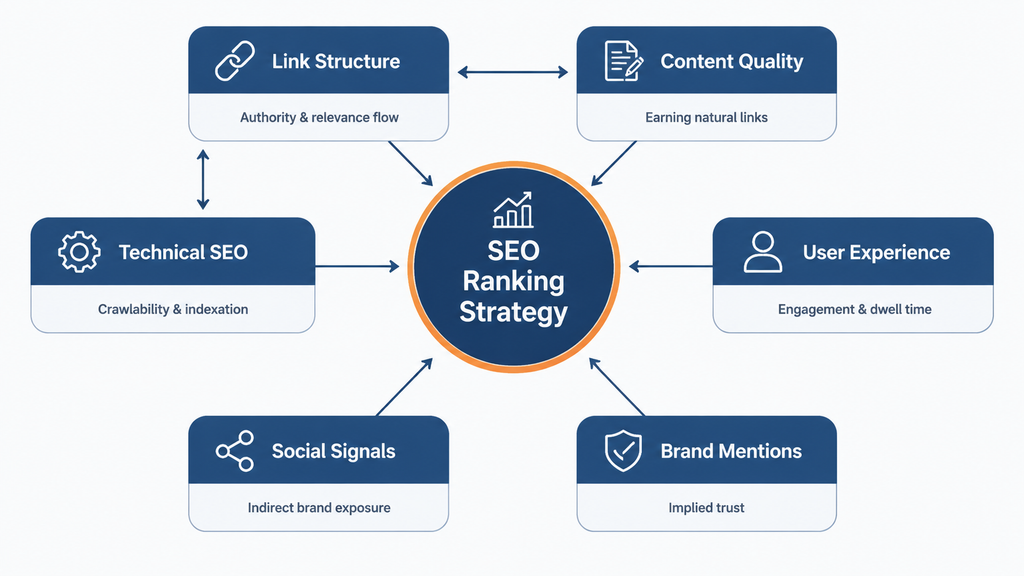
Internal linking SEO does not operate in isolation. It amplifies every other element of your SEO ranking strategy. Here is how it works alongside the rest of your optimisation efforts.
Links Multiply the Value of Backlinks
When you earn a backlink to a blog post, that post gains authority. But your service pages — the ones that actually convert visitors — rarely earn direct backlinks naturally. By adding internal links from your high-authority blog posts to your service pages, you redirect earned authority exactly where your business needs it most. One strong backlink to a blog post can fuel rankings across multiple service pages through deliberate internal link placement.
On-Page SEO and Link Placement
On-page SEO signals — like target keywords in headings, meta descriptions, and body content — work alongside link signals. When the anchor text of a link matches or closely relates to the target page’s focus keyword, it reinforces the on-page relevance signal. The combination of strong on-page optimisation and a clean internal linking SEO structure is what consistently separates top-ranking pages from those stuck on page two.
Technical SEO: Making Your Structure Crawlable
Your best practices only work if search engine crawlers can actually access and follow your links. Technical SEO elements — such as a clean XML sitemap, fast page loading speeds, and proper canonicalisation — ensure the architecture you build is fully crawlable. Always check that your links use standard HTML anchor tags and are not hidden behind JavaScript that crawlers cannot parse.
Ranking Takes More Than Tips
You know the strategy now — let Tasknestly handle the technical SEO, content, and link building that actually moves rankings.
Get SEO Services →Common Mistakes That Undermine Your Internal Linking SEO
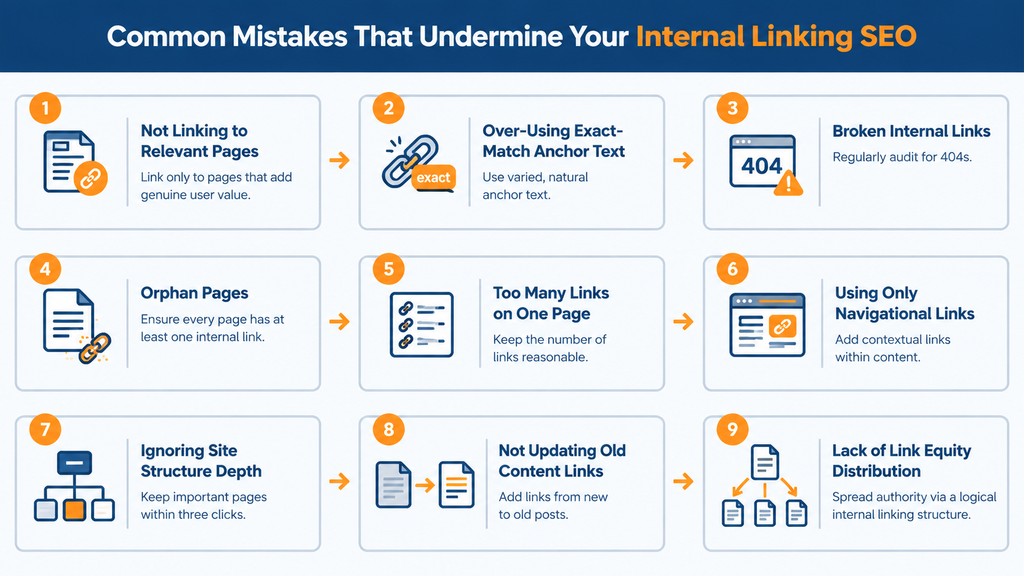
Even experienced website owners make mistakes that quietly undermine their SEO ranking strategy. Recognising these errors is the first step to correcting them.
Mistake 1: Using Generic Anchor Text
Anchor text like ‘click here,’ ‘learn more,’ or ‘this article’ wastes the contextual signal that internal links can provide. Always use descriptive, topically relevant anchor text. This is one of the most fundamental rules of internal linking SEO, yet it is routinely ignored across thousands of websites. Every instance of generic anchor text on an internal link is a missed optimisation opportunity that compounds over time.
Mistake 2: Over-Linking From a Single Page
Placing dozens of links on a single page dilutes the equity each individual link passes. A cluttered page also confuses both users and crawlers. Focus on five to ten high-value contextual internal links per page and prioritise the most relevant destinations. Quality always outperforms quantity when it comes to internal link placement.
Mistake 3: Ignoring Orphaned Pages
Pages with no links pointing to them are effectively invisible to search engines. If a page is worth having on your site, it is worth linking to. Every new page should receive at least two to three internal links from relevant existing pages as part of your website link structure plan. An orphaned page receives no benefit from your internal link equity, no matter how strong its content is.
Mistake 4: Broken Links
Broken links waste crawl budget and create a poor user experience. Conduct regular audits using tools like Screaming Frog to identify and repair 404 errors before they accumulate and erode your site’s credibility with Google. A broken internal link is a dead end in your link structure — it stops equity flow and frustrates visitors.
Mistake 5: Neglecting New Content
Many websites publish new content without building any links to it. A new page with no connections is an orphan from day one and receives no benefit from your existing internal link equity. Make it a workflow rule: every new piece of content receives internal links from at least three relevant existing pages within 48 hours of publication. This habit is central to effective internal linking SEO execution and ensures no page is left without support.
Ranking Takes More Than Tips
You know the strategy now — let Tasknestly handle the technical SEO, content, and link building that actually moves rankings.
Get SEO Services →Internal Linking SEO vs. Other SEO Strategies: A Clear Comparison
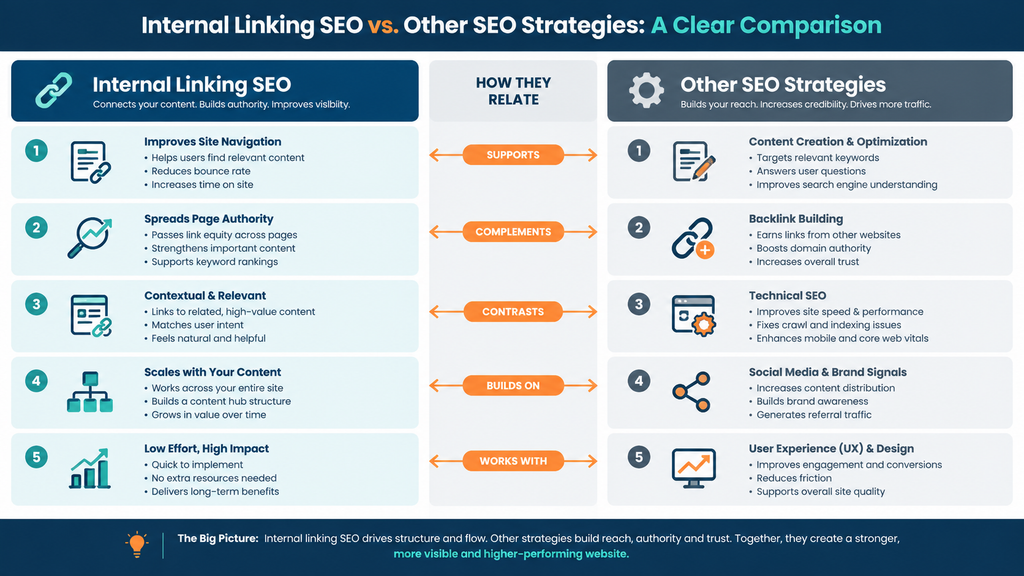
To put this discipline in context, here is how it compares to other common SEO ranking strategies by purpose, impact, and effort required. Understanding where it sits relative to other tactics helps you allocate resources more effectively.
| Strategy | Purpose | SEO Impact | Effort Level |
| Internal Linking SEO | Connect related pages | High – distributes link equity | Low |
| External Link Building | Earn links from other sites | High – builds domain authority | High |
| Content Optimisation | On-page keyword targeting | High – improves relevance signals | Medium |
| Technical SEO | Fix crawl & speed issues | Medium – removes ranking barriers | High |
| Social Sharing | Drive referral traffic | Low-Medium – indirect signal | Low |
| Schema Markup | Add structured data | Medium – rich snippet visibility | Medium |
As the table shows, a well-executed internal linking SEO strategy delivers high impact for relatively low effort — making it the most accessible and cost-effective tactic available to any website, regardless of size or budget.
| 3 Essential Tools to Supercharge Your Internal Linking SEOSEMrush — semrush.com — All-in-one SEO platform to audit your site, track rankings, and find internal linking opportunities.RankMath Pro — rankmath.com — The most powerful WordPress SEO plugin to manage your focus keywords, internal links, and metadata all in one place.Surfer SEO — surferseo.com — Optimise your content structure and keyword density to hit the sweet spot Google rewards with higher rankings. |
Ranking Takes More Than Tips
You know the strategy now — let Tasknestly handle the technical SEO, content, and link building that actually moves rankings.
Get SEO Services →Frequently Asked Questions: Internal Linking SEO
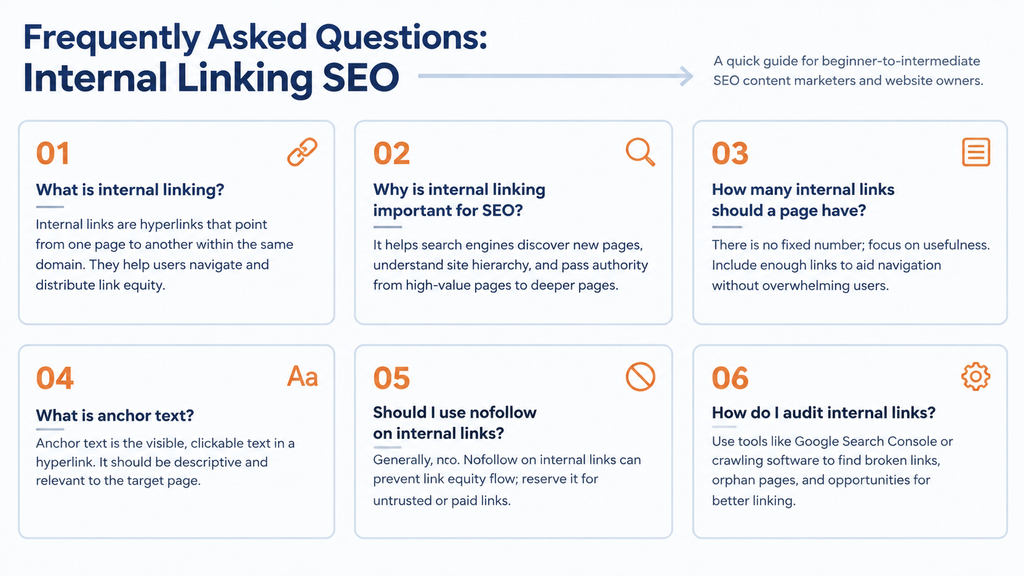
| Question | Answer |
| What is internal linking SEO? | Internal linking SEO is the practice of linking between pages on the same website to help search engines crawl and index content while distributing ranking authority across the site. |
| How many internal links should each page have? | Most SEO experts recommend 3-10 contextually relevant links per page. Quality and topical relevance matter more than quantity. |
| Does internal linking directly improve rankings? | Yes. A strong link structure helps distribute PageRank across your site, signals topical relevance to Google, and increases crawl frequency of important pages. |
| What is a pillar page in website link structure? | A pillar page is a comprehensive guide covering a broad topic that links to detailed supporting posts. This structure signals topical authority to search engines. |
| Can too many links on a page hurt SEO? | Excessive or irrelevant links dilute equity. Focus on contextual, descriptive links rather than stuffing posts with dozens of connections. |
| What anchor text should I use for internal links? | Use descriptive, keyword-rich anchor text that reflects the target page’s topic. Avoid generic phrases like ‘click here’ or ‘read more.’ |
| How often should I audit my link structure? | Conduct a link audit at least once a quarter using Screaming Frog or Ahrefs to catch broken links, orphaned pages, and missed opportunities. |
Ranking Takes More Than Tips
You know the strategy now — let Tasknestly handle the technical SEO, content, and link building that actually moves rankings.
Get SEO Services →Conclusion: Build a Website Link Structure That Works for You
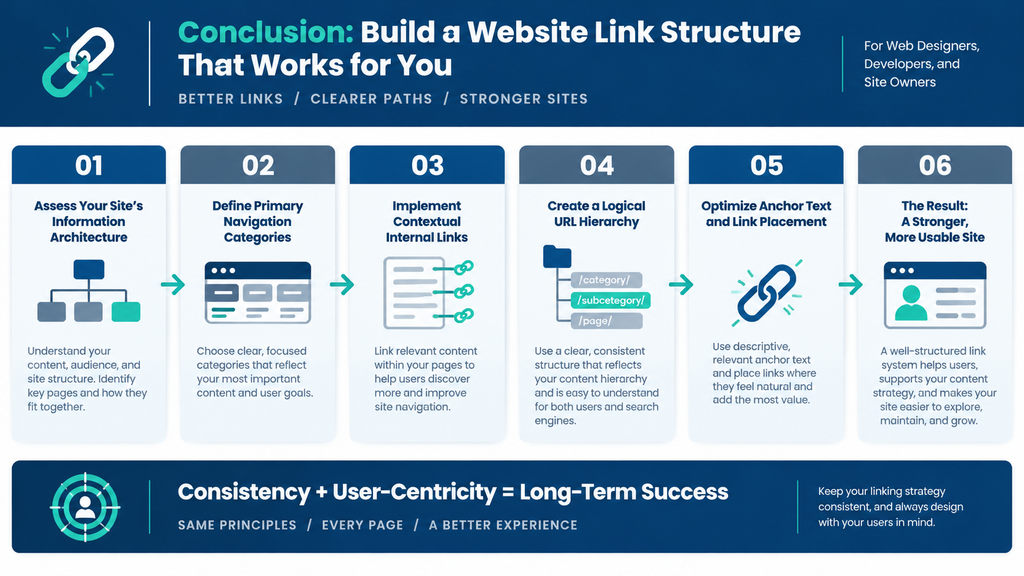
Internal linking SEO is not a one-time task — it is an ongoing discipline that pays compounding dividends over time. Every new piece of content you publish is an opportunity to strengthen your site architecture, distribute authority to high-value pages, and guide both search engines and visitors through a clear, logical path. The businesses that apply these principles consistently as part of their broader SEO ranking strategy are the ones that dominate organic search results in their niche.
The good news is that you do not have to build this internal linking system alone. A well-executed strategy requires planning, consistent execution, and regular auditing — which is precisely what a specialist digital agency delivers. When your internal link architecture works in harmony with strong content, technical SEO, and a reputable backlink profile, the cumulative result is a site that climbs rankings reliably and generates qualified leads month after month.
At Tasknestly, we combine strategic internal linking SEO services with full-spectrum digital marketing to help businesses achieve real, measurable ranking improvements. Ready to build a site architecture that converts? Request your free SEO quote today and let our team show you what a truly optimised website looks like.
For Google’s own guidance on crawlable links and anchor text, read its link best practices for Search.
Ranking Takes More Than Tips
You know the strategy now — let Tasknestly handle the technical SEO, content, and link building that actually moves rankings.
Get SEO Services →Grow With Tasknestly
Subscribe to the Tasknestly newsletter and get the latest tips on websites, SEO, social media, and digital growth.