

Keyword research techniques are the foundation of every successful SEO strategy. Before you write a single word of content, build a single page, or publish a single blog post, knowing which keywords to target — and which to avoid — determines whether your SEO effort generates meaningful organic traffic or disappears into a sea of competitive noise. The difference between a website that generates thousands of organic visitors per month and one that generates none is rarely content quality alone. It is almost always keyword strategy.
The most common keyword research mistake is targeting keywords based on intuition rather than data — writing about topics that seem relevant without verifying whether people actually search for them, or targeting broad terms that are so competitive that a new or mid-authority website has no realistic chance of ranking. Modern keyword research tools have made data-driven keyword selection accessible to businesses of any size and technical sophistication, eliminating the guesswork that once made SEO feel unreliable.
This guide covers 10 specific keyword research techniques that professional SEO teams use to identify high-value search terms, understand what searchers actually want, prioritise opportunities based on realistic difficulty assessments, and organise keywords into a coherent content strategy that builds organic traffic systematically over time. Each technique is explained with specific implementation steps and the tool recommendations that make it most efficient.
| Want an SEO Strategy That Targets the Right Keywords From Day One?Tasknestly’s professional SEO services include comprehensive keyword research, content strategy, and on-page optimisation — building organic traffic that compounds month after month.Get your FREE SEO Consultation → |
Ranking Takes More Than Tips
You know the strategy now — let Tasknestly handle the technical SEO, content, and link building that actually moves rankings.
Get SEO Services →Table of Contents
Foundational Keyword Research Techniques
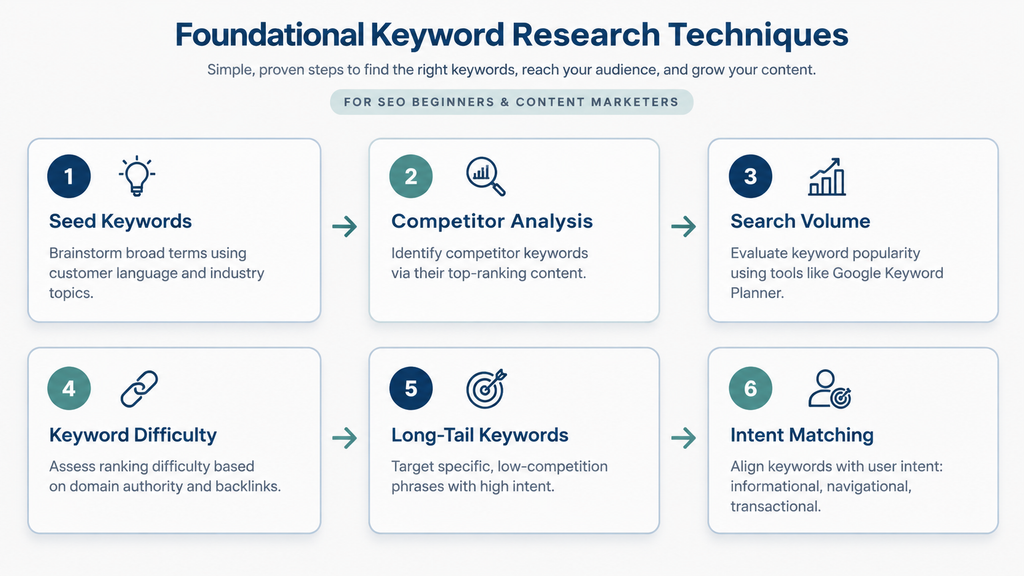
These keyword research techniques build the foundation of your keyword strategy — identifying the full universe of terms relevant to your business and establishing a realistic picture of where ranking opportunities exist.
Technique 1: Seed Keyword Expansion
Seed keyword expansion is the starting point for all keyword research techniques. Begin with three to five obvious, generic terms that describe your business, products, or content topic — your seed keywords. Enter each seed keyword into a research tool like SEMrush and explore the full list of related keywords it generates: variations, modifiers, question-based phrases, long-tail expansions, and related topics. This process transforms five starting ideas into a keyword universe of hundreds or thousands of potential targets.
From the full list generated, filter by three criteria: search volume (enough people searching to make ranking worthwhile), search intent alignment (the keyword matches the type of content or page you want to create), and keyword difficulty (a realistic chance of ranking given your domain’s current authority). This filtered shortlist becomes your initial keyword target bank and the foundation of all subsequent keyword research techniques.
Technique 2: Competitor Keyword Gap Analysis
Competitor keyword gap analysis is one of the most commercially valuable keyword research techniques because it reveals the specific keywords your competitors are ranking for that you are not — representing existing search demand that you are currently invisible to. In SEMrush, the Keyword Gap tool allows you to enter your domain and up to four competitor domains simultaneously, then displays every keyword where competitors rank but you do not, every keyword where you rank lower than competitors, and every keyword where you and competitors rank similarly.
The highest-priority keywords to extract from a gap analysis are those where multiple competitors rank on page one — indicating that Google considers this keyword category relevant to your industry — and where your domain authority gives you a realistic chance of competing. These are the fastest keyword research techniques for identifying immediately actionable ranking opportunities without starting from scratch.
Technique 3: Long-Tail Keyword Targeting
Long-tail keywords — specific, multi-word search queries with lower individual search volumes but higher purchase intent and lower competition — are among the most valuable targets in all keyword research techniques, particularly for newer websites with limited domain authority. While a broad term like ‘running shoes’ might generate 100,000 monthly searches, it is dominated by Nike, Amazon, and major retailers with enormous domain authority. ‘Waterproof trail running shoes for wide feet’ generates far fewer searches but can be ranked by a specialist retailer within weeks, and every visitor it attracts is highly specific and motivated.
The cumulative traffic from ranking for 50 long-tail keywords in a niche can significantly exceed the traffic from ranking on page three for a broad head term. Long-tail keyword research techniques involve using SEMrush’s keyword magic tool filtered to phrases of four or more words, exploring the ‘People Also Ask’ boxes in search results, and reviewing autocomplete suggestions in Google Search for your seed keywords.
Technique 4: Search Intent Mapping
Search intent mapping is one of the most technically important keyword research techniques because it ensures that the content you create actually matches what searchers want to find — the prerequisite for ranking and converting. Google has become highly sophisticated at understanding the intent behind search queries and serves results accordingly. Targeting a keyword without understanding its intent produces content that may rank briefly but loses position because it fails to satisfy the actual need behind the search.
The four intent categories are: informational (seeking knowledge — ‘how does X work’), navigational (seeking a specific website — ‘tasknestly ecommerce services’), commercial investigation (comparing options before buying — ‘best SEO tools 2026’), and transactional (ready to buy — ‘buy running shoes online’). Before targeting any keyword, identify its primary intent by reviewing the top 10 search results — the format of those results (blog posts, product pages, category pages, comparison articles) tells you exactly what Google has determined searchers want for that query.
Ranking Takes More Than Tips
You know the strategy now — let Tasknestly handle the technical SEO, content, and link building that actually moves rankings.
Get SEO Services →Advanced Keyword Research Techniques
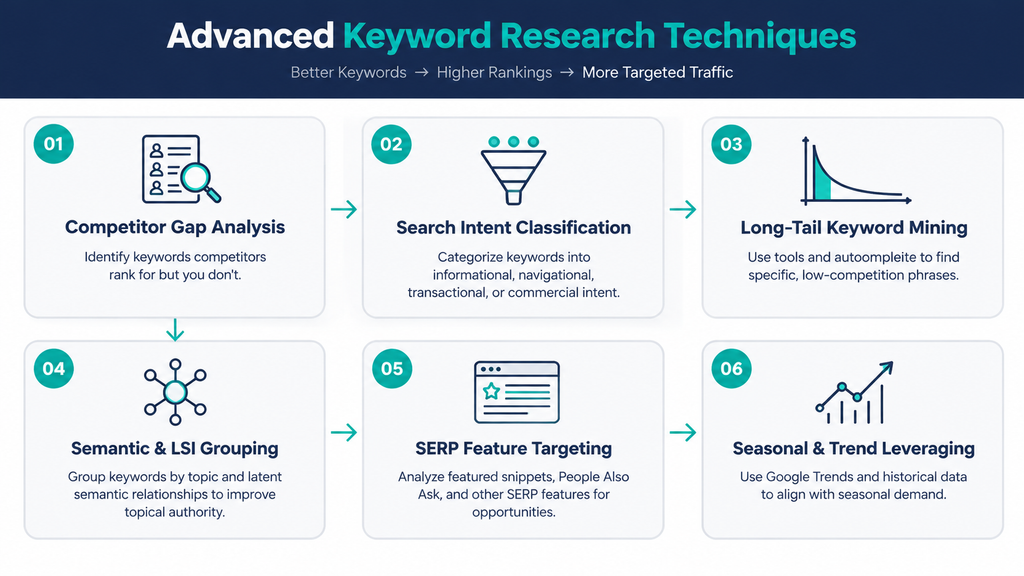
These keyword research techniques go beyond basic keyword lists to extract intelligence from your own data, competitor behaviour, and search engine features — identifying opportunities that basic tools do not surface automatically.
Technique 5: Google Search Console Data Mining
For websites with existing organic traffic, Google Search Console is the most valuable free source of keyword intelligence available — and mining it for ranking opportunities is one of the most underused keyword research techniques in ecommerce and content marketing. Search Console shows you every keyword your pages currently rank for, how many impressions and clicks each keyword generates, and — most valuably — which keywords you rank in positions 5 to 20 for, representing the strongest quick-win optimisation opportunities.
Filter Search Console’s Performance report to show keywords where your average position is between 5 and 20. These are pages and keywords where you are already ranking but not yet on page one — a small amount of targeted optimisation (strengthening the content, improving internal linking, or acquiring a few backlinks) frequently moves these pages to position 1 to 4, generating significantly more clicks from the same keyword without building a new page from scratch.
Technique 6: People Also Ask and Related Searches
Google’s ‘People Also Ask’ boxes and ‘Related Searches’ section at the bottom of search results are free, data-rich sources of keyword intelligence that many practitioners overlook in favour of paid tool data. These features reveal the specific questions and related queries that Google has identified as most commonly associated with your target keyword — making them invaluable keyword research techniques for FAQ content, blog post ideas, and supporting content that strengthens topical authority.
For every primary keyword you target, search for it in Google and capture every ‘People Also Ask’ question and every related search phrase. These become sub-topics within your main content piece, standalone FAQ entries, or additional blog post ideas that support your pillar page. Answering these questions comprehensively within your content is one of the most reliable ways to achieve featured snippet placement — the position zero result that appears above all organic listings.
Technique 7: Keyword Difficulty Filtering and Prioritisation
Keyword difficulty filtering is one of the keyword research techniques most directly responsible for whether a website’s SEO effort produces results in months or years. Targeting keywords with difficulty scores above your domain’s current authority level means competing against pages with hundreds of backlinks and years of ranking history — a competition a new or mid-authority site cannot win regardless of content quality. Filtering your keyword list to difficulty scores below your realistic competitive threshold ensures that your effort produces actual ranking improvements rather than theoretical content quality.
Use SEMrush’s keyword difficulty score (KD) as a primary filter. New websites with domain authority below 20 should target keywords with KD below 20 to 25. Websites with domain authority of 20 to 40 can compete for keywords up to KD 40. Established sites with authority above 50 can begin targeting KD 50 to 70. As your authority grows through content and link building, revisit your keyword list and progressively target higher-difficulty terms.
| Need a Complete Digital Marketing Strategy to Drive Organic Growth?Tasknestly’s digital marketing services combine keyword research, content strategy, SEO, and paid advertising into a cohesive plan that builds organic traffic and generates consistent leads.Start with a free digital marketing consultation → |
Ranking Takes More Than Tips
You know the strategy now — let Tasknestly handle the technical SEO, content, and link building that actually moves rankings.
Get SEO Services →Specialist Keyword Research Techniques for Growth
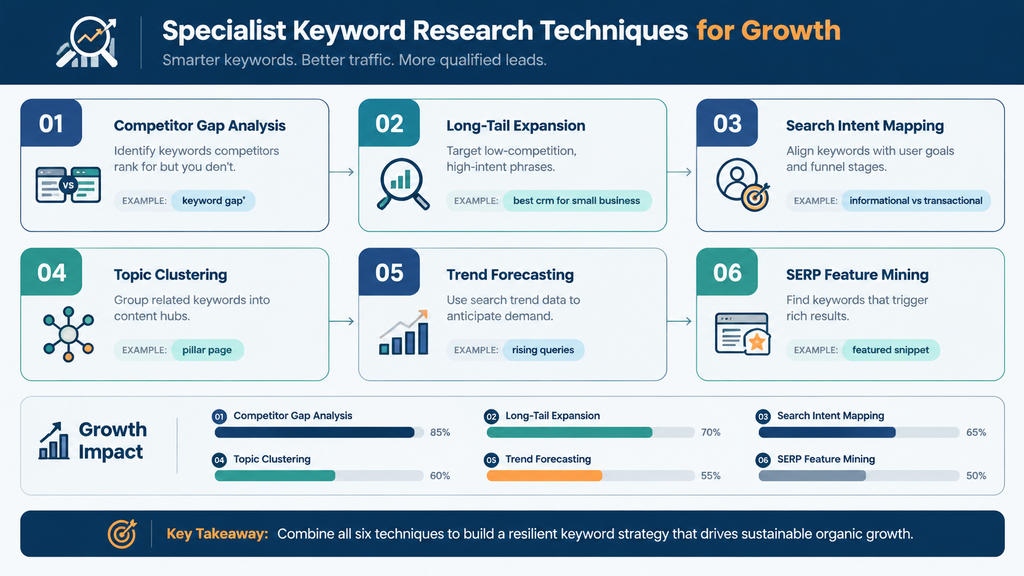
These final three keyword research techniques address specific high-value scenarios — local businesses, seasonal content, and the strategic organisation of keywords into an actionable content plan.
Technique 8: Seasonal and Trend Analysis
Seasonal keyword research techniques align your content calendar with predictable fluctuations in search demand — ensuring you publish optimised content in time for it to rank before peak demand arrives. Google Trends is the primary tool for this technique: it shows how search volume for any keyword has changed over time, reveals seasonal patterns, and compares the relative popularity of different keyword variations.
For ecommerce businesses, seasonal keyword research means identifying the peak demand periods for each product category and publishing targeting content eight to twelve weeks in advance — allowing sufficient time for Google to crawl, index, and rank the content before search volume peaks. For content businesses, it means identifying the topics that spike in interest at predictable times of year and building editorial calendars around those patterns.
Technique 9: Local Keyword Targeting
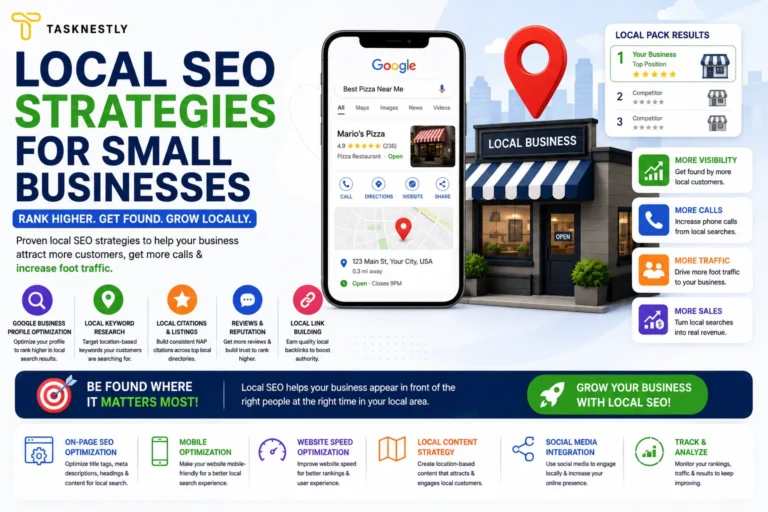
Local keyword keyword research techniques are specifically designed for service-area businesses, retailers, and any organisation whose customers are concentrated in a specific geographic market. Local keywords include location modifiers such as ‘[service] in [city]’, ‘[service] near me’, and ‘[service] [neighbourhood]’ — phrases that signal geographic purchase intent and are far less competitive than their national equivalents.
Local keyword research combines standard SEMrush research with Google Maps analysis — identifying the specific terms that trigger map pack results in your target location and optimising both your Google Business Profile and your website landing pages for those terms. For service businesses, local keyword keyword research techniques often produce faster, more commercially valuable results than national SEO because the competition is limited to businesses operating in the same geographic area.
Technique 10: Keyword Clustering and Content Planning
Keyword clustering is the final and most strategically organising of all keyword research techniques — the process of grouping related keywords into thematic clusters, each served by a single comprehensive piece of content, rather than attempting to rank separate pages for each individual keyword. This approach mirrors Google’s topical authority model: a website that comprehensively covers a topic through interconnected content that addresses every relevant question and keyword variation is recognised as an authority on that topic and ranked accordingly.
Cluster your keyword list by grouping terms with similar intent and topic into clusters of 10 to 20 keywords each. Create one comprehensive page or article per cluster, incorporating the full cluster of keywords naturally throughout the content. Link between cluster pages and a central pillar page for each topic area. This keyword clustering approach to keyword research techniques is the most scalable method for building topical authority systematically over time — and it is the framework that separates websites that rank for dozens of competitive terms from those that rank for none.
Ranking Takes More Than Tips
You know the strategy now — let Tasknestly handle the technical SEO, content, and link building that actually moves rankings.
Get SEO Services →Keyword Research Techniques: Quick Reference
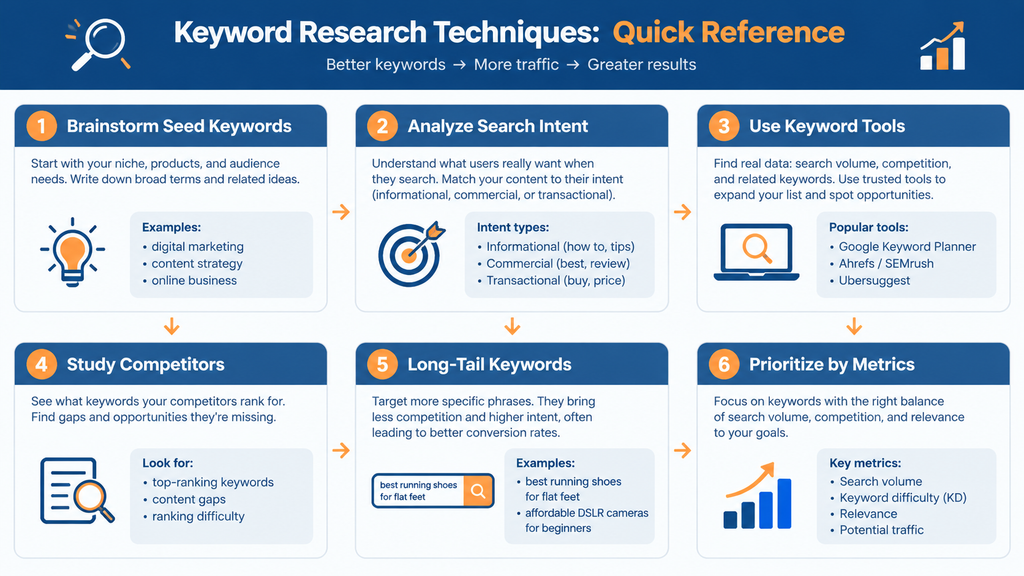
Use this table when planning your keyword research workflow or presenting your keyword strategy to stakeholders.
| # | Keyword Research Technique | Best For | Key Benefit |
| 1 | Seed keyword expansion | All websites starting SEO | Builds the foundational keyword universe |
| 2 | Competitor keyword gap analysis | Established businesses | Reveals high-value opportunities competitors hold |
| 3 | Long-tail keyword targeting | New sites and niche topics | Faster rankings and higher purchase intent |
| 4 | Search intent mapping | All content strategies | Ensures content matches what searchers actually want |
| 5 | Google Search Console data mining | Sites with existing traffic | Finds ranking opportunities hidden in your own data |
| 6 | People Also Ask and related searches | Content creation | Generates FAQ and supporting content ideas |
| 7 | Keyword difficulty filtering | Competitive markets | Identifies winnable keywords for current domain strength |
| 8 | Seasonal and trend analysis | Ecommerce and news sites | Times content for peak search demand periods |
| 9 | Local keyword targeting | Service-area businesses | Captures high-converting local search traffic |
| 10 | Keyword clustering and grouping | Content planning | Organises target keywords into logical content groups |
| Essential Tools for Professional Keyword Research TechniquesSEMrush — The most comprehensive keyword research platform for volume data, competitor analysis, keyword gap identification, and difficulty scoring.Surfer SEO — Optimise your content for target keywords with real-time scoring and keyword recommendations based on top-ranking competitor analysis.RankMath Pro — Implement your target keywords directly in WordPress with focus keyword guidance, meta tag optimisation, and content scoring built in. |
Ranking Takes More Than Tips
You know the strategy now — let Tasknestly handle the technical SEO, content, and link building that actually moves rankings.
Get SEO Services →Frequently Asked Questions: Keyword Research Techniques
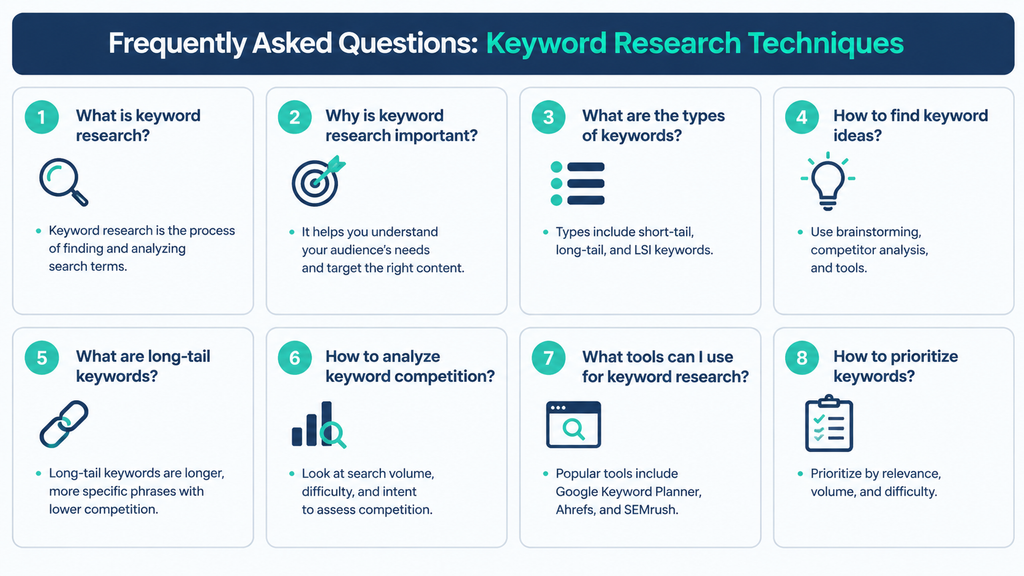
| Question | Answer |
| What are keyword research techniques? | Keyword research techniques are the methods used to identify, evaluate, and prioritise the specific search terms your target audience uses to find content or products related to your business. They range from simple seed keyword brainstorming to sophisticated competitor gap analysis, intent mapping, and data mining from your own Google Search Console data. |
| What is the best keyword research technique for beginners? | The best keyword research technique for beginners is seed keyword expansion — starting with three to five obvious keywords that describe your business or content, entering them into a tool like SEMrush or Google Keyword Planner, and exploring the full list of related keywords the tool generates. This builds a foundational keyword universe without requiring advanced SEO knowledge. |
| How many keywords should I target per page? | Target one primary focus keyword and two to four closely related secondary keywords per page. Trying to rank a single page for many unrelated keywords produces thin, unfocused content that ranks for nothing well. The best keyword research techniques involve grouping related keywords into clusters, with each cluster served by one comprehensive page. |
| What is keyword difficulty and how does it affect my strategy? | Keyword difficulty (KD) is a score from 0 to 100 indicating how hard it is to rank on page one for a given keyword, based on the authority of competing pages. New websites with low domain authority should target keywords with KD below 30. Established sites can compete for higher-difficulty terms. Keyword difficulty filtering is one of the most important keyword research techniques for prioritising realistic ranking opportunities. |
| What is search intent and why does it matter for keyword research? | Search intent is the reason behind a search query — whether the searcher wants information (informational intent), to navigate to a specific site (navigational), to compare options (commercial investigation), or to make a purchase (transactional). Targeting keywords without matching their search intent produces content that ranks briefly then loses position because it does not satisfy what searchers actually want. |
| How often should I do keyword research? | Conduct foundational keyword research when launching a new site or content strategy. Refresh your research quarterly to identify new keyword opportunities, monitor competitor ranking changes, and align with seasonal search demand shifts. Use Google Search Console data continuously to identify emerging ranking opportunities in your existing content. |
| What tools are best for keyword research techniques? | The best tools for keyword research techniques are SEMrush (comprehensive keyword data, competitor analysis, and gap identification), Google Keyword Planner (free baseline volume data), Google Search Console (actual performance data for your site), and Surfer SEO (content optimisation aligned with target keywords). RankMath Pro helps implement keyword targeting directly inside WordPress. |
Ranking Takes More Than Tips
You know the strategy now — let Tasknestly handle the technical SEO, content, and link building that actually moves rankings.
Get SEO Services →Conclusion: Apply These Keyword Research Techniques and Build Organic Growth
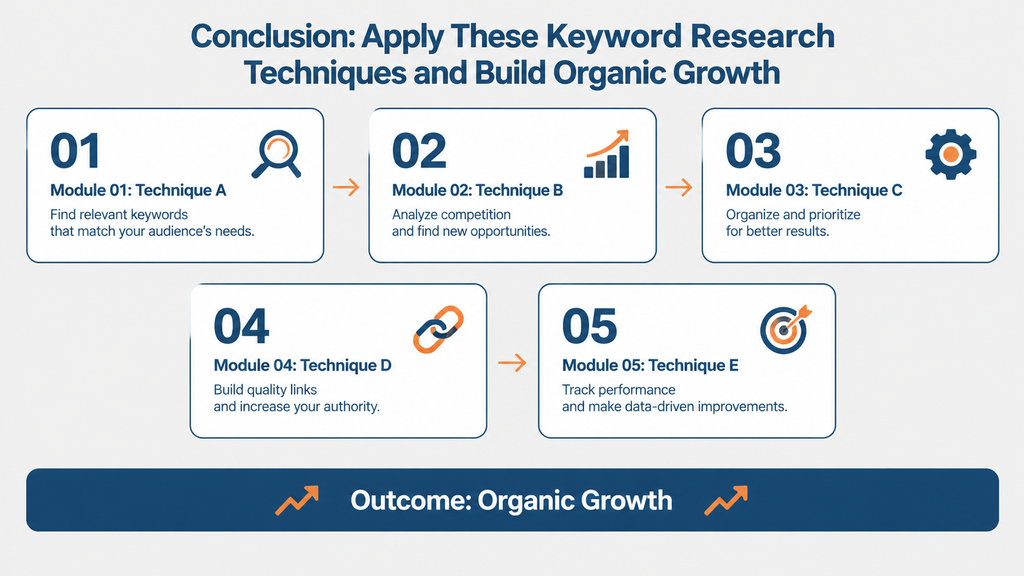
The 10 keyword research techniques in this guide — from seed keyword expansion and competitor gap analysis to intent mapping, Search Console data mining, and keyword clustering — are the same methods used by professional SEO teams to build organic traffic strategies that deliver compounding results over time. The businesses generating significant organic search revenue in 2026 are not doing anything mystical. They are identifying the specific terms their audience searches, creating content that comprehensively addresses those searches, and building the domain authority that allows them to rank for increasingly competitive terms as their site grows.
The most important principle across all keyword research techniques is to let data guide your decisions rather than intuition. The keywords that seem most obvious and most relevant to you are frequently the most competitive and the least attainable for your current domain strength. The keywords that data reveals as high-intent, lower-difficulty opportunities in adjacent areas of your topic are frequently the fastest path to meaningful organic traffic and the foundation on which broader authority is built.
At Tasknestly, we build keyword strategies and content plans for businesses that want organic search to become their primary source of qualified leads and revenue. If you are ready to invest in keyword research techniques and SEO that compound in value over time, explore our professional SEO services or request a free SEO consultation today.
The keyword research techniques that produce the fastest results are those applied to content that already has some ranking signal. Mining your Google Search Console data for keywords ranked 5-20 is the highest-ROI starting point for most established sites — these keyword research techniques leverage existing authority rather than building from scratch. Combining these quick-win keyword research techniques with longer-term techniques like cluster content planning and competitor gap analysis creates a keyword research programme that delivers both immediate and compounding results.
Build a regular keyword research techniques review into your SEO calendar. Keyword research techniques produce the most value when applied consistently — conducting keyword research techniques analysis quarterly ensures your content strategy reflects current search demand, competitor movement, and algorithm changes. The businesses generating compounding organic growth are those that treat keyword research techniques as an ongoing discipline rather than a one-time project.
To see what trend numbers do and don’t tell you, read Google’s Trends FAQ on how its search data is sampled and scaled.
Ranking Takes More Than Tips
You know the strategy now — let Tasknestly handle the technical SEO, content, and link building that actually moves rankings.
Get SEO Services →Grow With Tasknestly
Subscribe to the Tasknestly newsletter and get the latest tips on websites, SEO, social media, and digital growth.