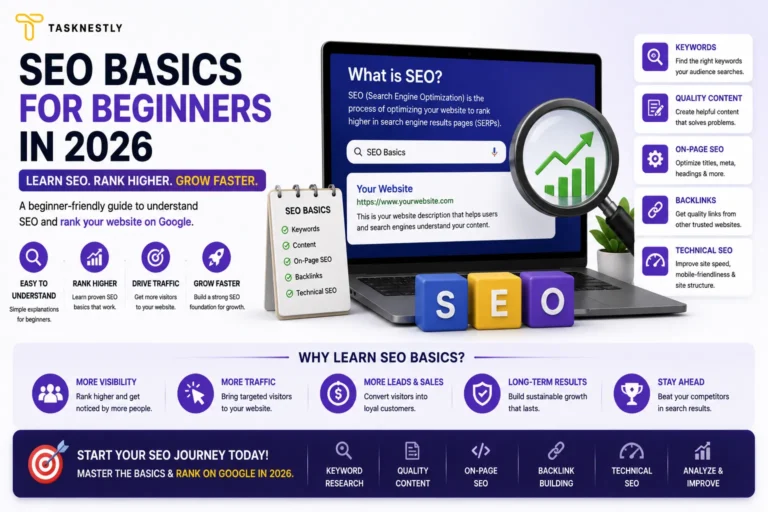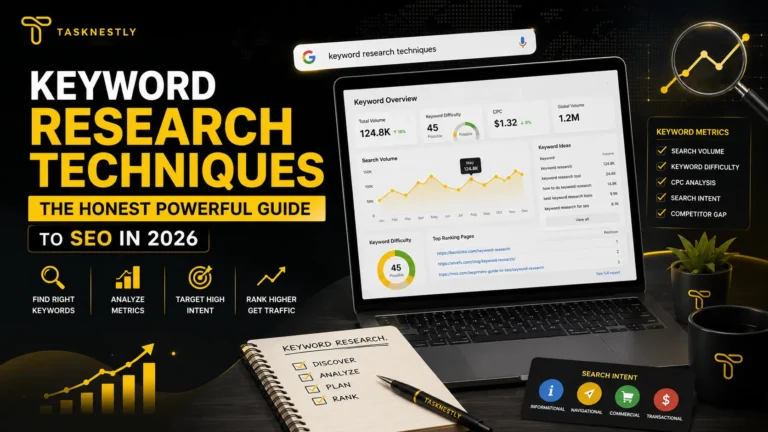

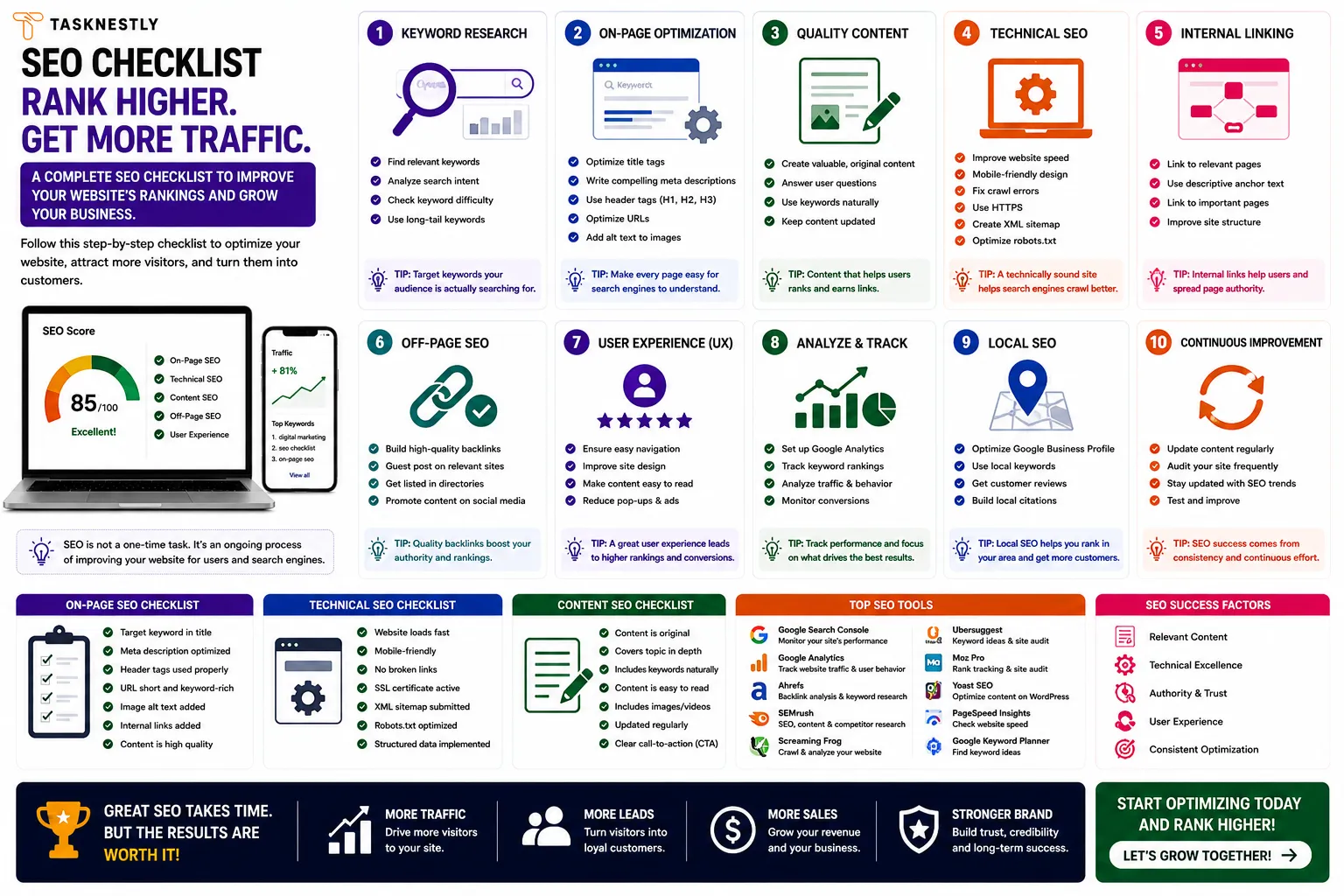
Every SEO professional and website owner needs a reliable on-page SEO checklist. On-page optimisation is the foundation of organic search performance — it is the set of optimisations you make directly on your own pages to help search engines understand, index, and rank your content. Without a structured on-page optimisation checklist, it is easy to publish page after page that technically works but fails to rank because of avoidable optimisation gaps.
The power of a good on-page SEO checklist lies in its consistency. Not every page will achieve top rankings, but every page can be fully optimised. Working through the same on-page SEO checklist for every piece of content you publish ensures that you never leave ranking signals on the table. It also builds a compound advantage: a website where every page is properly optimised sends consistently strong signals to search engines about content quality, relevance, and authority.
This on-page SEO checklist covers every element that matters in 2026 — from title tags and meta descriptions to content structure, internal linking, schema markup, and Core Web Vitals. Use it as your standard process for every page you create or audit, and you will build a website that search engines reward with consistent organic traffic growth.
| Want Professionally Optimised Pages That Rank and Convert?Tasknestly’s SEO team applies a rigorous on-page SEO checklist to every page we build and optimise, driving organic traffic that converts. Explore our professional SEO services or get a free SEO audit and proposal for your website today. |
Ranking Takes More Than Tips
You know the strategy now — let Tasknestly handle the technical SEO, content, and link building that actually moves rankings.
Get SEO Services →Table of Contents
Section 1 of Your On-Page SEO Checklist: Title Tags and Meta Descriptions
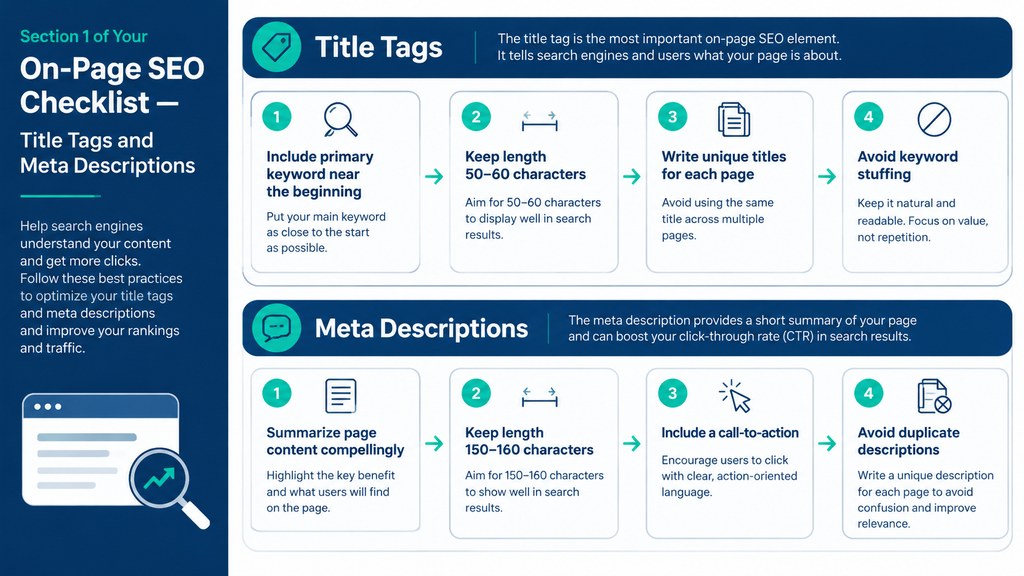
Your title tag and meta description are the first elements of your on-page SEO checklist and among the most impactful for both rankings and click-through rates.
Title Tag Optimisation
Your title tag should include the focus keyword naturally, preferably near the start. Keep it between 50 and 60 characters to avoid truncation in search results. Every page needs a unique title tag — duplicate titles are a common on-page SEO checklist failure that confuses search engines about which page should rank. Include a power word or value proposition to improve click-through rates. For Rank Math users, the plugin’s content analysis scores your title on keyword inclusion, sentiment, and length automatically.
Meta Description Optimisation
Meta descriptions do not directly influence rankings, but they significantly affect click-through rates, which indirectly influence SEO performance. For meta descriptions, your checklist should cover: include the focus keyword (Google bolds it in results), write a compelling call to action, keep it between 145 and 160 characters, and make every meta description unique. Never leave meta descriptions blank — Google will auto-generate one that is usually less effective than one you write yourself.
Ranking Takes More Than Tips
You know the strategy now — let Tasknestly handle the technical SEO, content, and link building that actually moves rankings.
Get SEO Services →Section 2: URL Structure and Slug
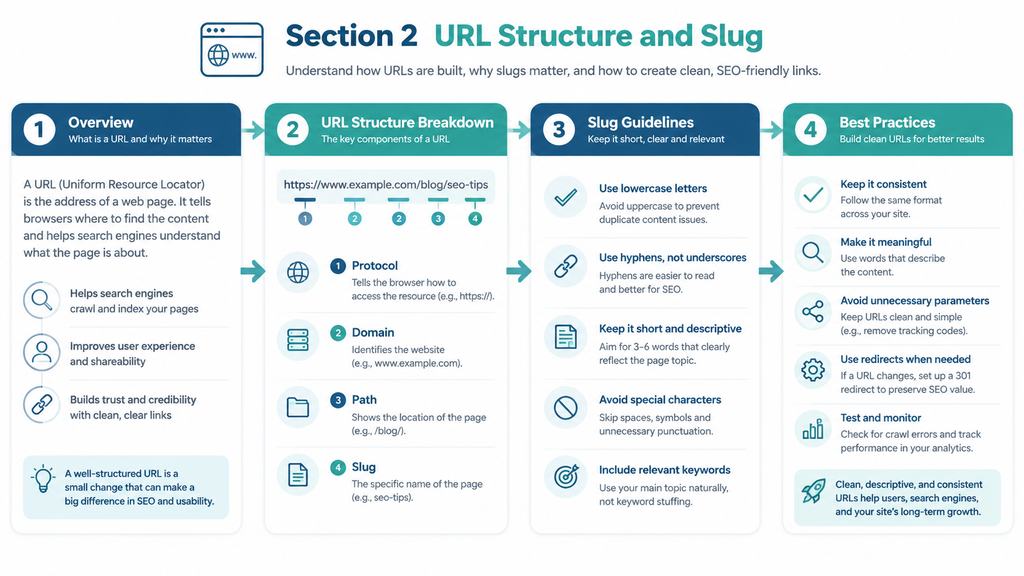
A clean, keyword-rich URL is a fundamental item on every on-page SEO checklist. Short, descriptive slugs that include the focus keyword perform better in search results and are more memorable for users. Avoid slugs that include dates, session IDs, or stop words that add length without adding context. Separate words with hyphens, not underscores. Once a page is published and indexed, avoid changing its URL without setting up a proper 301 redirect — URL changes without redirects lose any ranking equity the original URL had accumulated.
On-Page SEO Checklist for URL Best Practices
Your URL checklist best practices: keep slugs under 75 characters, include the primary keyword, use lowercase letters only, use hyphens to separate words, remove stop words (the, and, of) where possible without making the URL confusing, and ensure the URL structure reflects the page’s position in your site hierarchy for category and subcategory pages.
Section 3: Heading Structure
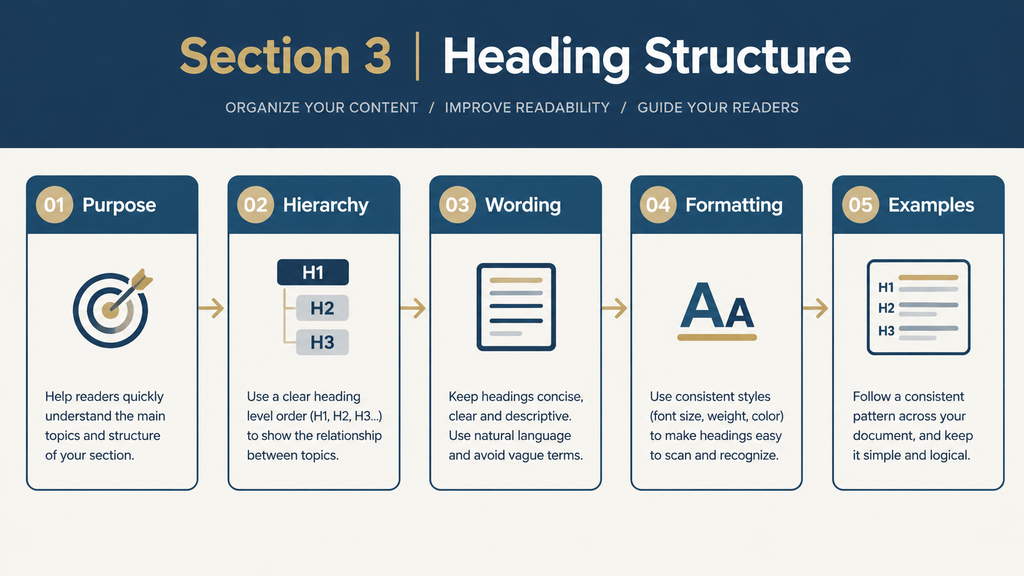
Heading structure is a critical component of any SEO checklist. Headings organise your content for both users and search engines, and they provide additional opportunities to include your focus keyword and related terms.
H1 Tag
Every page should have exactly one H1 tag that contains the focus keyword. Your H1 is your primary on-page signal to search engines about what the page is about — make it specific, compelling, and naturally aligned with the title tag. The H1 does not need to be identical to the title tag, but it should cover the same topic.
H2 and H3 Tags
Use H2 tags for your main content sections and H3 tags for subsections within those sections. Include the focus keyword in at least two H2 headings — this is a standard on-page SEO checklist requirement in Rank Math and other SEO tools. Use related keywords and semantic variations in your other headings to broaden the topical relevance of the page without keyword stuffing.
Ranking Takes More Than Tips
You know the strategy now — let Tasknestly handle the technical SEO, content, and link building that actually moves rankings.
Get SEO Services →Section 4: Content Quality and Keyword Density
Content quality is the most important signal in modern search, and the content section of your on-page SEO checklist is where most of the ranking work happens.
Keyword Density
Keyword density for your on-page SEO checklist should target 1.5 to 2% for the focus keyword in Rank Math. Rank Math measures density per individual word in a multi-word keyword phrase and uses the minimum occurrence rate as the reported density — so every word in your focus keyword needs to hit the threshold individually. Calculate density manually using the formula: (keyword occurrences ÷ total word count) × 100. Avoid keyword stuffing — natural, readable usage is more important than hitting an exact number.
Content Comprehensiveness
Search engines in 2026 reward comprehensive, authoritative content that fully satisfies the searcher’s intent. Your content checklist should include: does this page cover all the subtopics a searcher would expect? Does it answer follow-up questions? Does it use LSI keywords and related terms? Does it demonstrate first-hand experience or expertise? Pages that answer all these questions comprehensively consistently outperform thin content in competitive search results.
Content Length
Content length should be determined by what is needed to fully cover the topic, not by an arbitrary word count target. That said, most competitive keywords reward longer, more thorough content. Your content length checklist: check the top three ranking pages for your target keyword, assess the average content depth, and aim to match or exceed that depth while maintaining quality. For most competitive informational keywords, 2,500 to 4,000 words is the competitive range in 2026.
| Let Tasknestly Handle Your On-Page SEO OptimisationWorking through an on-page SEO checklist for every page of your website is time-intensive. Tasknestly’s optimisation specialists apply our complete checklist to your site and build a content programme that ranks. Explore how our SEO services work or request a free site audit to see exactly where your pages need improvement. |
Ranking Takes More Than Tips
You know the strategy now — let Tasknestly handle the technical SEO, content, and link building that actually moves rankings.
Get SEO Services →Section 5: Internal and External Links
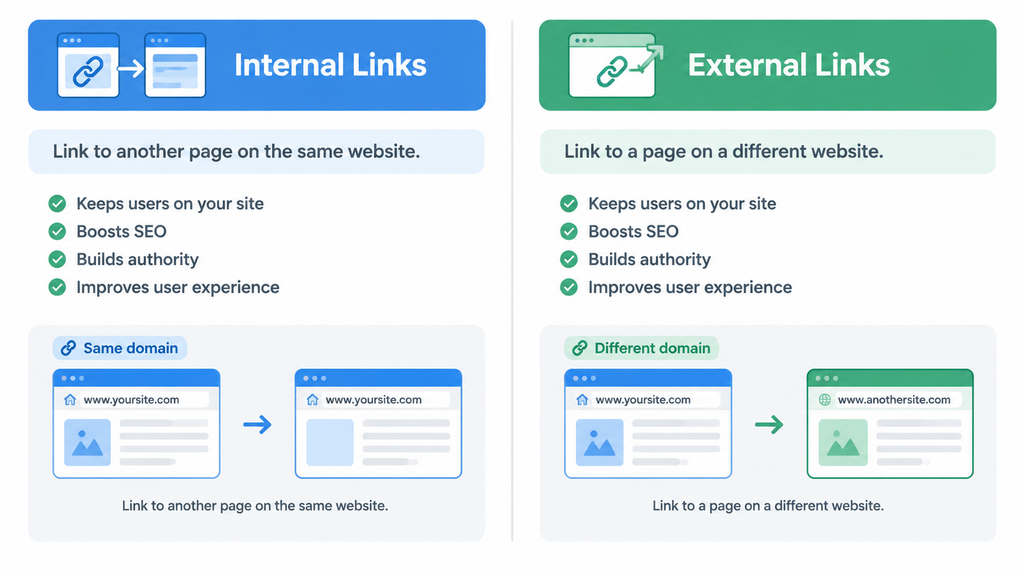
Linking is an essential section of any on-page optimisation checklist. Internal links distribute page authority across your site and help search engines discover and understand content hierarchy. External links to authoritative sources signal that your content is well-researched and connected to the broader web of information.
Internal Links
Every page on your website should have at least three to five internal links pointing to other relevant pages on your site. Use descriptive anchor text that indicates what the linked page is about — never ‘click here’ or ‘read more’. Include links to your most important service or category pages from high-traffic content pages. Also ensure that your important pages receive internal links from multiple other pages — this is how you signal to search engines that those pages are important.
External Links
For external links, your checklist: include one to two outbound links to authoritative, relevant external resources per page. External links to high-authority sources (academic research, government sites, industry publications) signal that your content is well-referenced. Use dofollow links for external resources you trust and want to endorse.
If you need help building a comprehensive internal linking structure as part of your on-page optimisation work, our ecommerce and website SEO services at Tasknestly include a full internal linking audit and implementation as standard.
Ranking Takes More Than Tips
You know the strategy now — let Tasknestly handle the technical SEO, content, and link building that actually moves rankings.
Get SEO Services →Section 6: Images and Media
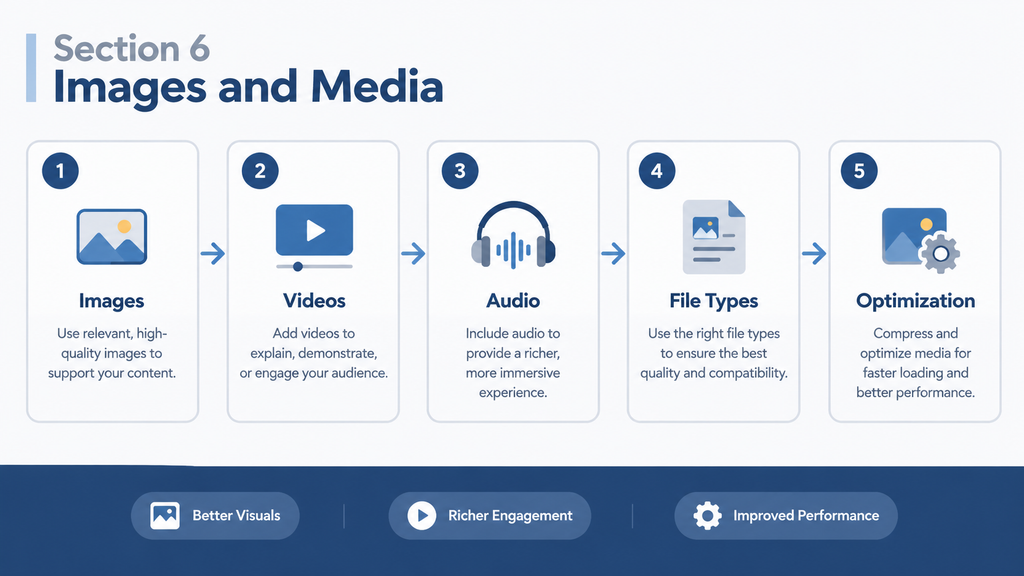
Images and media optimisation is frequently overlooked despite having meaningful impact on both rankings and page speed.
Image Alt Text
Every image on a page should have descriptive alt text that explains what the image shows. Include the focus keyword in the alt text of the most prominent image on the page — this is a standard Rank Math requirement. Use descriptive, specific alt text for all other images rather than leaving them blank or using generic filenames.
Image File Optimisation
Large image files are one of the most common causes of slow page load speed, which is both a user experience problem and an SEO ranking signal. For image optimisation, your checklist should cover: compress all images before uploading (WebP format is recommended for web use), use descriptive, keyword-rich filenames, set explicit width and height attributes to prevent layout shift, and use lazy loading for images below the fold.
Ranking Takes More Than Tips
You know the strategy now — let Tasknestly handle the technical SEO, content, and link building that actually moves rankings.
Get SEO Services →Section 7: Page Speed and Core Web Vitals
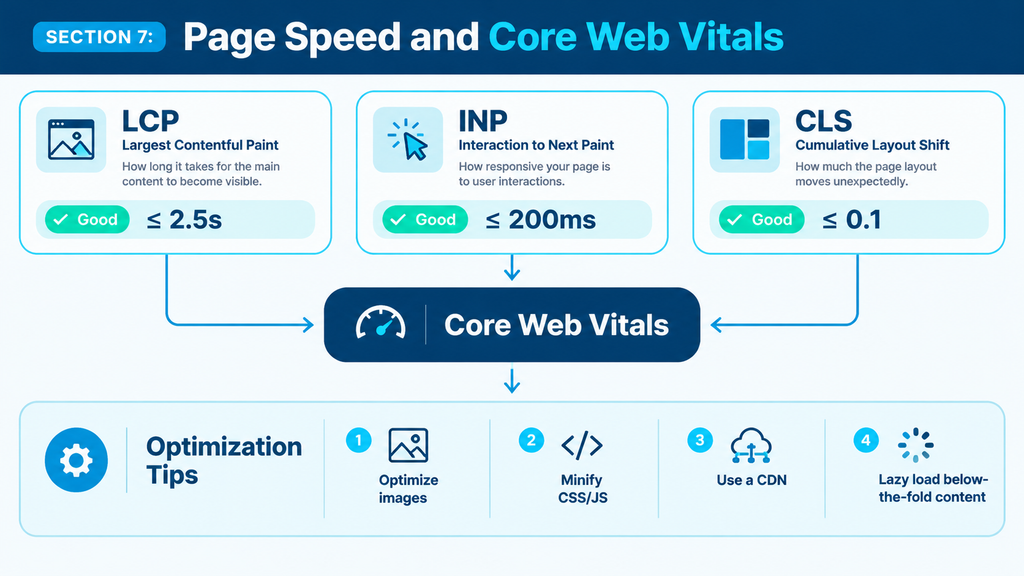
Page speed and Core Web Vitals have been explicit Google ranking factors since 2021 — non-negotiable for any optimisation checklist. Core Web Vitals measure three aspects of user experience: Largest Contentful Paint (loading performance), Interaction to Next Paint (interactivity), and Cumulative Layout Shift (visual stability).
Core Web Vitals Targets
Core Web Vitals targets for your checklist: LCP under 2.5 seconds (Good), INP under 200 milliseconds (Good), CLS under 0.1 (Good). Use Google PageSpeed Insights, Google Search Console’s Core Web Vitals report, or GTmetrix to measure your current scores. Common issues affecting Core Web Vitals include unoptimised images, render-blocking JavaScript, and unstable layout elements — each with specific technical fixes.
Section 8: Schema Markup
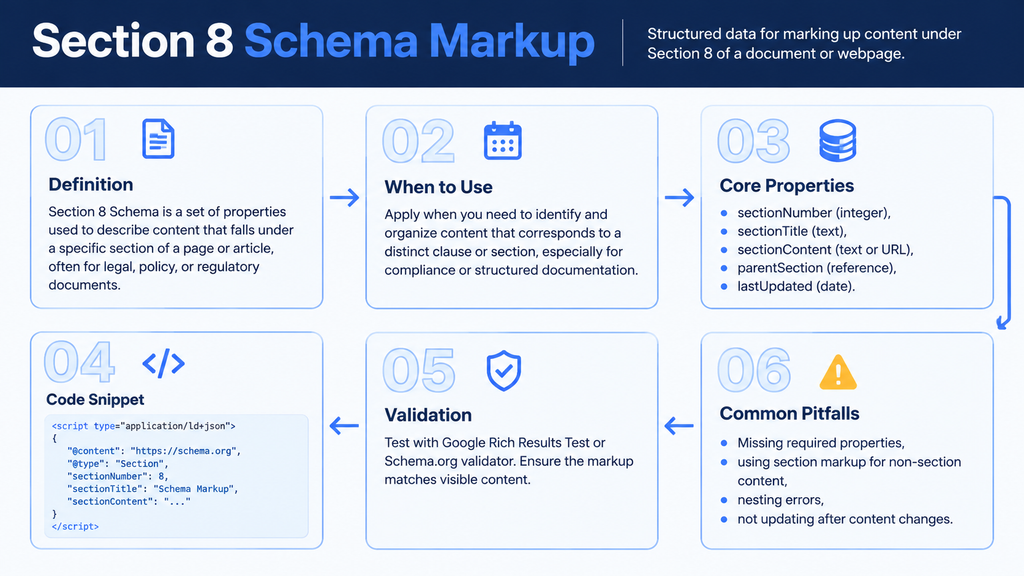
Schema markup is structured data that helps search engines understand your content and display rich results in search results pages. It is an advanced but impactful optimisation step that many competitors overlook.
Common schema types for ecommerce and blog content include: Article schema for blog posts, Product schema for product pages (including price, availability, and reviews), FAQ schema for pages with question-and-answer sections, HowTo schema for step-by-step guides, and BreadcrumbList schema for navigation hierarchy. Rank Math Pro includes a schema generator that makes implementing these schema types straightforward without custom coding.
Ranking Takes More Than Tips
You know the strategy now — let Tasknestly handle the technical SEO, content, and link building that actually moves rankings.
Get SEO Services →Priority and Impact Summary: Your On-Page SEO Checklist
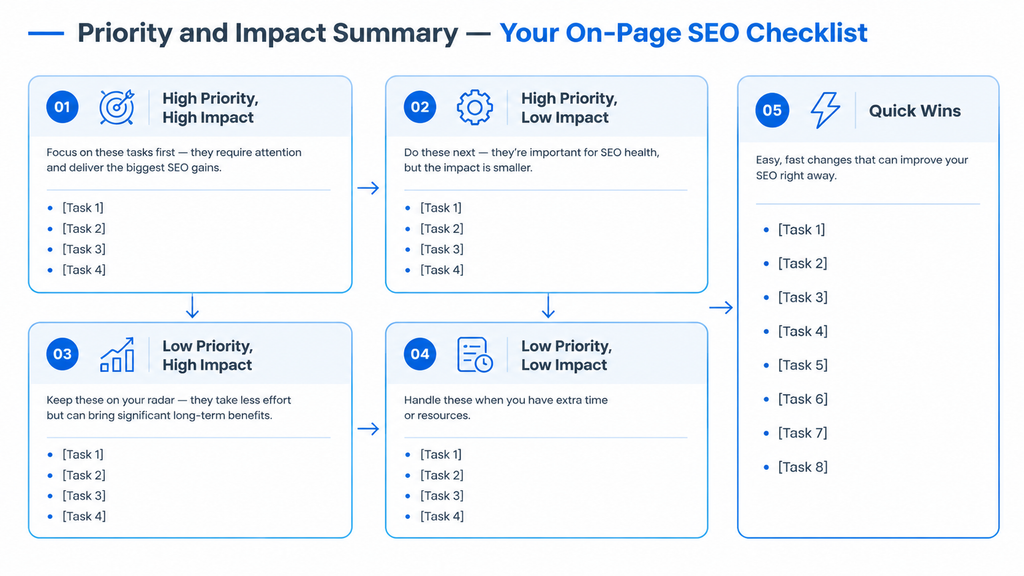
| Checklist Item | Priority | Difficulty | SEO Impact |
| Title tag with keyword | Critical | Easy | Direct ranking signal, click-through rate |
| Meta description | High | Easy | Click-through rate, indirect rankings |
| Focus keyword in H1 | Critical | Easy | Primary relevance signal |
| Keyword in H2s (min 2) | High | Easy | Topical relevance, structure |
| Keyword density 1.5-2% | High | Medium | Rank Math score, relevance signals |
| Image alt text | High | Easy | Image search, accessibility, rankings |
| Internal links (3-5) | High | Easy | Authority flow, crawlability |
| Schema markup | Medium | Medium | Rich results, CTR improvement |
| Core Web Vitals | High | Hard | Ranking factor + UX |
| Clean URL slug | High | Easy | Keyword relevance, shareability |
Ranking Takes More Than Tips
You know the strategy now — let Tasknestly handle the technical SEO, content, and link building that actually moves rankings.
Get SEO Services →On-Page SEO Checklist for WordPress: Using Rank Math Effectively
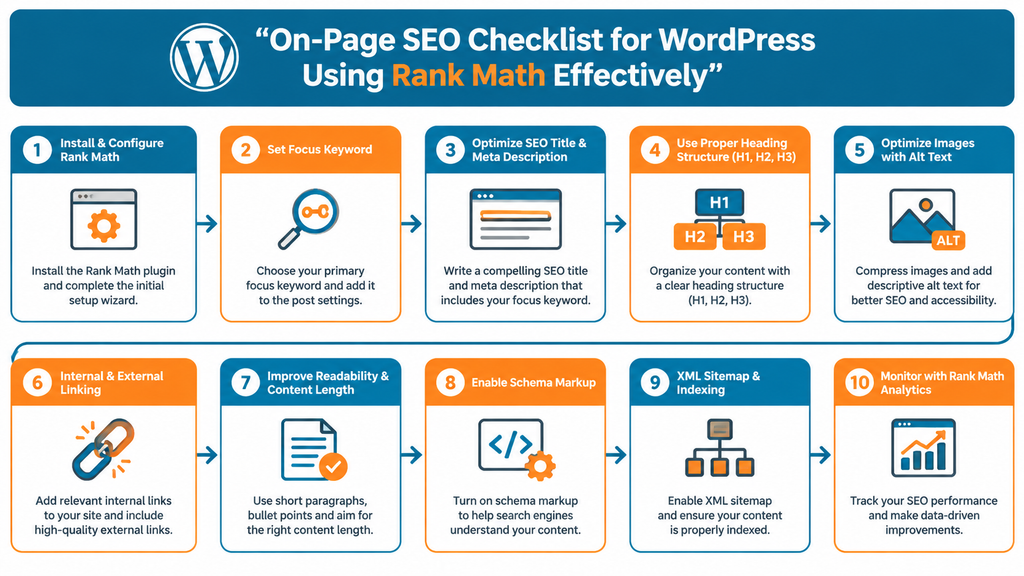
For WordPress websites, Rank Math is the most widely used tool for on-page SEO optimisation. Its content analysis panel appears directly within the WordPress editor and scores your page against a list of optimisation factors in real time as you write. Understanding how to use Rank Math effectively as your on-page optimisation companion reduces the time it takes to fully optimise each page.
The Rank Math analysis panel scores your page for title tag keyword inclusion, keyword in meta description, keyword in H1, keyword in subheadings, keyword density, keyword in first 100 words, image alt text, content length, and internal and external links. Aim for a Rank Math score of 80 or above for each page — scores below 70 indicate that significant on-page optimisation opportunities are being missed.
Rank Math’s advanced mode unlocks additional optimisation features including schema markup setup, advanced keyword tracking, and the ability to target multiple focus keywords on a single page. For content that targets a primary keyword and two or three supporting keywords, the advanced mode schema and content analysis tools are particularly valuable. Most Tasknestly SEO clients use Rank Math Pro as their standard on-page checklist tool.
If you need help configuring Rank Math and integrating it into your content workflow, our professional SEO and website setup services at Tasknestly include full plugin configuration and a custom optimisation process tailored to your site.
Ranking Takes More Than Tips
You know the strategy now — let Tasknestly handle the technical SEO, content, and link building that actually moves rankings.
Get SEO Services →On-Page SEO Checklist for Ecommerce Category and Product Pages
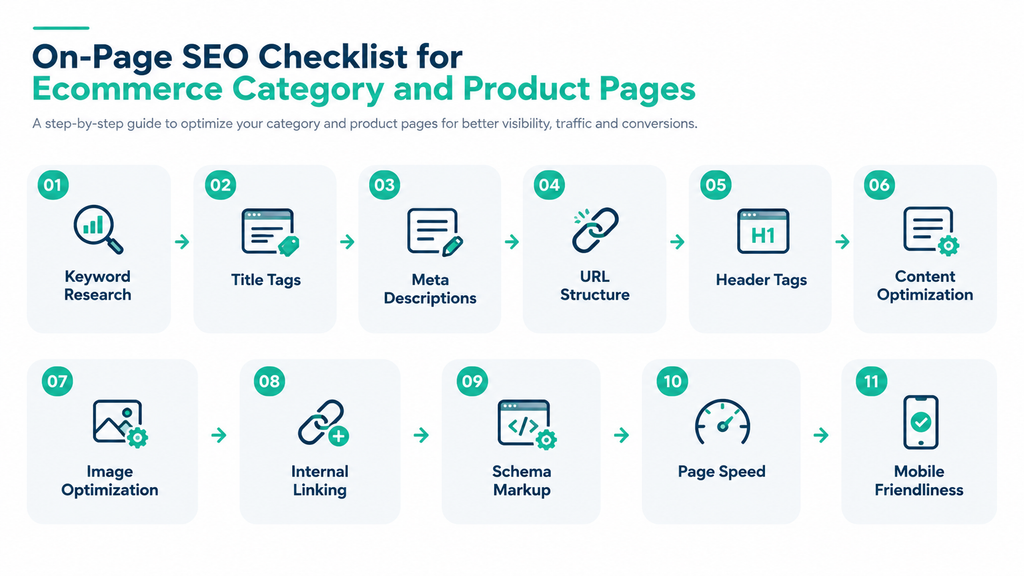
Ecommerce sites have unique on-page SEO requirements that go beyond the standard checklist for blog and service pages. Category pages and product pages each need their own checklist approach.
Category Page On-Page SEO Checklist
Category pages are often the highest-value pages on an ecommerce website — they target broader commercial keywords and sit above hundreds of product pages in your site hierarchy. Your category page checklist should include: a keyword-optimised H1, a unique category description of at least 200 words (above or below the product grid), internal links to subcategories and featured products, breadcrumb navigation with proper schema, and filtered facet URLs handled correctly to prevent duplicate content.
Product Page On-Page SEO Checklist
Product pages target high-intent buyer keywords and must be optimised to both rank and convert. Your product page checklist: unique product title with primary keyword, unique product description (never copy manufacturer text), product schema markup with price and availability, customer review schema if you have reviews, optimised alt text for all product images, related product internal links, and a clear call to action above the fold. Product pages with thin or duplicated content are among the most common on-page SEO checklist failures on ecommerce sites.
Ranking Takes More Than Tips
You know the strategy now — let Tasknestly handle the technical SEO, content, and link building that actually moves rankings.
Get SEO Services →Advanced On-Page SEO Checklist: Semantic SEO and Topic Authority
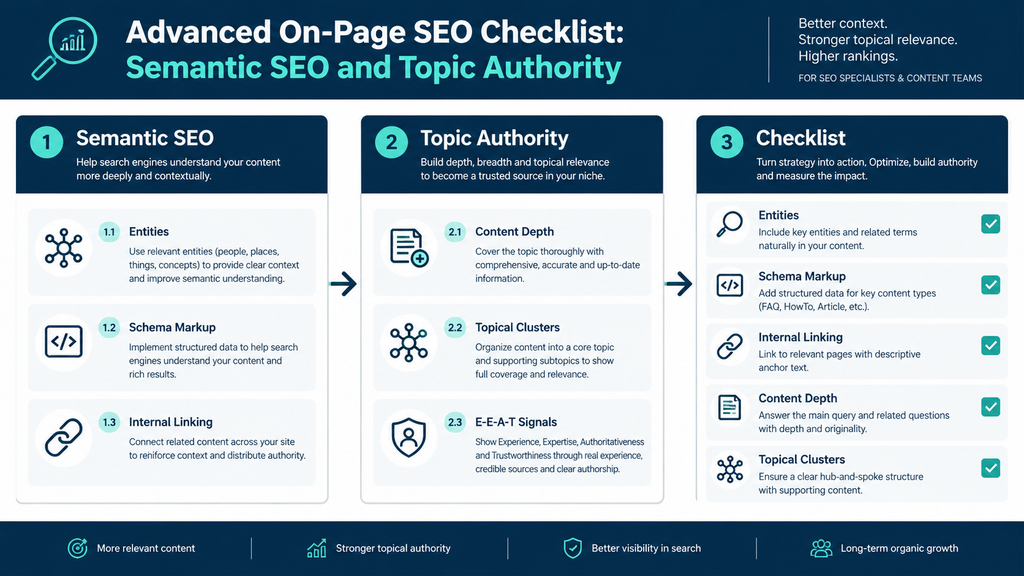
Advanced on-page optimisation in 2026 goes beyond traditional keyword targeting. Search engines have become increasingly sophisticated at understanding semantic relationships between topics, which means your strategy should now include elements that build topical authority, not just keyword relevance.
The concept of topical authority means creating a comprehensive cluster of related content around a subject rather than individual pages targeting isolated keywords. A website with a strong pillar page on a topic — supported by numerous related articles that link back to it — signals deep expertise to search engines. Your advanced on-page checklist should include: does this page link to related content on your site? Does it link out to authoritative external sources? Does it cover subtopics comprehensively? Does it include semantic keyword variations and related terms throughout?
Entity optimisation is another advanced checklist consideration. Google’s Knowledge Graph understands real-world entities — people, organisations, products, places — and their relationships. Mentioning relevant entities (brand names, technical terms, industry figures) in your content helps Google contextualise your page within its understanding of the topic space. For ecommerce, this means mentioning brand names, product specifications, and industry terminology naturally throughout product and category page content.
| Recommended Tools for Your On-Page SEO ChecklistThese beginner-friendly tools help you implement and track every item on your SEO checklist:Rank Math — rankmath.com — The leading WordPress SEO plugin for on-page SEO checklist implementation with real-time content analysis, schema generator, and keyword tracking.Screaming Frog — screamingfrog.co.uk — Powerful site crawler that audits on-page SEO elements across your entire website and identifies gaps in your checklist implementation.Google Search Console — search.google.com/search-console — Free Google tool for monitoring indexing, Core Web Vitals, keyword rankings, and page-level search performance. |
Ranking Takes More Than Tips
You know the strategy now — let Tasknestly handle the technical SEO, content, and link building that actually moves rankings.
Get SEO Services →Measuring the Impact of Your On-Page Optimization Efforts
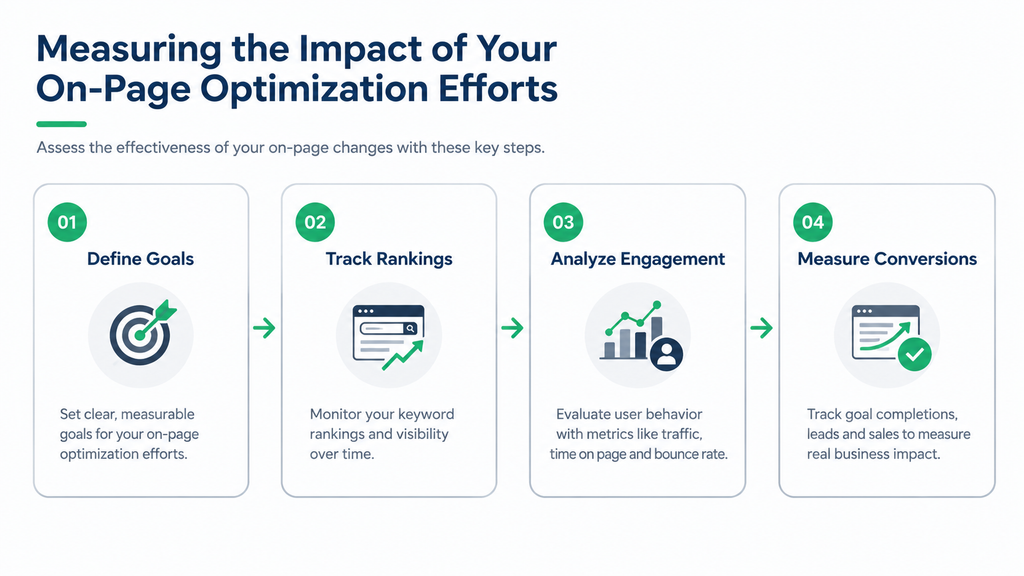
Knowing how to measure the results of your on-page optimisation work is as important as knowing what to implement. Without measurement, you cannot tell whether your optimisation efforts are producing results or where additional attention is needed. The right measurement framework turns your on-page SEO process from a series of tasks into a data-driven improvement cycle.
Google Search Console is your primary tool for measuring the impact of on-page optimisation. After updating a page, monitor its average position, impressions, and click-through rate in Search Console over the following four to eight weeks. Improvements in average position for target keywords confirm that your changes are being recognised by Google. A drop in CTR despite improved rankings often points to a meta description or title tag that needs to be revised to be more compelling.
GA4 provides the revenue and engagement data that Search Console does not: which pages generate the most conversions, what the bounce rate is for organic landing pages, and how different user segments engage with your content. Connecting Search Console with GA4 through the native integration gives you a complete picture — from initial keyword ranking through to on-site engagement and conversion — that covers the full impact of your on-page optimisation work.
Track rankings for your target keywords at the page level using a rank tracking tool. Weekly ranking checks after publishing or updating a page reveal how quickly changes take effect — typically two to six weeks for Google to fully re-evaluate a page after significant on-page changes. Documenting your changes and subsequent ranking movements builds an evidence base that informs future optimisation decisions and helps you replicate successful approaches across your site.
Ranking Takes More Than Tips
You know the strategy now — let Tasknestly handle the technical SEO, content, and link building that actually moves rankings.
Get SEO Services →On-Page SEO and User Experience: The Inseparable Connection
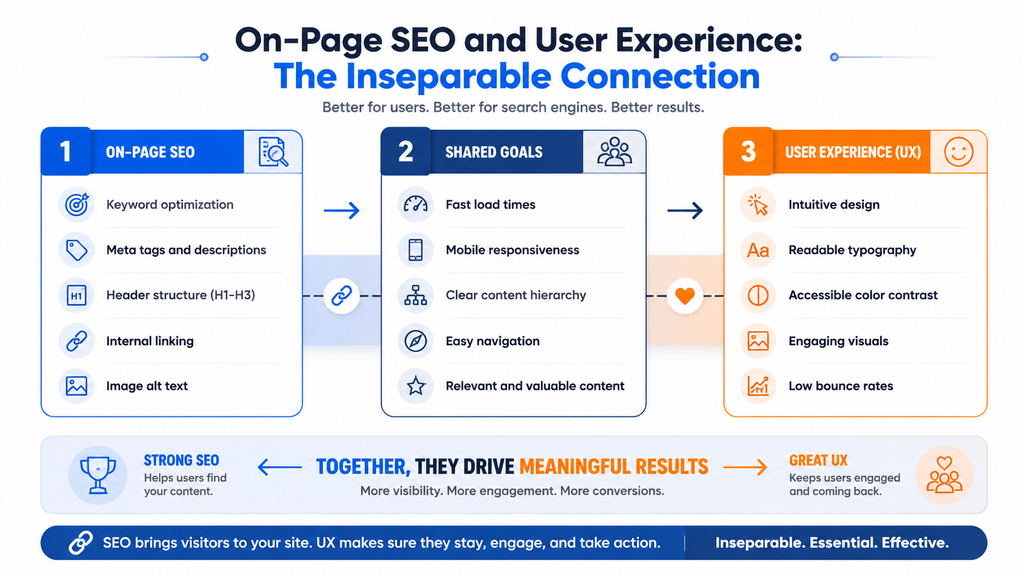
On-page SEO and user experience (UX) are increasingly inseparable in modern search. Google’s algorithm signals — particularly Core Web Vitals and engagement metrics — indicate that search engines are explicitly measuring how users experience your pages, not just how well-optimised they are in technical terms. A page that ranks but immediately loses users to frustration (slow load, poor mobile experience, confusing layout) signals to Google that it may not deserve its ranking.
Designing pages that are both optimised for search and genuinely useful to visitors is the most sustainable approach. This means using heading structure not just to signal keyword relevance but to genuinely guide readers through the content logically. It means writing meta descriptions that accurately represent what the page contains, so that visitors who click from search arrive on a page that meets their expectations. It means compressing images not just to improve Core Web Vitals scores but because slow pages frustrate real users.
The brands that understand this connection between search optimisation and user experience build websites that are genuinely better for visitors — and they are rewarded by search engines with rankings that are more durable and harder for competitors to displace. Technical optimisation and genuine content quality are not competing priorities; they are complementary, and the best results come from pursuing both simultaneously.
Accessibility also overlaps with search optimization in important ways. Proper heading hierarchy, descriptive image alt text, and clear page structure all improve accessibility for users with disabilities — and these same elements also provide SEO benefits. Building accessible web content is not just good practice from an ethical and legal standpoint; it aligns perfectly with sound optimization principles and reinforces the signals that search engines use to evaluate content quality and organization.
Ranking Takes More Than Tips
You know the strategy now — let Tasknestly handle the technical SEO, content, and link building that actually moves rankings.
Get SEO Services →Frequently Asked Questions: On-Page SEO Checklist
| Question | Answer |
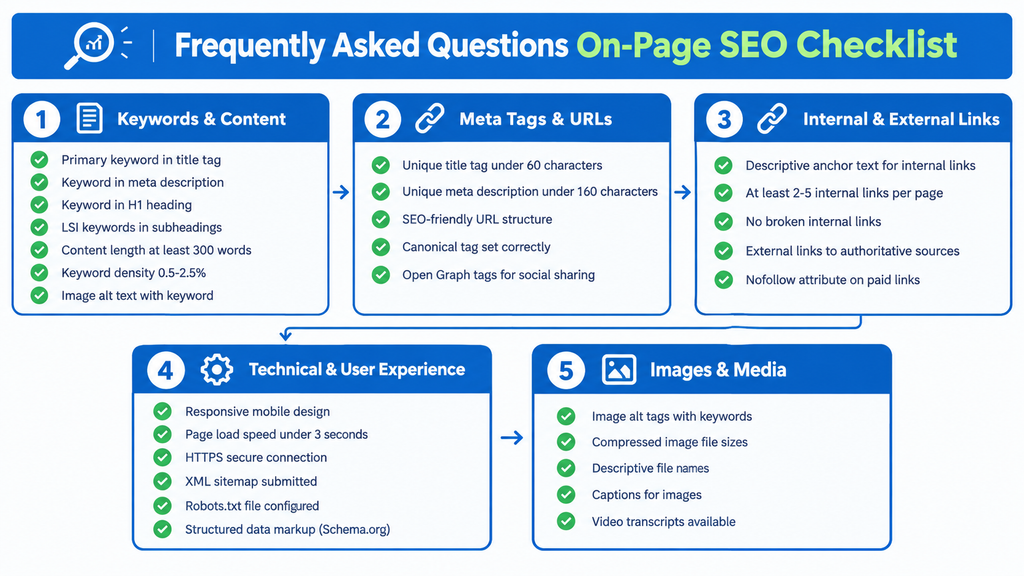
| What is included in an on-page SEO checklist? | A complete checklist covers: title tag with keyword, meta description, clean URL slug, H1 with keyword, H2s with keyword (minimum 2), keyword density 1.5-2%, comprehensive content, internal links, external links, image alt text, schema markup, and Core Web Vitals performance. All these elements should be verified for every page you publish. |
| How long does it take to complete an on-page SEO checklist? | For an experienced SEO professional using tools like Rank Math, working through an checklist for a new page takes 30-60 minutes. For an existing page audit, the checklist review itself takes 20-30 minutes. Building the habit of completing the checklist for every page before publication is the most efficient approach. |
| Does keyword density still matter for an on-page SEO checklist? | Yes, keyword density remains a factor in on-page SEO tools like Rank Math, which measures density per individual word in a phrase. The target is 1.5-2%. Natural, readable usage throughout the content is the best approach. |
| What is the most important item on an on-page SEO checklist? | Content quality and keyword relevance are the most important items on your optimisation checklist. A perfectly optimised title tag and meta description will not save a page with thin or irrelevant content. Conversely, excellent content with basic on-page optimisation will often rank above thin content with perfect technical implementation. |
| How often should I run through my on-page SEO checklist? | Apply your checklist to every new page before publication. For existing pages, schedule a quarterly review to identify optimisation gaps, update content that has become outdated, and add internal links from new pages published since the last review. Search engines reward pages that are regularly updated and improved. |
| Can I use an on-page SEO checklist for ecommerce product pages? | Absolutely. An optimisation checklist for ecommerce product pages should include all standard elements plus: product schema markup, customer review schema, optimised product titles with keyword, unique product descriptions (never manufacturer copy), optimised image alt text for all product images, and internal links to related products and category pages. |
Ranking Takes More Than Tips
You know the strategy now — let Tasknestly handle the technical SEO, content, and link building that actually moves rankings.
Get SEO Services →Conclusion
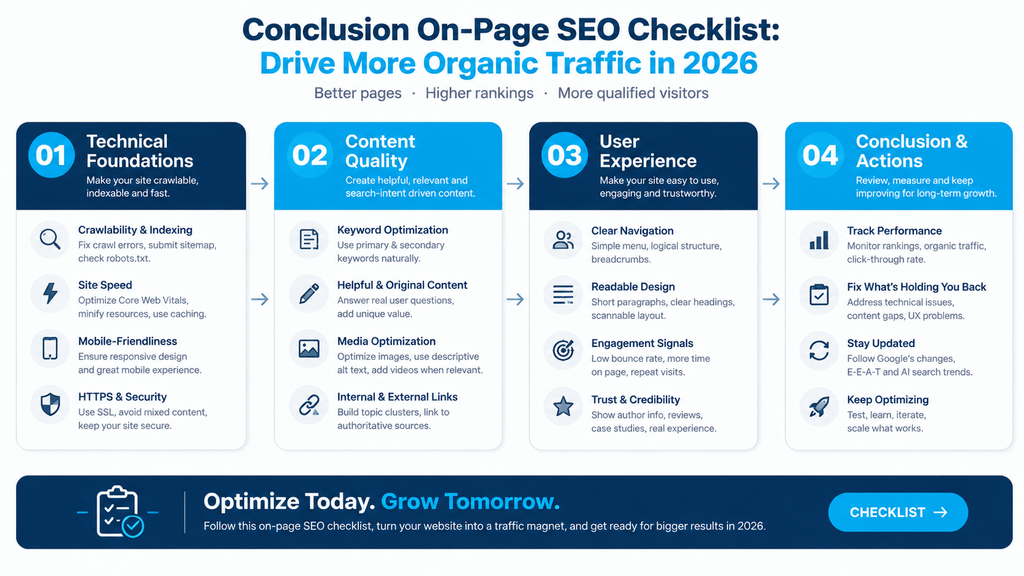
A well-implemented complete on-page SEO checklist is one of the highest-return investments you can make in organic search performance. Every item on the checklist — from title tag to Core Web Vitals — represents a ranking signal that cumulatively determines where your pages appear in search results. Skipping items because they seem minor is how pages end up in positions 4 through 10 instead of position 1.
The most important thing about an on-page SEO checklist is that it becomes a standard part of your content creation and publishing workflow. Not a one-time project, not an occasional audit — a consistent process applied to every single page. Websites that treat on-page optimisation as a standard operating procedure consistently outperform those that optimise pages inconsistently or only when rankings disappoint.
If you want expert help implementing a complete on-page SEO checklist across your website — from new content creation to existing page audits — get a free SEO proposal from Tasknestly. Our SEO specialists apply our comprehensive on-page checklist to every page we work on and build the organic traffic that drives consistent, compounding results for your business.
For Google’s own advice on page titles, read its guide to influencing your title links in search results.
Ranking Takes More Than Tips
You know the strategy now — let Tasknestly handle the technical SEO, content, and link building that actually moves rankings.
Get SEO Services →Grow With Tasknestly
Subscribe to the Tasknestly newsletter and get the latest tips on websites, SEO, social media, and digital growth.