
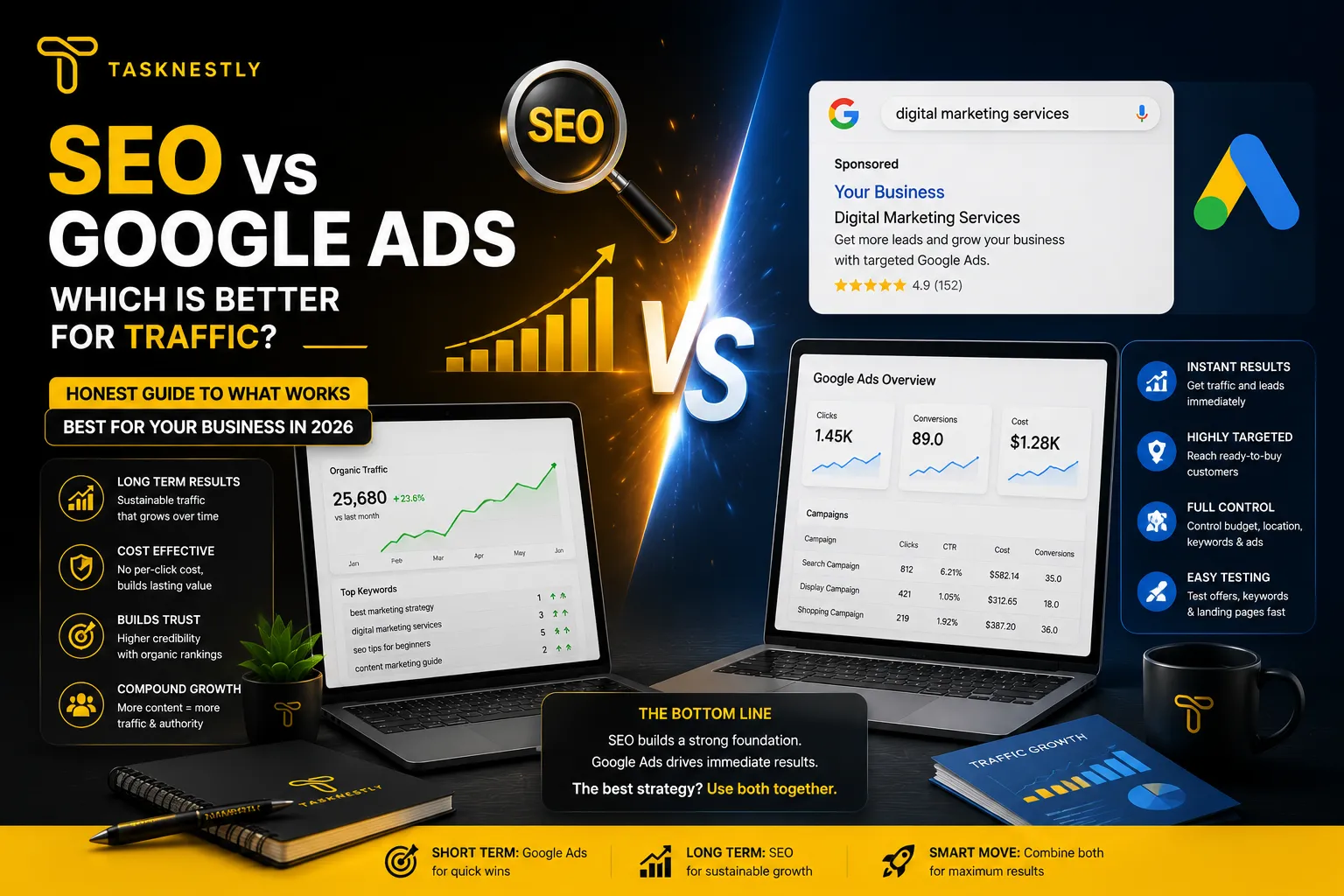
SEO vs Google Ads is the most consequential channel decision any business investing in digital marketing will make. Both channels place your business in front of people actively searching for what you offer — but they operate on fundamentally different economics, timelines, and risk profiles. Choosing between them without understanding those differences leads to misallocated budgets, missed growth opportunities, and the frustration of investing in a channel that does not match your business situation.
The reality is that this is rarely a binary choice. SEO and Google Ads serve different strategic purposes and different stages of business development — and the businesses generating the strongest ROI from search are almost always those using both intelligently. But understanding when each channel is right, what each delivers, and how they interact is the prerequisite for making that decision well.
This guide breaks down the SEO vs Google Ads comparison across 10 critical dimensions — cost, timeline, traffic quality, scalability, brand trust, conversion intent, click-through rates, compounding returns, data capabilities, and combined strategy — giving you the insights needed to allocate your marketing budget to the channel combination that matches your goals.
| Want an SEO Strategy That Builds Traffic You Own?Tasknestly’s professional SEO services build organic search visibility that compounds over time — driving qualified traffic to your website without the ongoing cost of paid advertising.Get your FREE SEO Consultation → |
Ranking Takes More Than Tips
You know the strategy now — let Tasknestly handle the technical SEO, content, and link building that actually moves rankings.
Get SEO Services →Table of Contents
SEO vs Google Ads: Understanding the Fundamentals
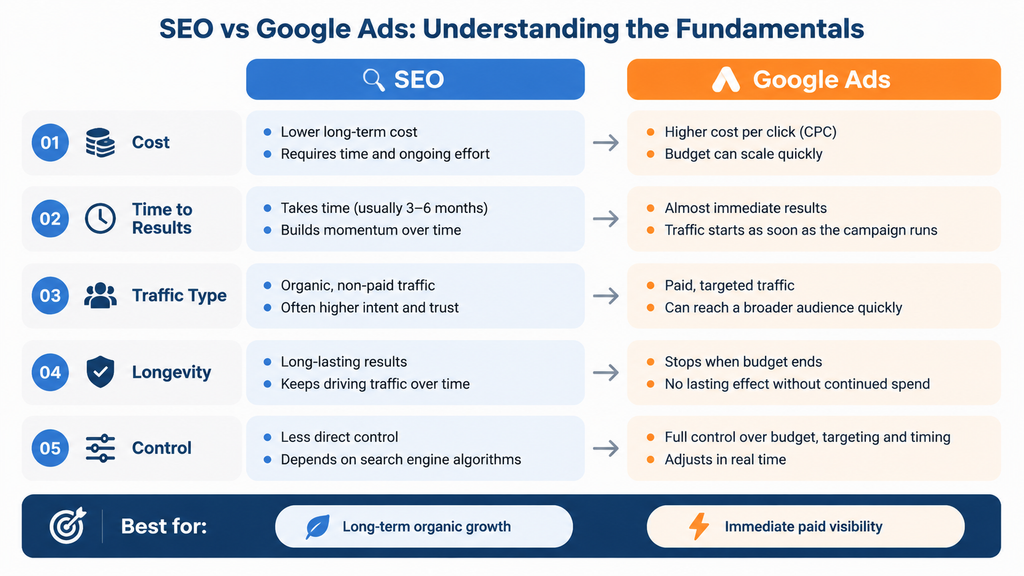
Before comparing specific dimensions, the SEO vs Google Ads decision requires a clear understanding of what each channel is and how each generates traffic.
What Is SEO?
Search engine optimisation (SEO) is the practice of improving your website’s content, technical structure, and authority to rank higher in organic — unpaid — search results. When someone searches Google and clicks a non-advertising result, that click is generated by SEO. Organic rankings are earned through producing high-quality, relevant content, building backlinks from authoritative sources, and maintaining a technically sound website that Google can crawl effectively.
The defining economic characteristic of SEO in the SEO vs Google Ads comparison is that once a page ranks, the traffic it generates is essentially free — it does not cost more to receive 10,000 organic visitors per month than 1,000. This compounding economic advantage is why businesses that invest in SEO early consistently lower their customer acquisition cost over time.
What Are Google Ads?
Google Ads is a pay-per-click advertising platform that places your listings at the top and bottom of search results for keywords you bid on. Traffic from Google Ads is immediate — campaigns can be live and generating clicks within hours of setup — but it is entirely dependent on continued budget: the moment you stop paying, the traffic stops.
In the SEO vs Google Ads comparison, Google Ads is a traffic rental model: you pay for access to search audiences while your campaign runs, but you build no lasting asset. SEO is a traffic ownership model: the content and rankings you build over time generate traffic long after the initial investment is made.
Ranking Takes More Than Tips
You know the strategy now — let Tasknestly handle the technical SEO, content, and link building that actually moves rankings.
Get SEO Services →SEO vs Google Ads: 10 Critical Insights
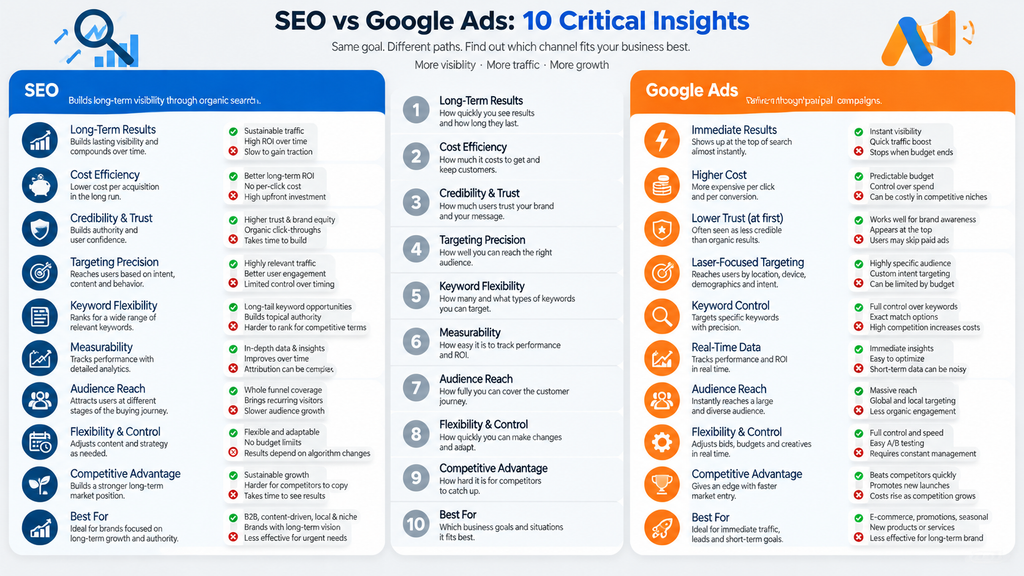
Insight 1: Cost Structure and Long-Term Economics
The cost structure is where the SEO vs Google Ads comparison is most misunderstood. Google Ads appears cheaper initially because there is no upfront content investment — you pay only for clicks received. SEO appears expensive initially because results take months to materialise. But over 12 to 24 months, the economics typically reverse dramatically.
SEO-generated traffic has effectively zero marginal cost once pages rank — a blog post that ranks on page one generates traffic indefinitely without additional investment. Google Ads traffic has a cost that scales linearly with volume and tends to increase over time as competition intensifies. The break-even point where SEO becomes more cost-effective than Google Ads typically arrives within 12 to 18 months for most competitive keywords.
Insight 2: Speed to Results
Speed is Google Ads’ clearest advantage in the SEO vs Google Ads comparison. A campaign can be set up in a day and generating qualified traffic within hours. This makes it the only viable channel for businesses that need immediate traffic — product launches, seasonal campaigns, or new businesses that need early revenue while longer-term strategies develop.
SEO produces meaningful traffic in 3 to 6 months for low to medium competition keywords and 6 to 12 months for competitive terms. Businesses that understand this timeline invest in SEO as early as possible so that organic traffic is established when they need to reduce paid advertising dependency.
Insight 3: Traffic Quality and Search Intent
Both channels in the SEO vs Google Ads comparison target people actively searching for what you offer — making both higher-intent than social media advertising, which interrupts people not actively looking. For informational keywords — ‘how to’ queries, comparison content — organic search dominates because users seeking information are more receptive to editorial content. For transactional keywords — ‘buy X’, ‘X price’ — ads perform strongly because purchase intent is clear.
Insight 4: Brand Trust and Credibility
Organic search results generate greater brand trust than paid results, and this trust differential is a meaningful factor in the SEO vs Google Ads comparison. Sophisticated searchers recognise the ‘Sponsored’ label on Google Ads and apply additional scrutiny to paid results. Organic rankings imply Google’s endorsement of the page as genuinely relevant and authoritative for the query.
This trust advantage is most pronounced in B2B markets, professional services, and high-ticket consumer purchases where buyers conduct extensive research. For these categories, appearing organically for multiple relevant queries builds credibility that paid presence alone cannot replicate.
Insight 5: Data and Testing Capability
Google Ads offers superior short-term data capabilities in the SEO vs Google Ads comparison — providing rapid feedback on which keywords convert, which ad copy generates highest click-through rates, and which landing page variations produce most leads. This data is available within days, making Google Ads the most efficient channel for validating product-market fit before investing in SEO content.
The most sophisticated operations use Google Ads data to inform SEO strategy: keywords that convert well in paid campaigns are prioritised for SEO content investment, accelerating organic growth by targeting validated commercial intent.
| Need an Integrated Search Strategy Using Both Channels?Tasknestly’s digital marketing services build search strategies combining SEO and paid advertising — maximising your visibility across both organic and paid results for every valuable keyword.Book your free marketing consultation → |
Ranking Takes More Than Tips
You know the strategy now — let Tasknestly handle the technical SEO, content, and link building that actually moves rankings.
Get SEO Services →SEO vs Google Ads: When to Prioritise Each
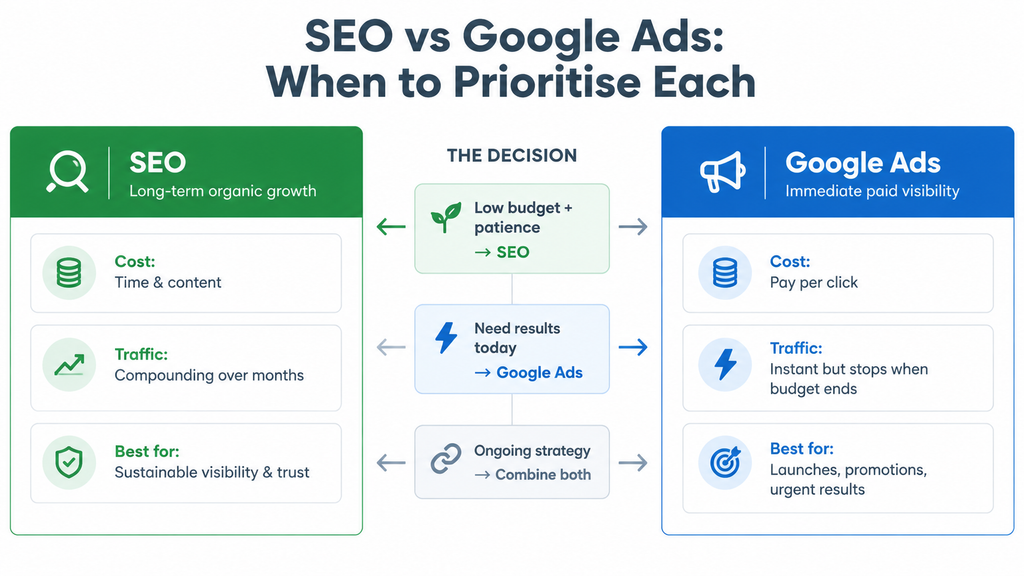
Insight 6: When SEO Should Lead
In the SEO vs Google Ads decision, SEO should be your primary investment when you have a 6 to 12 month horizon before requiring significant organic returns, when your target keywords have high monthly search volume making paid costs prohibitive at scale, or when you are building a content-driven business where topical authority compounds in value. SEO is also the correct priority in categories where organic rankings signal quality — professional services, healthcare, legal, and financial services.
Insight 7: When Google Ads Should Lead
Google Ads should lead in the SEO vs Google Ads allocation when you need immediate revenue — a new product launch, seasonal promotion, or business launch that requires traffic before organic rankings can be built. Google Ads is also right for highly competitive keywords where your domain authority is insufficient to rank organically. Many businesses run Google Ads on their most valuable commercial keywords indefinitely, even after achieving organic rankings, to dominate the full top-of-page results.
Insight 8: The Compounding Advantage of SEO
The most important long-term insight in the SEO vs Google Ads comparison is that SEO returns compound. A business that invests consistently in SEO for 24 months builds a growing asset: more pages ranking, more organic traffic, higher domain authority that makes new content rank faster, and a growing proportion of total traffic arriving at zero marginal cost.
Google Ads returns are linear — doubling your budget approximately doubles your traffic. SEO returns are non-linear — the 24th month of consistent SEO investment typically delivers far more than twice the traffic of the 12th month, because domain authority and topical coverage create compounding ranking power for new content.
Insight 9: Click-Through Rates
Click-through rate data favours organic results in the SEO vs Google Ads comparison. The number one organic result generates a click-through rate of 25 to 35 percent or higher. Google Ads average click-through rates are typically 2 to 5 percent across most industries. For high-volume keywords where both organic ranking and paid advertising are viable, the economic case for pursuing the organic position is often stronger — particularly for evergreen content that continues ranking without additional investment.
Insight 10: The Combined Strategy
The most commercially effective answer to the SEO vs Google Ads question is a deliberate combination that leverages the strengths of each channel. In the early months, Google Ads provides immediate traffic and conversion data while SEO content creation begins building the organic foundation. As organic rankings develop, the SEO vs Google Ads budget allocation shifts: paid spend reduces on keywords where organic positions deliver strong click volume, freeing budget for terms where organic rankings have not yet been achieved.
The result of this integrated SEO vs Google Ads strategy is a progressively more efficient channel mix where organic traffic handles an increasing share of total visits at declining cost, while paid advertising covers the gaps.
Ranking Takes More Than Tips
You know the strategy now — let Tasknestly handle the technical SEO, content, and link building that actually moves rankings.
Get SEO Services →SEO vs Google Ads: Full Comparison Table
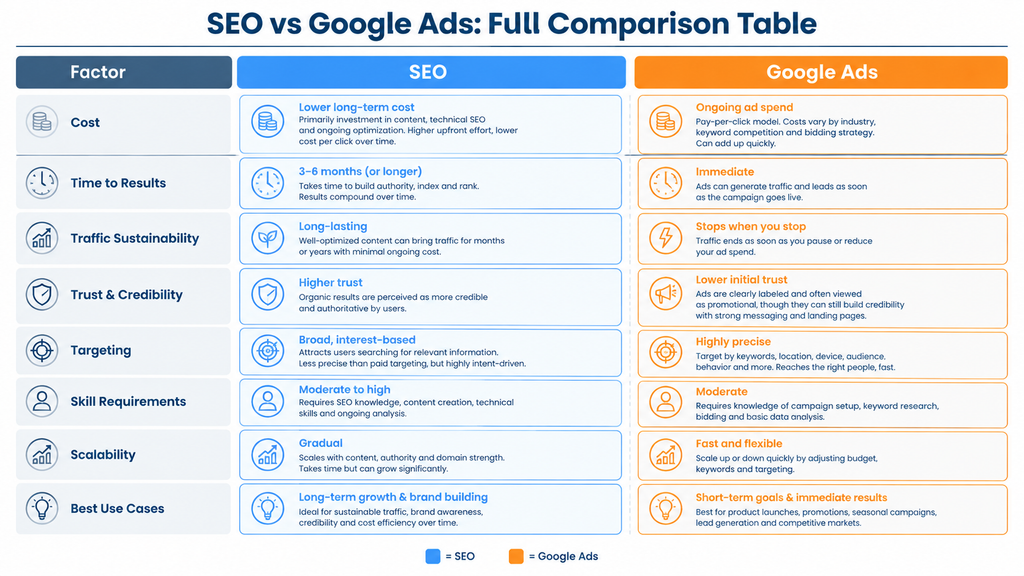
Use this table to compare SEO vs Google Ads across every key factor relevant to your channel decision.
| Factor | SEO | Google Ads |
| Cost structure | Time and content investment; low ongoing cost | Pay-per-click; stops when budget stops |
| Time to results | 3–6 months to meaningful traffic | Immediate — traffic from day one |
| Long-term ROI | Very high — traffic compounds over time | Moderate — depends on margin vs CPC |
| Traffic quality | High intent — organic searchers | High intent — keyword-targeted |
| Brand trust | Strong — organic listings build authority | Moderate — ads recognised as paid |
| Scalability | Scales with content and authority | Scales with budget |
| Click-through rate | 25–35%+ for positions 1–3 | 2–5% average CTR for most ads |
| Best for | Long-term sustainable growth | Launches, testing, immediate traffic |
| Biggest risk | Algorithm updates can shift rankings | Rising CPCs and budget dependency |
| Essential Tools for SEO and Search MarketingSEMrush — Research keywords, audit SEO performance, track rankings, and analyse Google Ads competition from a single platform.RankMath Pro — Optimise every page for target keywords inside WordPress with real-time SEO scoring and on-page guidance.Surfer SEO — Score your content against top-ranking competitors and optimise for the specific ranking factors in your niche. |
Ranking Takes More Than Tips
You know the strategy now — let Tasknestly handle the technical SEO, content, and link building that actually moves rankings.
Get SEO Services →Frequently Asked Questions: SEO vs Google Ads
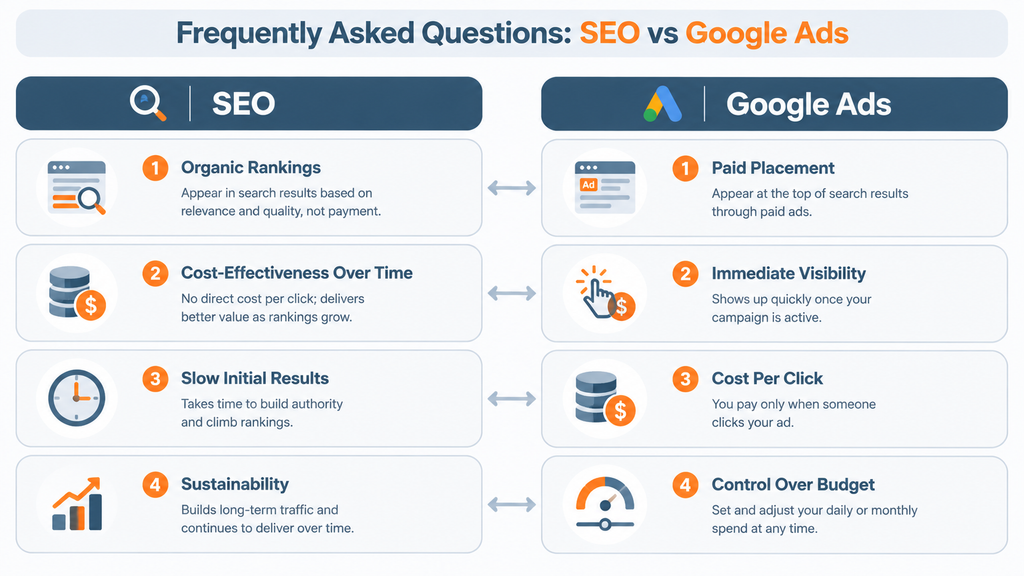
| Question | Answer |
| What is the main difference between SEO vs Google Ads? | SEO builds organic search visibility through content and links — generating free traffic that grows over time. Google Ads places paid listings at the top of search results, generating immediate traffic that stops when your budget runs out. SEO is a long-term investment; Google Ads is a short-term traffic lever. |
| Which is cheaper: SEO or Google Ads? | SEO has higher upfront time investment but lower ongoing cost — once pages rank, traffic is essentially free. Google Ads costs scale with traffic volume. Over 12+ months, SEO almost always delivers a lower cost per acquisition for competitive keywords, but Google Ads delivers faster initial results. |
| Should I use SEO or Google Ads for a new business? | Most new businesses benefit from running Google Ads for immediate revenue while simultaneously investing in SEO for long-term organic growth. Google Ads validates your offer and generates early revenue; SEO builds the sustainable traffic base that reduces advertising dependency as domain authority grows. |
| How long does SEO take compared to Google Ads? | Google Ads delivers traffic immediately upon campaign activation. SEO typically takes 3–6 months to produce meaningful organic traffic and 6–12 months for competitive keywords. However, SEO traffic compounds and grows without additional spend, while Google Ads traffic requires continuous budget to maintain. |
| Do Google Ads help SEO rankings? | No — Google has confirmed that running Google Ads does not directly improve organic SEO rankings. However, Ads can indirectly support SEO by generating brand searches, helping validate which keywords convert before investing in SEO content, and driving traffic that may earn natural backlinks. |
| Can SEO and Google Ads work together? | Yes — the most effective search strategies use SEO and Google Ads together. Google Ads provides immediate visibility while SEO builds, validates high-converting keywords before investing in SEO content, and covers keywords where organic rankings have not yet been achieved. |
| What budget should I allocate to SEO vs Google Ads? | There is no universal formula. Businesses needing immediate revenue should weight toward Google Ads initially. Businesses with a 12-month horizon and sustainable products should weight toward SEO for long-term ROI. The most effective allocation evolves over time as organic rankings reduce the paid traffic needed to hit revenue targets. |
Ranking Takes More Than Tips
You know the strategy now — let Tasknestly handle the technical SEO, content, and link building that actually moves rankings.
Get SEO Services →Conclusion: The Right SEO vs Google Ads Mix for Your Business
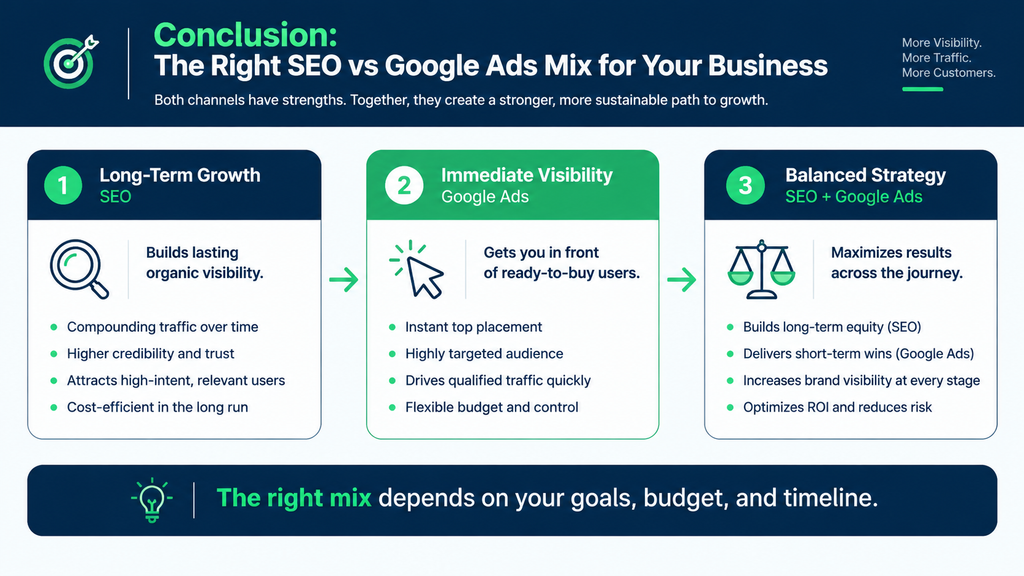
The SEO vs Google Ads decision is not a permanent binary choice — it is a dynamic allocation that should evolve with your business growth stage, competitive position, and marketing objectives. Google Ads wins on speed and flexibility; SEO wins on long-term ROI and brand trust. The businesses building the strongest search presence use both channels intentionally, allowing each to do what it does best while building toward a progressively more organic, cost-efficient traffic mix.
If you are early in your business journey, prioritise Google Ads for immediate traffic while beginning SEO simultaneously. If you are an established business spending significantly on paid search, audit how much of that spend covers keywords where organic rankings are achievable — and redirect a portion into SEO content that will eventually capture those rankings. The most powerful SEO vs Google Ads strategy is one where both channels continuously inform and support each other.
At Tasknestly, we build integrated search strategies that combine organic and paid channels into a cohesive, ROI-optimised programme. Whether you need to build SEO from scratch, reduce paid advertising dependency, or develop a combined strategy, explore our SEO services or request a free consultation today.
Ranking Takes More Than Tips
You know the strategy now — let Tasknestly handle the technical SEO, content, and link building that actually moves rankings.
Get SEO Services →SEO vs Google Ads: Building Your Integrated Search Strategy
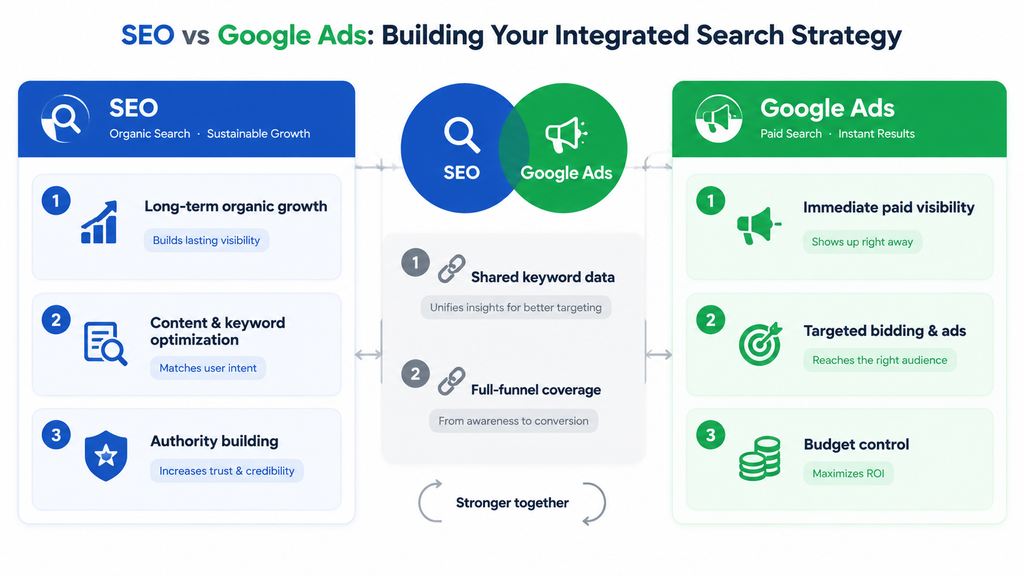
The most commercially effective SEO vs Google Ads practitioners treat the two channels as complementary components of a unified search strategy rather than mutually exclusive budget lines. In the earliest stage of a business or product launch, when no organic rankings exist and immediate revenue is needed, Google Ads carries the full load — generating traffic, validating which keywords convert, and funding the operations that allow time for SEO to develop. As organic rankings mature, the SEO vs Google Ads budget allocation shifts progressively toward organic, reducing the cost of traffic while maintaining the total search presence needed to hit revenue targets.
The specific SEO vs Google Ads allocation that works for your business depends on three variables: how competitive your keywords are (highly competitive keywords require more Ads budget while SEO authority develops), how quickly your business needs revenue (new businesses need more Ads; established ones can weight toward SEO), and what your available investment timeline is. A business that can invest for 18 months and sustain operations from existing revenue should weight heavily toward SEO from day one. A business that needs revenue in 30 days should start with Google Ads while building the SEO foundation in parallel.
Whatever your current SEO vs Google Ads allocation, establish a regular review cadence — monthly in the first year — to assess whether the balance is right for your current situation. Track customer acquisition cost from each channel, organic traffic growth trajectory, and paid traffic dependency ratio. The most successful long-term SEO vs Google Ads strategies are those that actively shift budget toward SEO as organic rankings reduce the traffic volume that paid advertising needs to cover.
Ranking Takes More Than Tips
You know the strategy now — let Tasknestly handle the technical SEO, content, and link building that actually moves rankings.
Get SEO Services →SEO vs Google Ads: Practical Budget Allocation Guide
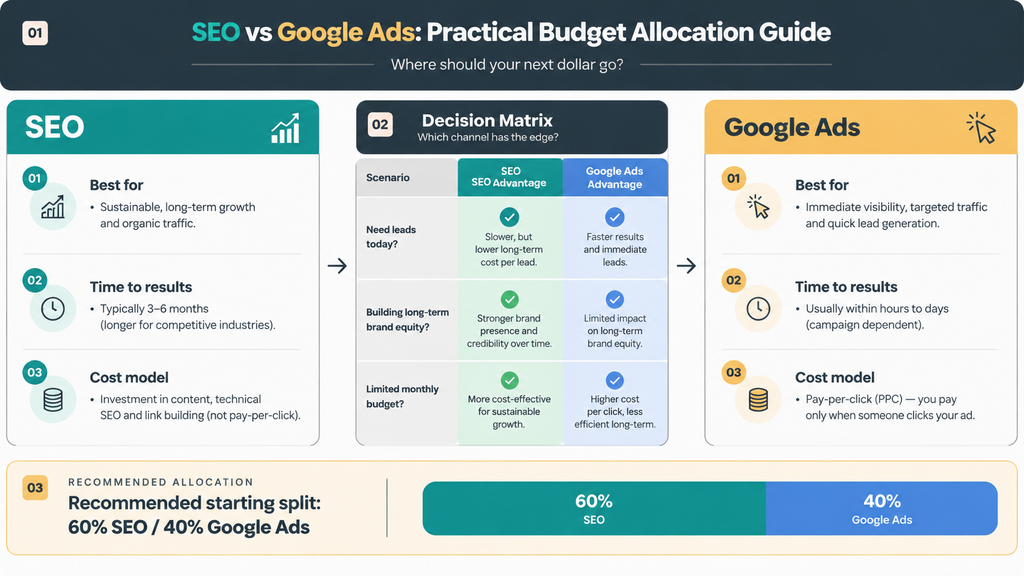
One of the most common questions in the SEO vs Google Ads debate is how to actually allocate budget between the two when both are part of your strategy. There is no universally correct answer, but a framework helps: in the first 6 months, allocate 70 percent of your search marketing budget to Google Ads and 30 percent to SEO content production. During months 6 to 12, as early organic rankings develop, shift to 50/50. After month 12, if organic traffic is growing consistently, shift to 30 percent Google Ads and 70 percent SEO. This graduated reallocation captures the compounding returns of SEO vs Google Ads over time while ensuring revenue continuity through the build period.
The SEO vs Google Ads budget question also has an industry dimension. In highly competitive categories where CPCs are very high — legal, financial services, insurance — the case for weighting SEO investment more heavily is strongest because paid traffic is extraordinarily expensive per click. In categories with low CPCs and high urgency — emergency services, event-based businesses, seasonal products — the Google Ads vs SEO balance may legitimately favour Ads for a longer period because the paid economics are more favourable and the seasonal window is too short for SEO to deliver traffic reliably.
Whatever SEO vs Google Ads allocation you adopt, track the blended cost per acquisition from both channels combined, not just from each channel in isolation. The most important metric is the average cost of acquiring a customer through your total search investment — the combination of what you spend on Google Ads clicks plus what you invest in SEO content and link building, divided by the total customers generated from search. This blended view of SEO vs Google Ads economics is what reveals whether your channel mix is improving or worsening over time.
The SEO vs Google Ads choice is ultimately a strategic question, not a technical one. Businesses that approach SEO vs Google Ads as a dynamic, evolving allocation — rather than a permanent either/or decision — consistently build better search economics over time.
To see how Google decides which ads show and what you pay, read Google’s explanation of the Google Ads auction.
Ranking Takes More Than Tips
You know the strategy now — let Tasknestly handle the technical SEO, content, and link building that actually moves rankings.
Get SEO Services →Grow With Tasknestly
Subscribe to the Tasknestly newsletter and get the latest tips on websites, SEO, social media, and digital growth.