
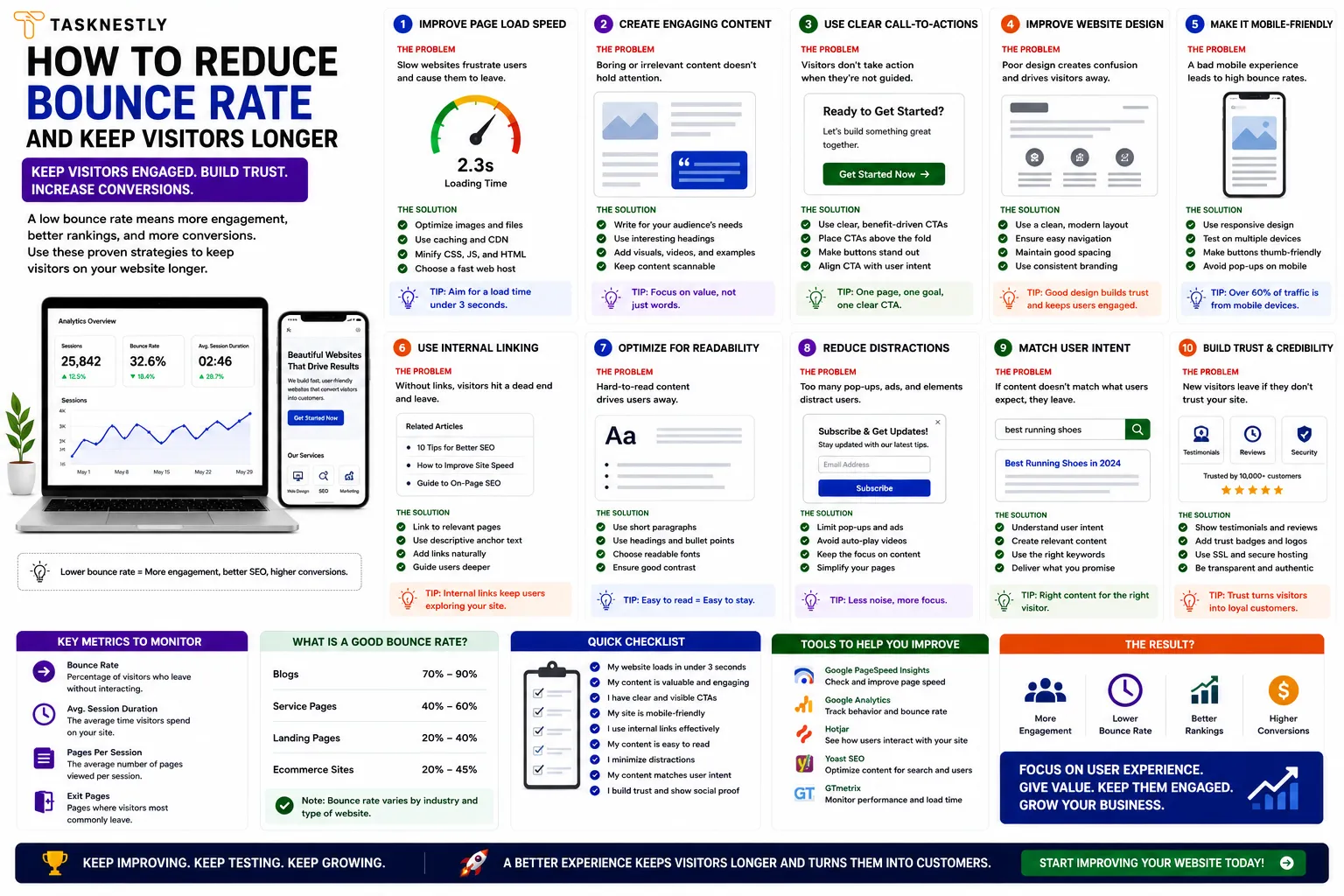
This metric is one of the most telling in web analytics — and one of the most misunderstood. A high reading tells you that visitors are arriving on your website and leaving without taking any further action: no second page visit, no form submission, no click on a CTA, no engagement beyond the initial page load. Understanding what drives visitors away and how to keep them engaged is one of the highest-impact improvements any business website can make, because every visitor who leaves immediately is a potential lead who decided your site was not worth exploring.
The significance of this metric goes beyond user experience. Google uses engagement signals — including time on site, pages per session, and scroll depth — as indirect quality indicators when assessing pages for ranking. While it is not a direct ranking factor, the behaviours associated with high early abandonment (short dwell time, no engagement, immediate return to search results) do influence how Google interprets the quality and relevance of your content. Reducing it therefore simultaneously improves user experience, increases conversion rate, and supports better organic search performance.
This guide covers the most effective strategies for how to reduce bounce rate across every major contributing factor — from page speed and content relevance to UX design and internal linking. Whether your bounce rate is slightly above average or alarmingly high, the tips in this guide will give you a clear, prioritised action plan for keeping more visitors on your site for longer.
Want a website built to engage visitors from the first second? Tasknestly’s web development team creates websites that reduce bounce rate through fast loading, clear messaging, and conversion-focused UX design. Get your free quote today.
Growing An Online Store?
The right AI marketing tools can automate ads, emails, and product promotion for your store. See which ones are actually worth paying for.
See AI Marketing Tool Reviews →Building Your Site Yourself?
AI coding tools can speed up development dramatically. Compare the best ones before you commit to a stack.
See AI Coding Tools →Your Site Should Be Converting More
Small fixes only go so far — Tasknestly builds and optimizes full websites designed to convert visitors into customers.
Get Website Services →Table of Contents
What Causes High Bounce Rate? The Key Contributors
Before you can reduce bounce rate effectively, you need to understand what is causing it. High abandonment rarely has a single cause — they typically reflect a combination of speed issues, content relevance problems, UX friction, and expectation mismatch. Identifying your specific drivers is the essential first step in any bounce rate optimisation strategy.
Slow Page Load Speed
Page speed is the single most common cause of high visitor abandonment on business websites. When a page takes more than three seconds to load on mobile, more than half of visitors abandon it before it has finished loading — producing an instant exit that has nothing to do with your content. No amount of excellent copy or engaging content can fix abandonment caused by slow loading, because visitors never get to see any of it.
Measuring your page speed with Google PageSpeed Insights is the first website bounce rate tip to implement. If your mobile score is below 60, page speed optimisation should be your first priority before addressing any other contributing factor.
Expectation Mismatch
Expectation mismatch — when the page a visitor lands on does not deliver what the ad, search result, or link that drove the click promised — is one of the most damaging and most avoidable causes of visitor abandonment. A visitor who clicked on a Google Ad promising “Free Website Audit” and arrives on a generic services homepage will bounce immediately because the expectation created by the ad was not met by the landing page.
Fixing expectation mismatch is one of the most effective ways to reduce early exits because it targets a fundamental disconnect between your marketing and your destination pages. Every traffic source should lead to a page that directly delivers on whatever promise motivated the click. This is what conversion optimisers call message match — and it is one of the most impactful tips for businesses running paid traffic.
Irrelevant or Low-Quality Content
Visitors who land on a page and quickly determine that its content does not address their specific question, need, or interest will leave immediately — producing a high bounce rate that no technical fix can address. Irrelevant or thin content signals to Google that your content is not satisfying the search intent behind the queries it ranks for — which can lead to ranking drops that reduce your traffic further.
Growing An Online Store?
The right AI marketing tools can automate ads, emails, and product promotion for your store. See which ones are actually worth paying for.
See AI Marketing Tool Reviews →Building Your Site Yourself?
AI coding tools can speed up development dramatically. Compare the best ones before you commit to a stack.
See AI Coding Tools →Your Site Should Be Converting More
Small fixes only go so far — Tasknestly builds and optimizes full websites designed to convert visitors into customers.
Get Website Services →How to Reduce Bounce Rate: Proven Strategies
With the causes identified, here are the most effective strategies for reducing bounce rate across the factors you can directly control.
Improve Page Speed — The Highest-Impact Bounce Rate Fix
Compressing images, enabling browser caching, reducing JavaScript, and using a Content Delivery Network are the most impactful page speed improvements for reducing bounce rate. Each of these technical changes reduces wait time — which directly reduces the abandonment that hurts your engagement metrics. Prioritise mobile page speed specifically, since mobile is the primary source of traffic for most websites and mobile bounce rate is almost always higher than desktop bounce rate due to slower connections and smaller screens.
Match Content to Search Intent
For organic search traffic, reducing bounce rate requires ensuring your content precisely matches the intent behind the search query that brought the visitor to your page. Informational queries (“how to reduce bounce rate”) need comprehensive, educational content. Commercial queries (“best bounce rate optimisation tools”) need comparison or review content. Transactional queries (“hire bounce rate consultant”) need direct service or product pages with clear CTAs. Misaligning content with search intent is one of the most common causes of poor engagement on SEO-driven pages.
Improve Above-the-Fold Content Immediately
Visitors make their stay-or-leave decision within seconds of landing on your page. The content visible without scrolling — your headline, your subheadline, your hero image, your introductory paragraph — is doing the critical work of convincing the visitor that they are in the right place and that continuing to read or explore is worth their time. Tips for above-the-fold content include: leading with the most compelling benefit rather than a generic welcome message, using a specific and immediately relevant headline, and making it visually clear what the page is about and what the visitor can get from it.
Growing An Online Store?
The right AI marketing tools can automate ads, emails, and product promotion for your store. See which ones are actually worth paying for.
See AI Marketing Tool Reviews →Building Your Site Yourself?
AI coding tools can speed up development dramatically. Compare the best ones before you commit to a stack.
See AI Coding Tools →Your Site Should Be Converting More
Small fixes only go so far — Tasknestly builds and optimizes full websites designed to convert visitors into customers.
Get Website Services →Bounce Rate Optimisation Through Internal Linking and Content Depth
One of the most effective and often overlooked engagement strategies is improving your internal linking structure. When a visitor finishes reading a page and sees clear, relevant links to related content — whether in the body text, a related posts section, or a contextual sidebar — they are more likely to click through to another page rather than bouncing back to search or closing the tab.
Strategic Internal Linking for Bounce Rate Reduction
Internal links that retain visitors are not random “you might also like” suggestions — they are contextually relevant links that anticipate what the visitor is likely to want next based on what they have just read. A visitor reading a guide on how to reduce bounce rate through page speed might naturally be interested in a more detailed guide on page speed optimisation, or a related guide on Core Web Vitals. Linking to these related resources within the page content — not just in a footer or sidebar widget — gives the visitor a clear, natural reason to continue exploring your site.
Tasknestly’s SEO services include a structured internal linking audit as part of technical optimisation, specifically targeting improved content navigation and user flow to reduce early exits.
Use Content Depth to Reward Visitors Who Stay
Content that rewards the visitor for scrolling keeps them engaged by making deeper reading valuable. This means front-loading your most compelling content rather than burying it, using headers and subheadings that work as standalone navigation points so visitors can scan to the sections most relevant to them, including multimedia elements (images, tables, comparison charts, video) that break up text and provide information in multiple formats, and ending each section with a transition or tease that gives the visitor a reason to read the next one.
For independent reviews of analytics and user behaviour tools that help you identify specifically where visitors are bouncing from your site and why, TechBothQ covers the leading platforms with detailed comparisons.
Want expert help identifying and fixing your bounce rate issues? Tasknestly’s digital marketing specialists combine UX auditing, content strategy, and technical SEO to reduce bounce rate and convert more of your existing traffic. Request your free quote.
Growing An Online Store?
The right AI marketing tools can automate ads, emails, and product promotion for your store. See which ones are actually worth paying for.
See AI Marketing Tool Reviews →Building Your Site Yourself?
AI coding tools can speed up development dramatically. Compare the best ones before you commit to a stack.
See AI Coding Tools →Your Site Should Be Converting More
Small fixes only go so far — Tasknestly builds and optimizes full websites designed to convert visitors into customers.
Get Website Services →Website Bounce Rate Tips for Specific Traffic Sources
Bounce rate varies significantly by traffic source, and the most effective bounce rate optimisation strategies differ depending on whether the high bounce rate is coming from organic search, paid traffic, social media, or direct visitors.
Lower Bounce Rate on Website From Paid Traffic
Paid traffic typically has the highest abandonment potential because the audience did not seek out your content organically — they responded to an ad message that may or may not have set accurate expectations. To keep paid traffic engaged on your pages: ensure message match between ad and landing page, use dedicated landing pages rather than generic pages, load faster on mobile (where most ad clicks originate), and give the visitor an immediate and obvious reason to engage rather than assume they will stay.
Reduce Bounce Rate From Social Media Traffic
Social media visitors arrive in a browsing mindset and are more likely to leave quickly if the content they land on does not immediately engage them emotionally or intellectually. Tips for retaining social traffic include: using visually compelling above-the-fold content, writing introductory paragraphs that are conversational and immediately engaging, and including relevant videos or interactive elements that match the visual expectations of social media visitors.
Bounce Rate Optimisation for Organic Search Traffic
Organic search bounce rate is most effectively reduced by content quality and search intent alignment. Google Analytics (GA4) now provides engagement rate — which measures sessions where visitors actively engaged with your content — as an alternative to bounce rate for understanding organic performance. Ensure your organic pages directly and comprehensively answer the search intent behind the queries driving traffic to them, and use structured content (headers, bullet lists, tables) that makes information easy to scan and find.
Growing An Online Store?
The right AI marketing tools can automate ads, emails, and product promotion for your store. See which ones are actually worth paying for.
See AI Marketing Tool Reviews →Building Your Site Yourself?
AI coding tools can speed up development dramatically. Compare the best ones before you commit to a stack.
See AI Coding Tools →Your Site Should Be Converting More
Small fixes only go so far — Tasknestly builds and optimizes full websites designed to convert visitors into customers.
Get Website Services →What Is a Good Bounce Rate? Setting Realistic Benchmarks
A common question is: what should I be aiming for? The honest answer is that good bounce rate varies significantly by industry, traffic source, and page type. As a general guide:
| Page Type / Industry | Typical Bounce Rate Range | Notes |
|---|---|---|
| Landing pages (paid) | 60–90% | Single-purpose pages designed for one action |
| Blog / content pages | 65–90% | High bounce is normal if visitors read and return to search satisfied |
| Ecommerce product pages | 20–45% | Lower is better — browsers should explore catalogue |
| Service pages | 30–55% | Visitors should explore and then enquire |
| Homepage | 25–50% | Should direct visitors deeper into the site |
| News / media | 65–90% | Readers often consume one article and leave |
These benchmarks provide context rather than targets. A figure significantly above these ranges for your page type is a signal worth investigating. A figure within or below these ranges indicates reasonable engagement for that content type.
Combining lower bounce rate performance with professional website development and strong SEO strategy creates a website that not only attracts more visitors but keeps them engaged long enough to convert. For ecommerce businesses, reducing bounce rate on product pages directly translates into increased add-to-cart rates and revenue — making visitor engagement optimisation one of the most commercially important improvements available through Tasknestly’s ecommerce solutions.
Growing An Online Store?
The right AI marketing tools can automate ads, emails, and product promotion for your store. See which ones are actually worth paying for.
See AI Marketing Tool Reviews →Building Your Site Yourself?
AI coding tools can speed up development dramatically. Compare the best ones before you commit to a stack.
See AI Coding Tools →Your Site Should Be Converting More
Small fixes only go so far — Tasknestly builds and optimizes full websites designed to convert visitors into customers.
Get Website Services →Bounce Rate vs Engagement Rate: Understanding the Difference in GA4
Google Analytics 4 replaced the traditional bounce rate metric with engagement rate — defined as the percentage of sessions where a visitor actively engaged with your content (scrolled significantly, clicked, or spent more than 10 seconds on page). This shift reflects a more nuanced understanding of visitor behaviour than the binary “did they visit a second page?” logic that underpinned the original metric.
For practical purposes, engagement rate is the inverse of the new session abandonment signal. An engagement rate of 65% means 35% of sessions showed no meaningful interaction. When working to improve your site’s performance in GA4, focus on increasing engagement rate rather than obsessing over the legacy figure — the strategies are identical, but the framing of engagement rate as a positive metric is more motivating and more accurately reflects what you are actually trying to achieve.
Understanding which pages have the lowest engagement rates in GA4 — combined with heatmap data from tools like Hotjar — gives you a precise, prioritised list of pages to improve first. Start with your highest-traffic, lowest-engagement pages, since these represent the greatest untapped opportunity for conversion improvement. A page receiving 5,000 monthly visits with a 20% engagement rate is leaving 4,000 potential leads or customers a month unengaged — and even moving that to 35% engagement would represent a transformative commercial improvement worth significant investment to achieve.
Top Tools to Help You Reduce Bounce Rate
- Google Analytics 4 — Track engagement rate, session duration, and pages per session to measure your bounce rate optimisation progress and identify which pages have the highest abandonment.
- Hotjar — Heatmaps and session recordings that show exactly how visitors interact with your pages before bouncing, making the specific causes of your high bounce rate easy to identify.
- Google PageSpeed Insights — Measure page speed on mobile and desktop separately, with Core Web Vitals data and prioritised recommendations for fixing the speed issues most likely causing your high bounce rate.
Growing An Online Store?
The right AI marketing tools can automate ads, emails, and product promotion for your store. See which ones are actually worth paying for.
See AI Marketing Tool Reviews →Building Your Site Yourself?
AI coding tools can speed up development dramatically. Compare the best ones before you commit to a stack.
See AI Coding Tools →Your Site Should Be Converting More
Small fixes only go so far — Tasknestly builds and optimizes full websites designed to convert visitors into customers.
Get Website Services →Frequently Asked Questions: Bounce Rate
| Question | Answer |
|---|---|
| When should I be worried about my abandonment metric? | A rate above the typical range for your page type is worth investigating. Whether it is a problem depends on context — a blog post that visitors read in full and then leave satisfied is not necessarily a bad bounce rate. Use engagement signals alongside bounce rate to get the full picture. |
| How do I check my website engagement rate? | Use Google Analytics 4, which reports engagement rate (the inverse of this metric) and provides page-by-page data. Third-party tools like Hotjar supplement this with visual behaviour data that helps explain why bounce rate is high on specific pages. |
| What is the fastest way to improve visitor retention? | Improve page load speed first — this is the single most impactful and immediately implementable bounce rate fix for most websites. Then address expectation mismatch by ensuring your content delivers exactly what the traffic source promised. These two changes alone can reduce bounce rate significantly within weeks. |
| Does high abandonment affect SEO? | Not directly — Google has stated this metric from Analytics is not a direct ranking signal. However, the behaviours associated with immediate exits (short dwell time, return to search results) are interpreted as negative quality signals. Reducing bounce rate through better content and UX improves both user experience and the indirect SEO signals that matter. |
| What engagement benchmarks should ecommerce sites target? | For ecommerce product pages and category pages, a figure below 45% is considered good. Homepage abandonment should ideally be below 40%. Cart and checkout pages should have bounce rates as close to zero as possible — any bounce from checkout represents abandoned revenue. |
| How do internal links help keep visitors engaged? | Internal links give visitors a clear, relevant next step after consuming the current page. Strategically placed links reduce early exits by making it easy and natural to explore further rather than returning to search or closing the tab. |
| Can pop-ups hurt visitor retention? | Yes — intrusive pop-ups that appear immediately on page load significantly increase early exits. Use exit-intent pop-ups, scroll-triggered pop-ups, or time-delayed pop-ups instead, and ensure they are easy to dismiss on all devices. |
Growing An Online Store?
The right AI marketing tools can automate ads, emails, and product promotion for your store. See which ones are actually worth paying for.
See AI Marketing Tool Reviews →Building Your Site Yourself?
AI coding tools can speed up development dramatically. Compare the best ones before you commit to a stack.
See AI Coding Tools →Your Site Should Be Converting More
Small fixes only go so far — Tasknestly builds and optimizes full websites designed to convert visitors into customers.
Get Website Services →Conclusion: Reduce Bounce Rate and Convert More of the Traffic You Already Have
Improving visitor retention and engagement is one of the most commercially efficient improvements a business website can make — because it converts more value from the traffic you are already paying for or earning through SEO, without requiring any increase in your traffic acquisition investment. Every percentage point improvement means more visitors exploring your content, more potential customers discovering your services, and more conversions from the same number of visitors.
Start with the strategies that address your most obvious friction points — the ones your analytics already flag as problems worth fixing: check your page speed on mobile, review whether your content matches the intent of the traffic sources driving visitors to it, audit your above-the-fold content for immediate clarity and relevance, and implement strategic internal links to guide visitors naturally to their next step within your site. Then use heatmap and session recording data to uncover the specific behaviours driving your bounce rate on your most important pages.
If you want expert support with a full audit and a targeted optimisation plan covering every page on your website, Tasknestly’s web development and digital marketing team is ready to help. Get your free quote today and let us genuinely help you improve engagement, reduce early exits, and turn more of your existing traffic into real, measurable business growth.
Growing An Online Store?
The right AI marketing tools can automate ads, emails, and product promotion for your store. See which ones are actually worth paying for.
See AI Marketing Tool Reviews →Building Your Site Yourself?
AI coding tools can speed up development dramatically. Compare the best ones before you commit to a stack.
See AI Coding Tools →Your Site Should Be Converting More
Small fixes only go so far — Tasknestly builds and optimizes full websites designed to convert visitors into customers.
Get Website Services →Grow With Tasknestly
Subscribe to the Tasknestly newsletter and get the latest tips on websites, SEO, social media, and digital growth.