
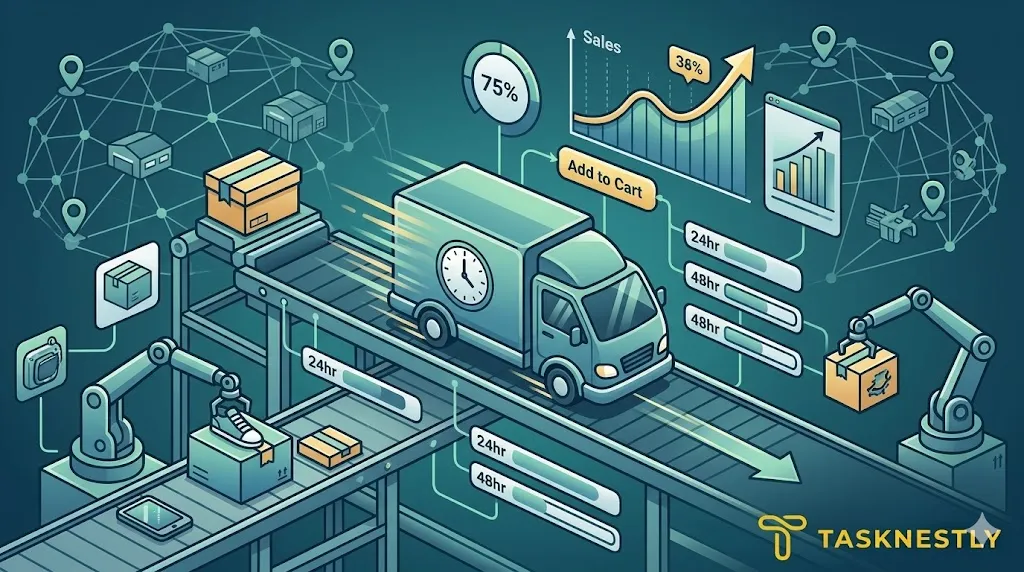
Fast shipping ecommerce is no longer a premium differentiator — it is a baseline expectation. Amazon Prime’s two-day delivery standard has permanently shifted what online shoppers consider acceptable, and stores that cannot deliver within a competitive timeframe are losing customers to those that can. In 2026, delivery speed is the second most important purchase decision factor for online shoppers after price, outranking brand reputation, product reviews, and even returns policy.
The commercial impact of shipping speed on ecommerce extends beyond the obvious logistics dimension. How prominently you display delivery timelines on your product pages affects your conversion rate. The shipping options you offer at checkout determine how many orders complete versus abandon. Your post-purchase delivery communication shapes how customers perceive your brand and whether they return. Shipping is not just an operational function — it is a marketing tool, a retention mechanism, and a conversion driver all at once.
This guide covers the 10 most impactful fast shipping ecommerce strategies available to online stores in 2026 — from setting the right free shipping thresholds and displaying delivery timelines to automating order processing and building a returns process that removes purchase risk. Each strategy is practical, implementable without enterprise-level infrastructure, and directly tied to measurable improvements in conversion rate, average order value, and customer lifetime value.
| Want an Ecommerce Store That Competes on Delivery and Conversion?Tasknestly’s ecommerce services include store design, checkout optimisation, and marketing strategies that make your shipping capabilities a powerful sales advantage.Get your FREE Ecommerce Quote → |
Want Your Store To Actually Convert?
Strategy is step one — execution is what moves revenue. Tasknestly builds and optimizes ecommerce stores that convert.
Get Ecommerce Services →Table of Contents
Fast Shipping Ecommerce: Conversion Strategies
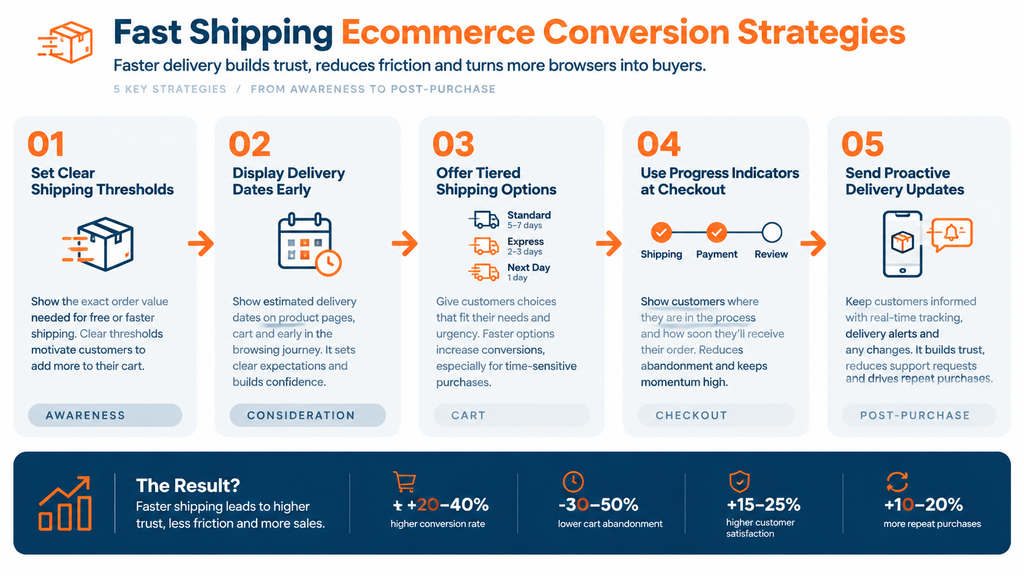
These fast shipping ecommerce strategies directly address the conversion impact of delivery — the decisions and displays that determine whether a visitor who wants to buy actually completes their purchase.
Strategy 1: Display Shipping Speed on Every Product Page
Delivery timeline visibility is one of the highest-impact fast shipping ecommerce conversion tactics available. Displaying a specific, reassuring delivery date — ‘Order before 2pm for next-day delivery’ or ‘Arrives by Thursday if ordered today’ — on every product page removes the delivery uncertainty that causes a significant proportion of shoppers to abandon before reaching the checkout. Research consistently shows that stores displaying specific delivery dates see 15 to 25 percent higher conversion rates than those showing vague ‘dispatch within 2-3 working days’ messaging.
Update your delivery messaging in real time based on the current time, day of week, and warehouse cut-off times. A shopper visiting at 11am on a Tuesday should see a different message than one visiting at 4pm on a Friday. Dynamic delivery messaging tools integrate with most major ecommerce platforms and require minimal technical setup — the conversion uplift they deliver makes them one of the fastest-payback investments in fast shipping ecommerce.
Strategy 2: Offer a Free Shipping Threshold
Unexpected shipping costs at checkout are the most commonly cited reason for cart abandonment in ecommerce — and free shipping thresholds solve this problem while simultaneously increasing your average order value. When shoppers see they are £8 away from free shipping, the majority will add another item rather than pay for delivery. Set your threshold 20 to 30 percent above your current average order value to maximise AOV uplift while maintaining profitability.
Communicate your free shipping threshold prominently throughout the shopping journey: on the homepage, in a sticky header bar, on every product page, and in the cart with a progress indicator showing how close the shopper is to qualifying. This persistent reminder is one of the simplest and most effective fast shipping ecommerce tactics for increasing revenue from every session — it works entirely through existing traffic with no additional customer acquisition cost.
Strategy 3: Offer Multiple Delivery Speed Options
Different shoppers have different delivery needs, and offering only one shipping option means failing every customer whose needs do not match it. A complete fast shipping ecommerce offering includes a standard delivery option at a competitive or free price point, a next-day or express option for urgency-driven shoppers willing to pay a premium, and a click-and-collect option where your fulfilment geography makes it viable.
Premium delivery options capture a specific and commercially valuable customer segment — shoppers who need the product urgently and are willing to pay £5 to £10 extra to receive it tomorrow. This segment is particularly valuable because their urgency often correlates with high purchase intent and low price sensitivity. Express delivery options cost you nothing unless selected — they are pure conversion tools that capture sales you would otherwise lose to competitors with faster default timelines.
Want Your Store To Actually Convert?
Strategy is step one — execution is what moves revenue. Tasknestly builds and optimizes ecommerce stores that convert.
Get Ecommerce Services →Fast Shipping Ecommerce: Operational Strategies
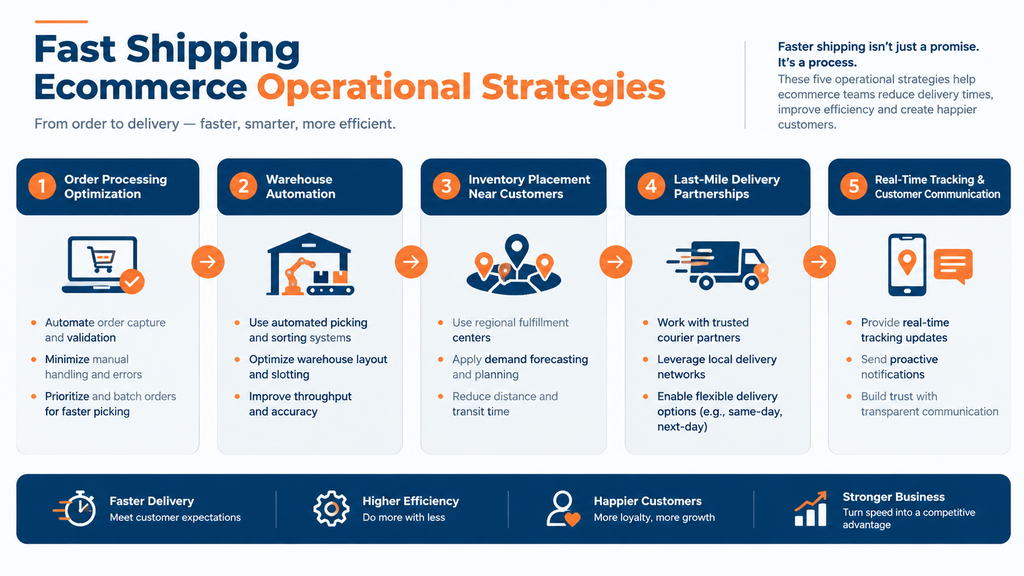
Delivering fast shipping ecommerce promises requires operational infrastructure that matches your marketing commitments. These strategies address the fulfilment side of the equation — the systems and processes that determine whether your stated delivery timelines are achievable and consistent.
Strategy 4: Automate Order Processing
Manual order processing is the most common bottleneck preventing ecommerce businesses from achieving fast shipping ecommerce at scale. Every hour between order placement and picking-and-packing is an hour added to the customer’s wait. Fulfilment automation software that generates picking lists automatically, books couriers on order confirmation, and prints shipping labels without manual intervention compresses your processing time from hours to minutes.
Set a daily order cut-off time — typically between 1pm and 3pm — before which all orders placed that day ship same day, and after which they ship the following morning. Communicate this cut-off prominently on your website as part of your delivery promise. ‘Order before 2pm for same-day dispatch’ is a powerful conversion statement that creates urgency and clearly communicates the speed of your fulfilment operation.
Strategy 5: Optimise Packaging for Speed and Cost
Inefficient packaging is a hidden cost and a hidden speed bottleneck in fast shipping ecommerce operations. Having a small number of pre-defined standard packaging sizes — rather than custom-cutting packaging for every order — reduces pick-pack time per order significantly. Standardised packaging also enables better carrier rate negotiation because you can predict your volume in each size category with accuracy.
Packaging optimisation also directly reduces your shipping costs through dimensional weight pricing — the carrier fee structure that charges based on the larger of the package’s actual weight or its dimensional weight. Packaging that is only marginally larger than the product it contains generates dramatically lower shipping costs than oversized boxes with void fill. Reducing dimensional weight across your order mix can lower your average shipping cost by 10 to 25 percent.
Strategy 6: Use Multiple Fulfilment Locations
Shipping distance is the primary determinant of delivery speed. A single fulfilment centre in one location means that customers on the opposite side of the country always receive slower delivery times than those nearby. Expanding to multiple fast shipping ecommerce fulfilment locations — either through third-party logistics providers with national warehouse networks or by partnering with regional fulfilment centres — reduces the average distance between your inventory and your customers, enabling faster delivery to every postcode.
Third-party logistics providers offer growing ecommerce businesses access to multi-location fulfilment without the capital cost of owning or leasing multiple warehouses. Services like Amazon FBA, Huboo, and Hubwoo provide professional pick-pack-ship fulfilment from their existing warehouse networks, making national fast shipping ecommerce achievable for businesses shipping as few as 50 to 100 orders per month.
| Need a Digital Marketing Strategy to Drive More Qualified Traffic?Tasknestly’s digital marketing services drive targeted, high-intent traffic to your optimised ecommerce store — combining SEO, content, email, and paid advertising for sustainable revenue growth.Book your free marketing consultation → |
Want Your Store To Actually Convert?
Strategy is step one — execution is what moves revenue. Tasknestly builds and optimizes ecommerce stores that convert.
Get Ecommerce Services →Fast Shipping Ecommerce: Customer Experience Strategies
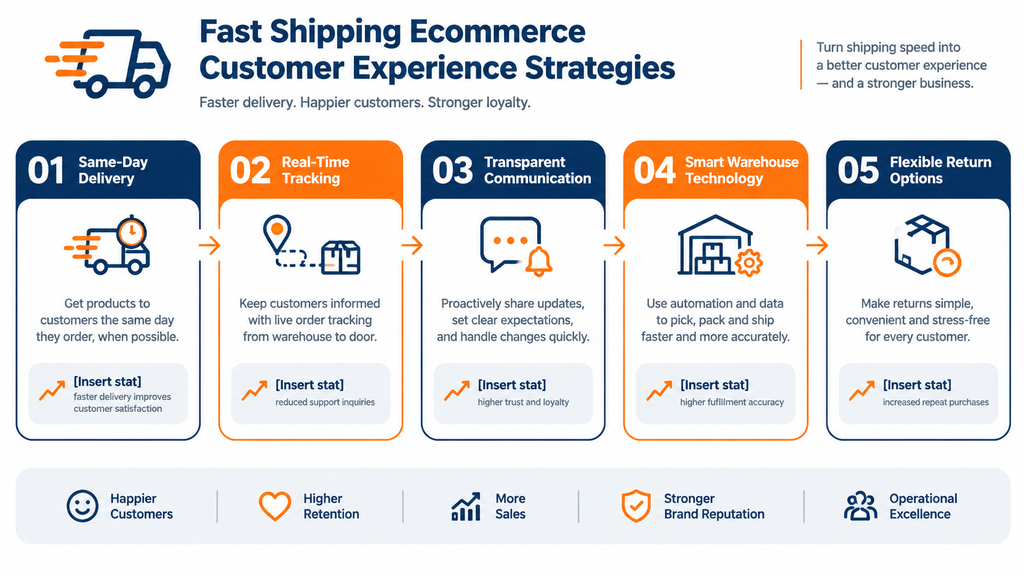
The fast shipping ecommerce experience does not end when the order ships — it continues through delivery and into the post-purchase period. These strategies address the customer-facing elements of shipping that build loyalty, generate reviews, and drive repeat purchases.
Strategy 7: Provide Proactive Delivery Communication
The period between order placement and delivery is one of the highest-anxiety moments in ecommerce, and proactive communication is the most effective tool for managing it. A fast shipping ecommerce communication sequence should include: an immediate order confirmation email with a clear dispatch estimate, a dispatch notification email with a tracking link when the order ships, and a delivery confirmation when the order is received. This three-touch sequence dramatically reduces ‘where is my order?’ customer service enquiries and significantly improves the post-purchase experience.
SMS delivery notifications generate even higher engagement rates than emails for shipping updates — many customers prefer a text message with a tracking link over an email they may not check for hours. For high-value orders, adding SMS to your delivery communication sequence costs pennies per order and meaningfully improves the customer experience.
Strategy 8: Build a Frictionless Returns Process
A fast, hassle-free returns process is one of the most counterintuitive but commercially proven fast shipping ecommerce strategies. Customers who know they can return easily without friction are more likely to make the initial purchase — particularly for products like clothing, footwear, and electronics where fit, compatibility, or quality can only be fully assessed in person. Including a pre-printed returns label in the original shipment, offering free returns on first orders, and processing refunds within 24 to 48 hours of receiving the return all reduce purchase risk in ways that directly increase conversion.
Generous returns policies also generate stronger positive reviews and higher repeat purchase rates — customers who have returned an item and been treated well are among the most loyal repeat buyers. The cost of returns is more than offset by the conversion uplift and customer lifetime value generated by a returns process that builds rather than erodes trust.
Strategy 9: Negotiate Carrier Rates Proactively
Shipping costs are a significant variable cost for most ecommerce businesses, and negotiating better carrier rates as your order volume grows is a fast shipping ecommerce strategy that directly improves your unit economics. Most courier services offer volume discount pricing that is not automatically applied — you need to request a rate review when your monthly shipment volume reaches meaningful thresholds (typically 100, 500, and 1,000 shipments per month).
Comparing rates across multiple carriers using a shipping aggregator platform is also worth doing annually. The most competitive carrier for your mix of package sizes, destinations, and required speed levels can change as carriers update their pricing structures. Even a 10 percent reduction in average shipping cost per order compounds into substantial annual savings as your order volume grows.
Strategy 10: Analyse Shipping Data to Identify Opportunities
Data analysis is the final and most systematic fast shipping ecommerce strategy — using your own shipping performance data to identify improvement opportunities that are specific to your operation rather than generic best practices. Track and review monthly: average dispatch time from order placement, on-time delivery rate versus your stated timelines, carrier performance by service level, geographic delivery performance variations, and customer return rates by product category.
These metrics reveal whether your fast shipping ecommerce promises are being consistently kept, which carriers and service levels are performing reliably, and where operational bottlenecks are adding time or cost to your fulfilment process.
Want Your Store To Actually Convert?
Strategy is step one — execution is what moves revenue. Tasknestly builds and optimizes ecommerce stores that convert.
Get Ecommerce Services →10 Fast Shipping Ecommerce Strategies at a Glance
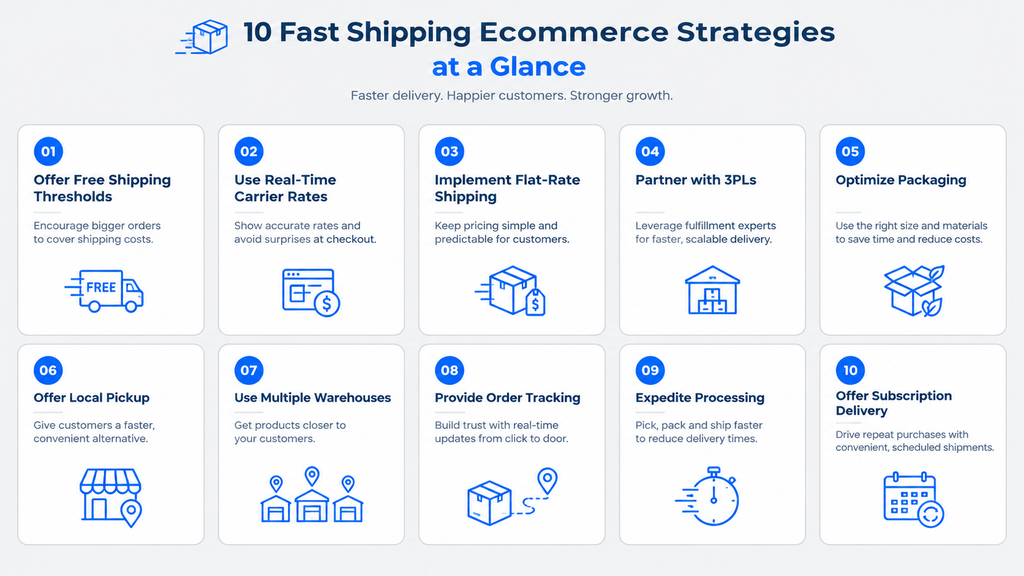
Use this table as a quick reference when planning your fast shipping ecommerce improvements for the quarter.
| # | Fast Shipping Strategy | Implementation | Expected Impact |
| 1 | Offer free shipping thresholds | Set minimum order for free delivery | Increases AOV and reduces abandonment |
| 2 | Display shipping speed prominently | Show estimated delivery on product pages | Reduces checkout uncertainty and dropout |
| 3 | Use multiple fulfilment centres | Partner with 3PL or use regional warehouses | Shorter delivery distances = faster shipping |
| 4 | Automate order processing | Use fulfilment software to cut processing time | Orders ship same day instead of next day |
| 5 | Offer next-day and express options | Partner with premium courier services | Converts urgency-driven shoppers |
| 6 | Set accurate delivery expectations | Real-time tracking and honest ETA | Reduces post-purchase anxiety and complaints |
| 7 | Optimise packaging for speed | Pre-packed standard sizes ready to ship | Reduces pick-pack time per order |
| 8 | Communicate shipping proactively | Automated confirmation and tracking emails | Builds trust and reduces support tickets |
| 9 | Create a clear returns process | Simple, pre-paid return label system | Removes purchase risk and increases conversion |
| 10 | Analyse and reduce shipping costs | Negotiate carrier rates at volume | Enables more competitive free shipping thresholds |
| Essential Tools to Power Your Ecommerce Shipping StrategyShopify — Built-in shipping rate management, courier integrations, and order fulfilment tools that make fast shipping ecommerce achievable from day one.SEMrush — Drive more qualified organic traffic to your store with keyword research, SEO auditing, and competitor analysis tools.Canva — Design professional packaging inserts, shipping confirmation emails, and return label graphics that enhance your brand experience. |
Want Your Store To Actually Convert?
Strategy is step one — execution is what moves revenue. Tasknestly builds and optimizes ecommerce stores that convert.
Get Ecommerce Services →Frequently Asked Questions: Fast Shipping Ecommerce
| Question | Answer |
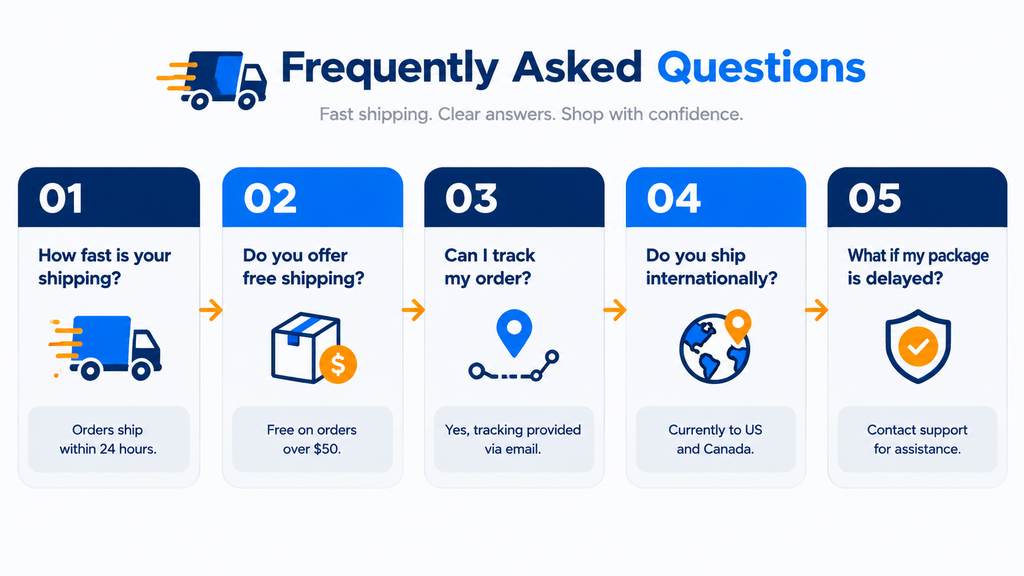
| Why does fast shipping matter for ecommerce? | Fast shipping ecommerce is a direct competitive advantage because delivery speed is now a primary purchase decision factor. With Amazon Prime setting a two-day delivery expectation, shoppers increasingly choose stores that can deliver quickly over those with slower timelines. Fast shipping also reduces cart abandonment, increases repeat purchases, and generates more positive reviews. |
| How does shipping speed affect ecommerce conversion rates? | Displaying a fast, specific delivery date on the product page — ‘Order before 2pm for next-day delivery’ — consistently increases conversion rates by 15 to 25 percent because it removes delivery uncertainty. Slow or vague shipping timelines are one of the top reasons shoppers abandon their cart before completing a purchase. |
| What is the best way to offer fast shipping without increasing costs? | The most cost-effective fast shipping ecommerce approach is to negotiate volume discounts with your primary courier as order volumes grow, use regional fulfilment centres to reduce delivery distances, optimise packaging to minimise dimensional weight charges, and offer free fast shipping only above a profitable order threshold. |
| Should I offer free shipping on my ecommerce store? | Yes, in most cases. Research consistently shows that unexpected shipping costs at checkout are the most common reason for cart abandonment. Free shipping above a minimum order threshold — set 20-30% above your average order value — reduces abandonment while simultaneously increasing your AOV as shoppers add items to qualify. |
| What is the difference between fast shipping and same-day delivery? | Fast shipping ecommerce typically refers to next-day or two-day delivery, which is achievable through national courier partnerships. Same-day delivery requires a local fulfilment infrastructure — either your own location or a last-mile delivery partner — and is generally only viable for urban-area businesses or stores with third-party logistics partnerships in major cities. |
| How do I manage fast shipping ecommerce for a small business? | Small ecommerce businesses can achieve fast shipping by setting a daily order cut-off time, integrating fulfilment software that automates picking lists and courier booking, using flat-rate packaging that simplifies picking and packing, and partnering with a third-party logistics (3PL) provider as order volumes grow beyond what in-house fulfilment can efficiently handle. |
| How does fast shipping affect customer loyalty? | Fast, reliable shipping is one of the strongest drivers of customer loyalty in ecommerce. Customers who receive their order faster than expected are significantly more likely to leave a positive review, purchase again, and recommend the store to others. Conversely, late deliveries — even when caused by the courier rather than the store — frequently result in negative reviews and lost repeat customers. |
Want Your Store To Actually Convert?
Strategy is step one — execution is what moves revenue. Tasknestly builds and optimizes ecommerce stores that convert.
Get Ecommerce Services →Conclusion: Make Fast Shipping Your Ecommerce Competitive Advantage
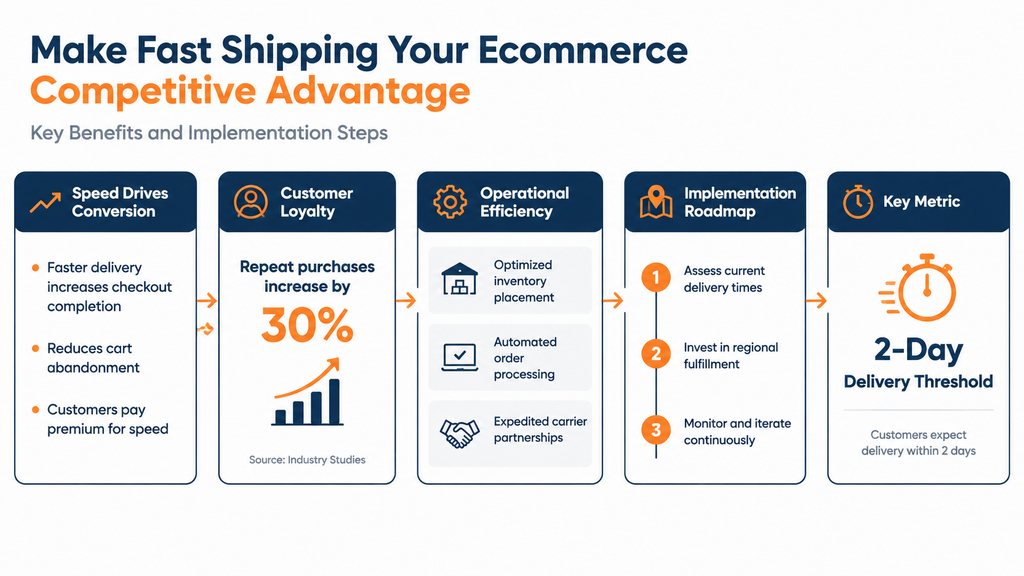
The 10 fast shipping ecommerce strategies in this guide address every dimension of the delivery experience — from the conversion impact of how you display delivery timelines on product pages, to the operational infrastructure that makes fast shipping promises reliable, to the post-purchase communication that turns a delivery into a brand-building moment. Shipping is not just logistics — it is marketing, customer service, and competitive positioning all in one.
Start with the changes that have the most immediate conversion impact: display specific delivery dates on your product pages, set a clear free shipping threshold, and implement automated order processing to compress your dispatch time. These three fast shipping ecommerce improvements require minimal investment and can produce measurable revenue uplift within weeks. Layer in the operational improvements — multi-location fulfilment, carrier rate optimisation, packaging standardisation — as your order volumes grow and justify the investment.
At Tasknestly, we help ecommerce businesses build stores and marketing strategies that convert traffic, retain customers, and drive sustainable revenue growth. If you are ready to make your ecommerce shipping a genuine competitive advantage, explore our ecommerce services or request a free quote today.
Want Your Store To Actually Convert?
Strategy is step one — execution is what moves revenue. Tasknestly builds and optimizes ecommerce stores that convert.
Get Ecommerce Services →Fast Shipping Ecommerce: Using Speed as a Marketing Message
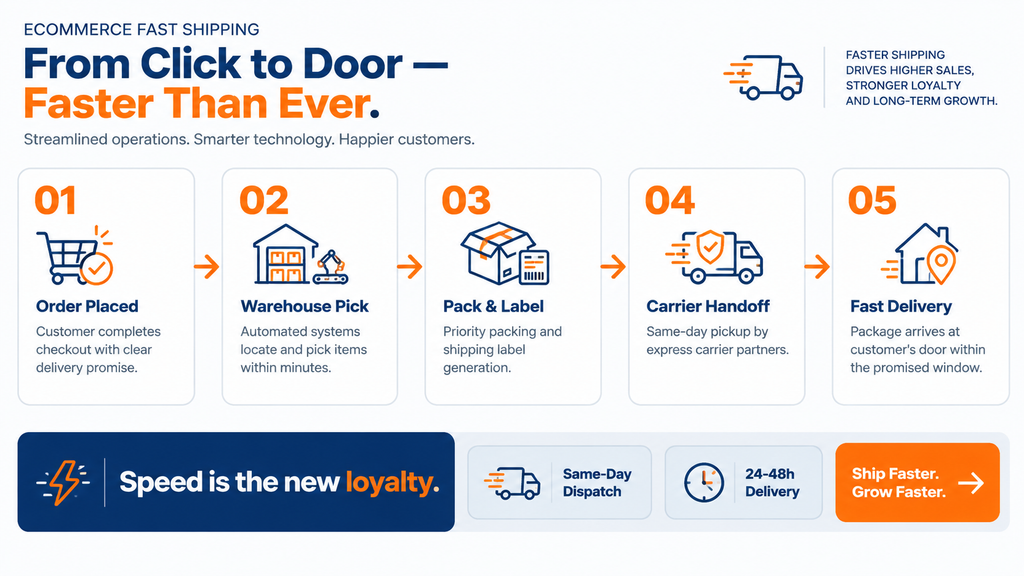
The most effective fast shipping ecommerce brands do not hide their delivery capabilities in policy pages — they lead with them. Displaying your fast shipping ecommerce promise in homepage banners, in product page delivery badges, in paid ad creative, and in social content positions speed as a competitive differentiator rather than a logistical footnote. Every fast shipping ecommerce commitment you communicate and consistently keep builds the brand reputation that earns repeat customers.
Fast shipping ecommerce as a brand differentiator is particularly powerful in categories where delivery urgency is common: gifts, event-related purchases, and replacement essentials. In these categories, advertising your fast shipping ecommerce capabilities captures time-sensitive customers who would otherwise default to Amazon or large retailers. Building a fast shipping ecommerce reputation takes consistent execution — but the customer loyalty it generates is among the most durable competitive advantages available to an independent online store.
Before you publish delivery promises and returns terms, check the rules in the UK government’s guide to online and distance selling for businesses.
Want Your Store To Actually Convert?
Strategy is step one — execution is what moves revenue. Tasknestly builds and optimizes ecommerce stores that convert.
Get Ecommerce Services →Grow With Tasknestly
Subscribe to the Tasknestly newsletter and get the latest tips on websites, SEO, social media, and digital growth.