
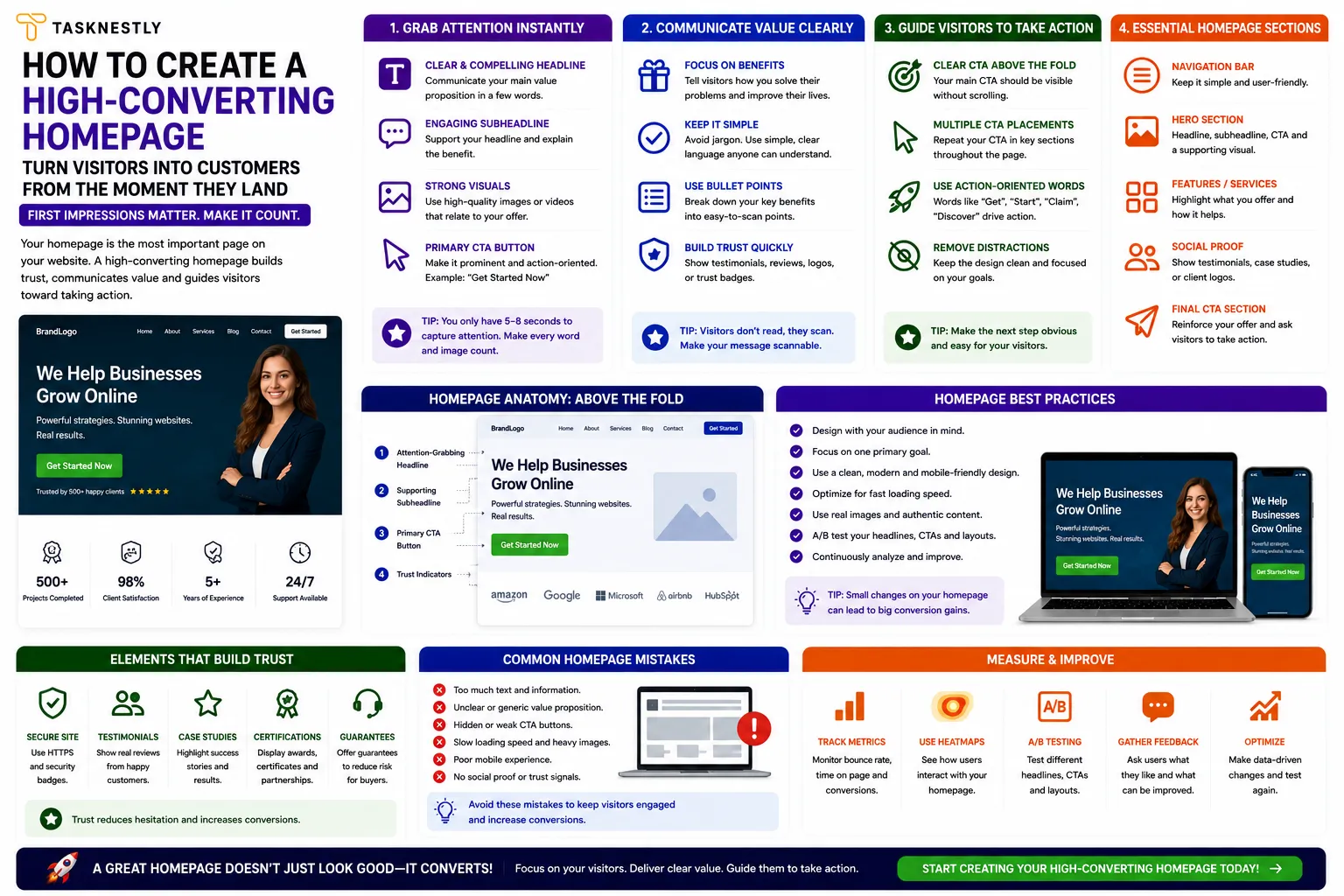
A high-converting homepage is the single most commercially important page on your website. It is the first impression the majority of your new visitors form of your brand, the page that receives the most traffic from paid and organic sources, and the primary determinant of whether a visitor moves deeper into your site or leaves within seconds. Yet despite its importance, most business homepages fail at the fundamental task of converting visitors into leads, enquiries, or sales.
Building a high-converting homepage requires understanding how visitors actually behave when they land on a page. Eye-tracking studies and heatmap analysis consistently show that most visitors scan rather than read — they look for visual cues, headlines, and signals that tell them quickly whether they are in the right place and whether this business can solve their problem. A high-converting homepage is designed around this scanning behaviour — putting the most critical information in the most prominent positions and guiding the visitor’s eye toward the action you want them to take.
This guide covers everything you need to know to build a high-converting homepage from scratch or improve one that is not converting as it should. From headline writing and hero section design to social proof placement and call to action strategy, every element of a high-converting homepage is covered with specific, actionable guidance that you can implement immediately.
Want a high-converting homepage built by experts who specialise in conversion? Tasknestly’s web design and development team creates homepages engineered for maximum leads and sales. Get your free quote today.
Your Site Should Be Converting More
Small fixes only go so far — Tasknestly builds and optimizes full websites designed to convert visitors into customers.
Get Website Services →Table of Contents
High-Converting Homepage Element 1: The Hero Section
The hero section — the above-the-fold area visible without scrolling — is the most important part of any high-converting homepage. It is where the visitor decides whether to stay or leave, and it needs to communicate your entire value proposition within five seconds. Most homepages fail to be high-converting because their hero section is vague, visually cluttered, or focused on the business rather than the customer.
What Should a Homepage Hero Include?
A high-converting homepage hero section includes four essential elements: a headline that communicates your primary benefit, a subheadline that adds specificity and addresses the visitor’s core problem, a visual (image or video) that reinforces the headline message, and a prominent call to action that tells the visitor exactly what to do next. Every element of the hero section should serve one purpose — persuading the visitor to stay and take action.
Homepage Design Tips for Headlines
The headline is the single most important copy element on a high-converting homepage. Homepage design tips for headlines consistently show that benefit-led, customer-focused headlines outperform company-focused ones by a significant margin. “Get More Leads From Your Website — Without Increasing Your Ad Budget” is a high-converting homepage headline. “Welcome to Our Website” is not. Your headline should speak directly to the problem your target customer is trying to solve and promise a specific, desirable outcome.
Subheadlines support the headline by adding specificity and credibility. While the headline makes the promise, the subheadline answers “how?” and “for whom?” — narrowing the message to your specific audience and making the promise feel achievable. Together, the headline and subheadline form the core argument of your high-converting homepage.
Your Site Should Be Converting More
Small fixes only go so far — Tasknestly builds and optimizes full websites designed to convert visitors into customers.
Get Website Services →High-Converting Homepage Element 2: Social Proof
Social proof is one of the most powerful conversion tools available on any high-converting homepage — and it is consistently underused. Visitors who arrive on your homepage have never met you, never used your product or service, and have no reason to trust you yet. Social proof bridges this trust gap by showing that other people — like them — have taken the same action and benefited.
Homepage Best Practices for Social Proof
For a high-converting homepage, social proof should appear early — ideally within the first two scrolls. The most effective forms include customer testimonials with specific outcomes (“We increased our revenue by 40% in three months after working with this team”), recognisable client logos, star ratings from verified review platforms, and quantified results (number of clients served, projects completed, revenue generated for customers).
Homepage conversion optimisation research consistently shows that testimonials with specific, measurable outcomes convert at a significantly higher rate than generic praise. “They were brilliant to work with” is weak social proof. “They redesigned our website and our conversion rate went from 1.8% to 4.2% in 60 days” is powerful social proof for a high-converting homepage because it gives the prospect a concrete, relatable result to aspire to.
Your Site Should Be Converting More
Small fixes only go so far — Tasknestly builds and optimizes full websites designed to convert visitors into customers.
Get Website Services →High-Converting Homepage Element 3: Clear Value Proposition
Your value proposition is the answer to the question every homepage visitor is silently asking: “Why should I choose you over everyone else?” A high-converting homepage communicates a clear, differentiated, compelling value proposition — not a list of generic service descriptions, but a specific articulation of what makes your approach, your results, or your offering uniquely valuable to your target customer.
How to Design a Homepage Value Proposition Section
The value proposition section of a high-converting homepage typically follows the hero section and expands on the headline promise with three to five specific benefits or differentiators. These should be framed from the customer’s perspective — what they gain, not what you do. Icons or visuals help this section scan quickly and make individual points stand out. Each point should be specific enough to be believable and distinctive enough to differentiate your offering from generic alternatives.
Homepage design tips for value proposition sections include: leading with the most compelling differentiator, using active language rather than passive descriptions, and connecting every benefit back to a specific customer outcome. A high-converting homepage value proposition does not describe features — it describes the transformation those features enable.
Your Site Should Be Converting More
Small fixes only go so far — Tasknestly builds and optimizes full websites designed to convert visitors into customers.
Get Website Services →High-Converting Homepage Element 4: A Compelling Call to Action
The call to action (CTA) is the conversion point of your high-converting homepage — the moment where a visitor’s interest becomes a commitment. Homepage best practices for CTAs are clear and evidence-backed: specific beats generic, benefit-led beats action-led, and visible beats buried.
Homepage Conversion Optimisation: CTA Design
For a high-converting homepage, every CTA should be immediately visible, visually distinctive (high contrast button colour against the background), and written in language that tells the visitor exactly what they get when they click. “Get My Free Quote” is stronger than “Contact Us.” “Start Growing My Business” is stronger than “Learn More.” “Book Your Free Strategy Call” is stronger than “Get in Touch.”
A high-converting homepage also includes multiple CTAs — not the same button repeated, but logically placed conversion invitations at each stage of the scroll. A visitor who is ready to take action after reading the hero section should not have to scroll to the bottom to find a way to contact you. Place a prominent CTA above the fold, repeat it after the social proof section, and include a final CTA at the bottom of the page with any remaining friction addressed.
Need a high-converting homepage that actually brings in business? Tasknestly’s digital marketing and web design specialists combine conversion science with great design to build homepages that perform. Request your free quote.
Your Site Should Be Converting More
Small fixes only go so far — Tasknestly builds and optimizes full websites designed to convert visitors into customers.
Get Website Services →High-Converting Homepage Element 5: Services or Products Overview
Every high-converting homepage needs a clear overview of what the business offers — but how this is presented matters as much as what is included. The services or products section of a high-converting homepage should be brief, scannable, and linked to individual service pages where visitors can learn more. It is not the place for comprehensive service descriptions — that content lives on dedicated pages. The homepage version should be a concise, benefit-led overview that gives visitors enough to understand your offering and enough to make them want to explore further.
What Should a Homepage Include in the Services Section?
Homepage design tips for the services section include: limiting the number of offerings shown (three to six is typically optimal for scannability), using customer-facing language rather than industry jargon, leading each service with a benefit rather than a title, and linking every service to a dedicated page that handles the full conversion conversation. A high-converting homepage uses its services section to guide navigation, not to replace it.
Your Site Should Be Converting More
Small fixes only go so far — Tasknestly builds and optimizes full websites designed to convert visitors into customers.
Get Website Services →High-Converting Homepage Element 6: Trust Signals and Credibility
Beyond testimonials, a high-converting homepage builds credibility through multiple layers of trust signals. These include professional photography (not stock images of generic office workers), clear team bios or a founder story section, media mentions or press coverage, industry accreditations or certifications, partnership logos, and a clear and easy-to-find privacy policy and contact information.
One of the most commonly overlooked homepage best practices is displaying contact information — specifically a phone number and address — prominently. These signals tell visitors your business is real, established, and accountable. For service businesses especially, a visible phone number on a high-converting homepage can significantly increase call-in conversion rate from visitors who prefer to enquire by phone rather than form.
For independent reviews of the best website analytics and conversion rate optimisation tools that help you measure and improve your high-converting homepage performance over time, TechBothQ covers the leading platforms with detailed comparisons.
Your Site Should Be Converting More
Small fixes only go so far — Tasknestly builds and optimizes full websites designed to convert visitors into customers.
Get Website Services →Common Homepage Mistakes That Kill Conversions
Understanding what makes a high-converting homepage also means knowing the mistakes that silently destroy conversion rates. These are the most common homepage errors that cause businesses to lose leads they should be capturing.
The most damaging mistake is a vague headline. “Welcome to [Company Name]” or “Your Trusted Partner in [Industry]” tells the visitor nothing about what the business does or why they should care. A non-specific headline is the single most common reason a homepage fails to be high-converting — visitors cannot convert if they cannot immediately understand whether this business is relevant to them.
Too many competing calls to action is the second most common conversion killer. When a homepage presents five different buttons — “Shop Now,” “Learn More,” “Book a Call,” “Download Our Guide,” and “Contact Us” — visitors experience decision paralysis and often take no action at all. A high-converting homepage has one primary CTA and at most one secondary CTA. Every other action competes with the conversion you actually want.
Slow load time is a silent conversion killer that affects almost every homepage that has not been specifically optimised for speed. As noted in our detailed guide on website speed, even a two-second delay in load time significantly increases bounce rate. A homepage that loads slowly loses conversions before the visitor has even seen the headline.
Generic stock photography undermines trust and authenticity. Real photos of your team, your office, your products, or your work consistently outperform stock images in conversion rate because they signal that your business is real and established. Visitors are increasingly sophisticated at identifying stock imagery and it reduces their trust in the brand they are considering.
Finally, no clear above-the-fold CTA is a mistake that forces visitors to scroll before they can take action. Many visitors who are ready to convert immediately will not scroll if they cannot see an obvious next step. Placing a prominent CTA button in the hero section of your high-converting homepage captures these high-intent visitors before they have the chance to leave. These mistakes are fully avoidable — and fixing them is often the fastest path to meaningful conversion rate improvement without rebuilding the page from scratch.
Your Site Should Be Converting More
Small fixes only go so far — Tasknestly builds and optimizes full websites designed to convert visitors into customers.
Get Website Services →Homepage Conversion Optimisation: Testing and Improvement
Building a high-converting homepage is an iterative process, not a one-time project. Homepage conversion optimisation requires systematic testing and data-driven refinement over time. Even a homepage that is performing well can almost always convert at a higher rate with targeted improvements to specific elements.
The most impactful homepage conversion optimisation tests to run are: headline variations (which promise drives more scroll-depth?), hero image variations (which visual reduces bounce rate?), CTA copy variations (which button text drives more clicks?), social proof placement (does moving testimonials above or below the value proposition section improve conversion?), and form length variations (does reducing form fields increase submission rate?).
Running these tests systematically using A/B testing tools creates a compounding improvement cycle where your high-converting homepage gets progressively better over time — increasing the return from every traffic source you invest in without increasing your traffic acquisition costs.
Combining a well-optimised high-converting homepage with professional SEO services and digital marketing strategy creates a complete growth system where more visitors find your site and a higher proportion of them convert. For ecommerce businesses, a high-converting homepage is the top of a funnel that should connect seamlessly to a high-performing ecommerce infrastructure built for conversion at every stage.
Top Tools to Help You Build and Optimise a High-Converting Homepage
- Hotjar — Heatmap and session recording tool that reveals exactly how visitors interact with your homepage, making it easy to identify where people drop off and which sections they engage with most.
- Google Optimize (via GA4) — Free A/B testing tool that lets you test headline, CTA, and layout variations directly on your live homepage and measure conversion impact with statistical confidence.
- Unbounce — Landing page and homepage builder with built-in A/B testing and AI-powered conversion optimisation tools designed specifically for marketers focused on homepage conversion optimisation.
Your Site Should Be Converting More
Small fixes only go so far — Tasknestly builds and optimizes full websites designed to convert visitors into customers.
Get Website Services →Frequently Asked Questions: High-Converting Homepage
| Question | Answer |
|---|---|
| What makes a high-converting homepage? | A high-converting homepage combines a benefit-led headline, specific social proof, a clear value proposition, prominent and specific CTAs, a services overview, and multiple trust signals — all structured to guide a scanning visitor toward taking a specific action within the first two scrolls. |
| What should a homepage include? | Every homepage should include a clear headline communicating the primary benefit, social proof from real customers, a concise services or products overview, multiple calls to action, contact information, and trust signals like client logos, testimonials, or accreditations. |
| How do I improve my homepage conversion rate? | Start with your headline — test a more specific, benefit-led version. Add a strong testimonial with a measurable outcome above the fold. Make your CTA button larger, higher contrast, and more specific. Remove unnecessary navigation links that distract from conversion. Then A/B test each change to quantify its impact. |
| How long should a homepage be? | A high-converting homepage should be long enough to address the visitor’s key questions and objections before the primary CTA — but no longer. For most service businesses, this means three to six sections totalling one to two minutes of reading time. Ecommerce homepages can be shorter, directing visitors quickly to category pages. |
| How important is the hero section for homepage conversion? | The hero section is the most important conversion driver on any homepage. If a visitor does not find a compelling reason to stay within the first five seconds, they leave — and no amount of excellent content below the fold will recover them. Investing in the hero section headline and visual delivers the highest return of any homepage improvement. |
| Should my homepage have a lot of text? | Not necessarily. A high-converting homepage should be scannable — using headlines, subheadlines, icons, and short bullet points to communicate key messages quickly. Detailed explanatory text belongs on service pages and blog posts. The homepage’s job is to orient, persuade, and direct — not to explain everything in detail. |
| How often should I update my homepage? | Review your homepage against your conversion analytics quarterly. Update it whenever your services, positioning, or target audience changes significantly. Run A/B tests on key elements continuously. A high-converting homepage is a living asset that should be actively optimised, not a static page that gets set and forgotten. |
Your Site Should Be Converting More
Small fixes only go so far — Tasknestly builds and optimizes full websites designed to convert visitors into customers.
Get Website Services →Conclusion: Build a High-Converting Homepage That Works as Hard as You Do
A high-converting homepage is one of the highest-return investments a business can make in its digital presence. When your homepage is converting well — turning a meaningful proportion of your traffic into leads, enquiries, or sales — every other marketing activity you invest in delivers better returns, because the traffic has somewhere compelling to land.
Building a high-converting homepage starts with understanding your visitor: what they need to see within the first five seconds, what concerns they need addressed before they trust you enough to act, and what specific action you want them to take and when. Every design decision, every copy choice, and every structural element on your high-converting homepage should serve this understanding rather than competing with it. It requires a compelling headline, genuine social proof, a clear value proposition, specific CTAs, and the trust signals that make a visitor confident enough to reach out. And it requires a commitment to ongoing testing and optimisation, because the first version of your homepage is never the best version.
Every business with a website deserves a homepage that actually works — that converts a meaningful proportion of visitors into real commercial relationships rather than simply existing as a digital brochure. If you want a high-converting homepage built from the ground up by specialists who understand conversion psychology, design, and digital marketing, Tasknestly’s web design and development team is ready to help. Get your free quote today and let us build the high-converting homepage your business needs to grow consistently and sustainably.
Your Site Should Be Converting More
Small fixes only go so far — Tasknestly builds and optimizes full websites designed to convert visitors into customers.
Get Website Services →Grow With Tasknestly
Subscribe to the Tasknestly newsletter and get the latest tips on websites, SEO, social media, and digital growth.