

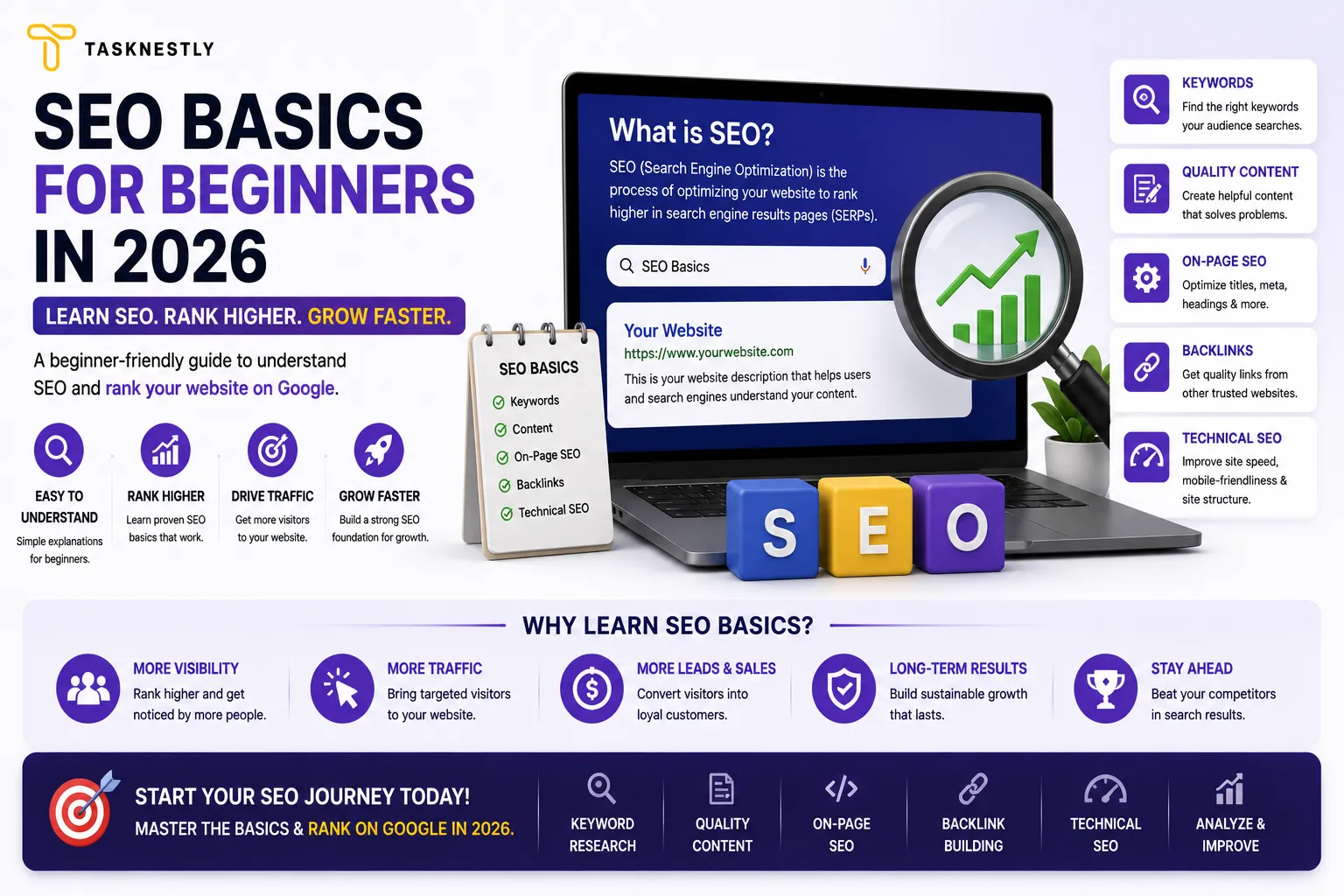
SEO basics for beginners do not require a computer science degree, an agency budget, or years of technical experience. The fundamental principles that drive organic search performance have remained consistent despite numerous algorithm updates — and the businesses generating the most organic traffic in 2026 are not doing so because they understand complex algorithmic nuances. They are doing so because they have applied the basics correctly, consistently, and comprehensively.
The overwhelming majority of websites that struggle to rank are not failing because of sophisticated technical problems or algorithm penalties. They are failing because they have not completed the basics: they have not done keyword research, their content is thin and uninformative, their pages have no meta descriptions, they have no internal linking structure, and they have never claimed their Google Search Console account to understand how their site performs. Fixing these fundamentals produces more ranking improvement than any advanced tactic.
This guide covers the 10 most important SEO basics for beginners — a complete, actionable foundation that will take your site from invisible to ranking if applied consistently over 3 to 6 months. No prior SEO knowledge is required. Each step is explained in plain language with specific tools and implementation guidance.
| Want SEO Done Right Without the Learning Curve?Tasknestly’s professional SEO services handle every aspect of SEO — from keyword research and content strategy to technical optimisation and link building — so you get organic traffic without spending months learning the craft.Get your FREE SEO Consultation → |
Ranking Takes More Than Tips
You know the strategy now — let Tasknestly handle the technical SEO, content, and link building that actually moves rankings.
Get SEO Services →Table of Contents
SEO Basics for Beginners: How Search Engines Work
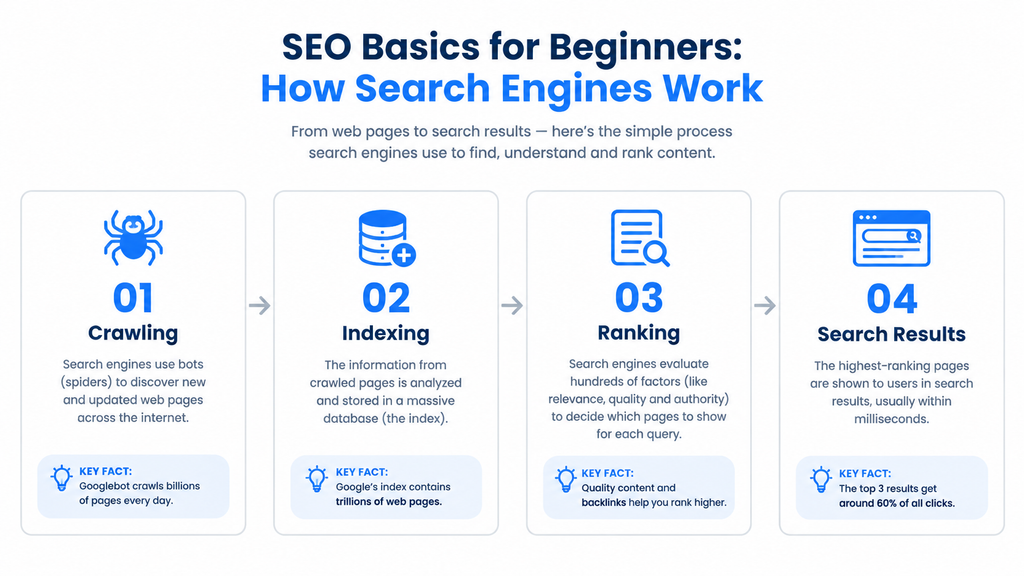
Before implementing any SEO basics for beginners, understanding how search engines actually work provides the strategic context that makes every subsequent step more intuitive.
Step 1: Understand How Google Ranks Content
The most important of all SEO basics for beginners is a conceptual one: Google’s job is to serve the most relevant, most helpful, most authoritative result for every search query. Every ranking factor — content quality, backlinks, page speed, user experience — exists in service of that single objective. Once you understand this, SEO decision-making becomes intuitive: ask yourself ‘does this make my page more helpful and relevant for my target searcher?’ before every optimisation.
Google discovers content by crawling the web with automated bots, indexes it by storing and categorising what it finds, and ranks it by evaluating hundreds of signals to determine which page best satisfies each search query. Your SEO job is to make it easy for Google to crawl your pages, give it clear signals about what your content is about, and demonstrate that your content is the best available answer for the queries you are targeting.
Ranking Takes More Than Tips
You know the strategy now — let Tasknestly handle the technical SEO, content, and link building that actually moves rankings.
Get SEO Services →SEO Basics for Beginners: Keyword Research
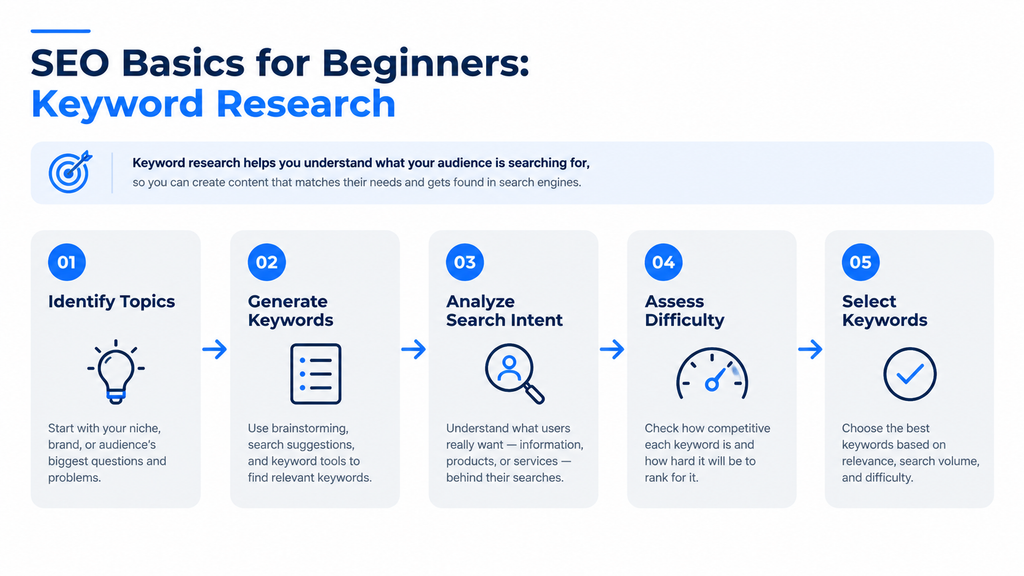
Keyword research is the foundation of all SEO basics for beginners — you cannot effectively optimise a page for search without first knowing what people are actually searching for.
Step 2: Do Keyword Research Before Creating Any Content
Every piece of content you create should be built around a specific keyword that people are actually searching. This is one of the most critical SEO basics for beginners because it prevents the most common beginner mistake: creating content about topics that seem relevant but have no search volume — pages that, however well written, will never attract organic visitors because nobody is searching for them.
Use Google Keyword Planner (free), SEMrush, or Ubersuggest to research keywords in your niche. For each potential keyword, evaluate: monthly search volume (aim for at least 100-500 searches per month for new sites), keyword difficulty (how competitive the ranking environment is), and search intent (what the searcher actually wants — information, a product, a local business). Start by targeting low-competition keywords in the 0-30 difficulty range — these are achievable for new sites and build the ranking history needed to eventually compete for harder terms.
Ranking Takes More Than Tips
You know the strategy now — let Tasknestly handle the technical SEO, content, and link building that actually moves rankings.
Get SEO Services →SEO Basics for Beginners: On-Page Optimisation
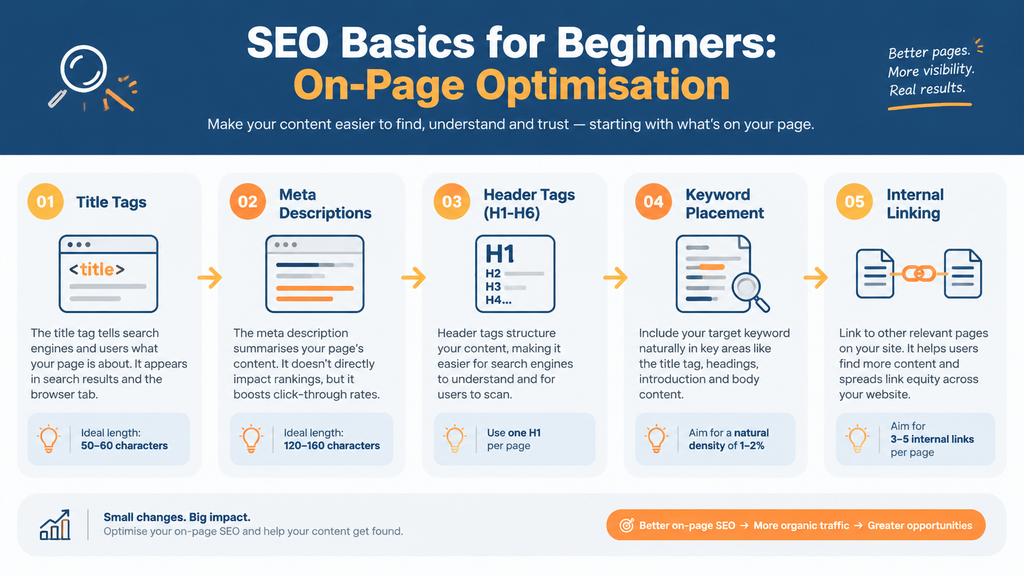
On-page optimisation is the set of SEO basics for beginners changes you make directly on your pages to signal their relevance to search engines and improve the experience for human readers.
Step 3: Optimise Page Titles and Meta Descriptions
Your page title (the HTML title tag) is the single most directly search-engine-facing element on your page and one of the most impactful SEO basics for beginners to get right. It should include your target keyword near the beginning, be 50-60 characters long, and be written to appeal to human searchers as well as search engines. Your meta description (the snippet shown in search results) should include your target keyword, summarise the page content compellingly, and be 145-155 characters long. Although meta descriptions are not a direct ranking factor, they significantly influence click-through rate — which indirectly affects rankings.
Step 4: Write High-Quality, Comprehensive Content
Content quality is the most important of all SEO basics for beginners. Google’s algorithms are increasingly sophisticated at evaluating whether content genuinely helps the searcher or merely appears to through keyword stuffing and surface-level coverage. The content that ranks in 2026 is content that thoroughly addresses the search intent behind its target keyword — covering the topic more comprehensively than competitors, answering the questions the searcher likely has, and presenting that information in a clear, scannable format.
Aim for a minimum of 1,500 words for informational content and 300+ words for product and service pages. Include your target keyword in the first paragraph, at least two H2 subheadings, and naturally throughout the content. Avoid keyword stuffing — mention your keyword where it fits naturally, not in every sentence. The most reliable SEO basics for beginners content principle is: write for your human reader first, then verify your keyword appears at the appropriate natural frequency.
Step 5: Use Heading Structure Correctly
Proper heading structure — using H1 for your main page title, H2 for major section headers, and H3 for subsections — is one of the SEO basics for beginners that is quick to implement but frequently done incorrectly. Your page should have exactly one H1 containing your primary keyword. H2 headings should contain related keywords and break your content into logical sections. H3 headings organise subsections within each H2. This hierarchical structure helps both search engines understand the content organisation and readers scan the page for the specific section relevant to their question.
Step 6: Optimise Images
Image optimisation is one of the most overlooked SEO basics for beginners — yet it affects page loading speed (a ranking factor), image search traffic (an additional discovery channel), and accessibility (a user experience signal). Every image should have a descriptive alt text attribute that includes your target keyword where natural: ‘seo-basics-beginners-checklist.png’ and alt=’SEO basics for beginners checklist’ is far better than ‘IMG_4521.png’ and alt=”.
Compress images before uploading using a tool like TinyPNG. Most product and blog images can be compressed to under 200KB without visible quality loss — dramatically reducing page loading time, particularly on mobile devices. Never upload uncompressed images from a camera or phone directly to your website.
| Need a Website That Ranks and Converts From Day One?Tasknestly’s website services build sites with SEO fundamentals built in from launch — fast loading, mobile-optimised, and structured for organic search growth from day one.Start with a free website consultation → |
Ranking Takes More Than Tips
You know the strategy now — let Tasknestly handle the technical SEO, content, and link building that actually moves rankings.
Get SEO Services →SEO Basics for Beginners: Links and Authority
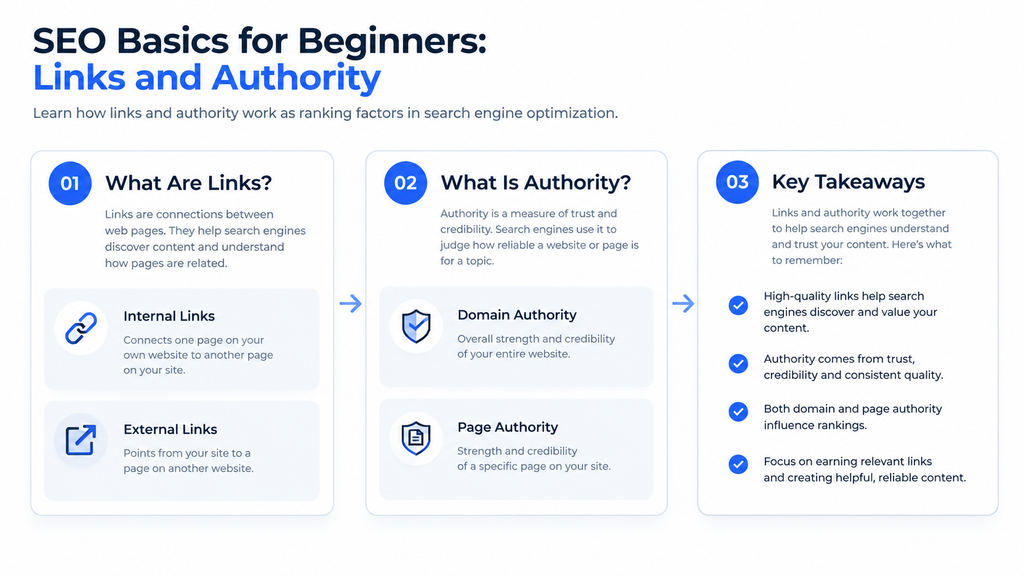
Links — both internal links between your own pages and external backlinks from other websites — are fundamental SEO basics for beginners that directly influence how search engines evaluate the authority and relevance of your content.
Step 7: Build Internal Links Between Your Pages
Internal linking — linking from one page on your website to another relevant page — is one of the most underutilised SEO basics for beginners. Internal links help search engines discover all your pages, understand how your content is related, and distribute authority from your high-traffic pages to your lower-traffic ones. Every time you create a new piece of content, identify two or three existing pages on your site that are topically related and add internal links between them.
Use descriptive anchor text — the visible, clickable text of a link — that accurately describes the destination page. ‘Read our guide to keyword research techniques’ is descriptive anchor text; ‘click here’ is not. Descriptive anchor text provides search engines with additional context about the content of the linked page and is one of the SEO basics for beginners that is simple to implement correctly from day one.
Step 8: Earn Your First Backlinks
Backlinks — links from other websites to yours — are one of the most powerful ranking signals in Google’s algorithm, making them an essential topic in SEO basics for beginners. Building backlinks is more time-consuming than on-page optimisation, but even a small number of quality backlinks from relevant, authoritative websites produces a meaningful improvement in ranking potential.
Beginner backlink strategies include: submitting your business to relevant industry directories, reaching out to local business associations and partner organisations for link placement, creating genuinely useful resources (tools, guides, research) that other websites naturally reference, and guest posting on relevant blogs in your niche. Focus on relevance — a link from a website in your industry or location is more valuable than a link from an unrelated high-authority site.
Ranking Takes More Than Tips
You know the strategy now — let Tasknestly handle the technical SEO, content, and link building that actually moves rankings.
Get SEO Services →SEO Basics for Beginners: Measurement and Technical Health
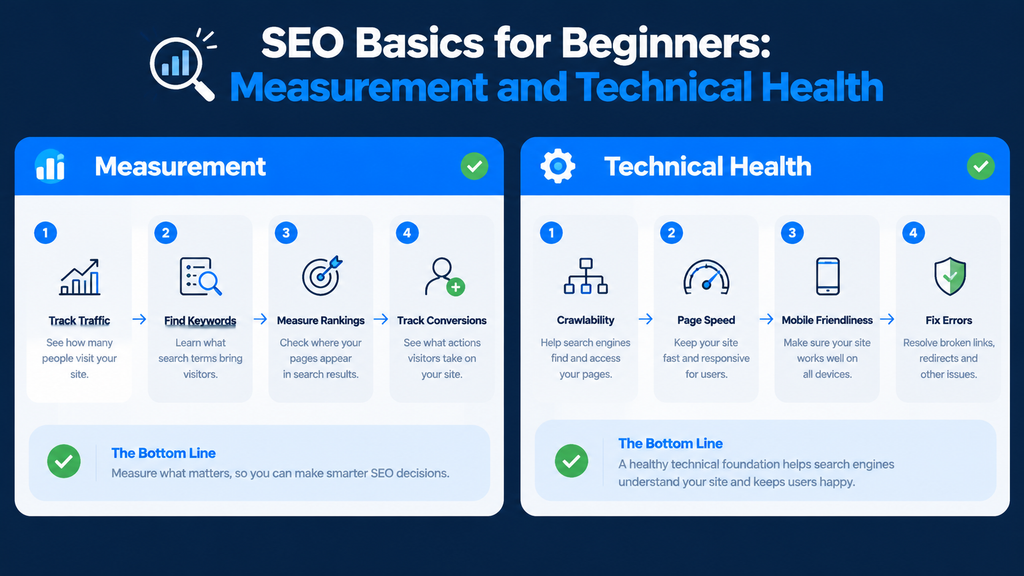
The final SEO basics for beginners steps address how you measure your progress and ensure your site has no technical barriers preventing search engines from accessing and ranking your content.
Step 9: Set Up Google Search Console and Analytics
Setting up Google Search Console and Google Analytics 4 is one of the most critical SEO basics for beginners — without these free tools, you are optimising blind. Search Console shows exactly which keywords your pages rank for, how many impressions and clicks you receive, and any technical errors preventing indexation. GA4 tracks which organic keywords and pages drive conversions and revenue, allowing you to focus SEO effort on the content types producing actual business results.
Connect Search Console to your GA4 account to see organic search performance data alongside on-site behaviour data. Submit your XML sitemap in Search Console to accelerate crawling and indexation of new content. Review both tools weekly in the early months of your SEO programme to catch any issues quickly.
Step 10: Fix Basic Technical SEO Issues
Technical SEO issues are one of the SEO basics for beginners areas most likely to be overlooked but most directly harmful to rankings. Common technical issues include pages returning 404 error codes (broken links), slow page loading speed (above 3 seconds), content that is not mobile-friendly, pages blocked from crawling by robots.txt incorrectly, missing or duplicate meta titles, and pages not being indexed despite being live.
Use Screaming Frog’s free version to crawl your website and identify technical issues across all pages. Use Google Search Console’s Coverage report to identify indexation errors. Use PageSpeed Insights to identify speed improvements. Fixing these SEO basics for beginners technical issues often produces faster ranking improvements than content optimisation because they remove specific barriers that were actively suppressing pages.
Ranking Takes More Than Tips
You know the strategy now — let Tasknestly handle the technical SEO, content, and link building that actually moves rankings.
Get SEO Services →SEO Basics for Beginners: Step-by-Step Checklist
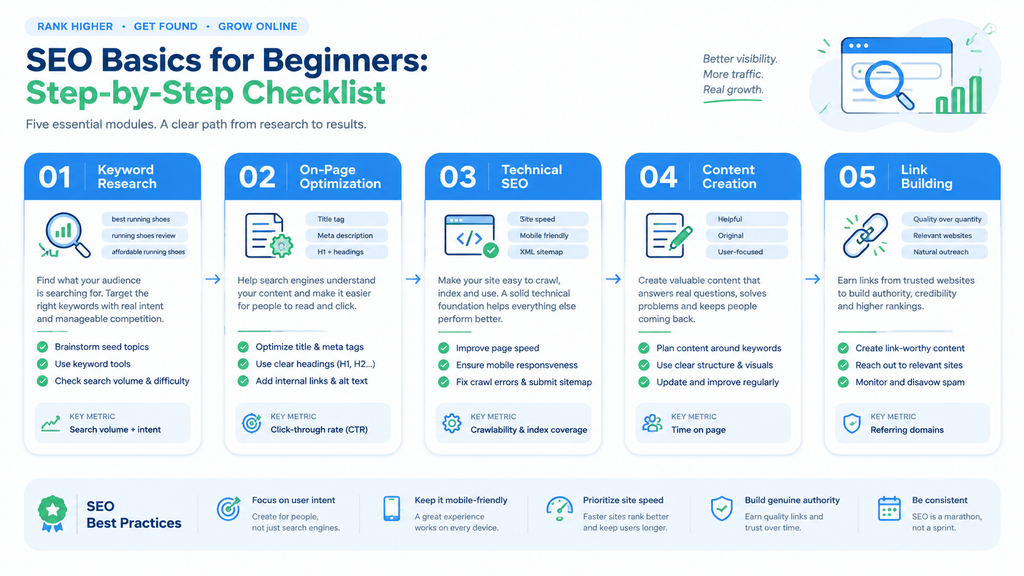
Use this table as a starting checklist when implementing SEO basics for beginners on any new or existing website.
| Step | SEO Basics for Beginners | Difficulty | What It Achieves |
| 1 | Understand how search engines work | Easy | Foundation for all SEO decisions |
| 2 | Do keyword research before creating content | Easy | Targets content at real search demand |
| 3 | Optimise your page titles and meta descriptions | Easy | Improves rankings and click-through rate |
| 4 | Write high-quality, comprehensive content | Medium | Most important on-page ranking factor |
| 5 | Use headings (H1, H2, H3) correctly | Easy | Organises content for readers and crawlers |
| 6 | Optimise images with alt text and compression | Easy | Improves speed, accessibility, and image search |
| 7 | Build internal links between your pages | Easy | Distributes authority and improves crawlability |
| 8 | Get your first backlinks | Medium | Builds domain authority over time |
| 9 | Set up Google Search Console and Analytics | Easy | Provides essential performance data |
| 10 | Fix basic technical SEO issues | Medium | Removes barriers to indexation and ranking |
| Essential Tools to Apply These SEO Basics for BeginnersSEMrush — Research keywords, analyse competitors, and audit your site’s SEO health from one beginner-friendly platform.RankMath Pro — Apply SEO basics directly in WordPress with real-time on-page scoring and keyword guidance for every post and page.Surfer SEO — Score your content against top-ranking competitors to ensure your writing meets the standards needed to rank. |
Ranking Takes More Than Tips
You know the strategy now — let Tasknestly handle the technical SEO, content, and link building that actually moves rankings.
Get SEO Services →Frequently Asked Questions: SEO Basics for Beginners
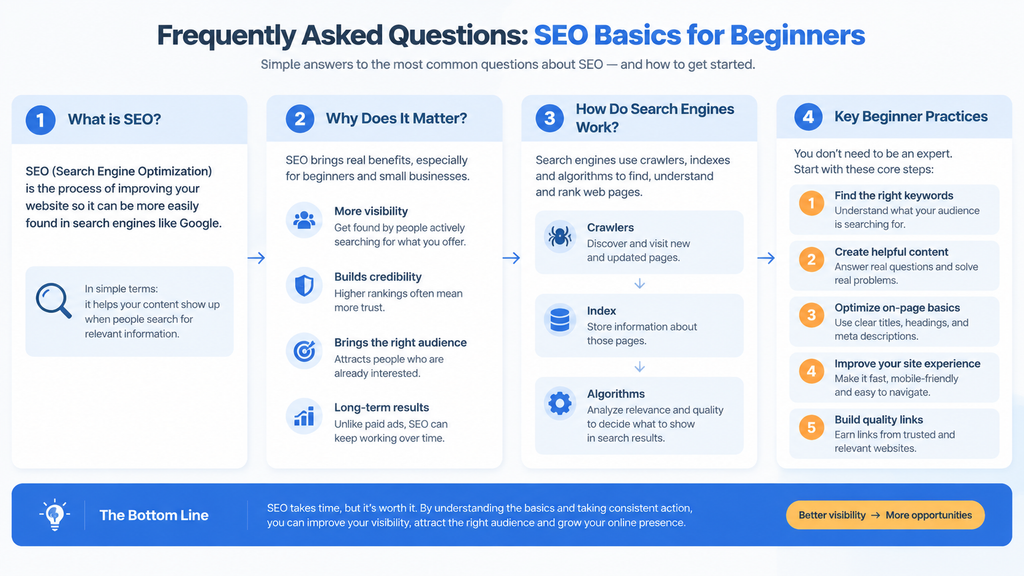
| Question | Answer |
| What are the SEO basics for beginners? | The SEO basics for beginners are keyword research, on-page optimisation (title tags, meta descriptions, heading structure, content quality), internal linking, basic technical health (page speed, mobile optimisation, no crawl errors), and starting to build backlinks. These fundamentals account for the majority of ranking potential for any website. |
| How long does SEO take to work for beginners? | SEO basics for beginners typically produce measurable results within 3 to 6 months when consistently applied. Very low competition keywords can rank within 4 to 8 weeks. Competitive terms may take 6 to 12 months or longer. Technical fixes often show faster results — pages with crawl errors corrected can gain rankings within days of the fix being indexed. |
| Do I need to know how to code for SEO? | No — the vast majority of SEO basics for beginners require no coding knowledge. Tools like RankMath Pro (for WordPress) handle technical optimisation tasks through visual interfaces. Screaming Frog identifies technical issues without requiring you to fix them in code. Most modern website builders handle the technical SEO infrastructure automatically. |
| What is the most important SEO basic for beginners? | Content quality is the single most important of all SEO basics for beginners. Google’s algorithm is designed to rank the most helpful, most relevant, most comprehensive content for any given search query. All other SEO basics — keyword research, technical optimisation, backlinks — amplify the ranking potential of genuinely good content. Poor content optimised perfectly will not rank; excellent content with basic optimisation typically will. |
| What is a keyword in SEO terms? | A keyword in SEO is the specific word or phrase that a person types into a search engine. SEO basics for beginners include understanding that each page you create should target a specific primary keyword — the main term you want that page to rank for — and a small number of related secondary keywords. Keyword research helps you identify which keywords have enough search volume to be worth targeting and which are realistic given your website’s current authority. |
| What is a backlink and do beginners need them? | A backlink is a link from another website to yours. Google treats backlinks as votes of confidence — the more authoritative sites that link to your page, the stronger the ranking signal for that page. SEO basics for beginners include understanding that some backlinks are essential for competitive keywords, but many low-competition keywords can be ranked without significant backlink acquisition if the on-page content is comprehensive and well-optimised. |
| Is SEO still worth learning in 2026? | Yes — SEO remains one of the highest-ROI digital marketing skills in 2026. Organic search drives the majority of website traffic across most industries, and the fundamental SEO basics for beginners have remained consistent despite algorithm updates. Businesses with strong organic search presence have a sustainable competitive advantage that paid advertising alone cannot replicate. |
Ranking Takes More Than Tips
You know the strategy now — let Tasknestly handle the technical SEO, content, and link building that actually moves rankings.
Get SEO Services →Conclusion: Apply These SEO Basics for Beginners and Start Ranking
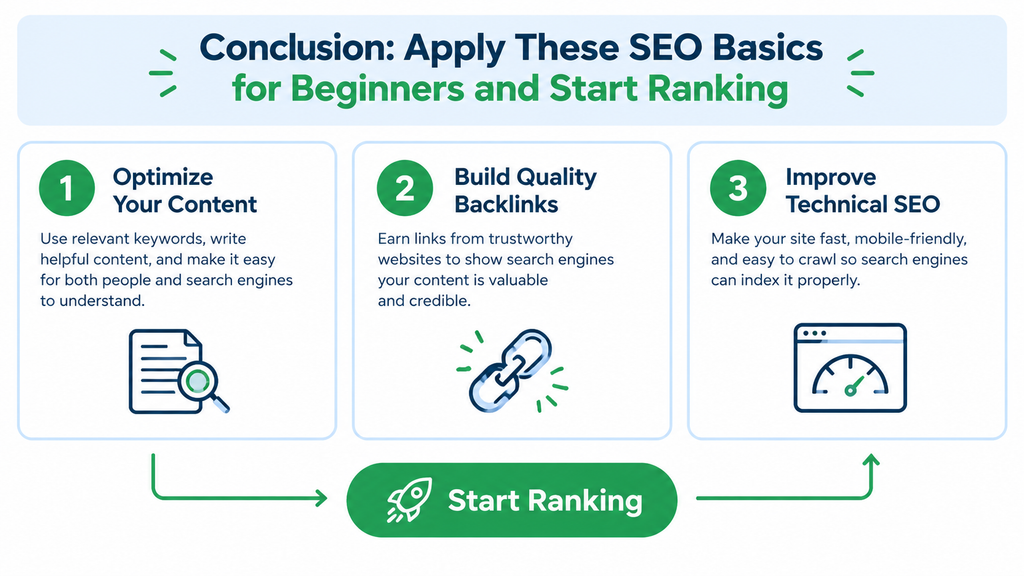
The SEO basics for beginners in this guide are not simplified approximations of what SEO professionals do — they are the actual fundamentals that drive the majority of organic ranking performance for any website. Keyword research, quality content, correct heading structure, image optimisation, internal linking, first backlinks, Google Search Console setup, and basic technical health are the ten steps that, applied consistently over 3 to 6 months, will produce measurable organic traffic growth on any website in any niche.
The most important mindset shift for anyone learning SEO basics for beginners is patience. SEO is not a channel that rewards short-term thinking. The websites generating significant organic traffic today are almost all those that began investing in these fundamentals 12 to 24 months ago and maintained that investment consistently. Start now, apply the basics correctly, measure your progress monthly, and trust the process — the compounding returns of SEO are among the most valuable long-term assets any business can build.
At Tasknestly, we help businesses at every stage of their SEO journey — from implementing SEO basics for beginners for new websites to advanced competitive strategies for established businesses. If you want organic traffic without the learning curve, explore our professional SEO services or request a free consultation today.
Ranking Takes More Than Tips
You know the strategy now — let Tasknestly handle the technical SEO, content, and link building that actually moves rankings.
Get SEO Services →SEO Basics for Beginners: Building Your First 90-Day Plan
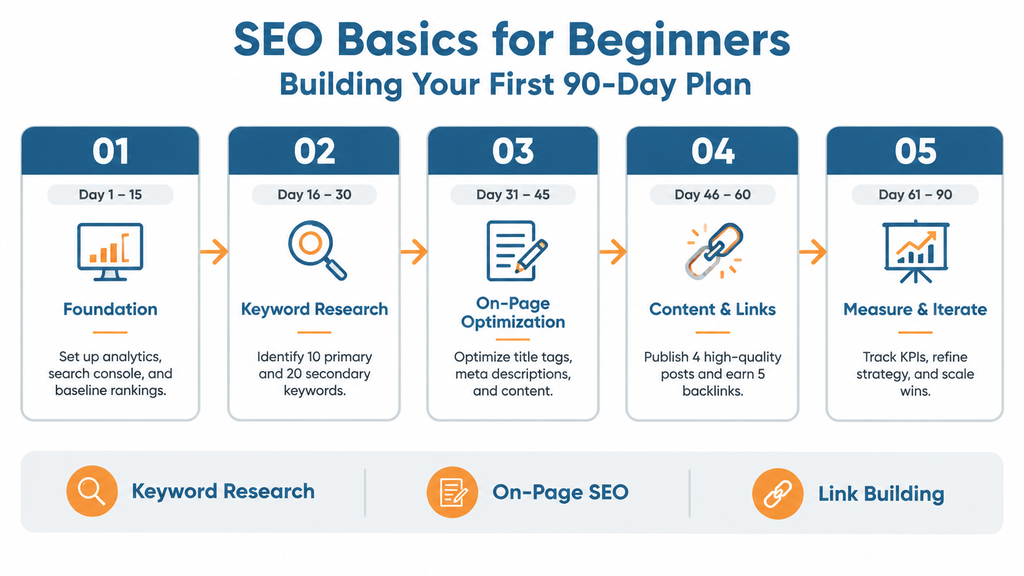
Applying SEO basics for beginners is most effective when organised into a 90-day plan that sequences the fundamentals in the right order. In the first 30 days, focus on the foundational setup tasks: install Google Search Console and Google Analytics 4, conduct keyword research for your primary service or content topics, optimise title tags and meta descriptions on your most important pages, and fix any technical errors identified in your first site crawl. These SEO basics for beginners deliver the fastest initial impact because they address the most common barriers to indexation and visibility.
In days 31 to 60, shift focus to content: publish your first two or three keyword-targeted pieces of content applying the SEO basics for beginners covered in this guide, optimise images on all existing pages, and build your first internal links between related content. In days 61 to 90, begin acquiring your first backlinks through directory listings and outreach, refresh any existing content that pre-dates your SEO programme with proper keyword optimisation, and review your Search Console data to identify which pages are beginning to generate impressions. By month three, most websites applying these SEO basics for beginners systematically will see their first measurable organic traffic gains.
To see how crawling, indexing and ranking work in Google’s own words, read Google’s in-depth guide to how Search works.
Ranking Takes More Than Tips
You know the strategy now — let Tasknestly handle the technical SEO, content, and link building that actually moves rankings.
Get SEO Services →Grow With Tasknestly
Subscribe to the Tasknestly newsletter and get the latest tips on websites, SEO, social media, and digital growth.