
Knowing how to start an ecommerce business correctly is the difference between a store that generates consistent revenue and one that sits live but invisible, waiting for customers who never arrive. Global ecommerce revenue is projected to exceed $8 trillion by 2027, and the barrier to entry has never been lower — modern platforms, affordable tools, and worldwide shipping networks mean that anyone with a validated idea and a clear plan can build a profitable online store from scratch.
But the ease of launching a store has also created an enormous amount of confusion about what actually matters. Entrepreneurs waste months perfecting their store design while neglecting product-market fit. They invest in paid advertising before establishing any organic presence. They choose the wrong platform for their business model and pay the price in limitations and migration costs years later. The 10-step guide below cuts through the noise and gives you the exact sequence that works.
How to start an ecommerce business for the first time, or how to relaunch an existing one on a stronger foundation, these 10 steps cover everything you need to know about how to start an ecommerce business that generates real, sustainable revenue — not just a live website that nobody buys from.
| Want Your Ecommerce Store Built by Experts?Tasknestly’s ecommerce services cover store design, product page optimisation, SEO setup, and ongoing marketing — everything you need to launch and grow a profitable online store.Get your FREE Ecommerce Quote → |
Want Your Store To Actually Convert?
Strategy is step one — execution is what moves revenue. Tasknestly builds and optimizes ecommerce stores that convert.
Get Ecommerce Services →Table of Contents
Steps 1–3: Foundation — Niche, Validation, and Business Model
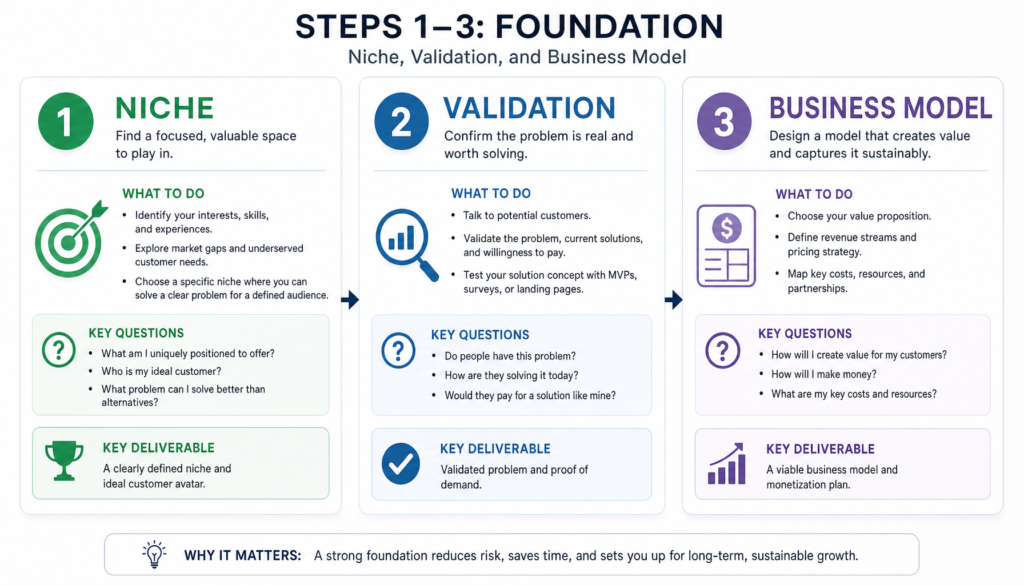
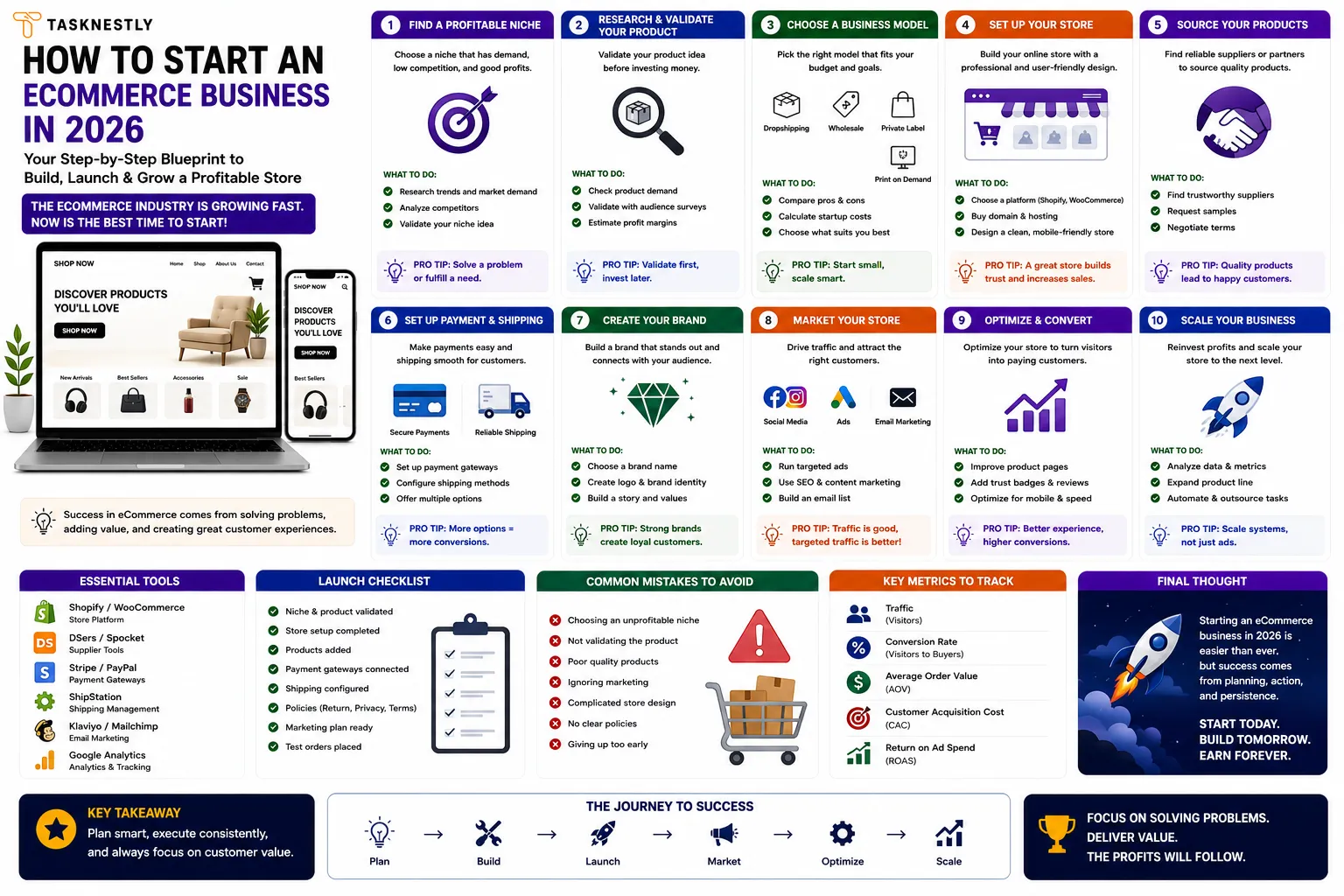
The most important decisions you will make when learning how to start an ecommerce business are made before you build anything. These three steps determine whether your store has a genuine chance of success or whether you are investing time and money into a fundamentally flawed premise.
Step 1: Choose Your Niche With Precision
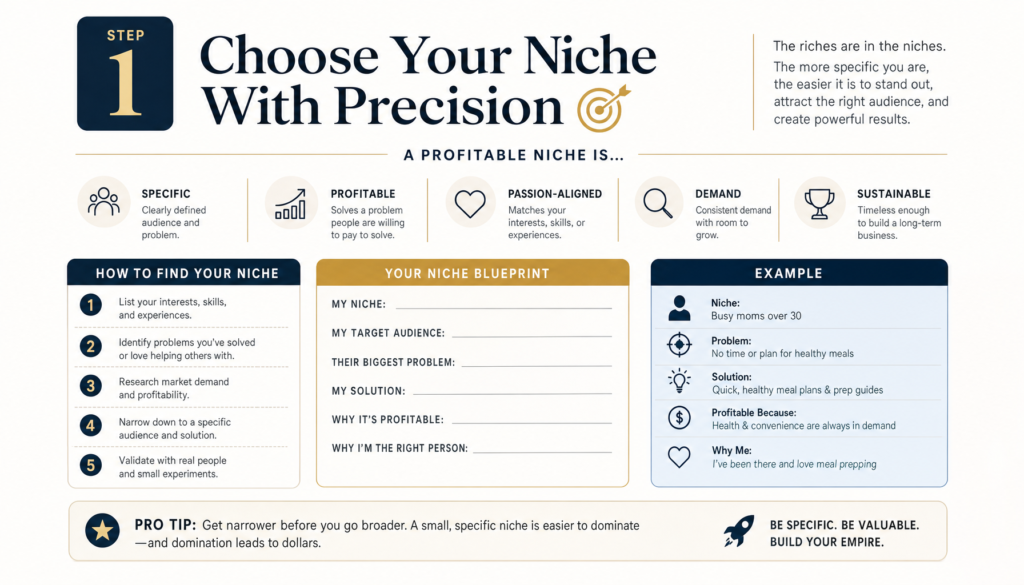
When you learn how to start an ecommerce business, the most common mistake is choosing a niche that is too broad. Health and wellness’ is not a niche — it is a market. ‘Posture-correction products for remote workers aged 30-50’ is a niche. The more specifically you can define your target customer, the more precisely you can source the right products, craft the right messaging, and target the right audience through your marketing.
Evaluate your niche idea against three criteria: demand (are people actively searching for and buying these products?), competition (is the market dominated by unmovable giants, or is there space for a focused challenger?), and margin (do the products generate enough profit after costs to sustain and grow the business?). The ideal niche for how to start an ecommerce business successfully sits at the intersection of all three.
Step 2: Validate Product Demand Before Building Anything
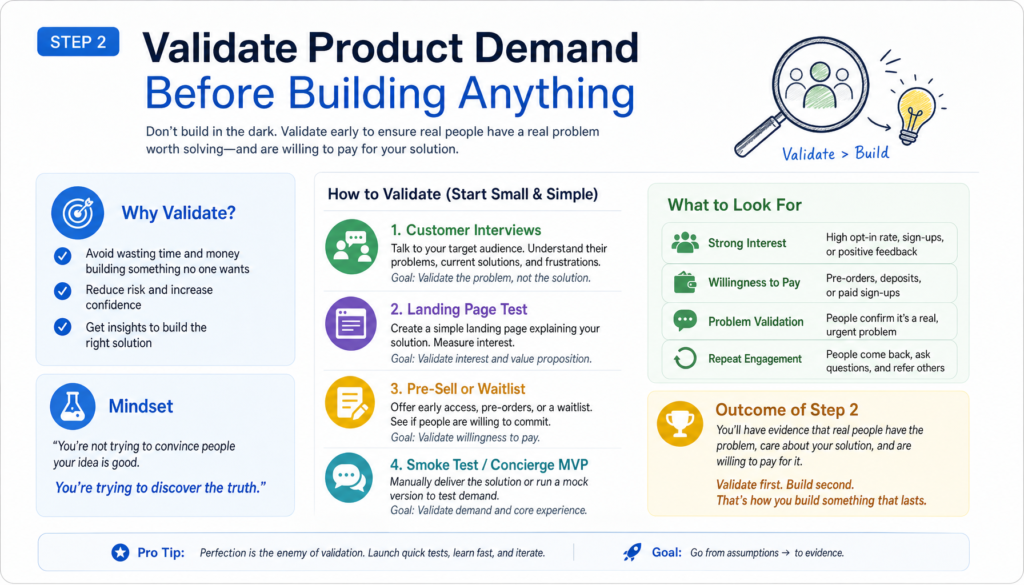
Before you start an ecommerce business with any serious investment, validate demand. Spending money on inventory, store design, or branding without demand validation is how to start an ecommerce business the wrong way on unproven ideas. Use Google Keyword Planner or SEMrush to verify that people are actively searching for your product category with meaningful monthly search volume. Study your competitors — if established brands are spending money on advertising in your niche, that is a strong signal that the market is profitable.
Additional validation methods include selling on Amazon or eBay before building your own store, running a small paid social media test to a landing page with a waiting list, and surveying your target audience directly through social media groups and communities. Validating demand costs nothing but time, and it is the cheapest part of how to start an ecommerce business. It can save you months of building a product nobody wants to buy.
Step 3: Choose Your Business Model
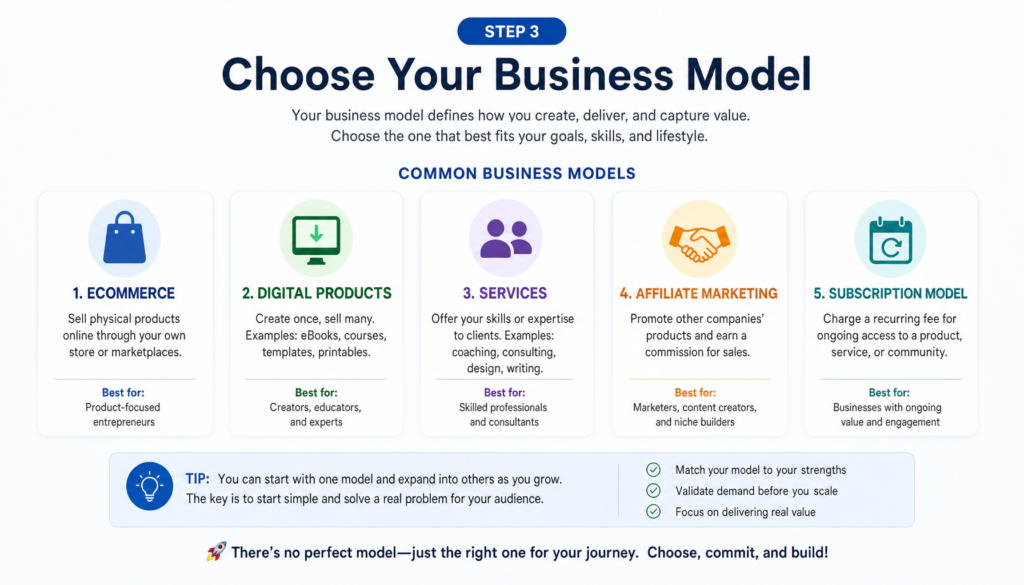
Choosing the right model when you start an ecommerce business is critical. Dropshipping — selling products you never physically hold, fulfilled directly by a supplier — offers the lowest startup cost and the most flexibility. Private label — sourcing generic products and branding them as your own — requires more upfront investment but delivers stronger margins and brand differentiation. Digital products — ebooks, templates, courses, software — offer the highest margins and no fulfilment costs. Wholesale — buying products in bulk at discounted rates — suits established businesses with capital to invest and storage capacity. Choose the model that matches your current resources, risk tolerance, and long-term brand ambitions when deciding how to start an ecommerce business in your specific situation.
Want Your Store To Actually Convert?
Strategy is step one — execution is what moves revenue. Tasknestly builds and optimizes ecommerce stores that convert.
Get Ecommerce Services →Steps 4–7: Building Your Ecommerce Business
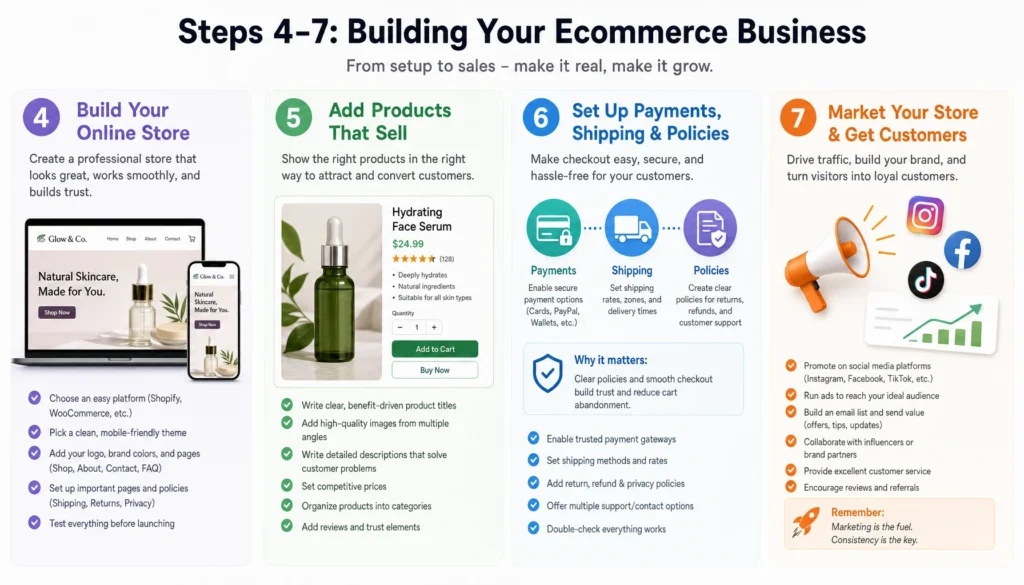
With your niche validated and business model chosen, the next four steps transform your idea into a live, trading ecommerce business.
Step 4: Choose Your Ecommerce Platform
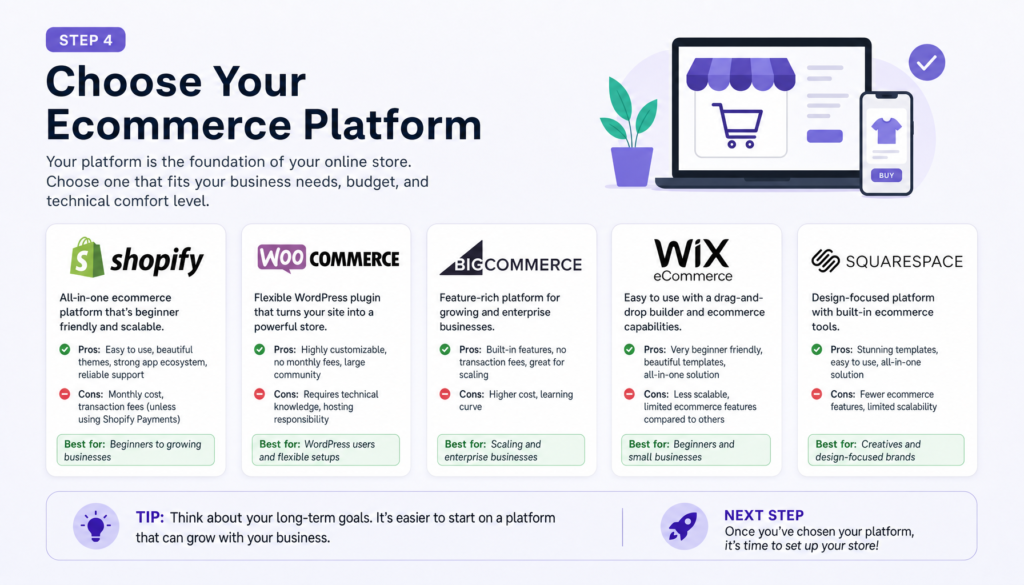
Your platform choice is one of the most consequential decisions in how to start an ecommerce business. Shopify is the most beginner-friendly option — it handles hosting, security, and platform maintenance for you, includes a large app ecosystem, and offers 24/7 customer support. WooCommerce, built on WordPress, is more flexible and cost-effective but requires more technical management. BigCommerce suits larger catalogues and enterprise requirements. Wix and Squarespace work for very simple stores with limited product ranges.
For most entrepreneurs learning how to start an ecommerce business for the first time, Shopify’s monthly fee is worth paying for the simplicity and reliability it provides. The time you save on technical management is better invested in product development, content creation, and customer acquisition.
Step 5: Register Your Business and Set Up Finances
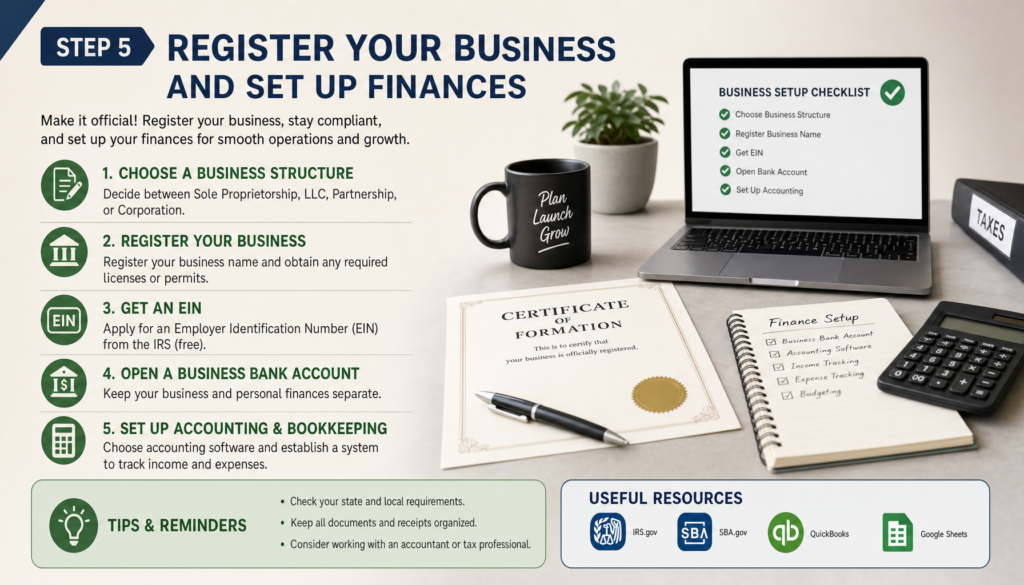
Operating as a legally registered business protects you personally and opens access to business banking, merchant accounts, and wholesale supplier relationships that require business credentials. In the UK, this typically means registering as a sole trader with HMRC or incorporating as a limited company through Companies House. In the US, forming an LLC provides the most flexible protection for most small ecommerce businesses.
When you start an ecommerce business properly, open a dedicated business bank account and set up accounting software from day one, and understand your VAT or sales tax obligations in every market you plan to sell into. Starting with clean financial separation between personal and business funds saves considerable accounting complexity as your ecommerce business grows.
Step 6: Source or Create Your Products
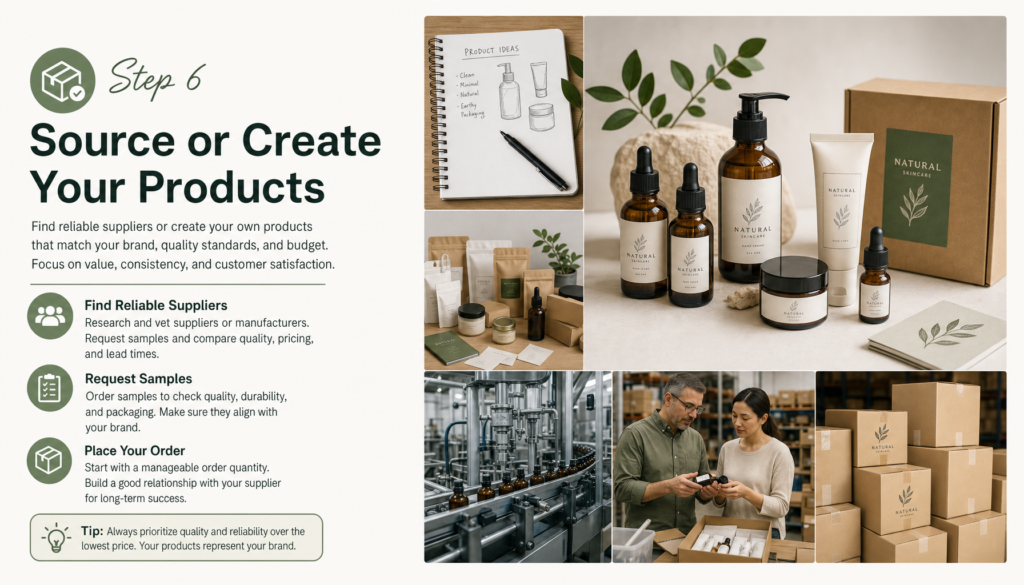
For physical products, your supplier relationship is as important as your customer relationship. Research suppliers on platforms like Alibaba, Faire, or Modalyst for dropshipping and wholesale. Order samples before committing to any supplier — product quality directly impacts your return rate, your reviews, and your brand reputation. Negotiate minimum order quantities, lead times, and quality control processes in writing before placing any commercial order.
For digital products, invest in producing genuinely high-quality assets — professionally designed templates, well-researched ebooks, or expertly produced courses. The digital product market is crowded, and quality is the primary differentiator. Understanding this is central to knowing how to start an ecommerce business that competes on value rather than price.
Step 7: Build and Launch Your Store
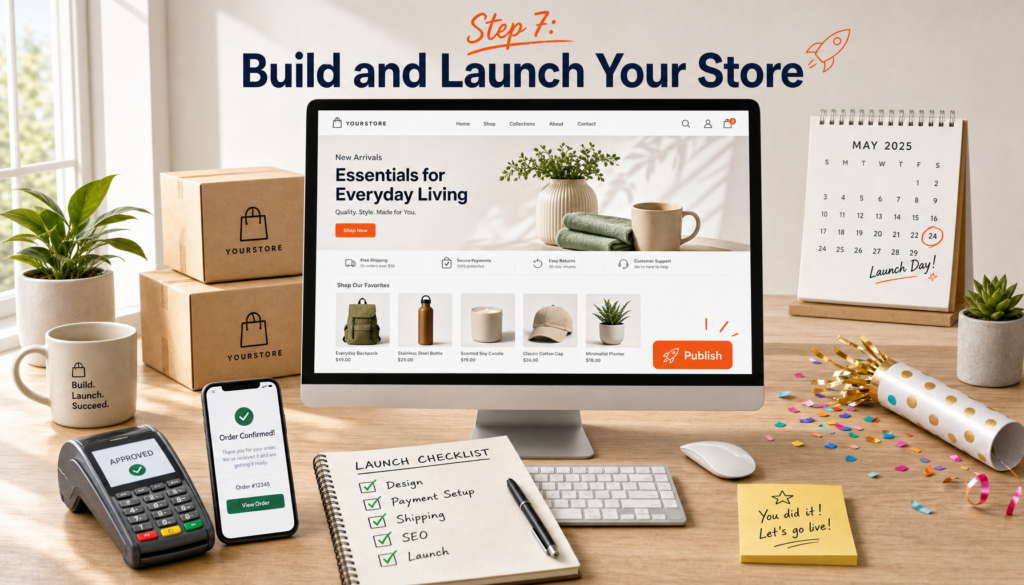
Knowing how to start an ecommerce business store with the right elements matters. Your store needs five core elements before launch: a professional, mobile-optimised design that loads in under three seconds; clear, benefit-focused product pages with high-quality images; a frictionless checkout with multiple payment options including Apple Pay and Buy Now Pay Later; an About page that builds trust with your brand story; and a clear returns and shipping policy that answers customer questions before they arise.
Resist the temptation to spend weeks perfecting your store design before your first sale. Launch with a clean, functional store and improve it continuously based on real customer behaviour data. The first version of any successful ecommerce business rarely looks like the tenth version — and the entrepreneurs who understand how to start an ecommerce business with a ‘launch fast and learn’ mindset consistently outperform those who wait for perfection.
| Need a Professional Ecommerce Website That Converts?Tasknestly’s website services include conversion-optimised ecommerce store design, mobile-first development, and full SEO setup — built to turn visitors into customers from day one.Start with a free website consultation → |
Want Your Store To Actually Convert?
Strategy is step one — execution is what moves revenue. Tasknestly builds and optimizes ecommerce stores that convert.
Get Ecommerce Services →Steps 8–10: Growing Your Ecommerce Business
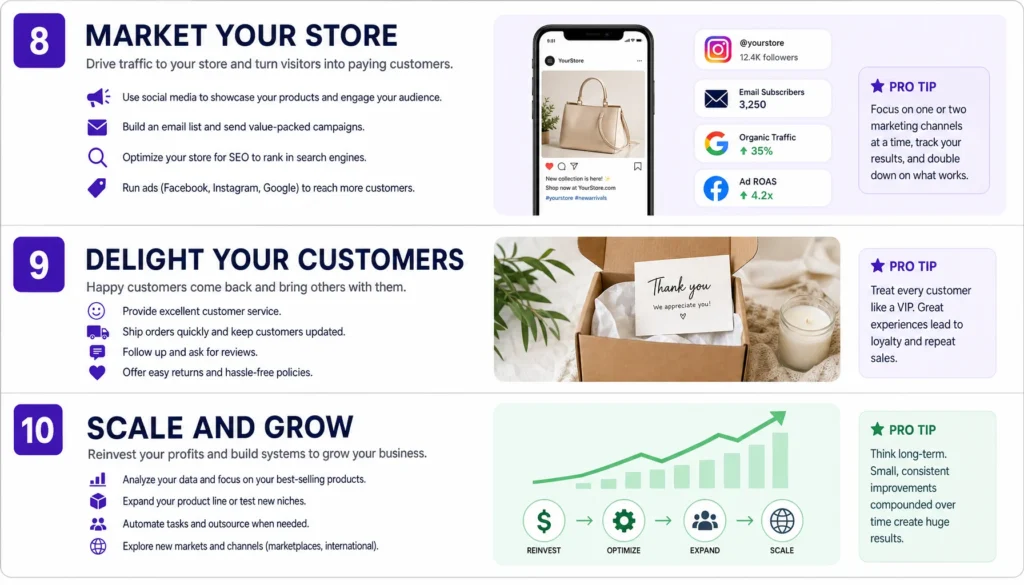
Launching your store is not the finish line — it is the starting line. These final three steps of how to start an ecommerce business and grow it into a sustainable revenue source address traffic generation, conversion improvement, and long-term scaling.
Step 8: Optimise Your Store for Search Engines from Day One
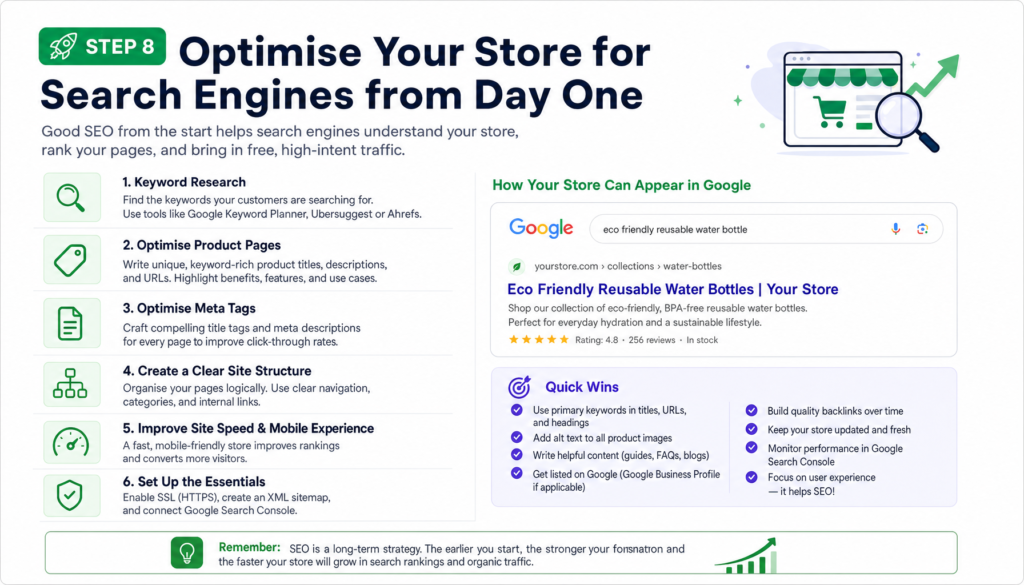
SEO is the most cost-efficient long-term traffic source for any ecommerce business. Optimising your product pages for search from day one — before you launch paid advertising — means you begin building organic rankings while your paid campaigns run, so that when your ad budget is reduced or paused, you still have a sustainable traffic foundation.
Keyword-optimise every product title, meta description, and product description for the specific terms your target customers use to search. Build a blog that targets informational queries related to your niche — ‘best running shoes for flat feet’ attracts a runner who might then browse your running accessories store. Understanding the SEO component of how to start an ecommerce business is what separates stores that grow their organic traffic month over month from those that are permanently dependent on paid acquisition.
Step 9: Drive Your First Traffic and First Sales
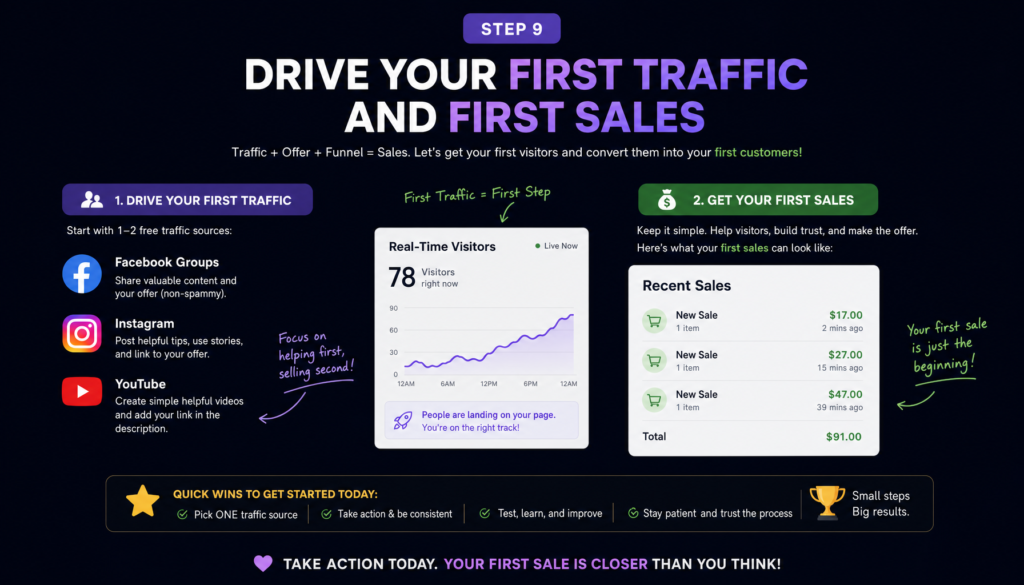
How to start an ecommerce business with early sales relies on a combination of paid and organic traffic to generate their first sales, because organic SEO takes time to build. The most effective paid channels for new stores are Google Shopping Ads (which place your products directly in front of people searching for them) and Meta Ads (which drive product discovery among relevant audiences before they search).
Organic traffic channels to build simultaneously include social media content on the platforms your target customer uses most, email list building through a lead magnet or pop-up on your store, and influencer outreach to nano and micro-influencers in your niche who can generate authentic social proof at relatively low cost. The combination of paid traffic for immediate revenue and organic traffic for long-term sustainability is the traffic strategy that underlies every scalable answer to the question of how to start an ecommerce business and grow it profitably.
Step 10: Analyse, Iterate, and Scale
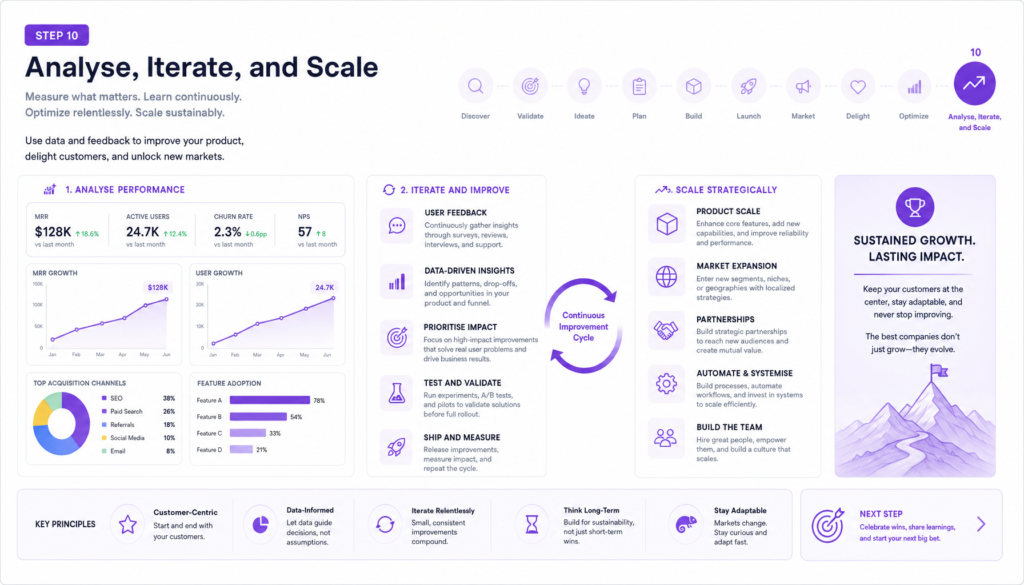
Every successful ecommerce business is built on relentless iteration guided by real data. Install Google Analytics 4 and set up ecommerce tracking from day one so you have accurate data on which products are viewed most, which pages have the highest exit rates, where customers are dropping out of your checkout, and which traffic sources generate the most revenue. Use this data to make informed improvements to your store, your product range, and your marketing — not guesses or assumptions. This commitment to data-driven iteration is the final and most enduring lesson in learning how to start an ecommerce business that grows sustainably over time.
Want Your Store To Actually Convert?
Strategy is step one — execution is what moves revenue. Tasknestly builds and optimizes ecommerce stores that convert.
Get Ecommerce Services →How to Start an Ecommerce Business: Common Mistakes to Avoid
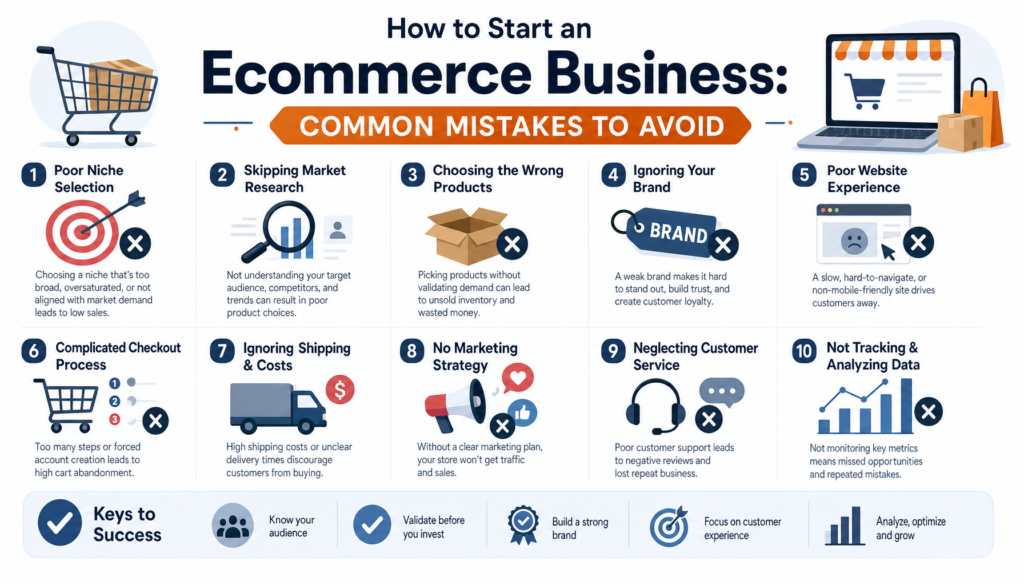
Understanding how to start an ecommerce business and how to avoid common pitfalls means understanding the most common mistakes that cause new stores to fail in their first year. Avoiding these pitfalls is as important as following the 10 steps correctly.
Launching without validation is the most expensive mistake when you start an ecommerce business. Spending months building a store around a product with insufficient demand wastes irreplaceable time and money. Always validate demand before writing a single line of product copy or designing a single page.
Neglecting mobile optimisation is how many new ecommerce stores lose sales before they even start building momentum. Over 70 percent of ecommerce traffic arrives on mobile devices. A store that looks perfect on desktop but is difficult to navigate on a phone will consistently underperform. Test your store on multiple mobile devices before launch and optimise ruthlessly for the mobile experience.
Underestimating customer acquisition costs is how many founders start an ecommerce business with unrealistic profit expectations. Calculate your cost to acquire a customer through paid advertising before relying on it as your primary traffic source. If your customer acquisition cost exceeds your average order margin, your business model is not yet viable — and knowing how to start an ecommerce business profitably means solving this before scaling spend.
Copying competitor stores is how many entrepreneurs start an ecommerce business that never achieves differentiation. Rather than differentiating produces a race to the bottom on price. Identify one specific way your store will serve a narrow audience better than any alternative, and build every aspect of your brand, product selection, and customer experience around that differentiation. How to start an ecommerce business that lasts is ultimately a question of how clearly you have defined why your store is the best possible choice for a specific customer.
Want Your Store To Actually Convert?
Strategy is step one — execution is what moves revenue. Tasknestly builds and optimizes ecommerce stores that convert.
Get Ecommerce Services →10-Step Ecommerce Business Launch Plan
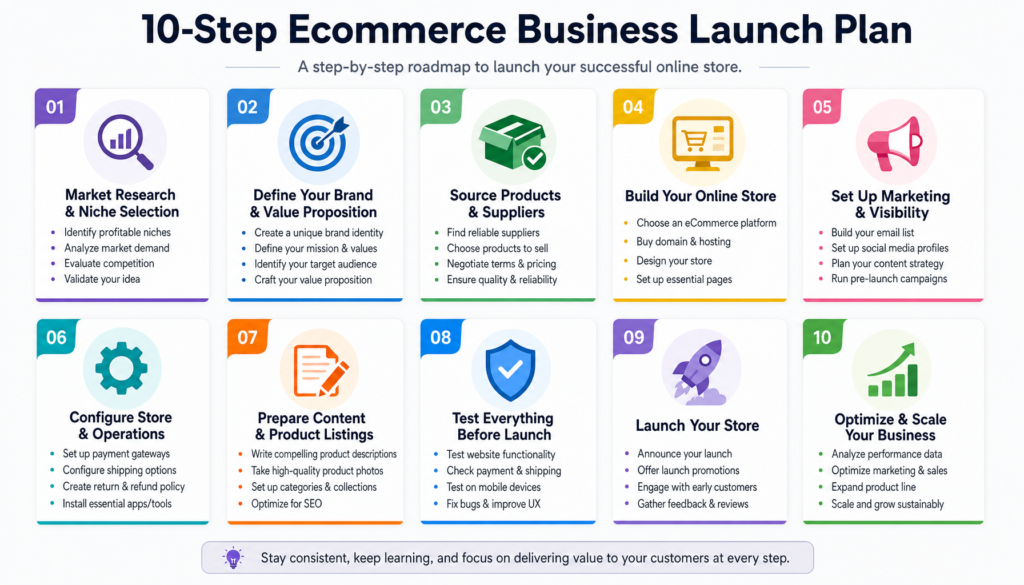
Use this table as a launch checklist and share it with any team members or partners involved in your ecommerce business launch.
| Step | Action | Key Decision | Expected Outcome |
| 1 | Choose your niche | Passion vs profit vs demand | A focused, viable business idea |
| 2 | Validate product demand | Keyword and competitor research | Proof people will pay for your product |
| 3 | Choose your business model | Dropshipping vs inventory vs digital | Clear revenue and fulfilment model |
| 4 | Select your ecommerce platform | Shopify vs WooCommerce vs BigCommerce | Store foundation suited to your needs |
| 5 | Register your business | Sole trader vs Ltd vs LLC | Legal and financial protection |
| 6 | Source or create your products | Suppliers vs manufacturers vs creators | Reliable product supply chain |
| 7 | Build and launch your store | Domain, design, pages, payment setup | Live store ready to accept orders |
| 8 | Write SEO product content | Keyword-optimised titles and descriptions | Organic discoverability from day one |
| 9 | Drive your first traffic | SEO, social, email, paid ads | First visitors and first sales |
| 10 | Analyse, iterate and scale | Analytics, CRO, ad scaling | Compounding revenue growth |
| Essential Tools to Start Your Ecommerce BusinessShopify — The most beginner-friendly ecommerce platform with everything you need to launch, manage, and grow your online store.SEMrush — Validate your niche, research product keywords, and build the organic strategy that drives long-term ecommerce growth.Canva — Design your brand identity, product images, social content, and store graphics without needing a professional designer. |
Want Your Store To Actually Convert?
Strategy is step one — execution is what moves revenue. Tasknestly builds and optimizes ecommerce stores that convert.
Get Ecommerce Services →Frequently Asked Questions: How to Start an Ecommerce Business
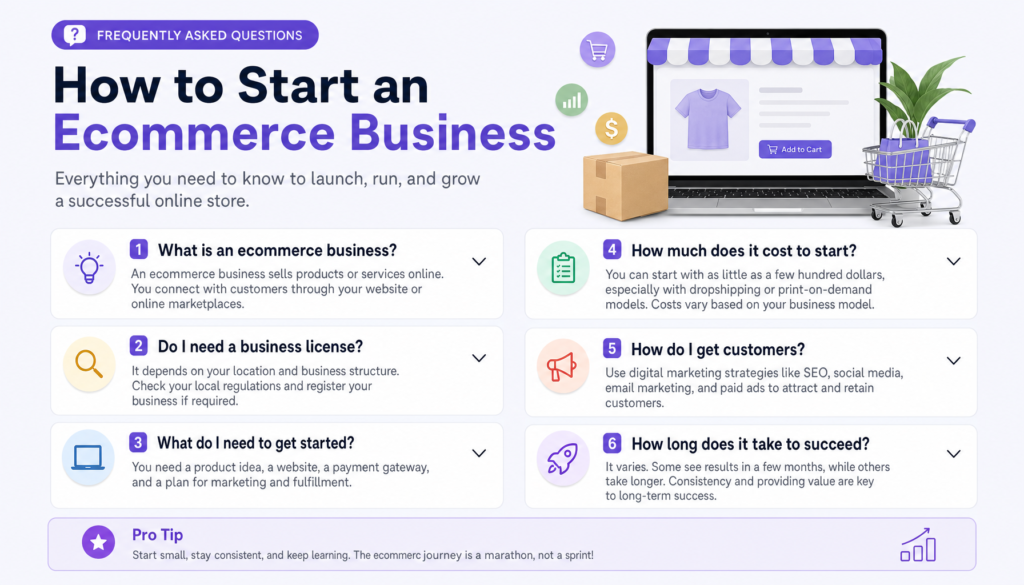
| Question | Answer |
| How much does it cost to start an ecommerce business? | Starting an ecommerce business can cost as little as £30 to £100 per month for a basic Shopify or WooCommerce store, domain name, and hosting. Product costs vary widely depending on your model — dropshipping requires minimal upfront stock investment, while private label and wholesale require more capital. |
| Do I need a business licence to start an ecommerce business? | Requirements vary by location. In the UK, you can start as a sole trader with minimal registration. Most businesses benefit from registering as a limited company once trading consistently. Always check your local regulations and consult an accountant before launching your ecommerce business. |
| Which ecommerce platform is best for beginners? | Shopify is the most beginner-friendly ecommerce platform — it requires no coding knowledge, includes hosting, and offers 24/7 support. WooCommerce is more flexible and cost-effective for businesses already on WordPress. The best choice depends on your technical comfort level and long-term requirements. |
| How long does it take to make money from an ecommerce business? | Most ecommerce businesses can generate their first sale within days of launching with paid advertising. Building consistent organic revenue through SEO typically takes three to six months. Sustainable, profitable ecommerce usually requires six to twelve months of consistent effort and iteration. |
| What products sell best in ecommerce in 2026? | Top-performing ecommerce categories in 2026 include health and wellness products, sustainable and eco-friendly goods, digital products and courses, home office accessories, pet products, and personalised gifts. The best niche for you is one that combines genuine demand with manageable competition and acceptable margins. |
| Can I start an ecommerce business with no money? | You can start an ecommerce business with very little money by using dropshipping, selling digital products, or using print-on-demand fulfilment — all of which eliminate upfront inventory costs. The minimum viable investment covers your platform subscription, domain name, and basic marketing. |
| What is the most important thing to do first when starting an ecommerce business? | Validate your product idea before investing in building a store. Use keyword research tools, competitor analysis, and social listening to confirm that people are actively searching for and buying products in your chosen niche. Launching without validation is the most common and most costly mistake new ecommerce entrepreneurs make. |
Want Your Store To Actually Convert?
Strategy is step one — execution is what moves revenue. Tasknestly builds and optimizes ecommerce stores that convert.
Get Ecommerce Services →Conclusion: Start Your Ecommerce Business the Right Way
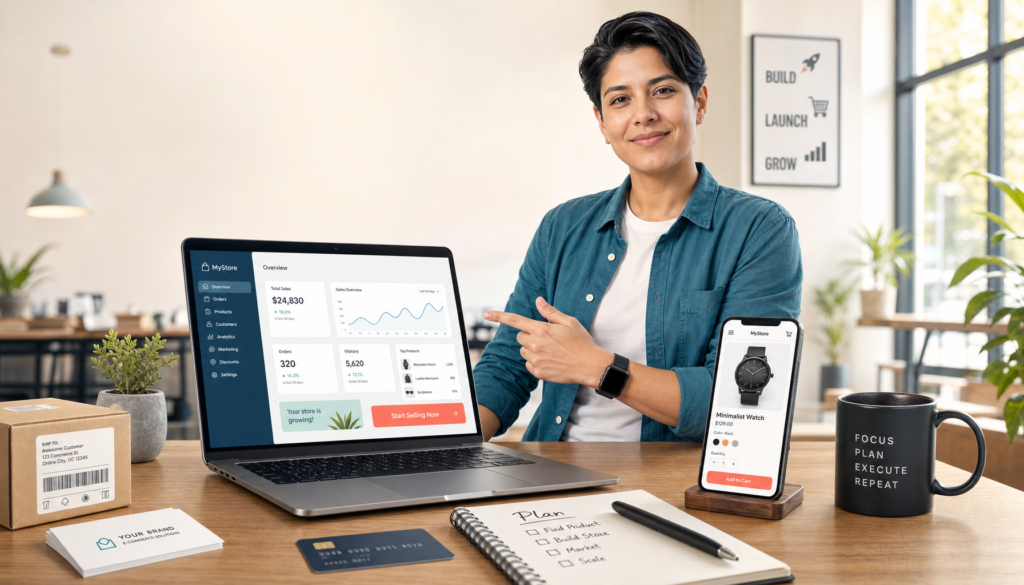
Knowing how to start an ecommerce business is different from knowing how to build one that succeeds — and how to keep it growing. Knowing how to start an ecommerce business with the right foundation makes every subsequent decision easier. Knowing how to start an ecommerce business on the right platform, how to validate demand, and how to drive your first traffic are the three most critical early skills. The businesses that generate consistent, growing revenue are those that validate their ideas before investing, choose their platform deliberately, optimise for organic traffic from day one, and treat their store launch as the beginning of a continuous improvement process rather than a finished product.
How to start an ecommerce business correctly means following the 10 steps in this guide in sequence and you will avoid the most costly mistakes that derail new ecommerce businesses. Choose a specific, validated niche. Select a business model that matches your resources. Build a clean, conversion-focused store. Drive traffic through multiple channels simultaneously. And never stop analysing, iterating, and improving based on what the data tells you. Understanding how to start an ecommerce business correctly is what separates the stores that grow from those that stall.
Understanding how to start an ecommerce business is the first step — but knowing how to grow it is what creates lasting success.
At Tasknestly, we know exactly how to start an ecommerce business, how to optimise it, how to market it, and how to scale it effectively. We help entrepreneurs that converts and ranks. We help entrepreneurs and businesses build ecommerce stores that are designed to convert and optimised to rank from day one. From store design and product page development to SEO and ongoing digital marketing, we handle the technical and strategic work so you can focus on building your brand and serving your customers. Ready to launch? Explore our ecommerce services or request a free quote today.
For an official checklist on registration, taxes, and permits, the U.S. Small Business Administration has a helpful guide to starting a business.
Want Your Store To Actually Convert?
Strategy is step one — execution is what moves revenue. Tasknestly builds and optimizes ecommerce stores that convert.
Get Ecommerce Services →Grow With Tasknestly
Subscribe to the Tasknestly newsletter and get the latest tips on websites, SEO, social media, and digital growth.