
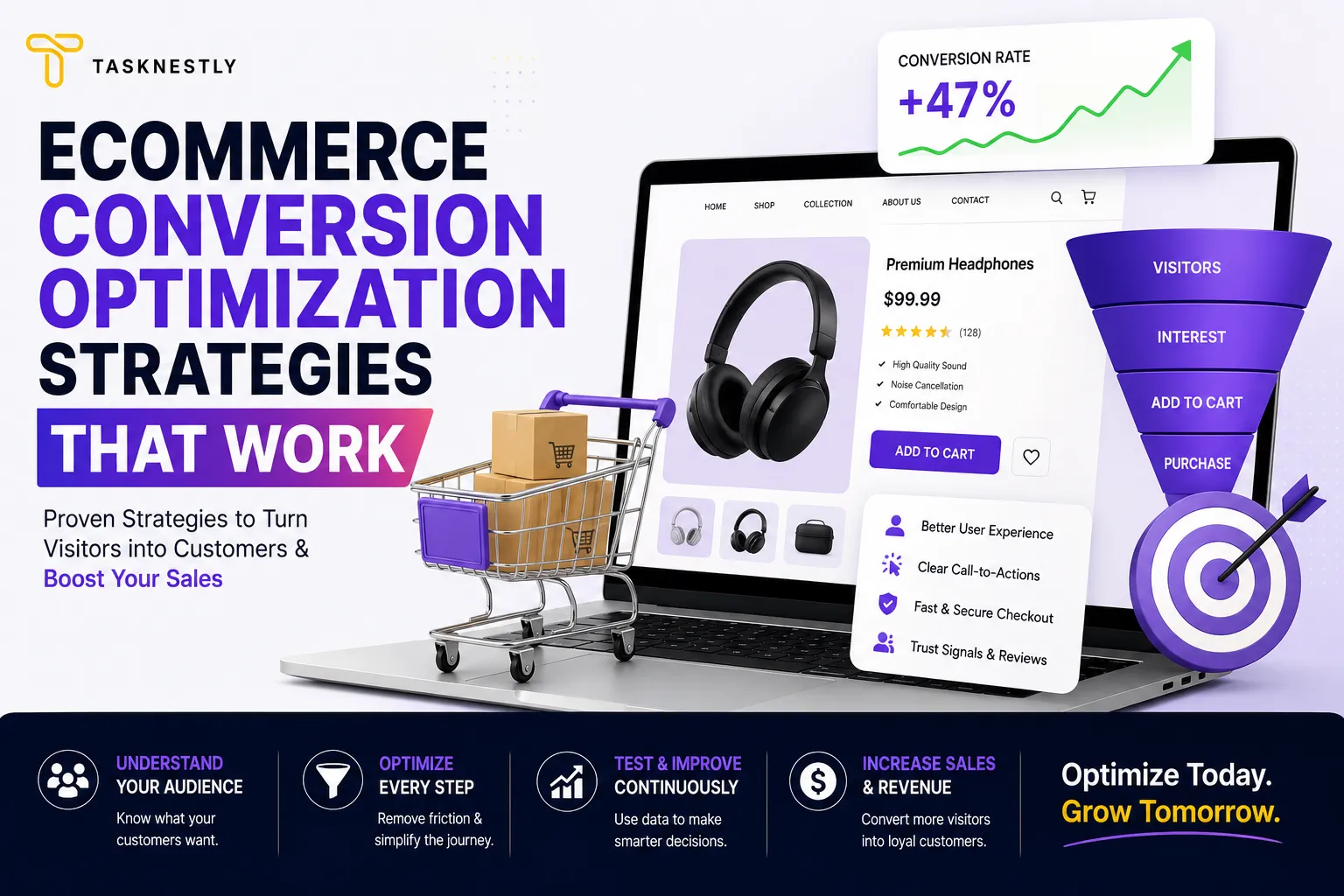
Ecommerce conversion optimization is the single highest-ROI investment available to any online store. Most ecommerce businesses spend the majority of their marketing budget on driving traffic — Google Ads, Meta Ads, SEO, influencer partnerships — yet neglect the fundamental question of what percentage of that traffic actually converts into a purchase. The average ecommerce store converts between 2 and 4 percent of its visitors. That means for every 100 people you pay to bring to your site, 96 to 98 leave without buying.
Improving your conversion rate by even one percentage point — from 2% to 3% — increases your revenue by 50 percent from exactly the same traffic. No additional ad spend. No new products. No additional team members. Just a more effective store that converts the audience you are already attracting. This is the compounding power of ecommerce conversion optimization, and it is why CRO consistently delivers the strongest ROI of any investment a growing ecommerce business can make.
This guide covers the 10 most impactful ecommerce conversion optimization strategies available in 2026 — from product page improvements and checkout simplification to cart abandonment recovery, personalisation, and A/B testing. Each strategy is explained with specific implementation guidance and realistic impact expectations so you can prioritise the changes most likely to move your conversion rate quickly.
| Want an Ecommerce Store Built to Convert From Day One?Tasknestly’s ecommerce services include store design, conversion optimisation, SEO, and ongoing marketing — everything you need to build an online store that generates consistent revenue.Get your FREE Ecommerce Quote → |
Want Your Store To Actually Convert?
Strategy is step one — execution is what moves revenue. Tasknestly builds and optimizes ecommerce stores that convert.
Get Ecommerce Services →Table of Contents
Ecommerce Conversion Optimization: Product Page Strategies
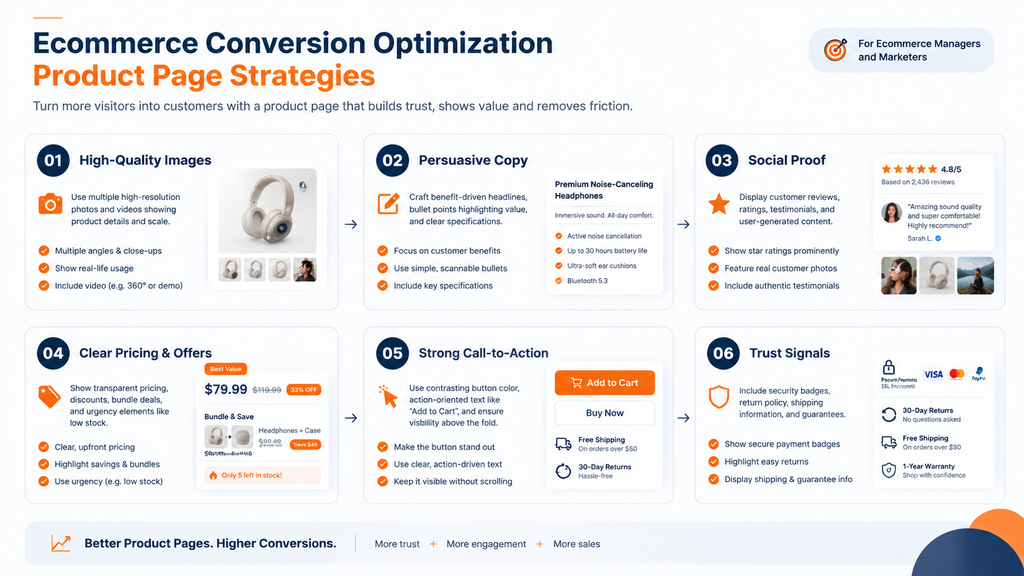
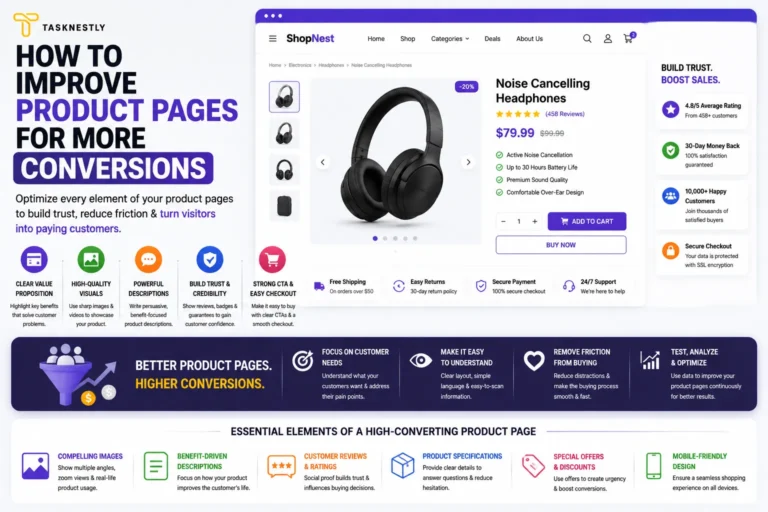
Your product page is the most critical conversion point in your store. Every visitor who reaches a product page is already interested in what you sell — the ecommerce conversion optimization challenge is giving them everything they need to commit to the purchase without friction, doubt, or distraction.
Strategy 1: Optimise Product Copy and Images
Product images are the closest thing to a physical retail experience an online shopper gets — and they are one of the highest-impact ecommerce conversion optimization changes you can make. Stores with high-quality images featuring multiple angles, lifestyle context showing the product in use, and zoom functionality consistently see 20 to 40 percent higher add-to-cart rates than stores with single, low-quality product shots.
Product copy should address every question a serious buyer might have before committing to purchase: dimensions, materials, compatibility, care instructions, and — most importantly — the specific benefit that differentiates this product from alternatives. Write copy for the buyer who is 90 percent convinced but needs one more piece of information to click ‘Add to Cart.’ That final reassurance is exactly what effective ecommerce conversion optimization product copy provides.
Strategy 2: Add Social Proof Throughout Your Store
Social proof is the most powerful ecommerce conversion optimization tool available because it transfers the trust of existing customers to new visitors at zero additional cost. Reviews, ratings, user-generated photos, and testimonials answer the fundamental question every first-time buyer asks: ‘Has this worked for someone like me?’
Place social proof strategically throughout your store: star ratings on product listing pages, full reviews with customer photos on product pages, aggregate review counts near your add-to-cart button, and testimonials on your homepage and checkout page. Encourage review submission through post-purchase email sequences — a 5-star review is the most persuasive piece of content your marketing can produce, yet most stores fail to systematically collect them. Aim for a minimum of 10 reviews per product before running paid advertising — the social proof dramatically improves conversion rates from paid traffic.
Strategy 3: Implement Live Chat or an AI Chatbot
Purchase objections that go unanswered become abandoned carts. Live chat and AI chatbots give shoppers an instant channel to resolve doubts about sizing, compatibility, delivery timing, or return policy — in real time, at the exact moment they are considering a purchase. This is one of the most impactful ecommerce conversion optimization tools for high-consideration product categories where buyers need reassurance before committing.
Modern AI chatbots can handle the majority of common pre-purchase questions automatically, escalating to human agents only for complex enquiries. This means even small teams can provide 24/7 purchase support without the overhead of full customer service staffing. Stores that implement live chat report average conversion rate increases of 10 to 30 percent on pages where chat is available and actively used.
Want Your Store To Actually Convert?
Strategy is step one — execution is what moves revenue. Tasknestly builds and optimizes ecommerce stores that convert.
Get Ecommerce Services →Ecommerce Conversion Optimization: Checkout Strategies
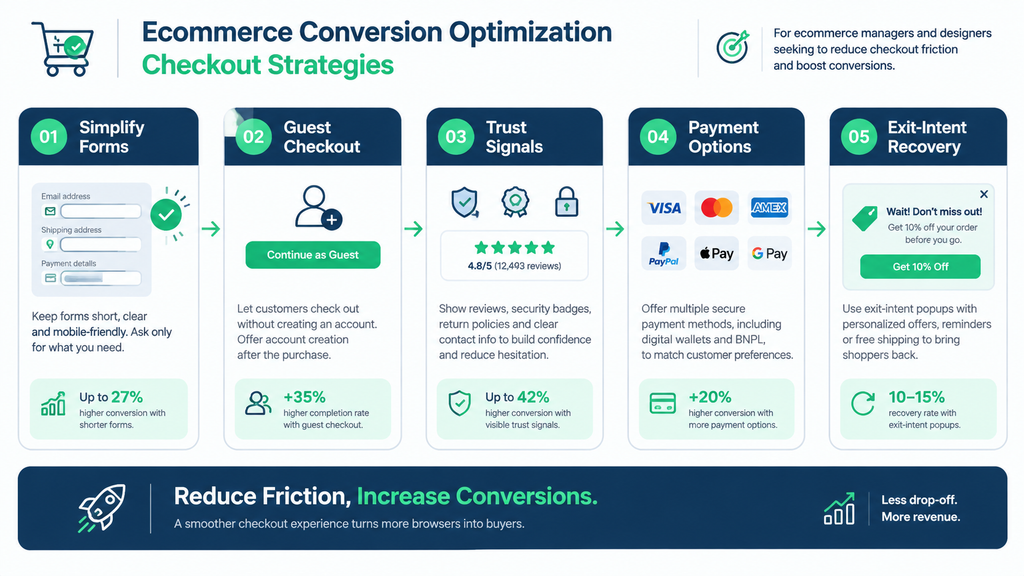
Checkout abandonment accounts for the majority of lost ecommerce revenue. The average abandonment rate at checkout is 70 percent — meaning 7 out of every 10 shoppers who begin the checkout process leave without completing their purchase. These ecommerce conversion optimization strategies directly target the friction points that cause abandonment and recover revenue that is already within reach.
Strategy 4: Simplify the Checkout Process
Every additional step, form field, and required account creation in your checkout increases abandonment. The most impactful single ecommerce conversion optimization change most stores can make is reducing their checkout to a single page with the minimum fields required to complete a transaction: name, email, delivery address, and payment details.
Enable guest checkout — never force account creation before purchase. Offer social login (Google or Facebook) for one-click account creation post-purchase if you want to capture account data. Autofill address fields using postal code lookup. Display a persistent order summary throughout checkout so shoppers never need to navigate away to verify what they are buying. Every friction reduction in checkout produces measurable conversion uplift — and the cumulative effect of eliminating multiple friction points simultaneously can double your checkout completion rate.
Strategy 5: Implement Cart Abandonment Email Sequences
Cart abandonment email sequences are among the most revenue-efficient ecommerce conversion optimization tools available — they recover sales from shoppers who were interested enough to add to cart but did not complete their purchase. The average cart abandonment email sequence recovers 5 to 15 percent of abandoned carts, representing pure incremental revenue at near-zero acquisition cost.
A three-email sequence works best: the first email sent one hour after abandonment (a simple, friendly reminder that items are waiting), the second sent 24 hours later (addressing common objections and reinforcing the product’s value), and the third sent 72 hours after abandonment (an optional limited-time incentive if the margin supports it). Personalise each email with the specific items left in the cart and dynamic product images. This sequence, once set up, runs automatically and generates consistent revenue recovery without any ongoing manual effort.
Strategy 6: Display Shipping Costs Early and Offer Free Shipping Thresholds
Unexpected shipping costs at checkout are the single most cited reason for cart abandonment in ecommerce. Shoppers who discover significant shipping costs only at the payment step feel deceived and abandon at extremely high rates. The most effective ecommerce conversion optimization fix is to display shipping costs — or free shipping offers — on every product page, not just at checkout.
Free shipping thresholds (‘Free shipping on orders over £50’) are a particularly powerful ecommerce conversion optimization tactic because they simultaneously reduce abandonment and increase average order value (AOV). When a shopper has £35 in their cart and sees they are £15 away from free shipping, most will add another item rather than pay for delivery. This threshold effect typically increases AOV by 15 to 30 percent and significantly improves checkout conversion among threshold-adjacent shoppers.
| Need a Digital Marketing Strategy to Drive More Qualified Traffic?Tasknestly’s digital marketing services drive targeted, high-intent traffic to your optimised ecommerce store — combining SEO, paid advertising, and content to build sustainable revenue growth.Book your free ecommerce marketing consultation → |
Want Your Store To Actually Convert?
Strategy is step one — execution is what moves revenue. Tasknestly builds and optimizes ecommerce stores that convert.
Get Ecommerce Services →Ecommerce Conversion Optimization: Technical and UX Strategies
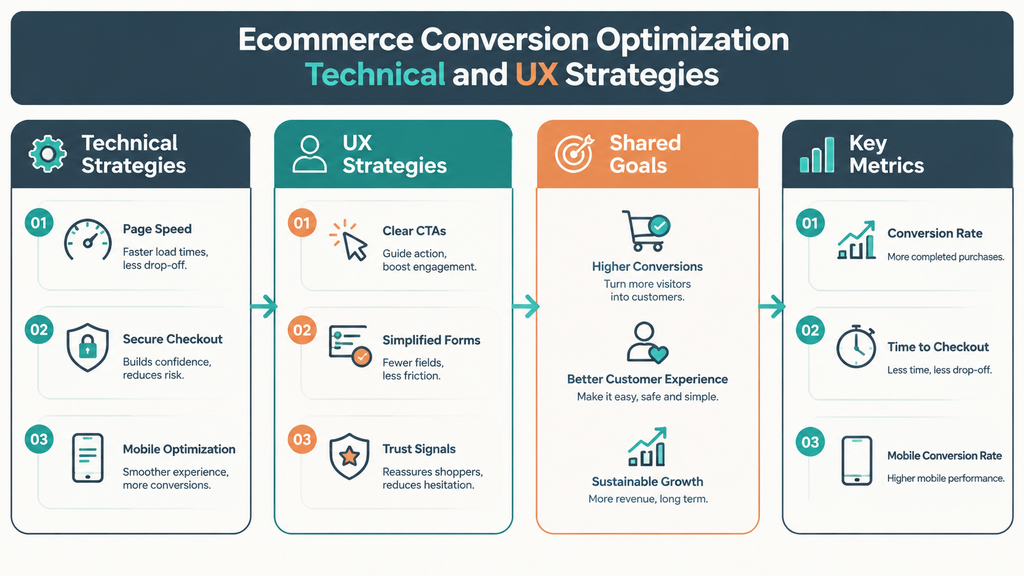
Technical performance and user experience issues are invisible to the business owner but painfully obvious to the shopper. These ecommerce conversion optimization strategies address the foundational technical factors that determine whether your store delivers a shopping experience that converts or one that frustrates visitors into leaving.
Strategy 7: Improve Site Speed and Mobile Experience
Site speed is one of the most directly measurable ecommerce conversion optimization factors in any ecommerce conversion optimization audit. Research consistently shows that a one-second delay in page loading reduces conversions by 7 percent — and that 40 percent of shoppers abandon a site that takes more than three seconds to load. On mobile, where the majority of ecommerce traffic now originates, speed is even more critical.
Audit your store’s performance using Google PageSpeed Insights and Core Web Vitals. Common improvements include compressing product images without sacrificing quality, implementing lazy loading for off-screen images, minifying CSS and JavaScript files, and enabling browser caching. For Shopify stores, app overload is a common speed killer — audit your installed apps and remove any that are not actively contributing to ecommerce conversion optimization or revenue.
Strategy 8: Use Urgency and Scarcity Tactics Authentically
Among ecommerce conversion optimization tactics, urgency and scarcity are the most psychologically potent tools because they trigger the loss aversion instinct — the well-documented human tendency to work harder to avoid losing something than to gain something equivalent. Displaying low stock counts (‘Only 3 left in stock’), limited-time offers (‘Sale ends in 4 hours’), or social proof triggers (’12 people viewing this right now’) can increase conversion rates significantly.
The critical qualifier is authenticity. Fake countdown timers that reset on page refresh, perpetually low stock indicators, and fabricated social activity destroy trust the moment a shopper notices them — and sophisticated online shoppers frequently do notice. Use genuine scarcity and urgency only: real stock levels, real sales deadlines, and real social activity data. Authentic urgency converts; manufactured urgency backfires.
Strategy 9: Offer Multiple Payment Options
Payment friction is a significant but easily overlooked ecommerce conversion optimization opportunity. Shoppers have strong payment preferences, and a store that does not offer their preferred method often loses the sale to a competitor that does. In 2026, a complete ecommerce payment stack should include credit and debit cards, PayPal, Apple Pay and Google Pay, and buy-now-pay-later options such as Klarna or Clearpay for higher-ticket items.
BNPL options deserve particular attention: research consistently shows that offering instalment payment options increases conversion rates on items priced above £50 by 20 to 30 percent, as they reduce the perceived financial commitment of the purchase without reducing your revenue (you receive the full amount upfront from the BNPL provider). Each additional payment method you offer reduces the friction for a different segment of your potential customers.
Want Your Store To Actually Convert?
Strategy is step one — execution is what moves revenue. Tasknestly builds and optimizes ecommerce stores that convert.
Get Ecommerce Services →Ecommerce Conversion Optimization: Data-Driven Strategies
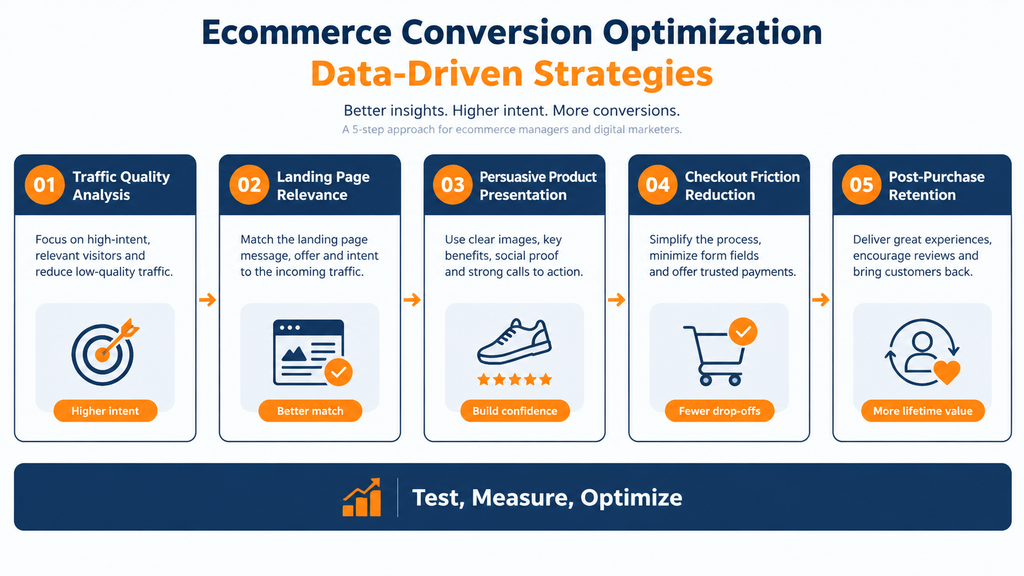
The most sustainable ecommerce conversion optimization programmes are built on data, not assumptions. These final two strategies ensure your optimisation decisions are guided by real evidence about how your specific customers behave in your specific store.
Strategy 10: A/B Test Product Pages and CTAs
A/B testing is the definitive ecommerce conversion optimization methodology — the only approach that proves whether a change actually improves conversion rates rather than simply seeming like it should. An A/B test presents two versions of a page element to different segments of your traffic simultaneously, then measures which version converts at a higher rate. The winner is implemented; the loser is discarded. Repeated over time, this iterative process produces conversion rate improvements that compound dramatically.
Prioritise testing the highest-impact elements first: your product page headline and primary CTA button text and colour, your add-to-cart button position and design, your product image order and quantity, your pricing display format, and your social proof placement. Run each test for a minimum of two weeks or until you reach statistical significance before drawing conclusions. For most ecommerce stores, disciplined A/B testing is the ecommerce conversion optimization activity that produces the strongest long-term results.
Want Your Store To Actually Convert?
Strategy is step one — execution is what moves revenue. Tasknestly builds and optimizes ecommerce stores that convert.
Get Ecommerce Services →Prioritising Your Ecommerce Conversion Optimization Efforts
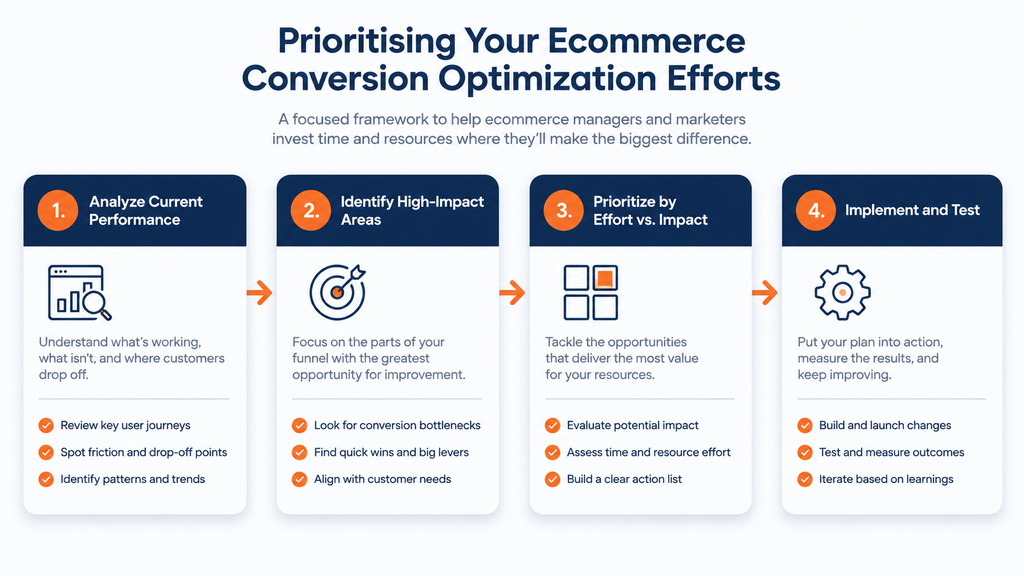
With 10 ecommerce conversion optimization strategies available, the challenge is knowing where to start. Install Google Analytics 4 on your store and identify your highest-traffic pages with the lowest conversion rates — these are your highest-priority ecommerce conversion optimization opportunities, because small improvements to high-traffic pages produce significant revenue impact.
Your mobile versus desktop conversion rate comparison is highly revealing. If mobile converts at less than half your desktop rate — a common finding for stores not built mobile-first — speed and UX improvements deliver the highest immediate return. If your checkout abandonment rate is above 70 percent, start there. Let data, not assumptions, guide your ecommerce conversion optimization priority order, and you will avoid the common mistake of investing effort in areas that produce minimal impact.
Want Your Store To Actually Convert?
Strategy is step one — execution is what moves revenue. Tasknestly builds and optimizes ecommerce stores that convert.
Get Ecommerce Services →Ecommerce Conversion Optimization Strategies at a Glance
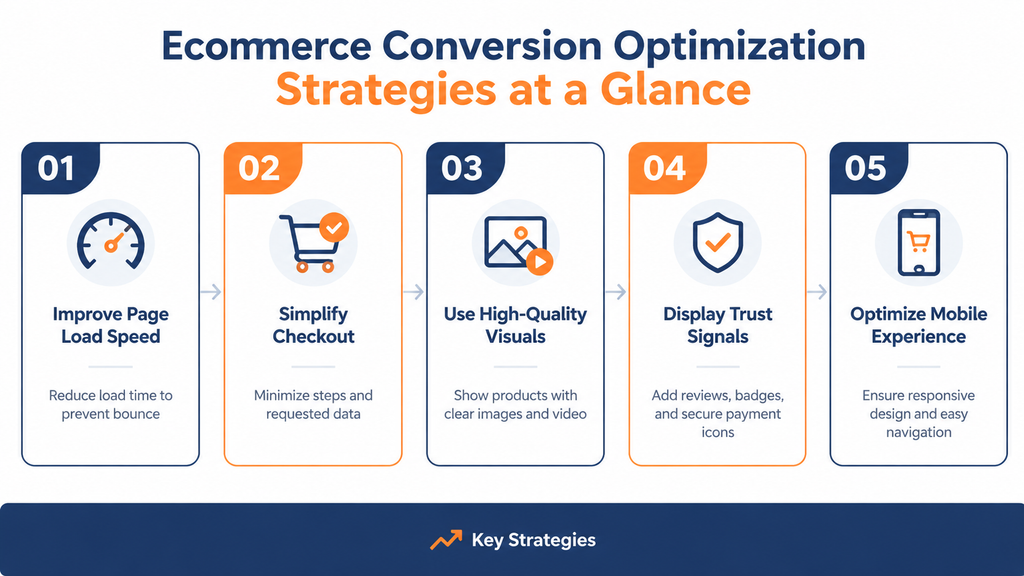
Use this table when planning your ecommerce conversion optimization priorities for the quarter, or when presenting your CRO roadmap to stakeholders.
| # | Strategy | Impact on Revenue | Difficulty to Implement |
| 1 | Optimise product page copy and images | High — direct conversion uplift | Low — no technical changes needed |
| 2 | Simplify the checkout process | Very High — reduces abandonment | Medium — requires UX changes |
| 3 | Add social proof throughout the store | High — builds purchase confidence | Low — add reviews and badges |
| 4 | Implement cart abandonment emails | Very High — recovers lost revenue | Low — one-time email setup |
| 5 | Improve site speed and mobile UX | High — reduces bounce rate | Medium — technical optimisation |
| 6 | Use urgency and scarcity tactics | Medium-High — increases impulse buy | Low — copywriting and display |
| 7 | Offer multiple payment options | Medium — reduces checkout friction | Low — payment gateway addition |
| 8 | Add a live chat or chatbot | Medium — handles objections in real time | Low — plugin or tool install |
| 9 | A/B test product pages and CTAs | High — cumulative conversion gains | Medium — requires testing tools |
| 10 | Personalise the shopping experience | Very High — increases AOV and return visits | Medium — requires customer data |
| Essential Tools for Ecommerce Conversion OptimizationShopify — The most beginner-friendly ecommerce platform with built-in conversion tools, analytics, and payment processing.SEMrush — Find high-intent product keywords, audit your store SEO, and track competitors stealing your traffic.Canva — Create professional product images, promotional banners, and ad creatives that boost conversion rates. |
Want Your Store To Actually Convert?
Strategy is step one — execution is what moves revenue. Tasknestly builds and optimizes ecommerce stores that convert.
Get Ecommerce Services →Frequently Asked Questions: Ecommerce Conversion Optimization
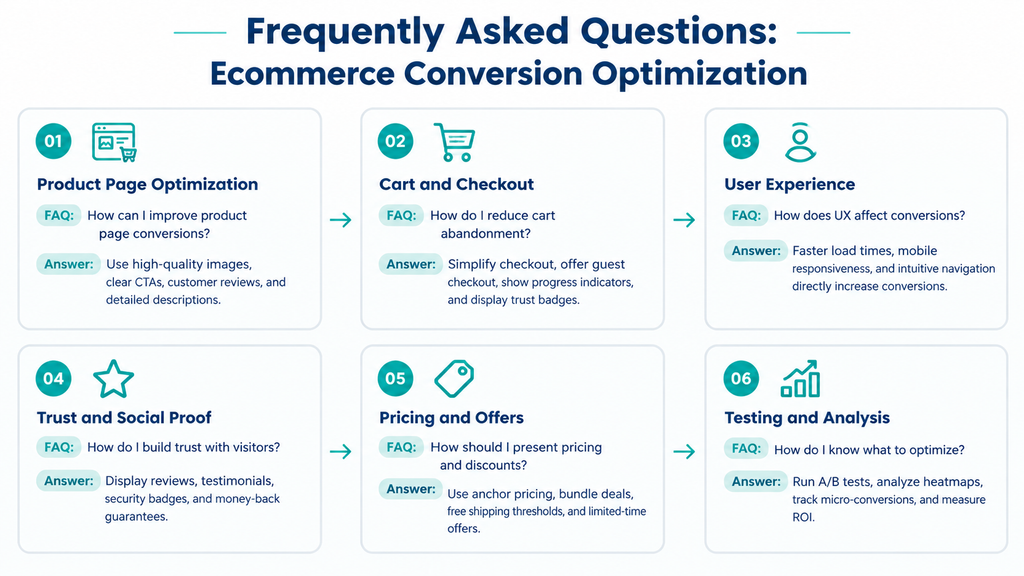
| Question | Answer |
| What is ecommerce conversion optimization? | Ecommerce conversion optimization (CRO) is the process of increasing the percentage of website visitors who complete a desired action — typically a purchase. It involves analysing visitor behaviour, identifying friction points in the shopping journey, and making data-driven changes to improve conversion rates. |
| What is a good ecommerce conversion rate? | The average ecommerce conversion rate across industries is 2 to 4 percent. A rate above 4 percent is considered strong, while rates below 1 percent indicate significant friction in the shopping journey. Industry benchmarks vary widely — luxury goods convert at lower rates than fast-moving consumer products. |
| How long does ecommerce conversion optimization take to show results? | Many ecommerce conversion optimization changes — such as adding trust badges, improving product images, and setting up cart abandonment emails — show measurable results within days or weeks. More complex changes like A/B testing require two to four weeks of data to produce statistically significant conclusions. |
| What causes low ecommerce conversion rates? | The most common causes of low ecommerce conversion rates are slow page loading speed, poor mobile experience, complicated checkout processes, lack of social proof, weak product descriptions, limited payment options, and unclear return policies. Most businesses can double their conversion rate by addressing these fundamentals. |
| Is paid traffic or conversion optimization a better investment? | Ecommerce conversion optimization is almost always a better investment than increasing paid traffic when your conversion rate is below 2 percent. Improving your conversion rate from 1% to 2% doubles revenue from existing traffic, effectively halving your customer acquisition cost without spending more on ads. |
| How important are product images for ecommerce conversion? | Product images are one of the most important elements of ecommerce conversion optimization. Studies consistently show that high-quality images with multiple angles, lifestyle context, and zoom functionality increase add-to-cart rates by 20 to 40 percent. Poor images are one of the fastest conversion killers in ecommerce. |
| What is cart abandonment rate and how do I reduce it? | Cart abandonment rate is the percentage of shoppers who add items to their cart but leave without completing the purchase — the average across ecommerce is 70 percent. The most effective ecommerce conversion optimization tactics for reducing abandonment include cart abandonment email sequences, exit-intent overlays, simplified checkout, and transparent shipping costs shown before checkout. |
Want Your Store To Actually Convert?
Strategy is step one — execution is what moves revenue. Tasknestly builds and optimizes ecommerce stores that convert.
Get Ecommerce Services →Conclusion: Start Your Ecommerce Conversion Optimization Today
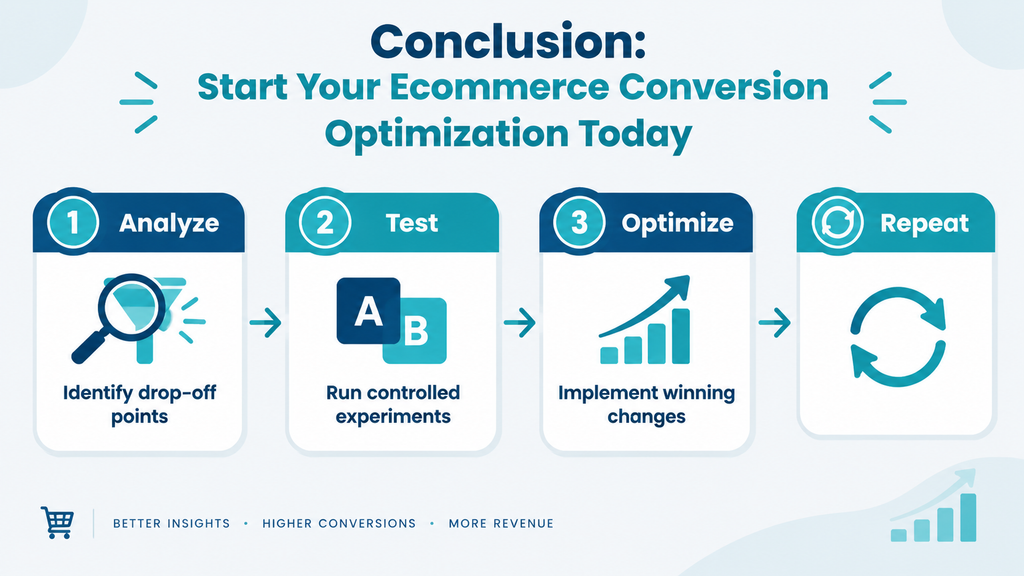
Every visitor who lands on your store and leaves without buying represents a missed opportunity — but it also represents a recoverable one. Ecommerce conversion optimization is the discipline of systematically recovering those opportunities by removing friction, building trust, and making it as easy as possible for the right shopper to complete a purchase. The 10 strategies in this guide address the most common and most impactful conversion barriers in ecommerce — from product page presentation and checkout simplification to cart recovery, personalisation, and data-driven testing.
Begin with the strategies that address your most obvious conversion barriers. If your checkout abandonment rate is above 70 percent, start with checkout simplification and cart abandonment emails. If your product pages have low add-to-cart rates, start with image quality and social proof. If your mobile conversion rate is significantly lower than desktop, start with site speed and mobile UX improvements. Prioritise based on your specific ecommerce conversion optimization data, not on generic assumptions about what all ecommerce stores need.
At Tasknestly, we help ecommerce businesses build stores that convert, grow traffic through organic and paid channels, and retain customers through strategic email and content marketing. If you are ready to build an ecommerce presence that generates consistent revenue and sustainable growth, explore our ecommerce services or request a free quote today.
To benchmark your own checkout against industry data, see the Baymard Institute’s research on cart abandonment rate statistics.
Want Your Store To Actually Convert?
Strategy is step one — execution is what moves revenue. Tasknestly builds and optimizes ecommerce stores that convert.
Get Ecommerce Services →Grow With Tasknestly
Subscribe to the Tasknestly newsletter and get the latest tips on websites, SEO, social media, and digital growth.