
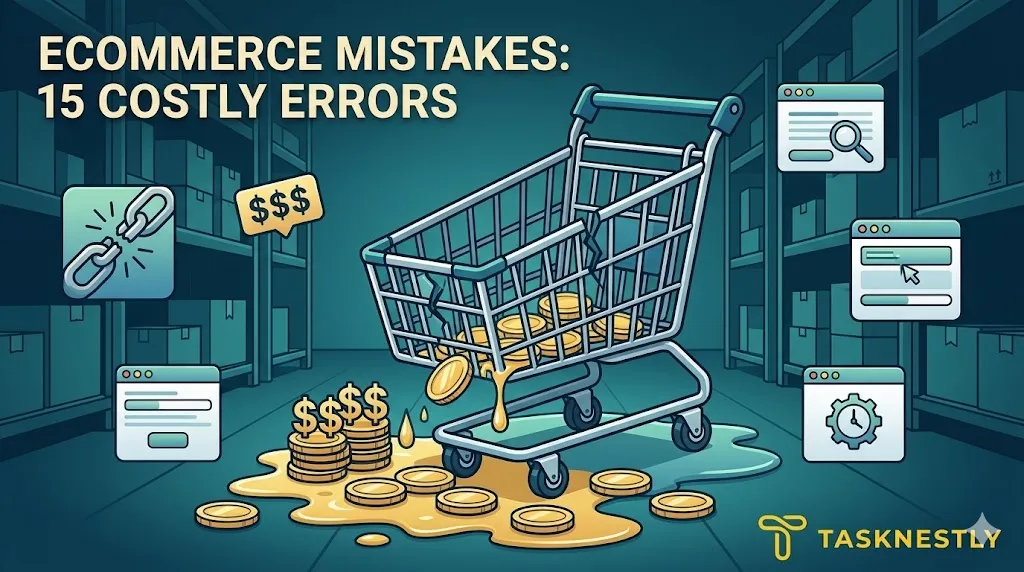
Ecommerce mistakes are expensive in a way that most store owners never fully quantify. Every slow-loading page, every forced account creation, every missing review, and every hidden shipping cost is costing you a specific, calculable percentage of your potential revenue — silently, continuously, and compoundingly. The average ecommerce store converts between 2 and 4 percent of its visitors. The stores converting at 4 percent are not simply luckier or better-funded than those converting at 1 percent — they have systematically identified and eliminated the ecommerce mistakes that drive visitors away before they buy.
The encouraging reality is that most of these mistakes are fixable without major investment. They are not the result of insufficient marketing budget or inadequate products — they are operational and technical errors that, once identified, can be corrected in days or weeks. The challenge is knowing which mistakes are costing you the most and in what order to address them.
This guide covers the 15 most costly ecommerce mistakes that reduce revenue for online stores in 2026 — with specific diagnostic criteria so you can identify whether each mistake applies to your store, and precise fixes so you can correct it. Work through this list as an audit of your current operation and prioritise the fixes with the most direct impact on your conversion rate and revenue.
| Want Expert Eyes on Your Ecommerce Store?Tasknestly’s ecommerce services include full store audits, conversion optimisation, and ongoing marketing support — identifying and fixing the specific ecommerce mistakes that are costing your store the most revenue.Get your FREE Ecommerce Audit → |
Want Your Store To Actually Convert?
Strategy is step one — execution is what moves revenue. Tasknestly builds and optimizes ecommerce stores that convert.
Get Ecommerce Services →Table of Contents
Technical Ecommerce Mistakes That Drive Visitors Away
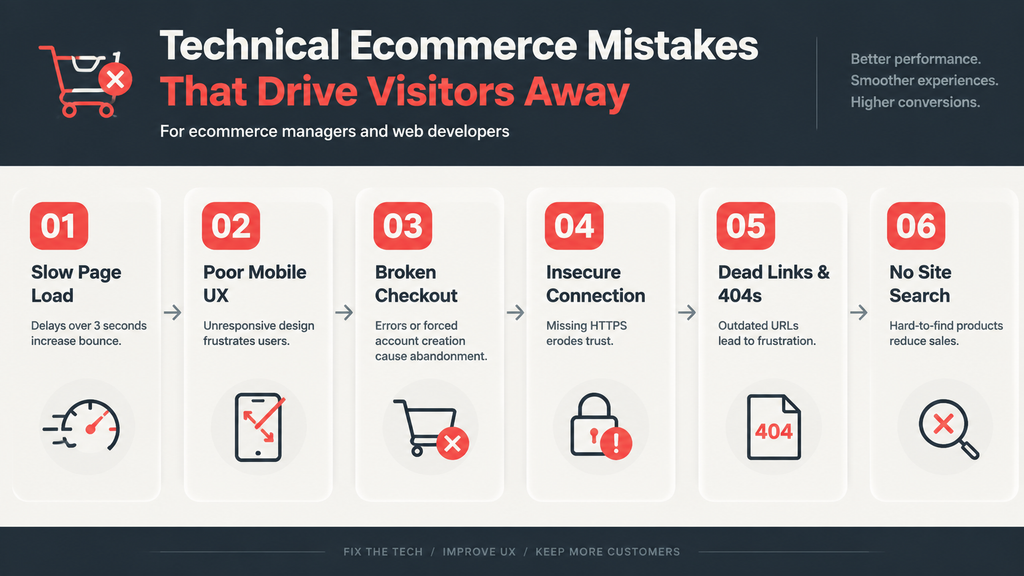
Technical ecommerce mistakes are invisible to the business owner but immediately apparent to the visitor — and they cause abandonment before a product is even viewed. These are the highest-priority fixes because they affect every session on your store.
Mistake 1: Slow Page Loading Speed
This is one of the most consequential ecommerce mistakes available — research consistently shows that a one-second delay in page loading reduces conversions by 7 percent, and that 40 percent of visitors abandon a site that takes more than three seconds to load. For an ecommerce store generating £10,000 per month, a two-second loading delay could be costing £1,400 or more in lost revenue every month. Google’s Core Web Vitals assessment also directly incorporates page speed into search rankings, meaning slow stores rank lower and attract less organic traffic simultaneously.
Diagnose: run your store through Google PageSpeed Insights and check your Core Web Vitals scores in Google Search Console. Fix: compress product images without quality loss, enable browser caching, reduce installed app count (the most common Shopify speed issue), and consider a CDN for faster global content delivery.
Mistake 2: Poor or Missing Mobile Optimisation
Over 70 percent of ecommerce traffic arrives on mobile devices, yet mobile conversion rates are typically 30 to 50 percent lower than desktop rates on stores that were not designed mobile-first. If this gap exists in your analytics, poor mobile optimisation is one of the ecommerce mistakes costing you the most revenue. A store that looks and functions beautifully on desktop but is difficult to navigate on a smartphone is effectively invisible to the majority of its potential customers.
Diagnose: review your mobile versus desktop conversion rate in Google Analytics 4. If mobile is significantly lower, use Chrome DevTools to inspect your store on mobile and identify specific friction points. Fix: ensure all buttons have adequate tap targets, that text is legible without zooming, that checkout is optimised for one-handed use, and that product images display correctly at mobile dimensions.
Mistake 3: No Analytics or Incorrect Analytics Setup
Operating an ecommerce store without accurate analytics is one of the most strategically damaging ecommerce mistakes a business can make — it means every marketing decision, every optimisation priority, and every product decision is based on guesswork rather than evidence. Without accurate ecommerce tracking, you cannot identify which traffic sources generate the most revenue, which products convert best, where visitors are dropping off in the funnel, or whether your marketing spend is profitable.
Fix: install Google Analytics 4 with full ecommerce tracking enabled, set up Google Search Console and link it to your Analytics account, and install heatmap and session recording software to observe actual visitor behavior. Do this before making any other changes — without a measurement baseline, you cannot accurately assess whether any fix is working.
Want Your Store To Actually Convert?
Strategy is step one — execution is what moves revenue. Tasknestly builds and optimizes ecommerce stores that convert.
Get Ecommerce Services →Product and Content Ecommerce Mistakes
These ecommerce mistakes occur on your product pages and in your content — the areas that most directly influence whether a shopper who is interested in your products develops enough confidence and information to make a purchase.
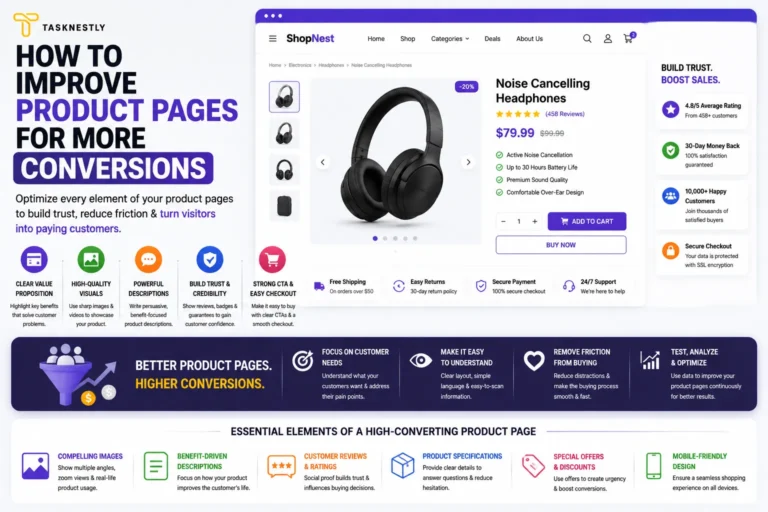
Mistake 4: Poor Product Images
Product imagery is the closest substitute for the physical retail experience, and poor images are one of the most common ecommerce mistakes that reduce both conversion rates and average order values. Single, low-quality images shot against inconsistent backgrounds fail to communicate the texture, scale, and quality of a product — leaving shoppers uncertain and unwilling to commit to a purchase they cannot physically verify.
Fix: invest in consistent, high-quality product photography featuring multiple angles, lifestyle shots showing the product in use, and size/scale references where relevant. For products where material or texture is important, include close-up detail shots. For high-ticket items, add short product demonstration videos. This single improvement frequently produces conversion rate uplifts of 20 to 40 percent on the pages where it is applied.
Mistake 5: Thin or Duplicate Product Descriptions
Thin product descriptions — under 200 words, lacking specific detail, or copied from manufacturer specifications — are ecommerce mistakes that damage both conversion rates and SEO simultaneously. From a conversion perspective, descriptions that do not answer the specific questions a buyer would ask leave purchase hesitation unaddressed. From an SEO perspective, thin or duplicate content provides search engines with insufficient material to evaluate the page’s relevance for specific product queries, suppressing rankings for the commercial keywords your products should be capturing.
Fix: write unique product descriptions of at least 250 to 300 words for every product, targeting the specific search terms buyers use when looking for that product type. Address the buyer’s practical questions: what problem does this product solve, who is it for, what makes it different from alternatives, and what specific details (dimensions, materials, compatibility, care) do they need to know before buying.
Mistake 6: No Customer Reviews or Social Proof
The absence of customer reviews is one of the ecommerce mistakes that most directly erodes purchase confidence, particularly for first-time buyers who have no existing relationship with your brand. Online shoppers read reviews before buying — 93 percent of consumers report that reviews influence their purchase decisions. A product page with no reviews is asking shoppers to trust an unfamiliar brand with their money without any social validation that others have done the same and been satisfied.
Fix: implement an automated post-purchase review request email sent two to three weeks after delivery — when the customer has received and used the product. Make leaving a review as simple as possible with a direct link to your review platform. Aim to collect a minimum of 10 reviews per product before running significant paid advertising to those product pages, as social proof dramatically improves paid ad conversion rates alongside organic trust.
| Let Tasknestly Fix These Ecommerce Mistakes for YouTasknestly’s digital marketing services cover SEO, email marketing, content, and paid advertising — addressing the ecommerce mistakes that limit your organic reach and customer retention.Book your free marketing consultation → |
Want Your Store To Actually Convert?
Strategy is step one — execution is what moves revenue. Tasknestly builds and optimizes ecommerce stores that convert.
Get Ecommerce Services →Checkout and Conversion Ecommerce Mistakes
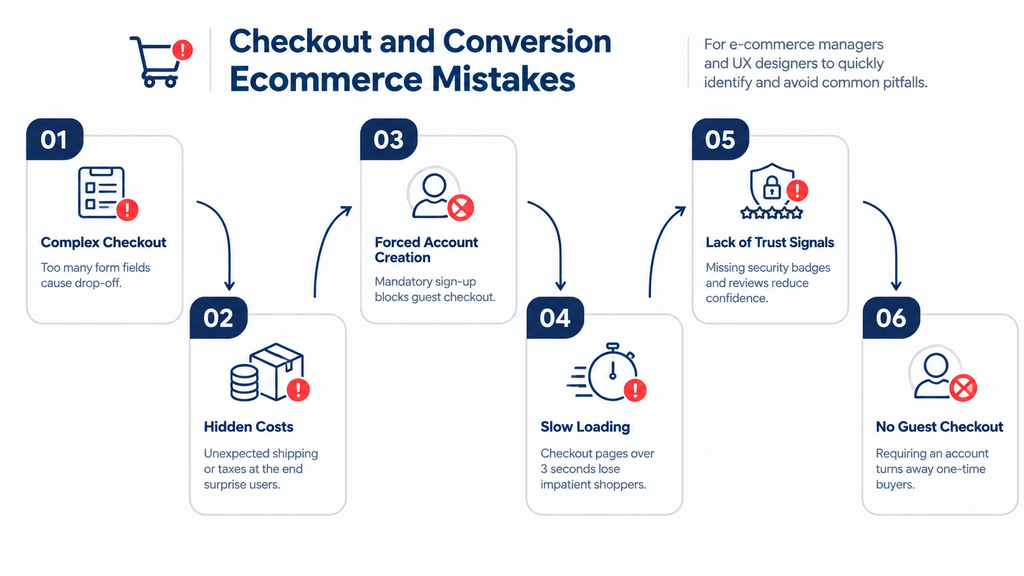
These ecommerce mistakes happen at the most critical moment in the shopping journey — when a visitor is ready to buy but encounters friction that drives them away at the final step.
Mistake 7: Forced Account Creation Before Checkout
Requiring shoppers to create an account before completing a purchase is one of the most consistently damaging ecommerce mistakes a store can make at checkout. First-time buyers are not yet committed enough to your brand to invest time in account creation — they want to complete their purchase quickly and evaluate whether the relationship with your brand is worth formalising after they receive their order.
Fix: enable guest checkout immediately. You can invite account creation after the purchase is confirmed — when the customer is already satisfied and more receptive to the convenience of having an account for future purchases. This single fix to one of the most common ecommerce mistakes typically improves checkout conversion by 10 to 20 percent.
Mistake 8: Hidden Shipping Costs at Checkout
Unexpected shipping costs revealed only at the payment step are the single most commonly cited reason for cart abandonment in ecommerce research. This is one of the ecommerce mistakes that shoppers find most frustrating — they have invested time selecting products only to discover at the final moment that the total cost is higher than they expected. The resulting abandonment is not just a lost sale; it is a damaged brand impression that reduces the likelihood of that shopper returning.
Fix: display your shipping cost policy clearly on every product page, in the cart, and at the entry to checkout. If you offer free shipping above a threshold, make it impossible to miss. If you charge for shipping, show an estimated cost before the shopper begins the checkout process. Transparency about shipping costs, even when those costs are not zero, consistently outperforms hidden-until-checkout pricing.
Mistake 9: No Abandoned Cart Recovery
With an average ecommerce cart abandonment rate of 70 percent, failing to implement an abandoned cart email sequence is one of the most costly passive ecommerce mistakes a store can make. Every day without a recovery sequence is a day where potentially thousands of pounds in near-complete transactions are left unrecovered. Abandoned cart emails — sent one hour, 24 hours, and 72 hours after abandonment — typically recover 5 to 15 percent of abandoned carts, representing pure incremental revenue at near-zero acquisition cost.
Fix: set up a three-email abandoned cart sequence through your email marketing platform. Include the specific items left in the cart with images, a clear return-to-checkout CTA, and optionally a modest discount in the third email if your margins support it. This is the single highest-ROI automation available to most ecommerce businesses.
Want Your Store To Actually Convert?
Strategy is step one — execution is what moves revenue. Tasknestly builds and optimizes ecommerce stores that convert.
Get Ecommerce Services →Strategic Ecommerce Mistakes That Limit Long-Term Growth
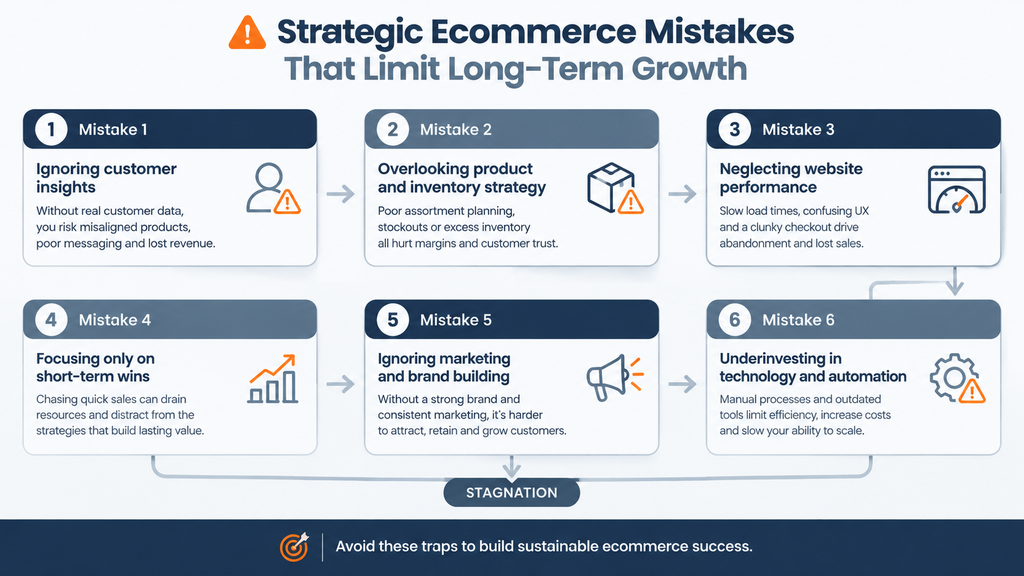
These ecommerce mistakes are not immediately visible in your daily metrics but compound into significant competitive disadvantages over months and years.
Mistake 10: Ignoring SEO From Launch
Launching an ecommerce store with no SEO strategy is one of the most strategically costly ecommerce mistakes a business can make in year one. The compounding nature of organic search means that stores that invest in SEO from launch build a growing foundation of organic traffic that reduces their customer acquisition cost over time. Stores that launch with no SEO and rely entirely on paid advertising remain permanently dependent on advertising spend — the moment the budget stops, so does the revenue.
Fix: conduct keyword research for every product and category page before launch, write unique SEO-optimised product descriptions from day one, set up Google Search Console and submit your sitemap, and begin building a blog that targets informational keywords related to your product category. The SEO foundation built in the first six months of trading produces disproportionate long-term dividends.
Mistake 11: Single Traffic Channel Dependency
Relying on a single traffic source — typically paid Facebook or Google ads — is one of the most strategically fragile ecommerce mistakes an ecommerce business can make. Platform algorithm changes, rising ad costs, account suspensions, or policy changes can eliminate your entire traffic source overnight. Businesses built on a single channel have no fallback and no negotiating position.
Fix: build traffic from at least three distinct sources: organic search (SEO and content), email marketing (your own list), and paid advertising. Each channel takes time to establish, which is why starting early is critical. Diversified traffic is the most resilient business foundation in ecommerce.
Mistake 12: No Email Marketing Programme
Email marketing consistently delivers the highest ROI of any marketing channel — yet many ecommerce businesses either have no email programme at all or send occasional newsletters without a systematic automation strategy. Ignoring email marketing is one of the most expensive ecommerce mistakes for businesses with existing customer bases, because it means leaving the highest-return channel entirely untapped.
Fix: at minimum, implement a welcome email series for new subscribers, an abandoned cart sequence, a post-purchase follow-up requesting a review, and a re-engagement sequence for inactive subscribers. These four automations address the most commercially valuable email marketing opportunities and require only one-time setup.
Want Your Store To Actually Convert?
Strategy is step one — execution is what moves revenue. Tasknestly builds and optimizes ecommerce stores that convert.
Get Ecommerce Services →15 Ecommerce Mistakes at a Glance
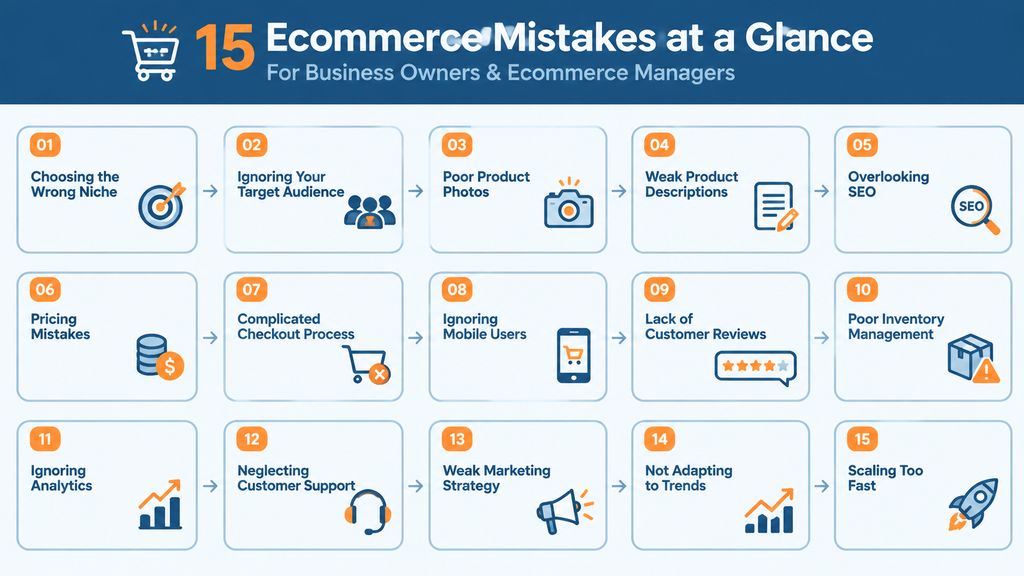
Use this table as a quarterly audit checklist to identify which ecommerce mistakes are present in your store and prioritise the highest-impact fixes.
| # | Ecommerce Mistake | Revenue Impact | Fix Priority |
| 1 | Slow page loading speed | High — every second costs 7% conversion | Critical — fix immediately |
| 2 | No mobile optimisation | Very High — 70%+ traffic is mobile | Critical — fix immediately |
| 3 | Poor product images | High — images drive add-to-cart decisions | High — fix this quarter |
| 4 | Forced account creation | High — kills checkout conversion | High — fix this quarter |
| 5 | Hidden shipping costs | Very High — top cause of abandonment | Critical — fix immediately |
| 6 | No social proof or reviews | High — trust signals drive decisions | High — fix this quarter |
| 7 | Thin product descriptions | Medium-High — hurts SEO and conversion | High — fix this quarter |
| 8 | Ignoring email marketing | Medium-High — highest ROI channel unused | Medium — build this month |
| 9 | No abandoned cart recovery | High — 70% of carts are abandoned | High — fix this quarter |
| 10 | Weak or missing CTAs | Medium — buyers need clear next steps | Medium — fix this month |
| 11 | No cross-sell or upsell | Medium — missed AOV opportunity | Medium — build this month |
| 12 | Ignoring SEO from launch | High — misses long-term organic traffic | High — start now |
| 13 | Poor returns policy | Medium-High — reduces conversion and trust | High — review now |
| 14 | No analytics setup | Medium — flying blind on all decisions | Critical — set up today |
| 15 | Single traffic channel dependency | Very High — one algorithm change = crisis | High — diversify now |
| Essential Tools to Fix Your Ecommerce MistakesShopify — The most beginner-friendly ecommerce platform with built-in tools to address the most common ecommerce mistakes from checkout to marketing.SEMrush — Identify the SEO and traffic mistakes costing your store organic rankings and lost revenue with comprehensive site auditing.Canva — Fix product image and branding mistakes with professional-quality visual content created without a designer. |
Want Your Store To Actually Convert?
Strategy is step one — execution is what moves revenue. Tasknestly builds and optimizes ecommerce stores that convert.
Get Ecommerce Services →Frequently Asked Questions: Ecommerce Mistakes
| Question | Answer |
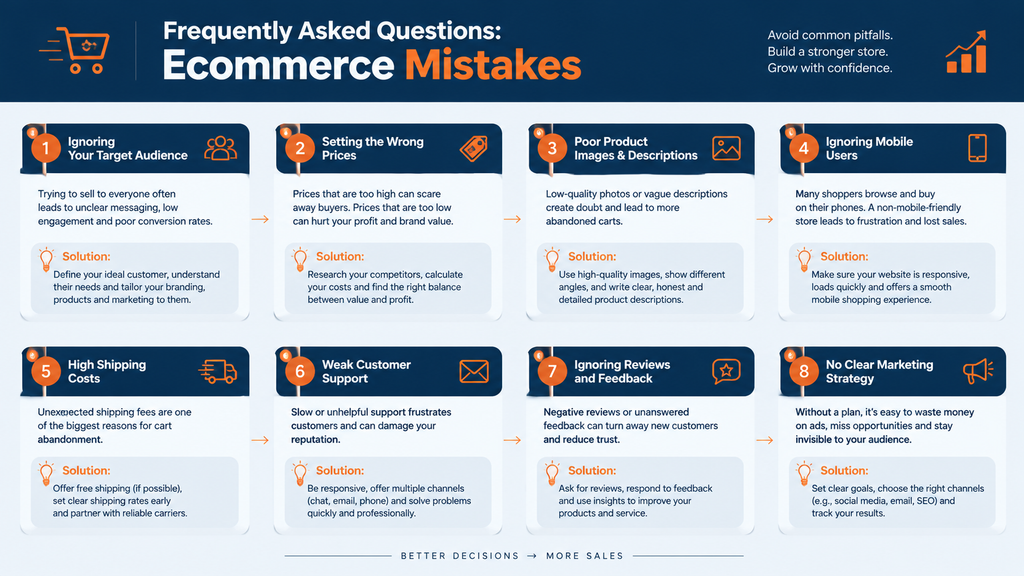
| What are the most costly ecommerce mistakes? | The most costly ecommerce mistakes in terms of direct revenue impact are slow page speed, poor mobile optimisation, hidden shipping costs at checkout, forced account creation before purchase, and lack of abandoned cart recovery. These five issues alone can account for a 60-80% reduction in potential revenue compared to a fully optimised store. |
| How do ecommerce mistakes affect organic search rankings? | Several ecommerce mistakes directly damage search rankings: slow page speed and poor Core Web Vitals scores reduce rankings, thin or duplicate product descriptions provide insufficient content for indexation, missing alt text on product images limits image search visibility, and poor mobile experience triggers Google’s mobile-first indexing penalties. |
| How can I identify which ecommerce mistakes my store is making? | Install Google Analytics 4, Google Search Console, and a heatmap tool like Hotjar to gather data on where visitors are dropping off, which pages have high exit rates, and where shoppers abandon the checkout. These tools reveal the specific ecommerce mistakes costing your store the most revenue and allow you to prioritise fixes by impact. |
| What is the most common ecommerce mistake for new stores? | The most common ecommerce mistake for new stores is launching without a defined SEO strategy. Relying entirely on paid advertising from day one creates a business that generates revenue only while the advertising budget runs — the moment it stops, so does the traffic. Building organic presence from launch is the most strategically important decision a new ecommerce business can make. |
| How much revenue do abandoned cart ecommerce mistakes cost? | The average ecommerce abandonment rate is 70 percent, meaning 7 out of every 10 shoppers who add a product to their cart never complete the purchase. Without abandoned cart email sequences to recover a portion of those shoppers, an ecommerce store is effectively leaving 15-20 percent of its potential revenue uncollected. Fixing this single mistake can add meaningful revenue within weeks. |
| Do product description ecommerce mistakes hurt SEO? | Yes significantly. Thin product descriptions under 200 words give search engines insufficient content to evaluate page relevance. Duplicate descriptions — copied from manufacturer specifications or used across multiple product variants — trigger duplicate content penalties. Unique, detailed product descriptions of 300+ words targeting specific keywords are both an SEO and a conversion requirement. |
| How long does it take to fix ecommerce mistakes and see results? | Technical fixes like page speed improvements and checkout streamlining show results within days. Email marketing and abandoned cart sequences typically show revenue impact within two to four weeks of launch. SEO improvements from better product descriptions and technical fixes show measurable ranking changes within four to eight weeks. Review generation shows conversion impact as reviews accumulate over one to three months. |
Want Your Store To Actually Convert?
Strategy is step one — execution is what moves revenue. Tasknestly builds and optimizes ecommerce stores that convert.
Get Ecommerce Services →Conclusion: Stop Making These Ecommerce Mistakes and Start Growing
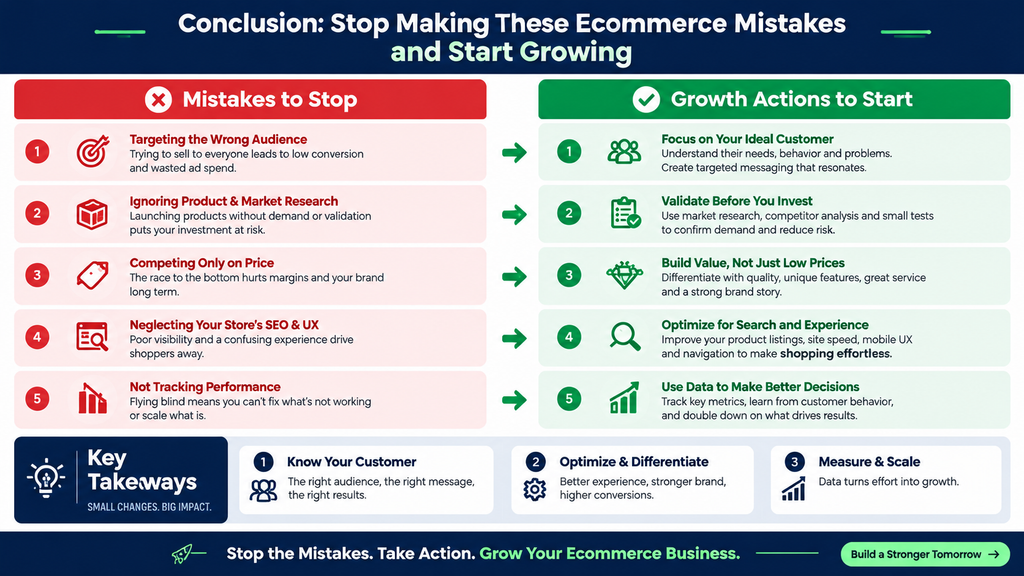
The 15 ecommerce mistakes in this guide are not obscure edge cases — they are the specific, repeated errors that keep ecommerce stores converting at 1 percent when they should be converting at 3 or 4 percent. Every one of them is fixable. Most are fixable within a week. And the cumulative revenue impact of addressing all 15 is not additive — it is multiplicative, because fixing technical performance improves the effectiveness of every other marketing investment you make.
Use this guide as an audit checklist. Work through each ecommerce mistake systematically, prioritising the ones with the most direct impact on your specific conversion bottleneck. Start with the technical issues — speed, mobile, analytics — because they affect every subsequent metric. Then address the product page and checkout mistakes that lose buyers who are genuinely interested. Finally, implement the strategic initiatives — SEO, email, traffic diversification — that build compounding long-term growth.
At Tasknestly, we identify and fix the specific ecommerce mistakes costing our clients the most revenue — through expert store audits, conversion optimisation, SEO strategy, and ongoing marketing management. If you are ready to stop leaving revenue on the table, explore our ecommerce services or request a free ecommerce audit today.
To make sure you can actually measure which of these mistakes is costing you the most, start with Google’s guide to setting up ecommerce measurement in Google Analytics 4.
Want Your Store To Actually Convert?
Strategy is step one — execution is what moves revenue. Tasknestly builds and optimizes ecommerce stores that convert.
Get Ecommerce Services →Grow With Tasknestly
Subscribe to the Tasknestly newsletter and get the latest tips on websites, SEO, social media, and digital growth.