

Technical SEO mistakes are silent killers. Unlike content gaps or missing keywords — which are at least visible — technical SEO mistakes often lurk beneath the surface of a website, suppressing rankings and blocking organic traffic without triggering any obvious symptoms. A website can have excellent content and a strong backlink profile and still underperform in search because of unresolved technical SEO mistakes that prevent Google from properly crawling, indexing, or rendering its pages.
Understanding the most damaging technical SEO mistakes in 2026 is essential for any business that relies on organic search traffic. Search engines have become increasingly sophisticated at detecting and penalising technical errors, and the competitive landscape for most keywords is tight enough that even minor technical SEO mistakes can be the difference between ranking on page one and being invisible. The good news is that most technical SEO mistakes are diagnosable and fixable — often without touching the content of a single page.
This guide covers the most critical technical SEO mistakes that website owners, developers, and marketers need to eliminate. From crawlability issues and indexation errors to page speed problems, duplicate content, and structured data failures, these are the technical SEO mistakes that most frequently suppress rankings — and the steps you need to take to fix them.
| Don’t Let Technical SEO Mistakes Cost You Rankings and RevenueTasknestly’s technical SEO specialists audit websites for all the critical technical mistakes that suppress rankings and fix them systematically. Explore our professional SEO services or get a free technical SEO audit to discover what is holding your site back. |
Ranking Takes More Than Tips
You know the strategy now — let Tasknestly handle the technical SEO, content, and link building that actually moves rankings.
Get SEO Services →Table of Contents
Technical SEO Mistake 1: Blocking Crawlers From Indexing Key Pages
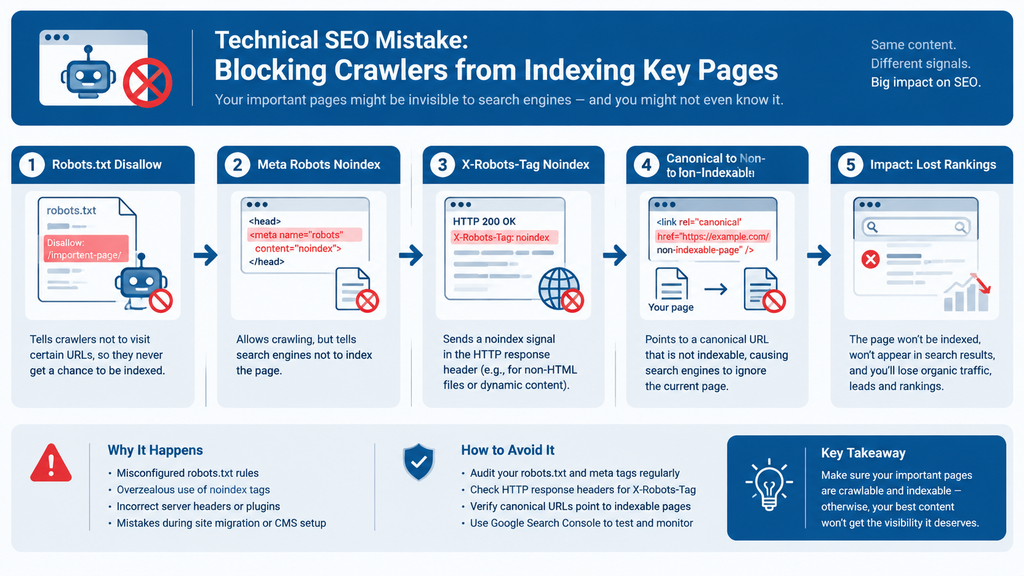
One of the most catastrophic technical SEO mistakes is accidentally blocking search engines from crawling or indexing your most important pages. This happens more often than you might expect — a developer sets noindex on a page during staging, a robots.txt rule blocks a directory, or a CMS plugin inadvertently adds a canonical tag pointing to the wrong URL. These technical SEO mistakes can take pages completely out of the index, making them invisible to search engines regardless of how strong their content is.
How to Find Crawl Blocking Technical SEO Mistakes
Google Search Console’s Coverage report is the first place to check for indexation problems. Look for pages in the Excluded section and review whether pages marked as ‘Noindex’ or ‘Excluded by robots.txt’ should actually be accessible to search engines. A site crawler tool like Screaming Frog lets you audit every page’s robots meta tag, X-Robots-Tag HTTP header, and robots.txt rules simultaneously — making it straightforward to identify these technical SEO mistakes at scale.
Fixing Crawl Blocking Errors
Once you identify pages incorrectly blocked from indexing, the fix depends on the cause. Remove noindex meta tags from pages that should be indexed. Update robots.txt to unblock directories incorrectly disallowed. Fix CMS plugin settings that may have introduced automatic noindex rules. After fixing these technical SEO mistakes, submit the affected URLs for re-indexing through Google Search Console’s URL Inspection tool and monitor their return to the index in the Coverage report.
Ranking Takes More Than Tips
You know the strategy now — let Tasknestly handle the technical SEO, content, and link building that actually moves rankings.
Get SEO Services →Technical SEO Mistake 2: Slow Page Load Speed
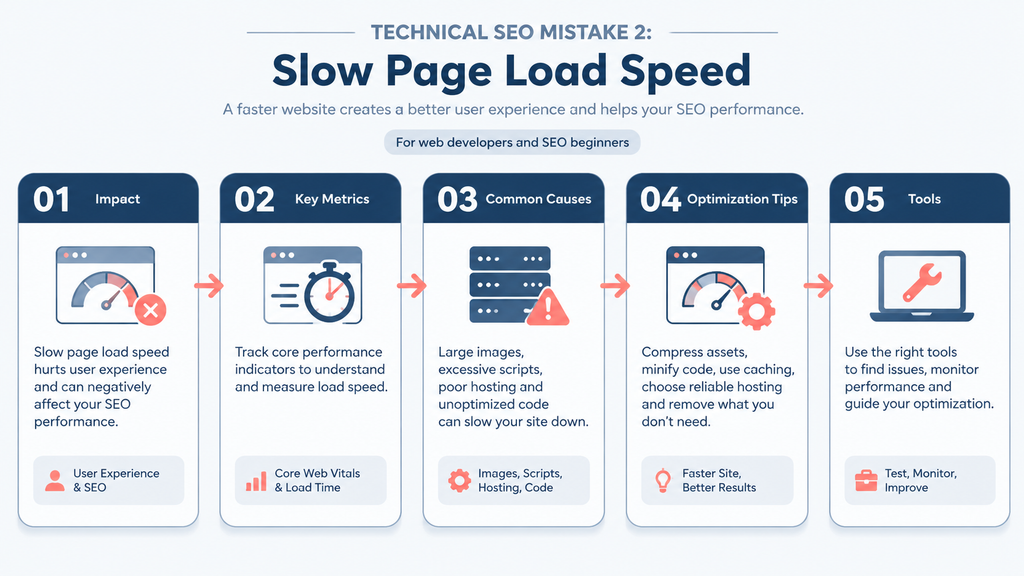
Page speed is both a direct Google ranking factor and a major user experience issue, making slow loading one of the most damaging technical SEO mistakes for organic performance. Google’s Core Web Vitals — specifically Largest Contentful Paint (LCP) — measure how quickly a page’s main content loads. Pages that fail to achieve an LCP of under 2.5 seconds are flagged as ‘Needs Improvement’ or ‘Poor’, which can suppress rankings in competitive search results.
Common Page Speed Technical SEO Mistakes
The most common page speed technical SEO mistakes include: unoptimised images uploaded without compression, render-blocking JavaScript that delays page display, excessive use of third-party scripts (chat widgets, analytics, advertising tags), missing browser caching directives, server response times over 200ms, and lack of a content delivery network (CDN) for geographically distributed audiences. Each of these technical SEO mistakes contributes to a slower LCP score.
Tools to Diagnose Page Speed Mistakes
Google PageSpeed Insights, Lighthouse, and Core Web Vitals reports in Google Search Console are the primary tools for diagnosing page speed technical SEO mistakes. Run PageSpeed Insights on your most important pages — homepage, category pages, top blog posts — and address the high-impact items flagged in the ‘Opportunities’ and ‘Diagnostics’ sections. Even fixing two or three major technical SEO mistakes related to speed can produce meaningful LCP improvements.
Ranking Takes More Than Tips
You know the strategy now — let Tasknestly handle the technical SEO, content, and link building that actually moves rankings.
Get SEO Services →Technical SEO Mistake 3: Duplicate Content
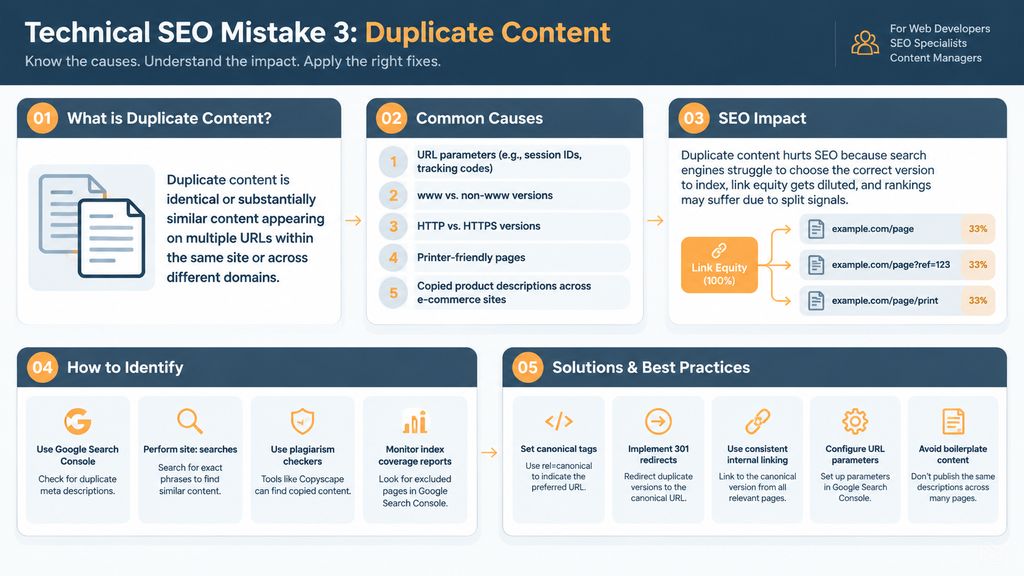
Duplicate content is one of the most widespread technical SEO mistakes, and it comes in more forms than most website owners realise. Exact duplicate pages — where identical content exists at two different URLs — are only the most obvious manifestation. Duplicate content technical SEO mistakes also include: near-duplicate product descriptions across multiple product variants, URL parameter variations creating multiple versions of the same page, HTTP vs HTTPS and www vs non-www versions both being accessible, and printer-friendly page versions without noindex tags.
Canonical Tags and Duplicate Content Mistakes
Canonical tags are the primary technical SEO tool for resolving duplicate content. A canonical tag on a duplicate page tells search engines which version is the ‘master’ — the one that should be indexed and receive ranking credit. Technical SEO mistakes with canonical tags include: canonical tags pointing to themselves (correct), canonical tags pointing to the wrong page (a serious mistake), multiple conflicting canonical signals, and pages with no canonical tag where duplicate variants exist. Audit all canonical tags carefully — a misconfigured canonical is one of the most insidious technical SEO mistakes because it is invisible to visitors but devastating to rankings.
Ecommerce Duplicate Content Mistakes
Ecommerce sites are particularly vulnerable to duplicate content technical SEO mistakes because of product variant URLs, faceted navigation, and session ID parameters being appended to URLs. Addressing these technical SEO mistakes requires configuring canonical tags on all variant pages, blocking faceted navigation URL parameters in robots.txt or via canonical, and implementing rel=next/prev for paginated category pages. These ecommerce-specific duplicate content mistakes can silently dilute the ranking power of your most valuable category and product pages.
Ranking Takes More Than Tips
You know the strategy now — let Tasknestly handle the technical SEO, content, and link building that actually moves rankings.
Get SEO Services →Technical SEO Mistake 4: Missing or Broken Internal Links
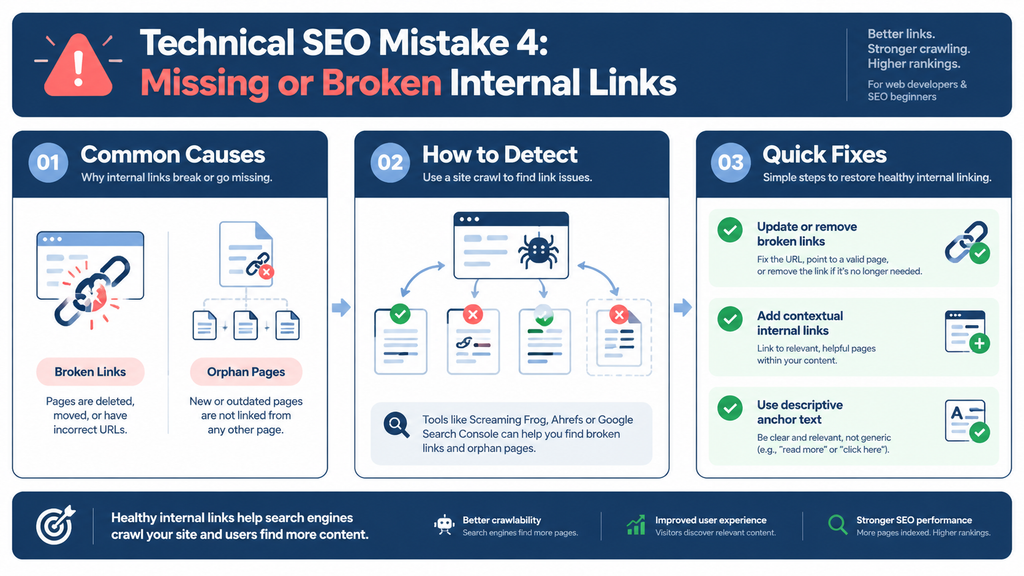
Internal linking is a fundamental technical SEO signal that many website owners underestimate. Broken internal links — links pointing to 404 error pages — are a technical SEO mistake that wastes crawl budget and prevents link equity from flowing through your site. Orphan pages — pages with no internal links pointing to them — are a related technical SEO mistake that leaves valuable content invisible to both search engines and users who do not arrive via direct URL.
Use Screaming Frog or a similar crawler to identify broken internal links and orphan pages on your site. Fix broken links by updating them to the correct URL or redirecting the destination page if it has moved. Address orphan pages by adding contextually relevant internal links from other pages on your site. Strong internal linking architecture is one of the technical SEO improvements that delivers the fastest ranking lift after implementation — particularly for pages that have authority but poor internal link support.
Our professional SEO team at Tasknestly conducts full technical SEO audits that cover internal linking architecture, crawl efficiency, and all other technical mistakes that suppress your site’s ranking potential.
| Get a Full Technical SEO Audit — Identify Every Mistake Holding You BackTasknestly’s technical SEO audits cover crawlability, indexation, speed, structured data, duplicate content, and every other class of technical mistake that impacts rankings. Explore our website and SEO services or request your free site audit today. |
Ranking Takes More Than Tips
You know the strategy now — let Tasknestly handle the technical SEO, content, and link building that actually moves rankings.
Get SEO Services →Technical SEO Mistake 5: Poor Mobile Experience
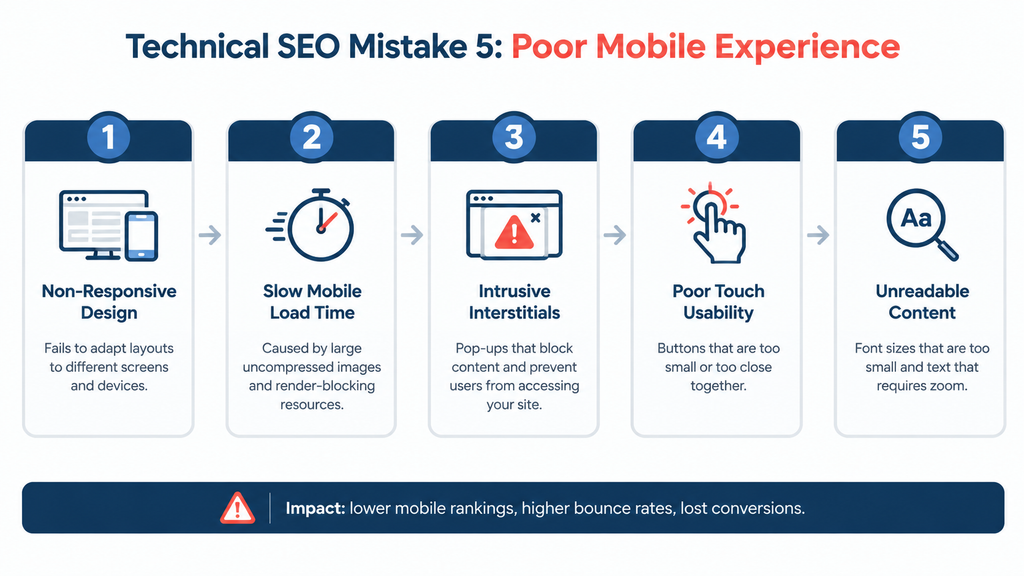
Google uses mobile-first indexing for all websites — meaning it primarily uses the mobile version of your site for ranking purposes. A poor mobile experience is therefore a critical technical SEO mistake that affects your rankings for all users, not just mobile visitors. Technical SEO mistakes related to mobile include: content that is different between mobile and desktop versions, interstitials that block content on mobile, touch elements that are too close together, viewport not configured correctly, and content that loads more slowly on mobile than desktop.
How to Test for Mobile Technical Errors
Google Search Console’s Mobile Usability report identifies specific mobile experience technical SEO mistakes affecting your site. Google’s Mobile-Friendly Test tool lets you check individual pages. Pay particular attention to font sizes, tap target sizes, viewport configuration, and the presence of any content that is hidden or truncated on mobile but visible on desktop — any disparity between mobile and desktop content is a technical SEO mistake under mobile-first indexing.
Ranking Takes More Than Tips
You know the strategy now — let Tasknestly handle the technical SEO, content, and link building that actually moves rankings.
Get SEO Services →Technical SEO Mistake 6: Missing or Incorrect Structured Data
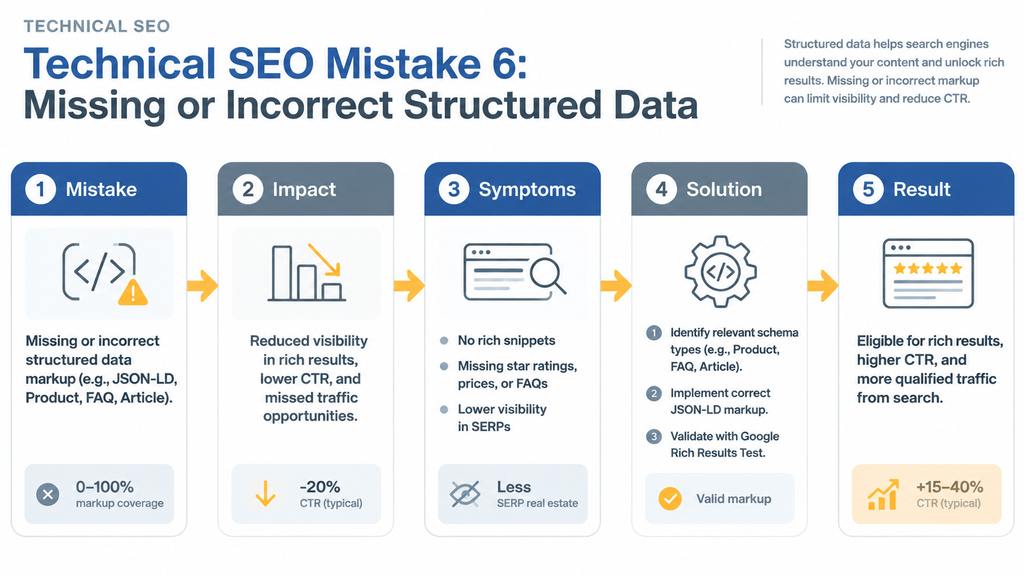
Structured data (schema markup) helps search engines understand your content and qualify your pages for rich results — enhanced search listings that include star ratings, FAQs, how-to steps, product prices, and more. Missing structured data is a technical SEO mistake of omission that leaves ranking opportunities unrealised. Incorrect structured data is an actively harmful technical SEO mistake that can trigger manual actions from Google for misleading rich result content.
Common Structured Data Technical SEO Mistakes
The most common structured data technical SEO mistakes include: schema markup that does not match the visible page content (a policy violation), missing required properties in Product schema (price and availability are mandatory for Shopping), implementing FAQ schema with questions that are not visibly present on the page, using deprecated schema types, and validating structured data with errors in Google’s Rich Results Test. Test all structured data with the Rich Results Test tool and address any errors or warnings before publishing.
Ranking Takes More Than Tips
You know the strategy now — let Tasknestly handle the technical SEO, content, and link building that actually moves rankings.
Get SEO Services →Technical SEO Mistake 7: HTTPS and Security Issues
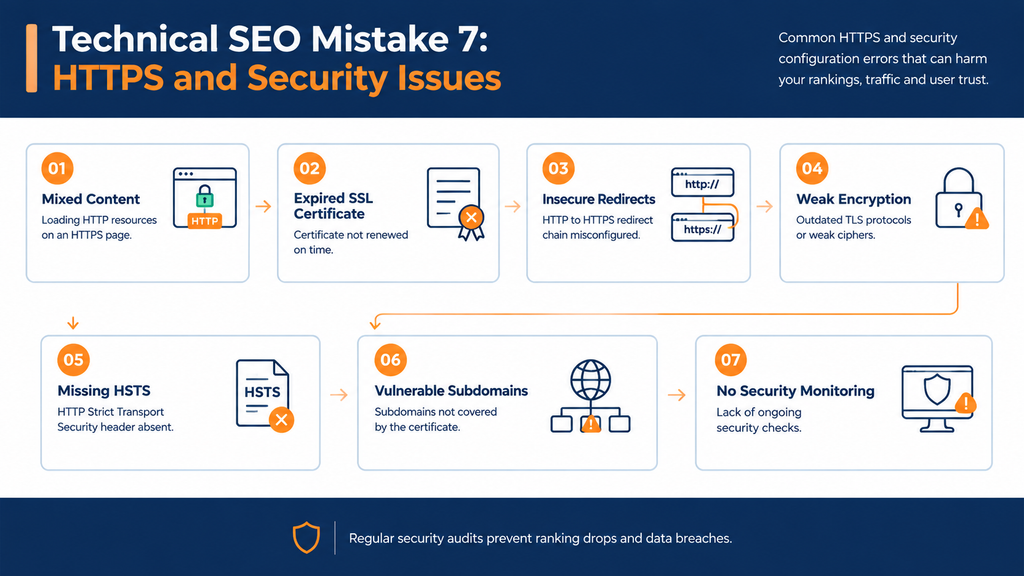
Running a website without HTTPS is a technical SEO mistake that affects both rankings and user trust. HTTPS has been a Google ranking signal since 2014, and browsers now display security warnings for HTTP pages — a significant conversion deterrent. Mixed content errors — where an HTTPS page loads HTTP resources — are a related technical SEO mistake that can trigger security warnings even on technically HTTPS-enabled sites.
Audit your site for HTTP resources loaded on HTTPS pages using browser developer tools or an HTTP header checker. Migrate all legacy HTTP resources (images, scripts, stylesheets) to HTTPS versions. Ensure your SSL certificate is valid, not expired, and covers all subdomains used on your site. These technical SEO mistakes related to security are relatively straightforward to fix but have an outsized negative impact on both rankings and user confidence when left unresolved.
Ranking Takes More Than Tips
You know the strategy now — let Tasknestly handle the technical SEO, content, and link building that actually moves rankings.
Get SEO Services →Technical SEO Mistake 8: Redirect Chains and Loops
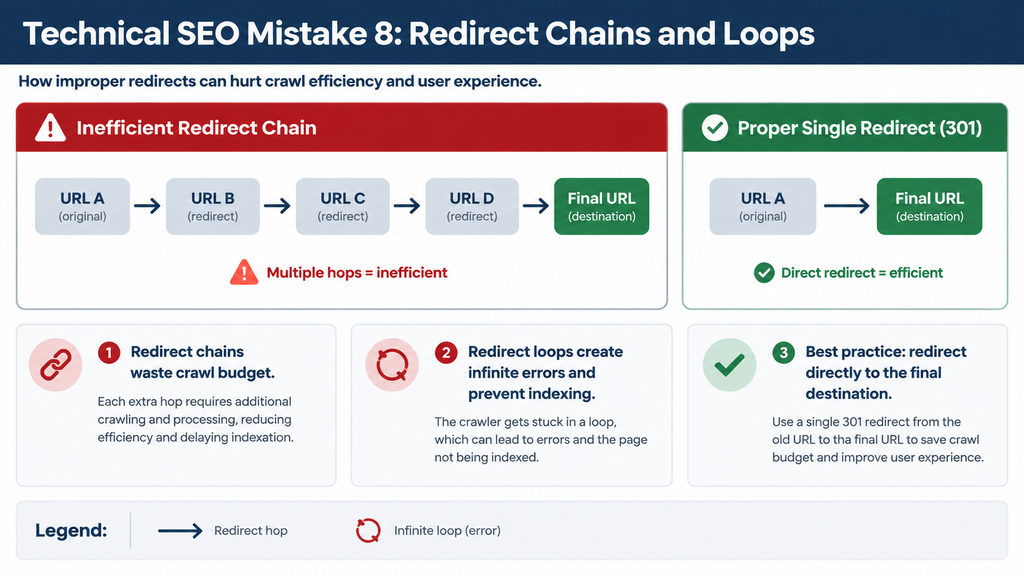
Redirect chains — sequences of multiple redirects (A→B→B→C) that a browser must follow to reach a destination — are a crawl efficiency issue that wastes budget and dilutes link equity with each additional hop. Redirect loops — where redirect A points to B, which points back to A — are a more severe problem that makes pages completely inaccessible. Both redirect error types are common after site migrations, URL restructuring, or CMS changes.
Use a crawler like Screaming Frog to identify all redirect chains and loops on your site. Consolidate redirect chains into single direct redirects (A→C) wherever possible. Eliminate any redirect loops immediately. Update any internal links that point to redirecting URLs to point directly to the final destination instead. These redirect errors are invisible to most content-focused audits but are consistently flagged by comprehensive technical SEO reviews.
Ranking Takes More Than Tips
You know the strategy now — let Tasknestly handle the technical SEO, content, and link building that actually moves rankings.
Get SEO Services →How to Build a Technical SEO Monitoring Routine
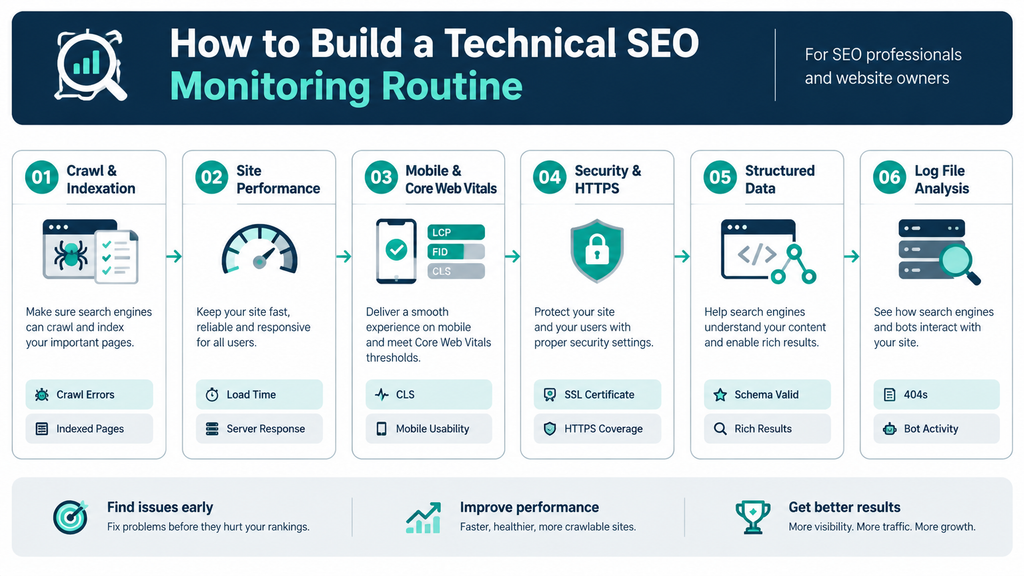
Fixing technical SEO errors once is not enough. Websites change continuously — new pages are published, plugins are updated, server configurations are modified, and developer changes introduce unintended consequences. Building an SEO monitoring routine ensures that new errors are caught quickly before they have time to suppress rankings.
Set up automated weekly or monthly crawls of your site using Screaming Frog or Semrush Site Audit. Configure alerts in Google Search Console for new Coverage errors, Core Web Vitals regressions, and manual action notifications. Review your Core Web Vitals report monthly to catch any speed regressions introduced by new code deployments or plugin updates. After every significant site change — a redesign, a CMS upgrade, a server migration — run a full technical crawl immediately to catch any problems before Google’s crawlers detect them.
Ongoing monitoring is particularly important after periods of rapid content growth. Adding hundreds of new pages can introduce indexation issues, duplicate content, internal linking gaps, and sitemap errors that were not present before. A quarterly audit — covering all error categories described in this guide — is a sound practice for any site that publishes content regularly and depends on organic search for traffic and revenue.
Our professional SEO services at Tasknestly include ongoing technical health monitoring as a standard part of our SEO retainer engagements — so your site stays clean and error-free as it grows.
Ranking Takes More Than Tips
You know the strategy now — let Tasknestly handle the technical SEO, content, and link building that actually moves rankings.
Get SEO Services →Technical SEO and Site Migrations: Avoiding Catastrophic Errors
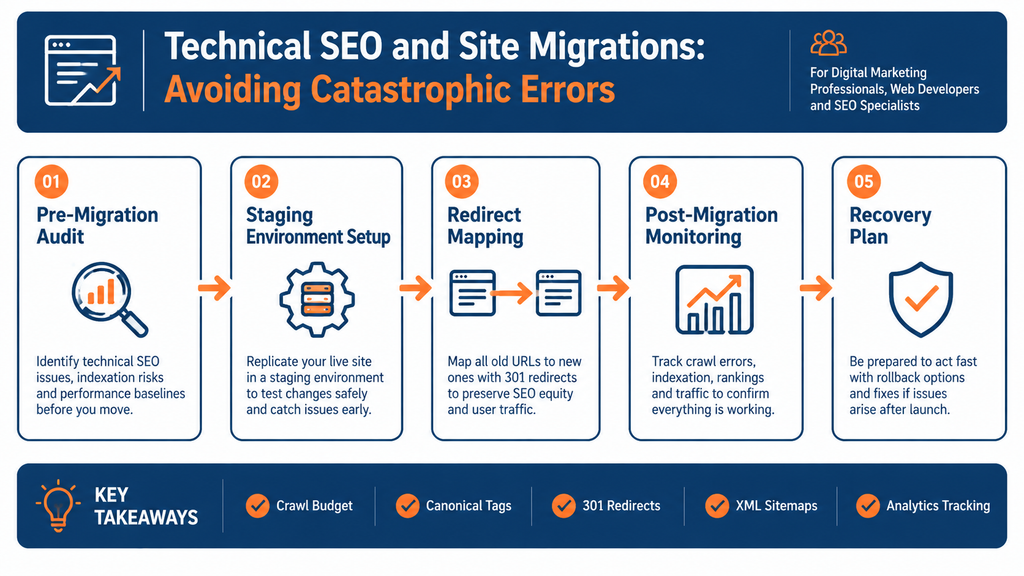
Site migrations are among the highest-risk events in technical SEO. Moving from one domain to another, switching from HTTP to HTTPS, changing URL structures, or migrating to a new CMS can all introduce serious errors if not executed with careful technical planning. A poorly managed migration can cause a site to lose the majority of its organic rankings within weeks — an outcome that can take months or years to recover from.
The most critical errors in site migrations are: failing to implement 301 redirects from every old URL to the corresponding new URL, setting up noindex tags on the new site while testing (then forgetting to remove them before launch), allowing both the old and new site to be simultaneously indexed (creating massive duplicate content), not updating internal links from old URLs to new ones after the migration, and not verifying the new site in Google Search Console before launch.
If you are planning a site migration, complete a technical SEO checklist before, during, and after the move. Before migration: document all current URLs and their traffic performance, plan redirect mappings for every URL, set up the new site in a staging environment with noindex on. During migration: implement all 301 redirects, verify canonicals, check robots.txt, and deploy. After migration: monitor Google Search Console Coverage report daily, check ranking performance weekly for the first month, and address any crawl errors or lost rankings immediately. A technically sound migration preserves organic performance; a sloppy one destroys it.
Migration issues are a category of technical SEO error that almost always requires expert support. The complexity of mapping hundreds or thousands of URLs, verifying redirect chains, and monitoring post-migration performance across multiple dimensions is beyond the capacity of most in-house content teams without specialist SEO knowledge and tooling.
Ranking Takes More Than Tips
You know the strategy now — let Tasknestly handle the technical SEO, content, and link building that actually moves rankings.
Get SEO Services →Technical SEO Mistakes: Severity and Fix Priority
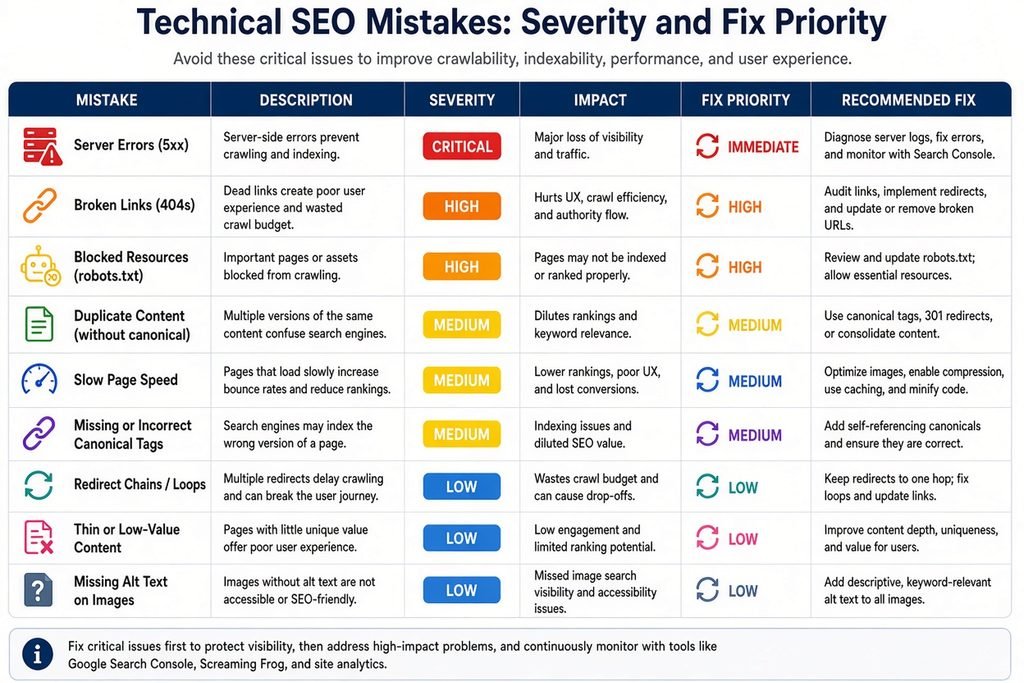
| Technical SEO Mistake | Severity | Fix Speed | Primary Impact |
| Blocking crawlers / noindex errors | Critical | Fast | Pages invisible to search engines |
| Slow page speed / poor Core Web Vitals | High | Moderate | Direct ranking factor + UX |
| Duplicate content / missing canonicals | High | Moderate | Split ranking signals, index bloat |
| Broken internal links / orphan pages | Medium | Fast | Lost link equity, poor crawlability |
| Poor mobile experience | High | Moderate | Mobile-first indexing penalty |
| Missing / broken structured data | Medium | Fast | No rich results, missed CTR boost |
| HTTPS / mixed content errors | High | Fast | Ranking signal + trust/conversion |
| Redirect chains and loops | Medium | Fast | Crawl budget waste, link equity loss |
Ranking Takes More Than Tips
You know the strategy now — let Tasknestly handle the technical SEO, content, and link building that actually moves rankings.
Get SEO Services →Technical SEO Mistakes That Are Easy to Miss
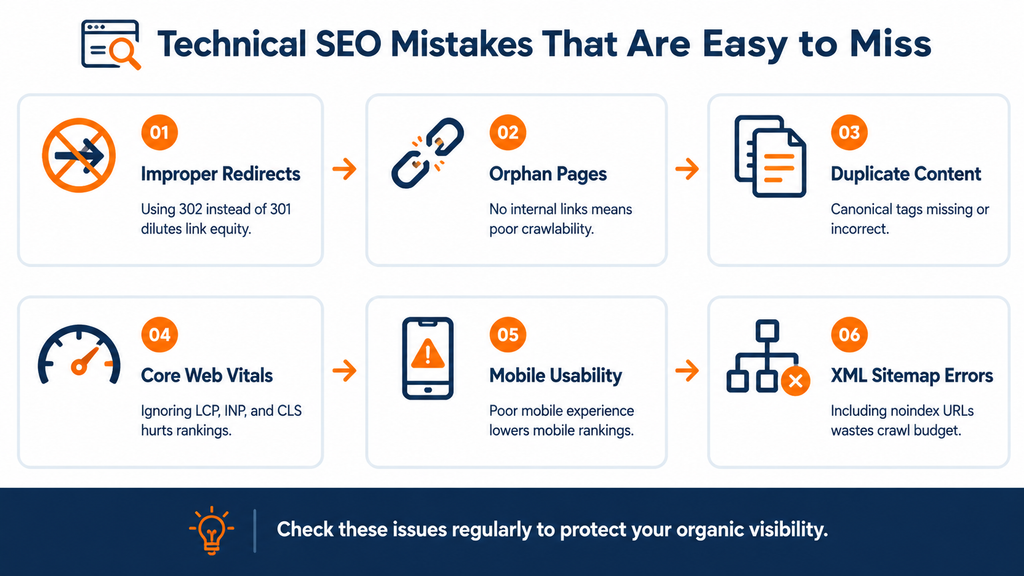
Beyond the most common mistakes already covered, there are several less obvious technical SEO mistakes that frequently go undetected even on sites that have had professional audits.
Missing Hreflang for Multilingual Sites
For websites targeting multiple language or regional audiences, missing or incorrect hreflang tags are a technical SEO mistake that causes search engines to show the wrong language version to international users. Hreflang errors are among the most complex technical SEO mistakes to diagnose because they require checking both the originating page and the referenced pages for consistent bidirectional implementation. Tools like Semrush’s International SEO checker can identify hreflang technical SEO mistakes at scale.
XML Sitemap Technical SEO Mistakes
An incorrect or outdated XML sitemap can misdirect search engine crawlers and is a surprisingly common technical SEO mistake. Sitemaps that include 404 pages, redirected URLs, or noindex pages send confusing signals to search engines about which pages should be prioritised for crawling. Keep your XML sitemap clean — include only canonical, indexable, 200-status pages. Resubmit an updated sitemap in Google Search Console whenever significant URL changes occur on your site.
Core Web Vitals CLS Mistakes
Cumulative Layout Shift (CLS) is the most frequently overlooked of the Core Web Vitals, yet CLS technical SEO mistakes are surprisingly common. CLS occurs when page elements shift unexpectedly as a page loads — typically because images, ads, or embedded content without defined dimensions cause the layout to reflow as they appear. Set explicit width and height attributes on all images and embedded media to prevent layout shift. CLS technical SEO mistakes above 0.1 are flagged as ‘Needs Improvement’ in Core Web Vitals reporting and can affect rankings in competitive queries.
| Recommended Tools to Find and Fix Technical SEO MistakesThese beginner-accessible tools help you audit, diagnose, and resolve technical SEO mistakes across your entire website:Screaming Frog SEO Spider — screamingfrog.co.uk — The industry-standard site crawler for identifying technical SEO mistakes including broken links, redirect chains, duplicate content, missing tags, and crawl errors.Google Search Console — search.google.com/search-console — Free Google tool that reports on indexation issues, Core Web Vitals failures, mobile usability problems, and structured data errors — essential for finding technical SEO mistakes.Semrush Site Audit — semrush.com — Comprehensive automated site audit tool that categorises technical SEO mistakes by severity, provides fix guidance, and tracks improvement over time. |
One area that deserves ongoing attention is canonical tag management. As websites grow and content is reorganised, canonical configurations that were correct at launch can drift out of alignment — particularly when new URL structures, filters, or pagination are introduced. Running a canonical audit as part of your quarterly review ensures that every page is canonicalising to the right version and that no new duplicate signals have crept in through CMS updates or developer changes. Canonical tag errors that go undetected for months or years can significantly dilute the ranking potential of your most important pages by fragmenting their authority across multiple URL variants.
Ranking Takes More Than Tips
You know the strategy now — let Tasknestly handle the technical SEO, content, and link building that actually moves rankings.
Get SEO Services →Frequently Asked Questions: Technical SEO Mistakes
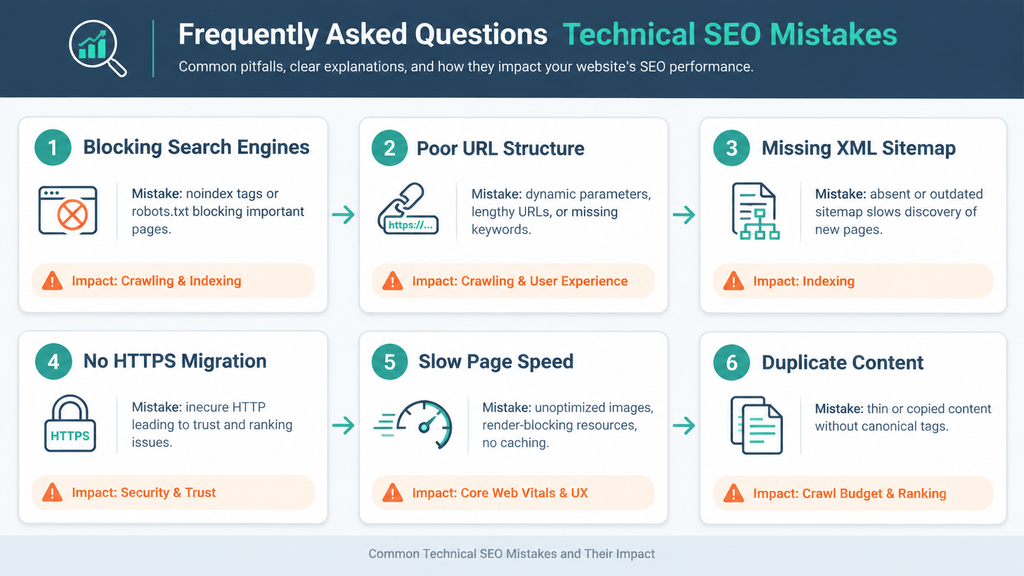
| Question | Answer |
| What are the most common technical SEO mistakes? | The most common technical SEO mistakes are: accidentally blocking pages from indexing with noindex tags or robots.txt, slow page speed and poor Core Web Vitals scores, duplicate content without proper canonical tags, broken internal links, poor mobile experience, and missing structured data. Fixing these technical SEO mistakes delivers the fastest improvement in organic rankings. |
| How do I find technical SEO mistakes on my website? | The best way to find technical SEO mistakes is to combine Google Search Console (for indexation, Core Web Vitals, and manual action reports) with a site crawler like Screaming Frog or Semrush Site Audit. Together these tools surface the vast majority of technical SEO mistakes that suppress organic performance, including crawl errors, redirect chains, duplicate content, and broken links. |
| Can technical SEO mistakes cause a website to lose rankings? | Yes. Technical SEO mistakes are among the most common causes of sudden ranking drops. A misconfigured robots.txt or accidentally added noindex tag can remove pages from Google’s index within days. Significant page speed degradation after a site update can suppress rankings within weeks. Resolving these errors is the first priority whenever a site experiences unexplained ranking losses. |
| How long does it take to fix technical SEO mistakes? | Simple technical SEO mistakes — removing a noindex tag, fixing a redirect chain, adding structured data — can be fixed within hours. Complex technical SEO mistakes like site-wide duplicate content or page speed issues requiring development work may take days to weeks. After implementing fixes, allow 2–6 weeks for Google to re-crawl affected pages and update rankings. |
| Do technical SEO mistakes affect all pages equally? | No. The impact of these issues varies depending on severity and scope. A noindex tag on a single page affects only that page. A site-wide duplicate content issue affects hundreds of pages. Page speed issues typically affect all pages on a shared hosting environment. Prioritise fixing problems that affect your highest-value pages — homepage, top category pages, best-performing blog posts — first. |
| Should I hire an expert to fix technical SEO mistakes? | For complex site migrations, JavaScript rendering issues, and server configuration problems, expert support is strongly recommended. These tasks require specialist knowledge that most in-house content teams do not have. Simpler issues like missing meta tags, broken internal links, and image optimisation can often be handled in-house with the right tools and guidance. |
Ranking Takes More Than Tips
You know the strategy now — let Tasknestly handle the technical SEO, content, and link building that actually moves rankings.
Get SEO Services →Conclusion
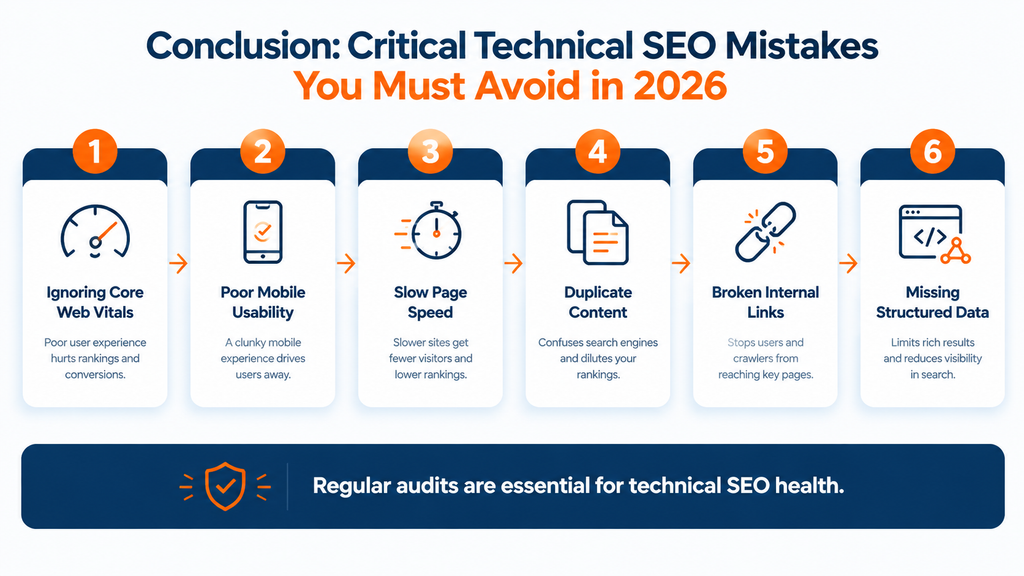
Technical SEO mistakes are the hidden saboteurs of organic search performance. A website with excellent content, a strong brand, and a smart marketing strategy can still dramatically underperform in search if it is riddled with unresolved technical SEO mistakes. The most damaging ones — crawl blocks, duplicate content, page speed failures, poor mobile experience — are also the most fixable once identified.
The most important step is to audit your site systematically rather than guessing where problems might lie. A comprehensive technical audit using Google Search Console, a site crawler, and a page speed tool will surface the specific issues most affecting your site’s rankings. Prioritise fixes by severity — start with anything blocking pages from being indexed, then address speed and Core Web Vitals, then tackle duplicate content and structural issues.
If you want expert help identifying and resolving every technical SEO mistake on your website, get a free technical audit from Tasknestly. Our technical SEO specialists cover every class of mistake that impacts organic performance — from crawlability and indexation to Core Web Vitals, structured data, and site architecture — and deliver a prioritised fix roadmap with full implementation support.
If you are unsure whether a page is being blocked by robots.txt or carries a noindex rule, Google’s own guide to blocking Search indexing with noindex explains how each rule works and why combining the two can backfire.
Ranking Takes More Than Tips
You know the strategy now — let Tasknestly handle the technical SEO, content, and link building that actually moves rankings.
Get SEO Services →Grow With Tasknestly
Subscribe to the Tasknestly newsletter and get the latest tips on websites, SEO, social media, and digital growth.